CONTACT US

What if the only thing standing between your facility and a million-dollar revenue loss is a commercial generator maintenance checklist that hasn’t been updated for the 2026 regulatory landscape? It’s a sobering thought for any leader managing complex multi-site assets. You already know that your cloud-based surveillance and IT servers are only as reliable as the power that feeds them. When the grid fails, your standby power must engage instantly and flawlessly to protect your infrastructure; there is no room for mechanical uncertainty.
Staying ahead of the 2025 edition of NFPA 110 and the new 2026 National Electrical Code requirements doesn’t have to be a source of anxiety. We’ve designed this resource to help you transition from reactive repairs to a sophisticated, data-driven maintenance strategy. You’ll learn how to integrate the latest battery technologies and automated monitoring to achieve 100% uptime while extending the lifespan of your equipment. This article provides a clear roadmap through the technical and regulatory shifts of 2026, ensuring your facility remains a model of stability and protection.
Key Takeaways
- Understand why a rapid response from your Automatic Transfer Switch (ATS) is the critical first step in preventing data loss during a power failure.
- Implement a structured commercial generator maintenance checklist that balances routine visual inspections with technical deep-dives to ensure constant readiness.
- Identify the “Big Three” system failures-fuel, cooling, and electrical-and learn the specific protocols required to mitigate 90% of common generator issues.
- Discover how to integrate standby power health into your Remote Monitoring Management (RMM) dashboard for real-time visibility and proactive protection.
- Transition from manual, paper-based tracking to a professional maintenance partnership that aligns your power assets with modern safety codes and business continuity goals.
Table of Contents
- Why a Commercial Generator Maintenance Checklist is Your Continuity Foundation
- The Multi-Tiered Maintenance Framework: Weekly, Monthly, and Annual Protocols
- Critical Systems Deep-Dive: Fuel, Cooling, and Electrical Integrity
- Integrating Generator Health with RMM and Security Infrastructure
- Implementing a Professional Maintenance Strategy for 2026
Why a Commercial Generator Maintenance Checklist is Your Continuity Foundation
A commercial generator maintenance checklist serves as the strategic blueprint for your facility’s resilience. It is the preventative protocol that ensures your Automatic Transfer Switch (ATS) and engine respond within seconds of a utility failure. In 2026, increasing grid instability has transformed standby power from a luxury into a core component of risk management. Without a rigorous inspection schedule, the complex mechanical and electrical systems designed to protect your operations may remain dormant when you need them most.
There is a vital distinction between emergency power and standby power that every facility manager must understand. While emergency power is mandated for life safety, such as exit lighting and fire alarms, standby power is what maintains your operational continuity. It provides the steady current required to keep your servers running and protect your sensitive structured cabling from the hardware surges and data packet loss that occur during abrupt outages.
To better understand how specific mechanical components require regular attention, watch this helpful video on water separator maintenance:
The Cost of Neglect: Beyond the Outage
The hidden costs of power failure often outweigh the immediate loss of lights. When a system fails to engage, your facility enters a security “dark period” where cloud-based access control and surveillance may be compromised. Beyond operational downtime, failing to adhere to the 2025 edition of NFPA 110 standards creates significant liability risks for commercial facilities. Conversely, maintaining a documented commercial generator maintenance checklist serves as vital evidence for insurance providers, often leading to premium reductions by demonstrating a commitment to proactive risk mitigation.
Generator Readiness as a Strategic Asset
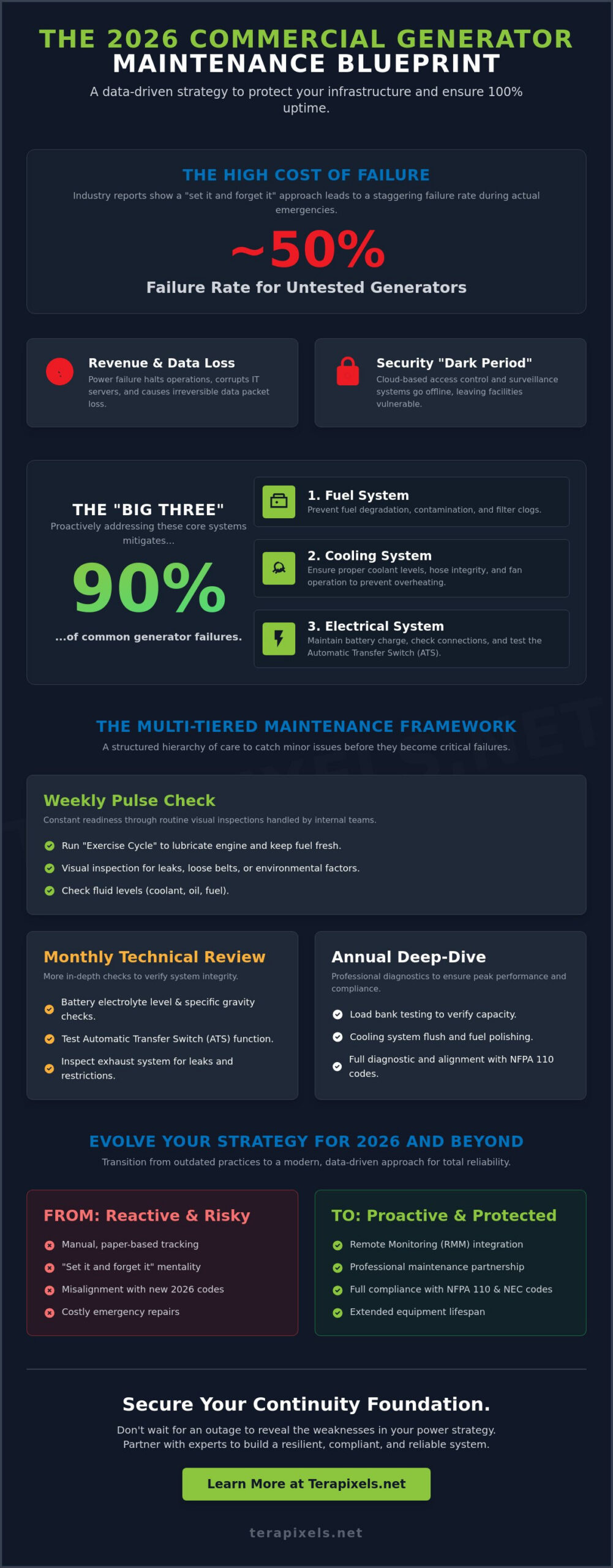
Many organizations fall into a “set it and forget it” mentality, which industry professionals report can lead to a failure rate of nearly 50% during actual emergencies. Most of these failures stem from simple issues like battery depletion or fuel degradation. Adopting the role of a Reliable Architect means designing a maintenance schedule that views the generator as the foundation of the entire tech stack. Whether your facility relies on a natural gas unit or a diesel generator, transitioning from reactive repairs to a culture of proactive reliability ensures that your infrastructure remains protected, regardless of external conditions.
The Multi-Tiered Maintenance Framework: Weekly, Monthly, and Annual Protocols
Effective facility management relies on a structured hierarchy of care. A robust commercial generator maintenance checklist categorizes tasks by frequency and complexity, separating simple visual inspections from advanced technical diagnostics. This tiered approach ensures that minor issues, like a slow coolant leak or a loose belt, are caught before they escalate into catastrophic failures during a grid outage.
Central to this framework is the “Exercise Cycle.” Running the unit weekly is non-negotiable for maintaining engine health; it keeps internal components lubricated, prevents seal drying, and ensures fuel remains fresh within the lines. While internal facility teams can handle these routine observations, identifying subtle trends in engine or alternator degradation requires the steady hand of a professional partner who understands the nuances of power generation.
Weekly and Monthly: The Operational Pulse
These frequent checks keep the system in a state of constant readiness. Consistent monitoring allows staff to spot environmental factors or small mechanical shifts that could impact performance. Key steps include:
- Step 1: Inspect for “wet stacking” in diesel units, which occurs when unburnt fuel accumulates in the exhaust, and check for any fluid leaks involving oil, coolant, or fuel.
- Step 2: Verify battery charger operation and clean terminals. Battery failure is a leading cause of “no-start” events, making this a critical safety check for any facility.
- Step 3: Run the unit under “no-load” for 30 minutes. This confirms the controller and Automatic Transfer Switch (ATS) are communicating properly and meeting NFPA 110 maintenance requirements for operational readiness.
Semi-Annual and Annual: The Technical Deep-Dive
Annual service moves beyond observation into rigorous testing and component replacement. A primary component of this phase is the Load Bank Test. During this procedure, a technician forces the generator to operate at 100% of its rated capacity for an extended period. This verifies the cooling system and engine can handle a full building load without overheating or losing frequency stability.
During these sessions, technicians also replace oil, filters, and spark plugs to maintain combustion efficiency. A critical but often overlooked task is calibrating the voltage regulator. Precise voltage control is essential for protecting your CAT6 cabling installation from harmonic distortion. Unstable power can degrade data transmission and damage sensitive networking hardware over time. Logging this performance data creates a historical record, allowing you to predict component failure before it happens. If you’re looking to streamline these complex tasks, our team can help you implement a managed maintenance strategy tailored to your specific infrastructure.
Critical Systems Deep-Dive: Fuel, Cooling, and Electrical Integrity
The reliability of your standby power rests on three critical pillars: fuel, cooling, and electrical integrity. Industry data suggests that these “Big Three” systems account for 90% of all generator failures. While the previous sections focused on the timing of your commercial generator maintenance checklist, this deep-dive examines the mechanical precision required to keep these systems operational. For businesses prioritizing network security for small business, the quality of the power is just as vital as the quantity. Modern servers and security appliances require “clean power”, which is electricity with stable voltage and frequency, to prevent hardware degradation and unexpected reboots.
Maintenance nuances vary significantly between Natural Gas (NG) and Diesel systems. Diesel units provide high torque and immediate response but require more intensive fuel management. NG units offer a virtually bottomless fuel supply through utility lines but rely on complex mechanical regulators that must be tested for precision. Regardless of the fuel source, ensuring that the electrical output remains within tight tolerances is the only way to safeguard the sensitive digital infrastructure that defines modern commercial operations. This is especially critical as managed cybersecurity for commercial properties increasingly depends on always-on network connectivity to detect and respond to threats in real time.
Fuel Management and Polishing
Diesel and Natural Gas systems present distinct maintenance challenges. Diesel units are susceptible to fuel degradation, which can clog injectors and cause engine stalling during a crisis. Fuel polishing is a process of removing water and sediment to ensure combustion reliability. We recommend this specialized service every 12 to 24 months to maintain the chemical integrity of your stored energy. In contrast, NG systems rely on the integrity of regulators and solenoid valves. These components must be inspected for leaks and mechanical sticking to ensure that fuel delivery is instantaneous when the utility grid drops.
Cooling and Battery Health
Longevity during an extended outage depends almost entirely on the cooling system’s ability to shed heat. While smaller units might be air-cooled, larger commercial generators are typically liquid-cooled and require precise coolant pH balancing to prevent internal corrosion. Neglecting this balance can lead to radiator failure just as the unit reaches its peak operating temperature.
The single most frequent cause of generator failure is battery expiration. We implement a strict three-year replacement cycle for all starting batteries, regardless of their apparent health. A battery that passes a simple voltage test today can still fail under the massive cranking load required during a cold start. Managing heat is also a significant safety concern. An overheating generator can inadvertently trigger fire suppression systems in modern facilities, leading to costly cleanups and unnecessary downtime for your low-voltage infrastructure.
Integrating Generator Health with RMM and Security Infrastructure
A generator sitting in a remote enclosure or a basement shouldn’t be an “out of sight, out of mind” asset. In a sophisticated facility, standby power is a critical node in the digital ecosystem rather than just a mechanical fallback. Integrating your power status into a Remote Monitoring Management (RMM) dashboard is the final, essential step in a modern commercial generator maintenance checklist. This connectivity ensures that the transition from utility power to standby power happens with full visibility, protecting the sensitive electronics that manage your business operations.
When the main grid fails, there is typically a 10-second gap before the engine reaches full speed and the transfer switch engages. An Uninterruptible Power Supply (UPS) is vital for bridging this silence; it keeps your networking equipment alive so your keycard access control systems don’t reboot or experience damaging voltage spikes during the power handoff. By syncing these systems, you create a seamless bridge that maintains security protocols without interruption, ensuring that your facility remains locked and monitored even during total grid collapse.
Digital Oversight: RMM for Power Systems
Modern RMM services provide a single source of truth for all facility infrastructure. Instead of waiting for a manual inspection, facility managers receive real-time mobile alerts for low fuel levels, battery voltage drops, or engine faults. This data-driven approach allows you to use analytics to predict component failure before the weekly exercise cycle even begins. It transforms your maintenance strategy from a series of tasks into a proactive shield for your entire tech stack.
Securing the Facility During the Transition
A power outage is a moment of vulnerability for any site. Utilizing AI security camera systems allows you to visually verify that the generator has started and that the perimeter remains secure while the building switches loads. This synergy between professional backup generator installation and AI-driven site lockdowns ensures that cloud-based surveillance doesn’t lose a single frame of data. AI video analytics can monitor generator enclosures for tampering or fuel theft. If you’re ready to unify your power and security systems, our team can help you design a resilient infrastructure that never leaves you in the dark.
Implementing a Professional Maintenance Strategy for 2026
Transitioning from a manual, paper-based commercial generator maintenance checklist to a managed service partnership is the hallmark of a resilient 2026 enterprise. While internal staff can perform routine visual checks, the increasing complexity of modern electrical systems requires a deeper level of technical oversight. A professional Site Assessment is the first step in this evolution. It allows us to identify utility bottlenecks and ensure that your standby power is perfectly scaled for your current infrastructure. For national-scale businesses, maintaining multi-site reliability demands a consistent partner who can enforce the same high standards across every location, ensuring that no single facility becomes a weak link in the corporate chain.
Choosing a Maintenance Partner
Selecting the right partner requires looking beyond basic mechanical skills. You need a provider who understands the delicate intersection of power, high-speed networking, and cloud-based security. It’s essential to verify that your partner is well-versed in the 2025 edition of NFPA 110 and the structural revisions found in the 2026 National Electrical Code. High-stakes facilities should also prioritize contracts that include priority response clauses. This ensures that when regional grid failures occur, your facility is at the top of the list for technical support and resource allocation.
The Lifecycle of Reliable Power
A strategic maintenance plan accounts for the fact that facilities are dynamic environments. We recommend regularly auditing your power load, especially as you integrate new technologies like EV chargers or high-density server racks that significantly alter your electrical profile. Planning for the 10 to 15 year overhaul or replacement cycle is also vital for avoiding catastrophic failure as components reach their natural end-of-life. By adopting this Reliable Architect approach, you ensure total facility uptime and long-term stability. Our goal is to create a seamless integration where your power systems, security infrastructure, and business continuity goals work in perfect harmony. Property managers looking to unify these elements should explore how integrated security systems for commercial real estate can architect a unified ecosystem where access control, cloud surveillance, and power redundancy operate in total harmony.
Securing Your Operational Future with Resilient Power
The transition toward a fully integrated facility requires more than just mechanical oversight; it demands a strategic alignment of your standby power with your digital security. By implementing a comprehensive commercial generator maintenance checklist, you ensure that your infrastructure is prepared for the regulatory and environmental challenges of 2026. We’ve explored how the synergy between fuel integrity, cooling precision, and real-time monitoring creates a foundation that protects your sensitive data and physical assets during the most critical moments of utility failure.
Terapixels Systems provides the steady hand needed to manage these complex background systems. Our expertise in integrated power and security systems, combined with our sophisticated Remote Monitoring Management (RMM) solutions, allows you to maintain total visibility over your assets. Whether you manage a single site or require national reach for consistent multi-site support, we act as your Reliable Architect to guarantee long-term stability. Secure your facility's power and security infrastructure with Terapixels Systems today. We’re ready to help you build a more resilient future where your operations never skip a beat.
Frequently Asked Questions
How often should a commercial standby generator be serviced by a professional?
A commercial standby generator should receive professional technical service at least twice a year. While internal facility teams handle weekly exercise cycles and monthly visual inspections, a certified technician must perform semi-annual fluid checks and annual load bank testing. This frequency ensures compliance with the 2025 edition of NFPA 110 and guarantees that the system’s mechanical and electrical components remain ready for an immediate response during an outage.
What is the difference between a standby generator and an emergency generator?
The primary difference lies in their intended purpose and the systems they support. Emergency generators are legally mandated to power life-safety systems, such as exit lighting and fire alarms, within 10 seconds of a utility failure. Standby generators are designed for broader operational continuity; they power IT infrastructure, surveillance systems, and general building loads to prevent revenue loss and data corruption during extended disruptions.
Does a commercial generator maintenance checklist help with NFPA 110 compliance?
Yes, a structured commercial generator maintenance checklist is the primary tool for achieving and documenting NFPA 110 compliance. It provides a verifiable record of weekly exercise cycles, battery health tests, and fuel quality reports required by local authorities. Maintaining these records is essential for passing fire marshal inspections and can serve as vital evidence for insurance providers to demonstrate proactive risk management within your facility.
Can I perform generator maintenance myself, or do I need a certified technician?
You can perform basic visual inspections and weekly exercise cycles using internal staff, but technical diagnostics and load bank testing require a certified technician. Professional intervention is necessary to calibrate voltage regulators and handle high-voltage electrical components safely. Utilizing a professional partner ensures that your maintenance meets the rigorous standards of the 2026 National Electrical Code while protecting your facility’s sensitive security and IT infrastructure. For commercial real estate operators, aligning this technical oversight with a broader strategy for integrated security systems for commercial real estate ensures that power redundancy and physical security work as a single, cohesive system.
What is fuel polishing, and why is it critical for diesel generators?
Fuel polishing is a specialized technical process that removes water, sediment, and microbial growth from stored diesel. It’s critical because diesel fuel naturally degrades over 12 to 24 months; contaminated fuel can clog injectors and lead to total engine failure during a crisis. Regular polishing ensures that the combustion process remains reliable, protecting the massive investment you’ve made in your standby power system and ensuring immediate startup readiness.
How long can a commercial generator run continuously during an outage?
Most commercial generators can run continuously for as long as they have a steady fuel supply and proper oil levels, typically ranging from 24 to 72 hours on a single tank. However, extended runtimes require pausing the unit every 24 hours to check oil and coolant levels. Natural gas units can theoretically run indefinitely, provided the utility lines remain intact and the engine is maintained according to its specific duty cycle.
Will a standby generator protect my server room from power surges?
A standby generator provides power but doesn’t inherently protect sensitive electronics from the initial surge or the 10-second gap before it starts. To fully safeguard a server room, you must integrate the generator with an Uninterruptible Power Supply (UPS) and high-quality surge protection. This combination bridges the power gap and filters the current, ensuring that your networking hardware and structured cabling remain protected from harmonic distortion and voltage spikes.
What are the most common reasons a commercial generator fails to start?
The most common reasons for a “no-start” event include battery failure, fuel degradation, and the unit being left in the “off” position after previous service. Environmental factors, such as pests nesting in enclosures or damaging wiring, are also frequent culprits; for comprehensive facility protection, Mosquito Assassin Pest Control LLC provides expert management solutions to safeguard your infrastructure. Dead or weak batteries account for a significant percentage of failures, which is why a three-year replacement cycle is a standard part of any commercial generator maintenance checklist. Regular inspections help identify these simple issues before they lead to a catastrophic failure during an actual outage.