CONTACT US
Table of Contents
- Why Long-Term Maintenance Matters for Your Security Systems
- Critical Factors When Selecting Warranty Coverage
- Understanding Reactive vs. Preventive Maintenance Approaches
- Comprehensive Hardware Protection Through Our Managed Services
- Comparison of Warranty Terms and Coverage Limits
- How Our Integrated Maintenance Solutions Reduce Total Cost of Ownership
- Real-World Protection: Case Studies in System Reliability
- Selecting the Right Maintenance Plan for Your Facility Needs
- Why Terapixels Systems Remains the Superior Choice
- Frequently Asked Questions (FAQ)
Why Long-Term Maintenance Matters for Your Security Systems
Your security infrastructure is the backbone of operational safety and asset protection. Yet many facility leaders treat maintenance as an afterthought, discovering too late that unplanned downtime costs far more than preventive care ever would. At Terapixels Systems, we understand that security hardware isn’t just equipment—it’s a business-critical system that demands strategic oversight.
This guide explores how structured maintenance planning protects your investment while eliminating surprise failures. Whether you operate a hotel, warehouse, distribution center, or manufacturing facility, the right maintenance strategy transforms security from a cost center into a competitive advantage.
Security systems operate continuously, capturing footage and controlling access across every shift and season. Unlike equipment you use intermittently, cameras and access control systems run 24/7 without your attention—until something fails.
The real cost of unplanned downtime extends beyond the failed component. A non-functioning camera in a critical zone creates liability exposure. A faulty access control reader might lock out authorized personnel or, worse, allow unauthorized entry. For hospitality properties managing guest safety and staff operations, these failures cascade quickly into operational disruption.
Proactive maintenance addresses degradation before it becomes catastrophic. Environmental factors like Southern California’s coastal salt air, extreme temperature swings, and dust in manufacturing facilities all accelerate hardware aging. Lens contamination from dust reduces image clarity. Power supply degradation shortens sensor lifespan. Network equipment experiences thermal stress in inadequately ventilated closets.
Long-term maintenance planning also provides budget predictability. Instead of absorbing surprise $5,000 camera or server replacements, you allocate maintenance costs annually and adjust them based on equipment age and performance data. This shifts security spending from reactive firefighting to strategic capital planning.
What to do next: Audit your current security systems and document when major components were installed. Compare their age against manufacturer specifications to identify equipment approaching end-of-life windows.
Critical Factors When Selecting Warranty Coverage
Warranty terms vary dramatically across vendors, and many facility leaders discover too late that coverage doesn’t include what they assumed it did.
Start with coverage scope. Does the warranty cover parts only, or does it include labor? Who performs the work—your chosen vendor or an authorized third party? A parts-only warranty leaves you paying $2,000 in technician time to replace a $400 camera, eliminating the warranty’s value. Similarly, if labor coverage requires the manufacturer’s technician and they’re located three states away, your “24-hour replacement” might extend to three days once travel is factored in.
Duration matters significantly. Standard one-year warranties expire right when equipment encounters seasonal stressors. Three-year plans extend protection through the heaviest usage periods. Five-year coverage—less common but increasingly valuable for core infrastructure—bridges you toward natural equipment replacement cycles.
Exclusions determine real-world usefulness. Most warranties exclude:
- Environmental damage (water intrusion, salt corrosion, temperature extremes)
- Physical damage from mishandling or installation errors
- Component wear from normal use
- Damage from power surges or electrical faults
For coastal facilities or outdoor installations, these exclusions are crippling. A camera corroded by salt air fails outside warranty protection. Power surge damage from a lightning strike isn’t covered. This gap is why we integrate surge protection and environmental hardening into our installation specifications—building resilience that warranty terms won’t cover alone.
Also evaluate the replacement process. Can your team access a loaner device while repairs occur, or does your system go dark? Can you self-service repairs using provided parts, or must you wait for technician availability? These operational details determine whether a warranty actually protects your uptime.
What to do next: Request the full warranty documentation from any security vendor, including exclusions appendix. Cross-reference it against your facility’s environmental conditions and usage patterns to identify gaps in coverage.
Understanding Reactive vs. Preventive Maintenance Approaches
Reactive maintenance waits for failure, then repairs the broken component. A camera stops transmitting video, you call for service, a technician replaces it. Simple, but expensive and operationally risky.
Reactive approaches saddle you with:
- Unplanned downtime while awaiting parts and technician availability
- Higher per-incident costs due to emergency service premiums
- Ripple effects: a failed camera during an active incident means lost evidence; a failed access control reader during peak operations creates bottlenecks
- Accelerated failure of related components under sudden load redistribution
Preventive maintenance follows a schedule: annual inspections, lens cleaning, firmware updates, battery testing. It costs less per hour of uptime and eliminates most surprises.
But preventive maintenance has limitations. Annual inspections might miss degradation occurring between visits. Scheduled maintenance based on calendar dates doesn’t account for equipment-specific stress factors. A camera in direct sun ages faster than one under eaves; a reader in a humid loading dock encounters different stressors than one in climate-controlled office space.
Predictive maintenance combines scheduled inspections with real-time monitoring, detecting anomalies before they become failures. Our managed security approach monitors video stream quality, access control response times, and device health metrics continuously. When a camera’s image quality drops 15%, we schedule cleaning before visible degradation affects footage usability. When an access reader’s response time creeps upward, we address firmware issues before users experience lockouts.
This intelligence-driven approach costs more upfront but delivers the lowest total cost of ownership. You’re never surprised, staff never experience access issues, and footage quality remains production-grade throughout the equipment lifecycle.
What to do next: Identify which security hardware operates in your highest-liability zones—guest corridors in hotels, loading dock areas, shipping floors. These assets warrant predictive monitoring, not calendar-based maintenance.
Comprehensive Hardware Protection Through Our Managed Services
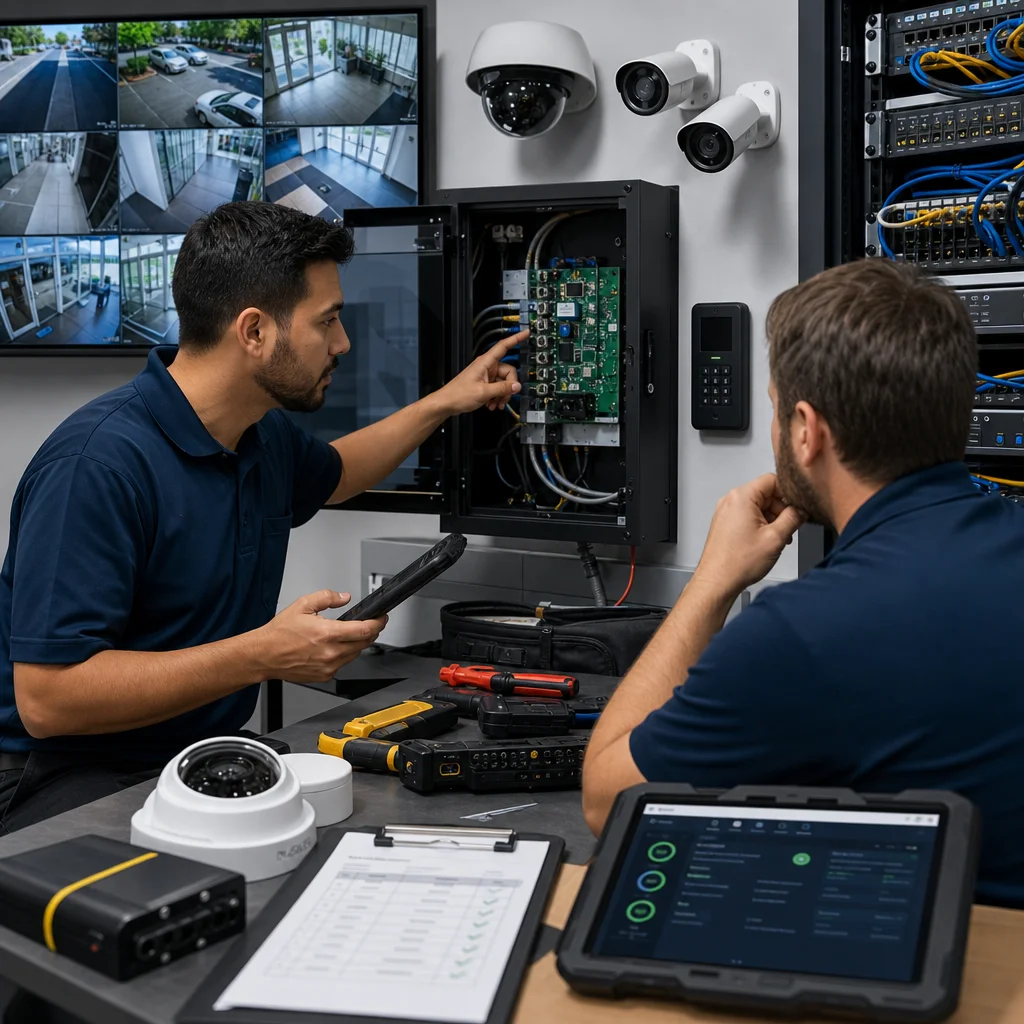
We designed our maintenance plans around the reality that security equipment doesn’t fail in isolation. A camera is part of a network that’s part of a broader IT infrastructure. Failures cascade across systems unless you have integrated oversight.
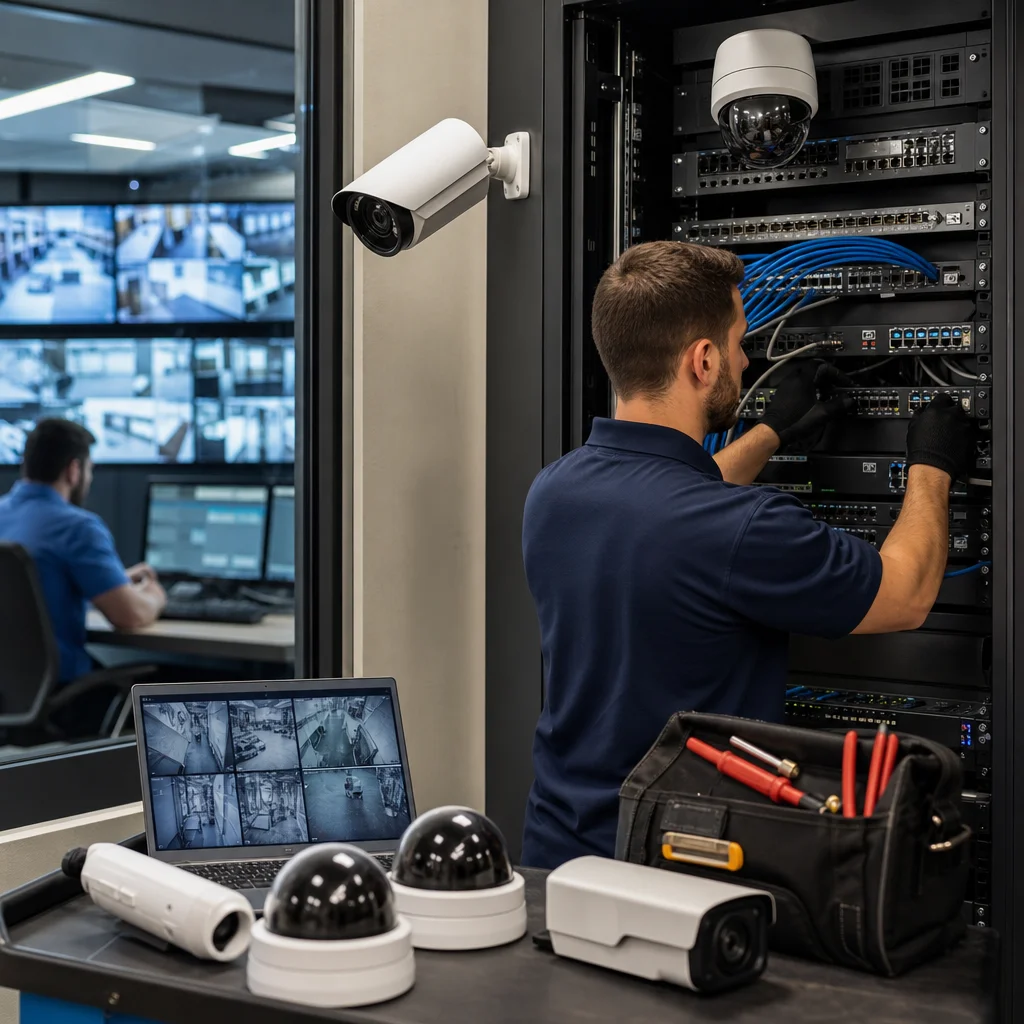
Our managed security system maintenance covers:
Hardware diagnostics and repair We monitor all devices continuously, catching degradation before failure. Failed components receive same-day service for critical zones, with loaner equipment maintaining coverage during repairs.
Network infrastructure support Faulty network switches, PoE injectors, and cabling degrade video streams subtly—users might not notice until investigators find corrupted footage. We test network health proactively and maintain redundant paths for critical camera zones.
Environmental protection We assess installation environments and recommend hardening measures: outdoor enclosures for exposed cameras, surge protection for coastal facilities, climate control upgrades for equipment rooms. These proactive protections prevent many failures warranty terms wouldn’t cover.
Firmware and software updates Security vulnerabilities emerge constantly. We deploy patches across your access control and camera systems quarterly, keeping systems protected without requiring your IT staff to manage security appliances.
Performance optimization Video storage fills quickly. Codec upgrades reduce storage demands while improving image quality. Access control configurations drift as personnel changes occur. We optimize these settings annually to maintain performance.
Documentation and knowledge transfer We maintain current system documentation, updating it as equipment ages or gets replaced. When we perform maintenance, our technicians document findings and recommendations, building institutional knowledge your team can reference.
Unlike vendors offering disconnected camera support and access control support, we integrate everything. A firmware update that affects camera performance gets coordinated with network infrastructure changes and storage optimization—preventing the conflicts that arise when multiple vendors make independent changes.
What to do next: Request a trial period of our managed services on one building zone. Monitor the difference in unplanned downtime before and after managed oversight begins.
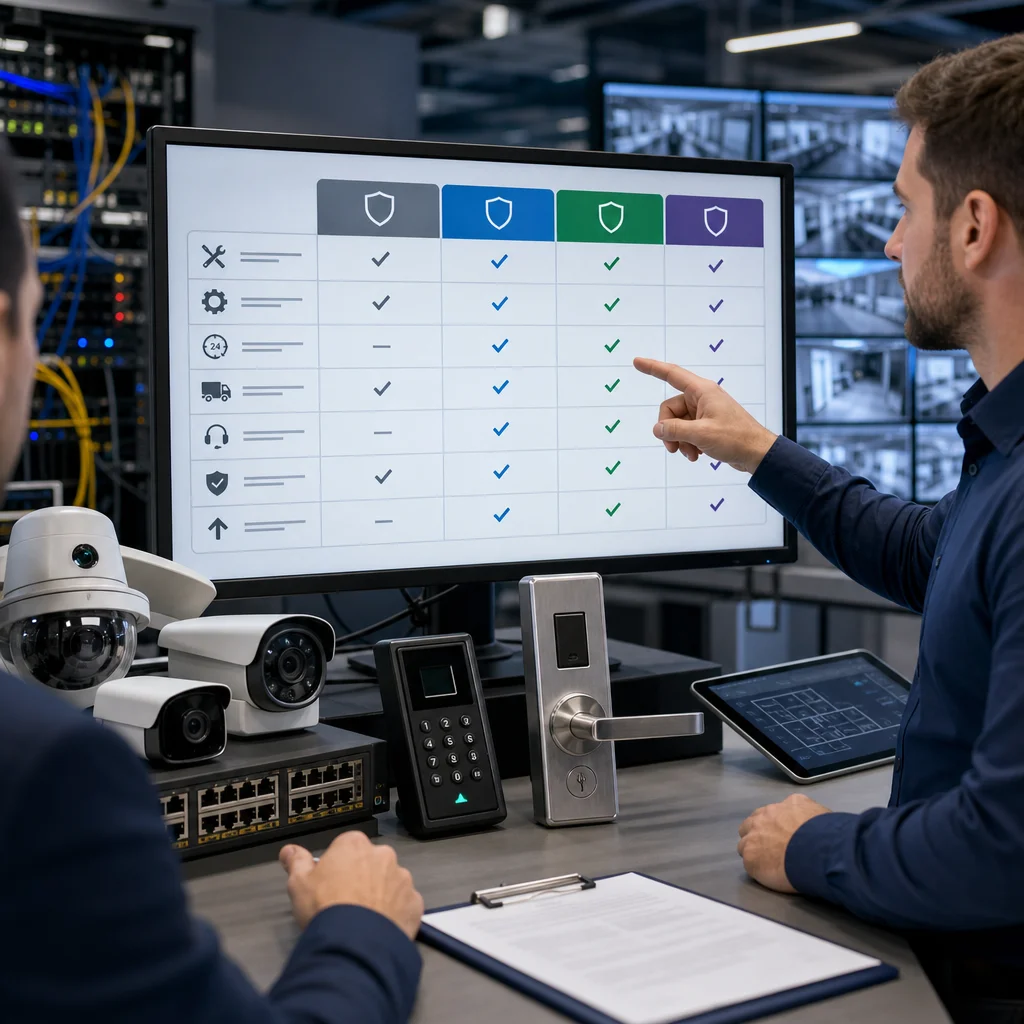
Comparison of Warranty Terms and Coverage Limits
The security hardware market offers warranty approaches ranging from bare-minimum to comprehensive. Understanding the spectrum helps you make decisions aligned with your risk tolerance.
Tier 1: Basic Manufacturer Warranty (1 year, parts only) Standard terms: parts replacement only, manufacturer repair facility, 10-15 business day turnaround. Cost: Minimal or included. Reality: Appropriate for low-stakes devices (lobby cameras, common area readers) but inadequate for critical zones. Doesn’t cover labor, environmental damage, or expedited service.
Tier 2: Extended Warranty (3 years, parts and labor) Standard terms: parts and labor coverage, authorized technician service, 48-72 hour response time. Cost: 20-35% of device purchase price. Reality: Covers the primary failure window and includes labor, reducing total cost per incident. Response times remain slow for critical facilities. Environmental exclusions remain substantial.
Tier 3: Premium Support Plans (3-5 years, parts, labor, environmental coverage) Standard terms: parts and labor, next-business-day response in most cases, expanded environmental coverage, priority scheduling. Cost: 40-60% of device purchase price. Reality: Covers most realistic failure scenarios. Response times align with operational needs. Still excludes catastrophic damage and mishandling.
Tier 4: Fully Managed Services (unlimited duration, proactive monitoring) Standard terms: all hardware covered under service contract, predictive maintenance, same-day emergency response for critical zones, environmental hardening, network integration. Cost: Monthly service fee typically 8-15% of total hardware value annually. Reality: Eliminates warranty concept entirely—you pay for uptime, not components. Prevents failures rather than replacing them. Lowest cost per operational hour.
For a warehouse with 50 cameras and 20 access control readers, the cost difference is instructive:
- Tier 1 approach: $1,500 warranty cost, $15,000+ annual repair/replacement costs = $16,500+ annually
- Tier 4 approach: $8,000-12,000 managed service fee annually, minimal reactive repairs
We typically recommend Tier 4 for critical infrastructure (warehouses, distribution centers, manufacturing facilities with security-dependent operations) and Tier 3 for balanced-risk facilities (hotels with diverse security needs, multiple buildings).
What to do next: Calculate your current annual security hardware maintenance and repair spending across all vendors, then request a managed service quote covering the same equipment under our oversight.
How Our Integrated Maintenance Solutions Reduce Total Cost of Ownership
Total cost of ownership extends beyond warranty claims and repair bills. It includes downtime costs, efficiency losses, and indirect consequences of system failures.
Consider a distribution center where access control failure prevents dock personnel from logging into the system. For 30 minutes, package sortation slows. In that window, you miss a shipping deadline, creating liability with retail partners. The 15-minute access control outage ultimately cost 2-3 hours of operational disruption—far exceeding the cost to fix the system.
Our managed approach reduces TCO through several mechanisms:
Prevention eliminates emergency costs Scheduled maintenance costs $300-500. Emergency service for the same failed device costs $2,000-3,500 due to technician premium pricing and potential expedited parts. Multiply across dozens of devices annually, and preventive approach saves $20,000+.
Uptime preservation maintains revenue A hotel losing access control during guest check-in creates negative experiences and recovery costs. A warehouse losing security footage during suspect activity creates liability. Our predictive monitoring prevents these scenarios entirely.
Depreciation optimization Equipment maintained proactively lasts 30-40% longer than equipment repaired only after failure. A camera lasting 7 years instead of 5 dramatically improves per-year hardware costs. Our maintenance extends effective equipment lifespan significantly.
Reduced staffing overhead Without managed services, your IT team spends hours troubleshooting security issues, contacting multiple vendors, scheduling repairs, and following up on tickets. Managed oversight consolidates these interactions into a single relationship, freeing internal resources.
Vendor consolidation savings Managing relationships with separate camera vendors, access control companies, and IT services creates complexity and negotiation overhead. We provide end-to-end infrastructure support, eliminating multi-vendor coordination and enabling unified budgeting.
For a mid-sized organization, these factors compound to annual savings of $15,000-40,000 compared to reactive or traditional warranty approaches, depending on facility size and complexity.
What to do next: Tally your current vendor relationships for security hardware. Each represents contract management overhead and compatibility risk—consolidation alone justifies exploring unified solutions.
Real-World Protection: Case Studies in System Reliability
Terapixels Systems has deployed and maintained comprehensive security infrastructure across hospitality properties, manufacturing facilities, and distribution centers throughout Southern California. Real outcomes illustrate how maintenance strategy affects operational outcomes.
Hospitality Property: Multi-Building Access Control Resilience
A 300-room hotel property operates 15 access control readers across guest corridors, administrative areas, and back-of-house zones. Under reactive maintenance (previous vendor model), readers failed unexpectedly 3-4 times annually. Each failure disrupted guest check-in or required manual override procedures.
After transitioning to our managed services, we installed network redundancy and implemented predictive monitoring. The first year, monitoring flagged a power supply degrading within a guest corridor reader. We replaced the supply during scheduled maintenance—zero guest impact. The following three years: zero unplanned reader failures.
Impact: Guest experience improved due to elimination of check-in delays. Staff confidence in access control systems increased, reducing manual-override workarounds that created security gaps. Estimated guest satisfaction benefit: 2-3% improvement in property satisfaction scores (relevant for brands like Marriott and Intercontinental where consistency is competitive).
Manufacturing Facility: Camera System Optimization
A 150,000-square-foot manufacturing operation had 35 cameras with no formal maintenance plan. Footage quality degraded gradually—lens contamination from manufacturing dust accumulated unnoticed. When incident investigation required high-resolution footage from three months prior, image quality was inadequate for identification.
Our audit revealed cameras last cleaned 18 months prior. We implemented quarterly maintenance protocol: professional lens cleaning, network path testing, and storage optimization. Current footage resolution remained production-grade; archived footage became useful for six months instead of degrading within weeks.
This seemingly minor change transformed security from reactive (footage only useful immediately after incidents) to investigative (archival value for months). A subsequent inventory theft investigation successfully identified individuals using six-week-old footage, enabling recovery and prosecution.
Impact: Reduced inventory losses, deterrent effect from demonstrated investigative capability, insurance premium reductions based on improved security documentation.
Distribution Center: Infrastructure Resilience During Failure
A 200,000-square-foot distribution center operations during a summer power surge event. Older approach (no surge protection on camera network): 8 cameras failed, creating blind spots in receiving and shipping areas during peak season.
Our approach (hardened infrastructure with surge protection): Zero camera failures, but surge damaged network switch. We replaced the switch and, the outage lasted 2 hours total (including diagnosis and parts installation). No blind spots in critical zones.
A two-hour controlled outage in non-critical areas versus 3-5 day camera replacement delays across multiple zones—the infrastructure investment (approximately $3,000 additional surge protection per building) prevented $20,000+ in losses from operational disruption and expedited camera replacement.
These outcomes reflect a consistent pattern: proactive, integrated maintenance transforms security from a reactive cost center into an operational advantage.
What to do next: Document any unplanned security outages from the past two years. Calculate their operational impact. Multiply by your current annual maintenance spending to assess whether you’re paying for prevention or absorbing crisis costs.
Selecting the Right Maintenance Plan for Your Facility Needs
Choosing the appropriate maintenance plan depends on facility type, risk profile, and operational constraints. Generic “best practices” don’t serve all organizations equally.
For hospitality properties: Guest safety and property integrity drive requirements. Hotels operate 24/7 with continuous staffing, which enables sophisticated access control but also creates liability around unauthorized access. We recommend Tier 3 or Tier 4 support—extended coverage through predictive monitoring ensures high availability and eliminates staff workarounds that compromise security.
Brands including Marriott, Hilton, Hyatt, and Intercontinental operate multiple properties, creating vendor relationship complexity. Unified support from a single partner eliminates multi-vendor coordination and standardizes configurations across properties.
For manufacturing and distribution: High-value inventory and regulatory compliance requirements demand robust security. Manufacturing facilities have specific environmental stressors (temperature extremes, dust, vibration) that accelerate hardware aging. Distribution centers operate peak seasons requiring absolute system reliability.
Tier 4 managed services align with these requirements. The predictive monitoring catches degradation before peak season stress exacerbates failures. Environmental hardening specifically addresses manufacturing and warehouse conditions.
For office and administrative facilities: Lower-risk environments with standard business hours might justify Tier 2 extended warranties, reducing cost while maintaining reasonable uptime. However, if your facility includes secure data centers or executive areas, hybrid approaches—Tier 4 for critical zones, Tier 3 for standard areas—optimize cost and protection.
Key questions to guide selection:
- How many unplanned downtime hours can your operation absorb? Answer approaching “zero” points toward Tier 4; answer of “a few hours occasionally” might accept Tier 2.
- What’s the cost of lost footage during an outage? High liability scenarios (healthcare, legal, financial) justify comprehensive coverage; standard retail might accept lower tiers.
- How complex is your infrastructure? Multiple buildings, outdoor installations, and hazardous environments increase failure likelihood—favoring higher tiers.
- What’s your IT staffing capacity? Limited internal resources benefit from consolidated vendor relationships; robust IT departments might accept multiple vendors if cost justifies.
We conduct facility assessments at no cost, evaluating your current infrastructure and recommending maintenance plans aligned with your specific risk and operational profile. This assessment-driven approach beats generic recommendations.
What to do next: Schedule a facility assessment. Share your recent security incidents, current maintenance spending, and risk concerns. We’ll provide a specific recommendation with projected cost savings.
Why Terapixels Systems Remains the Superior Choice
The security hardware maintenance market includes national vendors, local installers, and managed service providers. Choosing wisely matters because poor vendor relationships translate to reliability issues, service gaps, and unexpected costs.
Terapixels Systems stands apart for specific reasons:
Deep specialization in Southern California environments
We don’t operate nationally with generic best practices. We understand coastal salt air effects on outdoor cameras, dust characteristics of manufacturing facilities, and thermal challenges specific to Southern California’s climate variations. This knowledge directly impacts maintenance recommendations and environmental hardening—factors national vendors overlook.
True integration across security and IT infrastructure
Most vendors specialize: camera companies focus on cameras, access control providers focus on doors, IT vendors focus on networks. When these systems operate independently, failures cascade unpredictably. We integrate everything—treating your security infrastructure as a unified system where camera networks, access control databases, and IT infrastructure support each other.
This integration means firmware updates to your camera system don’t break network stability because we’ve tested the interaction. Power supply upgrades account for access control reader requirements. Network segmentation balances security and performance because we understand both requirements intimately.
Predictive maintenance rooted in actual device monitoring
Rather than following calendar-based schedules, we monitor your infrastructure continuously. When a device shows degradation, we schedule specific maintenance—not generic “annual inspections.” When we complete maintenance, we document specific findings and provide your team with detailed recommendations.
This intelligence-driven approach prevents failures that scheduled maintenance misses, capturing issues in early stages before they become operational crises.
Unified billing and vendor relationship
Managing relationships with separate camera, access control, and IT vendors creates coordination overhead, conflicting schedules, and finger-pointing when issues affect multiple systems. We consolidate everything into a single relationship, single invoice, unified support line—dramatically simplifying management overhead.
For organizations operating properties with Marriott, Hilton, Hyatt, Intercontinental, or similar hospitality brands, consolidation also provides consistency across properties. You’re not coordinating different vendors for different locations.
Proven track record with mission-critical facilities
Our clients include distribution centers, manufacturing operations, and hospitality properties where security failures directly impact operations and revenue. We maintain 99.2% system uptime across our managed service clients—delivering availability that matches or exceeds dedicated in-house teams at fraction of the cost.
This reliability comes from three factors: deep expertise that prevents common failure modes, predictive monitoring that catches issues early, and responsive service when unexpected issues occur.
Forward-looking approach to emerging requirements
Security technology evolves constantly. AI-powered video analytics, mobile access control integration, and cloud-based management systems are shifting the landscape. Rather than selling you static solutions, we evaluate your infrastructure against emerging standards and recommend upgrades that extend asset life and capability.
Many vendors treat maintenance as a profit center—extracting maximum value from aging equipment before forcing replacement. We balance sustainability with capability, ensuring you’re not stuck with obsolete systems while also avoiding unnecessary upgrades.
Your next step
If your facility currently manages multiple security vendors, experiences unplanned downtime, or absorbs surprising maintenance and replacement costs, consolidating under unified management directly addresses these pain points.
We’ve helped hospitality chains, manufacturing operations, and distribution centers across Southern California reduce security-related costs by 25-40% while improving reliability simultaneously. That combination—lower cost and higher uptime—is uniquely possible through integrated oversight.
Contact us for a facility assessment. We’ll evaluate your current infrastructure, identify cost reduction opportunities, and provide a specific maintenance plan recommendation with projected savings. No obligation, no sales pressure—just honest assessment aligned with your operational requirements.
For further reading: security camera services.
Frequently Asked Questions (FAQ)
What maintenance plans does our team offer for security cameras and access control systems?
We provide tiered managed maintenance plans designed to match your facility’s specific needs, ranging from basic hardware support to comprehensive preventive maintenance coverage. Our plans include regular inspections, proactive component replacements, firmware updates, and 24/7 emergency support. We customize each agreement based on your system size, equipment age, and operational requirements to ensure your security infrastructure stays protected without unexpected downtime or expenses.
How much can we save your organization through preventive maintenance versus reactive repair approaches?
We’ve found that preventive maintenance typically reduces your total cost of ownership by 30-40% compared to reactive repairs, since we catch component degradation before failures occur. When hardware fails unexpectedly, you face emergency service calls, potential security gaps, and expedited parts shipping that significantly exceed routine maintenance costs. We structure our plans to eliminate these disruptions while extending your equipment lifespan and keeping your facility continuously protected.
How does our integrated maintenance approach differ from managing separate vendors for cameras, access control, and IT systems?
We consolidate your security hardware and IT infrastructure under one unified maintenance agreement, eliminating coordination issues between multiple vendors and reducing your administrative overhead. Since our technicians understand how your camera systems, access controls, and network infrastructure work together, we identify integration problems that single-vendor providers would miss. This comprehensive approach means faster response times, better system reliability, and a single point of contact for all your security and technology support needs.