
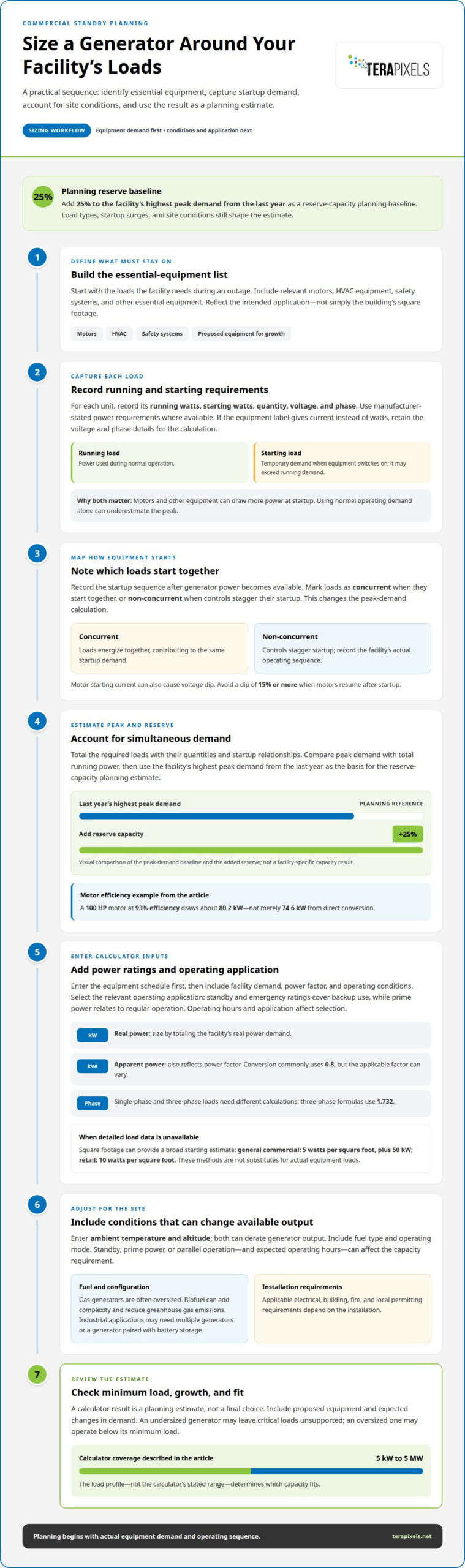
The right standby generator size isn’t determined by square footage alone. A commercial generator sizing calculator is most useful when it starts with the equipment your facility needs to keep running, including both running wattage and startup surge. As a planning baseline, add 25 percent to the facility’s highest peak demand from the last year for reserve capacity; the right estimate also depends on load types and peak power.
That distinction matters because equipment can draw more power at startup than during normal operation. Learn how to list essential equipment, find its starting and running wattage, and enter inputs such as facility demand, power factor, and operating conditions. The result is a clearer starting point for planning standby capacity and recognizing when a more detailed assessment is needed.
Key Takeaways
- Build an equipment list around the loads your facility needs to keep operating, using actual equipment power requirements where available.
- Separate normal running demand from startup surges so motors and HVAC equipment don’t skew the capacity estimate.
- Use facility size as one input, then account for power factor, operating mode, temperature, and altitude.
- Treat the calculator result as a planning estimate; load characteristics and installation conditions shape the final generator choice.
How the commercial generator sizing calculator works?
A commercial generator sizing calculator estimates capacity based on connected equipment, peak demand, and operating conditions. For commercial and industrial planning, the goal is to cover required loads while accounting for startup surges and future equipment.
Commercial and Industrial Load Sizing
Load sizing is estimating the generator capacity needed to support a facility’s electrical demand. List essential equipment, including motors, HVAC, and safety systems, then identify each item’s power requirements and operating pattern. Total power must account for simultaneous loads and peak demand, not just typical wattage. A planning estimate can add 25% to the facility’s highest peak demand from the last year for reserve capacity.
Load Ratings, Steps, and Quantities
Load ratings describe equipment’s electrical demand, while steps and quantities record how loads start and how many units operate. Enter each item’s running watts, starting watts, quantity, and whether it starts with other equipment. Motor starting demand can be several times its running demand. For motor calculations, efficiency matters: a 100 HP motor at 93% efficiency draws about 80.2 kW, not merely 74.6 kW from direct conversion.
Minimum Capacity, Load Types, and Peak Power
Minimum generator capacity is the lowest load the generator can support appropriately. Load types and peak demand determine how much capacity the system must supply at once. A calculator should account for motors and other startup surges, then compare that demand with total running power. An undersized generator may leave critical loads unsupported; an oversized one may operate below its minimum load. To plan for growth, include proposed equipment and expected changes in operating demand.
Power Ratings, Codes, and Sizing Units
Power ratings describe generator output for different operating applications. Standby and emergency ratings cover backup use, while prime power ratings relate to regular operation; operating hours and application affect selection. In the United States, applicable electrical, building, fire, and local permitting requirements depend on the installation. Size in kW by totaling real power demand; kVA also reflects power factor. Conversion commonly uses 0.8, but the applicable factor can vary. Single-phase and three-phase loads require different calculations; three-phase formulas use 1.732. Altitude and temperature can derate output, so include site conditions in the capacity estimate.
Listing equipment and finding starting and running wattage
An accurate equipment schedule separates normal electrical demand from startup needs. Record each load’s rating, quantity, voltage, and starting sequence before estimating generator capacity.
Running and Starting Electrical Loads
Running load is the power equipment uses during normal operation; starting load is the temporary demand when it switches on. Record both values for each item, then note which devices operate together. Starting loads may exceed running loads, so considering only normal operation can underestimate peak demand. Make sure the schedule reflects the facility’s actual operating sequence.
Equipment Starting and Running Wattage
Equipment wattage is its electrical power demand during operation or startup. Use the manufacturer’s stated power requirements rather than relying only on sample consumption charts. Record voltage, running watts, starting watts, and quantity for each unit. If the label gives current instead of watts, retain the voltage and phase details for the sizing calculation. Consistent entries make the total more accurate and easier to review.
Starting Sequences and Motor Current
A starting sequence is the order in which equipment energizes after generator power becomes available. Mark loads as concurrent when they start together, or non-concurrent when controls stagger their startup. This distinction changes the peak demand calculation. For a three-phase motor using direct-on-line starting, a calculator can estimate the required starting kVA. Motor starting current can also cause voltage dip; avoid a dip of 15% or more when motors resume after startup.
Generator sizing calculator inputs
Calculator inputs are facility details that shape the estimated generator capacity. Enter the load schedule first, then add square footage, application, site conditions, and operating mode. These inputs help distinguish a rough screening estimate from an assessment based on equipment demand.
Square footage is a broad method for estimating facility demand when detailed load data is unavailable. A general commercial estimate uses five watts per square foot, plus 50 kW; retail estimates use 10 watts per square foot. For example, a retail facility’s floor area provides an initial input, but its equipment list gives a more specific picture. Treat square-footage methods as starting points, not substitutes for actual loads.
Include safety systems that need to remain available during an outage, along with other essential equipment, so the estimate reflects the intended application. Operating mode matters too: standby, prime power, or parallel operation, as well as expected operating hours, can affect the capacity requirement.
Site conditions are environmental factors that can reduce a generator set’s rated output. Enter ambient temperature and altitude because both can derate capacity. Fuel type also affects sizing; gas generators are often oversized, while biofuel can add complexity and reduce greenhouse gas emissions. Industrial applications may need multiple generators or a generator paired with battery storage. Calculator coverage can range from 5 kW to 5 MW, but the load profile determines which capacity fits.
Terapixels Systems: Generator Installation & Maintenance
Terapixels Systems installs and maintains generators for commercial facilities moving from a sizing estimate to an installed standby system. The equipment schedule, load sequence, and site conditions help shape installation planning and maintenance needs. Move beyond a calculator when critical loads, motor starts, or planned expansion require an integrated capacity decision.
For facilities considering more than one energy source, commercial solar can also be part of the broader power plan. The right arrangement depends on operating priorities and how the systems are intended to work together. Aligning generator planning with actual business requirements makes the next steps more practical.
Contact Terapixels Systems to discuss generator installation and maintenance for your facility.
Move From Capacity Planning to a Resilient Power Strategy
A commercial generator sizing calculator can help frame the decision, but the next step is aligning backup power with your facility’s operating priorities. Consider which systems must remain available during an outage and how generator planning fits the wider infrastructure supporting your business. Terapixels Systems provides generator installation and maintenance, alongside Remote Monitoring Management, Cyber Security, and Structural Cabling. These services address different parts of commercial technology infrastructure and can support your needs as they develop.
When you’re ready to discuss generator support for your facility, contact Terapixels Systems.
A thoughtful power plan gives your team a clearer foundation for business continuity and future decisions.
Frequently Asked Questions
What size standby generator do I need?
Choose a generator that can support the loads your facility must keep operating, including their startup demands. Start by identifying essential systems and separating them from equipment that can remain off during an outage. Then consider how those systems operate together and whether planned facility changes will increase demand. This priority-based approach makes the capacity estimate more useful than floor area alone.
What is the starting and running wattage of those items?
Use each item’s equipment label or manufacturer documentation to find its electrical requirements. Record running and starting wattage separately, along with the listed voltage and phase. If the documentation gives amps or kVA instead, retain those units and details rather than treating them as watts. For packaged equipment, use the requirements for the complete unit, not just one internal component.
What information does a commercial generator sizing calculator need?
Provide a facility load inventory that records each item’s quantity, electrical rating, and expected operating sequence. Include the facility’s voltage and phase, the intended application, and relevant site conditions such as altitude and ambient temperature. Keep units consistent across entries, and distinguish essential loads from those that can be disconnected. Clear inputs help the estimate reflect the intended backup plan.
How do motor starting and inrush currents affect generator sizing?
Motor inrush creates a short-lived demand that can affect generator voltage as equipment starts. If several motors start together, their surges can overlap and raise the peak requirement. Staging starts can reduce that overlap. During motor resumption, avoid a voltage dip of 15% or more. Include motor starting characteristics, not only normal operating demand, in the load assessment.
How do you size a generator for HVAC, elevators, pumps, and other large commercial loads?
Assess each large load by its electrical rating, startup behavior, and role in facility operations. For HVAC, elevators, and pumps, identify which units must run during an outage and whether they can start in sequence. Consider their combined demand when operating together. This helps distinguish a critical-load plan from one designed to support the facility’s broader electrical demand.