CONTACT US

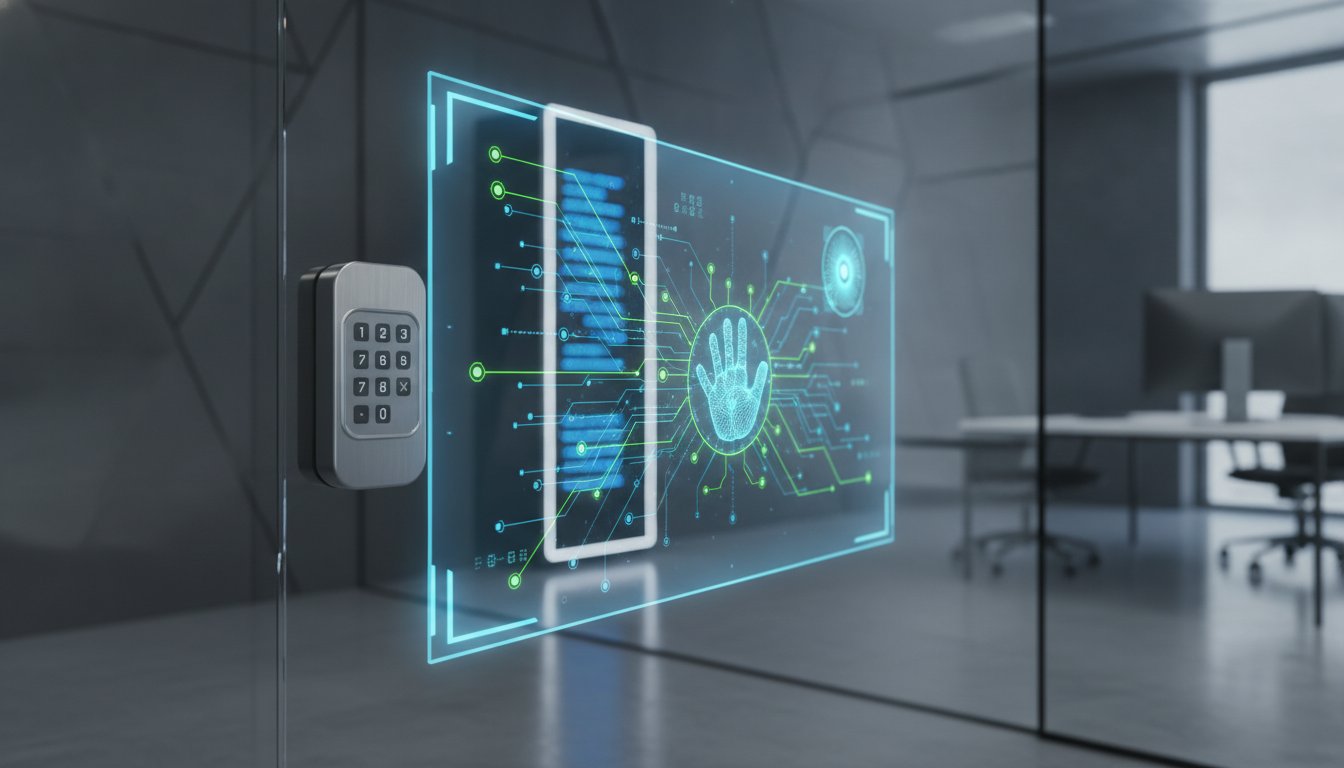
If your security strategy relies on physical keys and manual handovers, you aren’t just managing access; you’re managing a liability that grows with every new hire. It’s a common frustration to deal with the constant cycle of lost fobs or the high costs of re-keying locks every time an employee moves on. You deserve a system that offers stability and clear oversight without the administrative burden. Implementing a modern keycard access control system for business provides the audit trails and remote management needed to protect your facility effectively.
We understand that choosing the right architecture is a significant decision for your long-term infrastructure. This 2026 guide will help you identify the best technologies to secure your facility, from recognizing why insecure 125 kHz RFID standards are being phased out to leveraging cloud-integrated platforms. We will explore how to choose the right hardware and structural cabling to ensure your security system remains a reliable asset for years to come.
Key Takeaways
- Transitioning to digital credentials eliminates the recurring expenses of re-keying locks and provides a transparent audit trail of all facility entries.
- Distinguish between standard RFID and high-encryption smart cards to ensure your security architecture meets the specific needs of high-traffic and restricted zones.
- Select the ideal keycard access control system for business by matching hardware form factors, such as durable fobs or photo ID cards, to your specific operational environment.
- Recognize the critical role of high-quality structured cabling and Power over Ethernet in building a stable, future-proof access control network.
- Explore the advantages of a unified security strategy that integrates cloud-based access with AI-driven video analytics for real-time visual verification.
Table of Contents
- Beyond the Metal Key: The Business Case for Keycard Access in 2026
- Technology Roundup: RFID, Smart Cards, and Cloud-Based Readers
- Hardware Form Factors: Keycards vs. Fobs vs. Micro-Tags
- Infrastructure Requirements: The Role of Structured Cabling
- Designing an Integrated Access Strategy with Terapixels Systems
Beyond the Metal Key: The Business Case for Keycard Access in 2026
Modern security has evolved past the limitations of the traditional metal key. A sophisticated access control framework is no longer just a physical barrier; it’s a data-driven layer that integrates directly into your business operations. When you implement a keycard access control system for business, you’re moving from a passive defense to an active, networked management strategy. This shift allows you to treat security as a measurable asset rather than a recurring maintenance headache. It transforms every entry point into a source of intelligence that helps you understand how your facility is used.
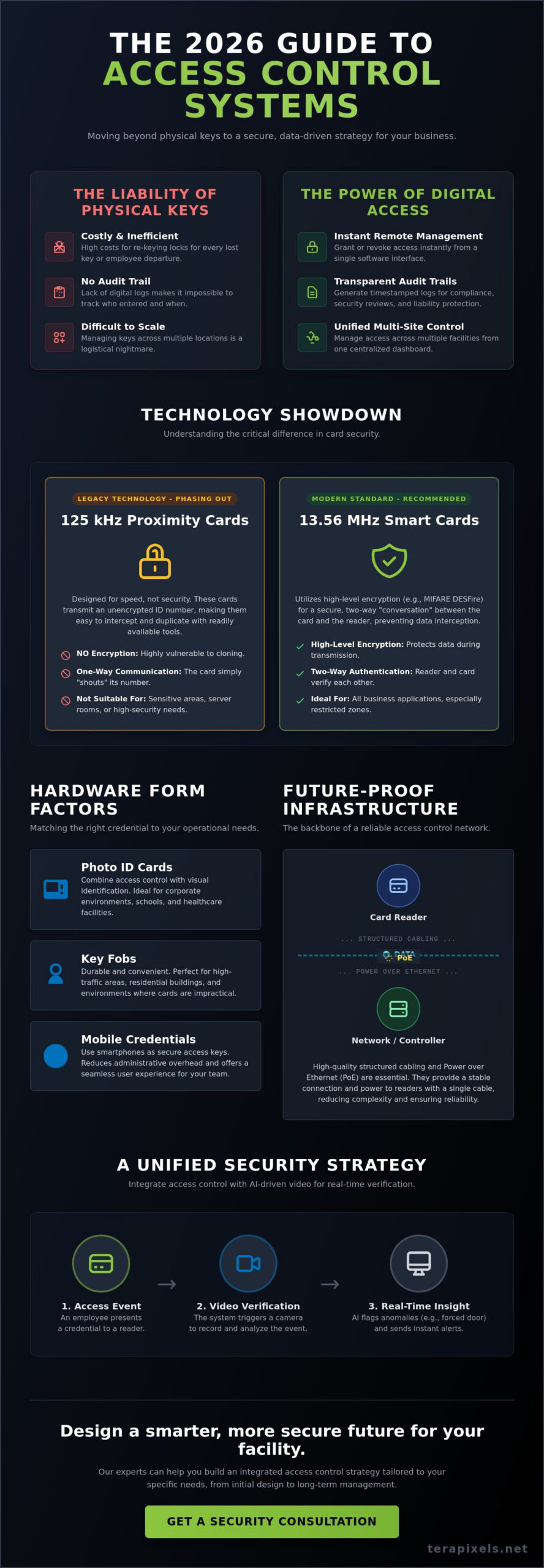
The financial argument for digital credentials becomes clear the moment an employee leaves or a key is lost. Traditional locks require a locksmith, physical hardware changes, and the distribution of new keys to every authorized user. These costs add up quickly. Digital credentials offer a superior return on investment because you can revoke access instantly through a software interface. This eliminates the need for physical lock changes and ensures your facility remains secure without the “re-keying tax.” Moving to a networked system provides several immediate advantages:
- Elimination of physical key management and the risks of unauthorized duplication.
- Automated compliance reporting for industries with strict regulatory requirements.
- Seamless transition from standalone entry points to a unified facility network.
- Enhanced visibility into high-traffic areas to optimize staffing or energy use.
Reducing Liability for Commercial Property Managers
For property managers, the ability to produce a timestamped digital log is invaluable. These audit trails provide concrete evidence during insurance claims or legal disputes, showing exactly who entered a specific room at a specific time. By linking these events to cloud-based surveillance systems, you create a unified record of activity. This integration allows for real-time alerts, notifying you immediately if a door is forced open or propped for too long. It’s a proactive way to prevent small security gaps from becoming major liabilities.
Scaling Access Across Multiple Locations
Managing security across different sites, such as offices in both San Diego and Orange County, requires a centralized approach. A networked keycard access control system for business enables you to manage your entire footprint from a single dashboard. You can customize access levels based on department, seniority, or even specific time windows. This granularity ensures that a warehouse worker in one city doesn’t have unnecessary access to a server room in another. When offboarding occurs, a single click revokes access across all locations, maintaining the integrity of your perimeter without delay.
Technology Roundup: RFID, Smart Cards, and Cloud-Based Readers
Choosing the right hardware is the foundation of a reliable keycard access control system for business. It’s no longer just about granting entry; it’s about the integrity of the data exchange between the card and the reader. As outlined in the Overview of Access Control Systems, different architectures provide varying levels of protection and administrative control. In 2026, the industry has shifted away from simple mechanical solutions toward intelligent, encrypted credentials that can be managed from a central interface. This transition ensures that your security stays ahead of common bypass techniques.
Smart cards, specifically those utilizing MIFARE DESFire technology, have become the preferred choice for organizations that prioritize data integrity. Unlike basic proximity cards, these credentials use high-level encryption to secure the communication between the card and the reader. This is particularly vital for protecting sensitive zones or server rooms where unauthorized access could lead to a significant breach. Many facilities are also adopting mobile credentials, allowing employees to use their smartphones as their primary access key. This reduces the administrative burden of managing physical plastic while providing a more convenient experience for your team.
The Security Gap: 125kHz Proximity vs. 13.56MHz Smart Cards
Legacy systems often rely on 125kHz proximity cards, which were designed for speed rather than security. These older cards are now highly vulnerable because they lack encryption, making them easy targets for simple cloning tools found online. For high-security environments, such as San Diego tech firms or research laboratories, upgrading to 13.56MHz smart cards is a necessity. While 125kHz cards transmit a simple, unencrypted ID number, 13.56MHz smart cards use sophisticated cryptographic handshakes to verify the credential’s authenticity before granting access. This frequency shift provides the robust protection required to prevent unauthorized duplication and cloning.
Cloud-Integrated Access Control for Modern Facilities
The traditional “closet server” is becoming a thing of the past as facilities move toward more agile architectures. Modern keycard access control system for business deployments often utilize cloud-based readers that connect directly to secure web portals. This setup eliminates the need for expensive on-site server maintenance and ensures your system remains updated with the latest security patches. Automatic firmware updates are pushed directly to your readers, protecting your facility against emerging cyber threats without requiring a manual technician visit. Explore how Access Control systems can be tailored to your specific building layout to maintain high uptime. Even if your internet connection drops, hybrid readers retain enough local data to keep your doors functional and your staff safe.
Hardware Form Factors: Keycards vs. Fobs vs. Micro-Tags
Selecting the physical credential is a decision that impacts daily user experience and long-term system durability. While the software manages the logic, the hardware form factor is what your team interacts with every morning. A robust keycard access control system for business offers various options to suit different operational needs. Whether you require a traditional card or a compact fob, the choice should reflect the practical realities of your workspace. It’s about finding the balance between ease of use and the security requirements of your specific facility.
Standard ISO cards remain the gold standard for corporate headquarters. These cards allow for high-resolution custom printing, serving as both a security credential and a visible photo ID badge. This dual-purpose design helps your security personnel identify authorized individuals at a glance, strengthening your facility’s perimeter. In contrast, key fobs are the preferred choice for industrial environments and warehouses. Their rugged construction withstands the physical demands of a busy loading dock or construction site. Fobs are easily attached to key rings, reducing the likelihood of loss compared to loose cards.
Adhesive micro-tags offer a unique way to turn existing assets, such as company laptops or employee smartphones, into access credentials. This flexibility is part of a broader trend toward wearables and biometric integration, which you can explore in this comprehensive overview of access control systems. These innovations prioritize hands-free entry, allowing for a smoother flow of personnel through high-traffic corridors. By diversifying your credential types, you can accommodate different departments while maintaining a unified security architecture.
Choosing the Right Form Factor for Your Workforce
Choosing the right form factor requires a durability checklist. Office settings benefit from the professional appearance of printed cards, while industrial parks require the impact resistance of fobs. For businesses with high-turnover seasonal staffing, a cost-per-unit analysis is essential. Standard cards are often more economical for large-scale deployments. Fobs represent a more durable, long-term investment for permanent staff who need hardware that can survive a demanding workday.
Environmental Considerations for Southern California
Southern California presents unique environmental challenges for security hardware. For outdoor San Diego installations, selecting UV-resistant and heat-stable readers is critical to prevent hardware degradation under the intense sun. Coastal properties in Orange County require IP-rated hardware to protect against salt air and humidity. Modern architectural designs also demand aesthetic integration; your keycard access control system for business should complement the building’s facade rather than detract from it. We ensure that every piece of hardware is a building block in a larger narrative of technological reliability.
Infrastructure Requirements: The Role of Structured Cabling
A keycard access control system for business is only as reliable as the physical network supporting it. Think of your wiring as the nervous system of your facility. If the connection is weak, the most advanced smart readers in the world won’t function correctly. Building a stable environment starts with a professional structured cabling foundation. This architectural approach ensures that data packets move from the card reader to the controller without latency or loss, providing the “quiet confidence” that your doors will open every time a valid credential is presented.
Power over Ethernet (PoE) technology has simplified how we design these systems. It allows us to deliver both electrical power and data through a single cable. This streamlines the installation process and reduces the need for separate electrical runs at every door. For modern commercial properties, a high-quality CAT6 cabling installation is the standard for maintaining high-speed communication. In high-occupancy buildings or multi-story offices, we often recommend low voltage structured cabling with fiber backbones to future-proof the system as your security needs expand over the next decade.
Network Security and Data Integrity
Backup Power and Continuity
Stability means planning for the unexpected. We integrate access panels with commercial backup generators to ensure your facility remains protected during San Diego’s occasional grid failures. For shorter interruptions, Uninterruptible Power Supplies (UPS) provide the necessary battery backup to keep locks functional. This is a critical safety matter; your system must comply with local fire codes to ensure fail-safe locks release during an emergency egress. Contact our team to design structural cabling solutions that prioritize long-term technological reliability.
Designing an Integrated Access Strategy with Terapixels Systems
Effective security isn’t a collection of isolated gadgets; it’s a cohesive ecosystem designed to support your business growth. At Terapixels Systems, we take the role of a Reliable Architect, looking beyond the physical lock to see how data flows through your entire facility. A keycard access control system for business performs best when it’s woven into your broader infrastructure. This architectural approach ensures that every component, from the readers to the network backbone, works in harmony to provide comprehensive protection and stability.
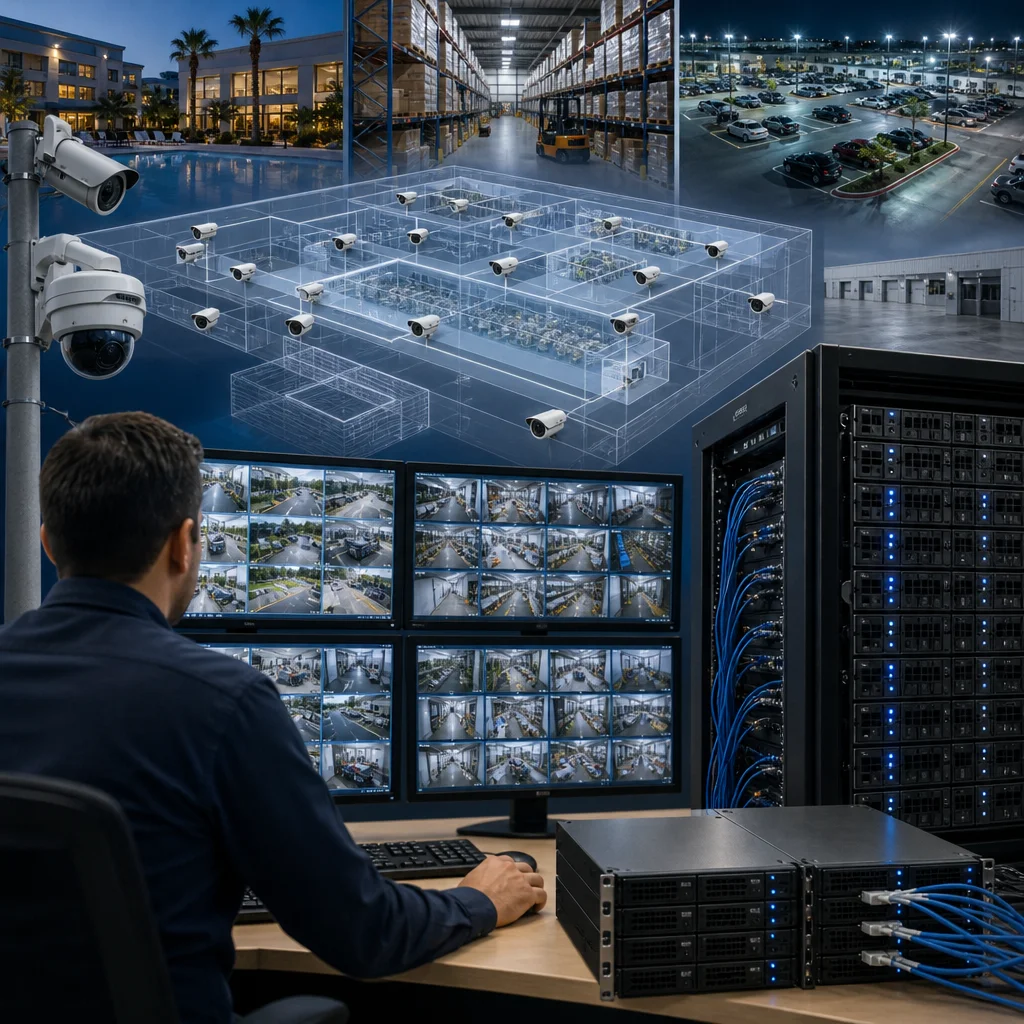
One of the most significant advantages of our strategy is the integration of AI Analytics with your physical entry points. When an employee scans their credential, our systems can trigger high-definition CCTV to perform visual verification. This creates a complete security narrative, matching the digital record with the visual truth. We also utilize Remote Monitoring and Management (RMM) to conduct constant health checks on your hardware. If a controller or reader shows signs of a technical fault, our team can identify and address the issue remotely, maintaining the reliability of your perimeter without interruption.
Modern commercial facilities in Southern California are increasingly looking for ways to unify their technical assets. We bridge the gap between security and operational efficiency by linking access credentials to other building systems. For instance, your keycards can manage authorized usage for EV Chargers or track entry into areas powered by your Commercial Solar array. This level of integration ensures that your investments in green energy and facility infrastructure are protected and utilized only by authorized personnel, creating a symbiotic relationship between your security and your sustainability goals.
The Power of Unified Security Systems
A unified system transforms reactive security into a proactive shield. Access events can be programmed to trigger specific actions, such as turning on lights or initiating recording on nearby Cloud-Based Surveillance Systems. If an unauthorized attempt occurs, mobile alerts are sent instantly to your management team, providing real-time situational awareness. This synergy between access data and smart building controls allows you to manage energy usage more effectively by adjusting HVAC or lighting based on actual room occupancy levels, ensuring your facility operates at peak efficiency.
Your Local Partner in Southern California
We pride ourselves on being a supportive, localized guide for businesses throughout San Diego and Orange County. Our process begins with a thorough on-site assessment to identify blind spots in your current plan and suggest hardware that withstands the unique coastal environment. Every installation follows our rigorous network cabling checklists to ensure your infrastructure is ready for future office build-outs. Contact Terapixels Systems today to schedule a comprehensive security and infrastructure audit, and let’s build a foundation for your long-term technological reliability.
Building a Foundation for Future-Proof Facility Security
Securing your commercial property requires more than just installing locks; it demands a strategic alignment of hardware, network infrastructure, and intelligent management. By transitioning to a modern keycard access control system for business, you eliminate the vulnerabilities of legacy cloning and the recurring costs of physical re-keying. As we’ve explored, the stability of your system relies heavily on professional structured cabling and the ability to integrate with AI-driven analytics for real-time verification. These components work together to provide a seamless, high-tech experience for your employees while maintaining a robust perimeter.
Terapixels Systems serves as your dedicated partner in Southern California, specializing in commercial properties throughout San Diego and Orange County. Our team brings deep expertise in both physical security and the complex cabling required to support it. We offer sophisticated cloud-based management and AI analytics that turn simple entry events into actionable intelligence. Secure your facility with a custom access control solution from Terapixels Systems. We’re ready to help you architect a system that provides comprehensive protection and long-term reliability for your facility.
Frequently Asked Questions
How much does a keycard access system cost for a small business?
The total investment for a keycard access control system for business depends on the number of entry points, the type of credentials selected, and the underlying network infrastructure. Costs typically include the reader hardware, electronic locking mechanisms, and the necessary CAT6 or fiber cabling. Ongoing expenses may also include software subscriptions for cloud-based management. We recommend a professional site assessment to determine the specific architectural needs of your facility and provide an accurate scope of work.
What happens to the keycard system if the power goes out?
Modern systems are designed with continuity in mind, utilizing Uninterruptible Power Supplies (UPS) to provide immediate battery backup. These batteries keep the controllers and readers operational during short-term interruptions. For extended outages, we often integrate these systems with commercial backup generators to ensure your facility remains secure. The behavior of the doors themselves depends on whether you have installed fail-safe or fail-secure hardware, which determines if a door unlocks or stays locked when power is lost.
Can keycard systems be integrated with existing security cameras?
Yes, integrating access control with your surveillance infrastructure creates a unified security narrative. When a keycard is scanned, the system can trigger nearby cameras to record the event, providing visual verification of who is entering the building. This synergy allows for AI-driven analytics to detect unauthorized tailgating or forced entries. By linking these systems, you move from simple door management to a comprehensive security strategy that offers better visibility and faster response times.
Is a cloud-based access control system more secure than an on-premise one?
Cloud-based systems offer significant security advantages by providing automatic firmware updates and encrypted data storage. This ensures your system is always protected against the latest cyber threats without requiring manual intervention. On-premise systems require you to manage your own servers, which can become a vulnerability if not maintained correctly. A cloud architecture also allows for remote management, giving you the ability to revoke credentials or monitor logs from any location through a secure web portal.
What is the difference between fail-safe and fail-secure door locks?
Fail-safe and fail-secure refer to how an electronic lock behaves during a power failure. A fail-safe lock, such as a magnetic lock, releases when power is cut, allowing the door to be opened for emergency egress. This is often required by fire codes for specific exit routes. A fail-secure lock, like an electric strike, stays locked when power is lost, maintaining the security of the perimeter. Choosing the right configuration requires balancing the safety of your personnel with the physical security of your assets.
How many employees can a standard keycard system handle?
Modern keycard access control system for business deployments are highly scalable and can manage anywhere from a few dozen to several thousand employees. The capacity is typically determined by the memory of the door controllers or the specific software license you choose. Because these systems are networked, adding new users or additional locations is a straightforward process that doesn’t require overhauling your existing hardware. This flexibility makes it an ideal solution for businesses planning for long-term growth.
Do I need to replace my doors to install a keycard system?
In most cases, you don’t need to replace your existing doors to implement an electronic access system. Most commercial doors can be retrofitted with electronic strikes, magnetic locks, or electrified mortise sets. Our technicians evaluate your current hardware to ensure the new components integrate seamlessly with your building’s architecture. While some specialized high-security doors might require specific modifications, a standard commercial door is usually compatible with modern reader and locking technology.
Can I use my smartphone instead of a physical keycard?
Smartphone-based access, often called mobile credentials, is a standard feature in modern security architectures. Users can unlock doors using Bluetooth or NFC technology through a secure app on their device. This eliminates the need for physical plastic cards and reduces the administrative burden of replacing lost fobs. Many businesses choose a hybrid approach, providing physical cards for some staff while allowing others to use their phones for a more convenient, hands-free entry experience.