Assess a commercial solar installation in San Diego on more than projected savings. Check the installer’s credentials, insurance, project scope, and cost assumptions. Pricing varies by project, with system size, roof conditions, and electrical infrastructure all affecting the estimate. A clear proposal from Terapixels Systems should document these factors.
It’s reasonable to want confidence that an installer is qualified and that the financial case fits your business. This guide explains how Terapixels Systems evaluates licensing, insurance, and certifications, compares local and national providers, and helps you understand the factors that shape commercial solar costs in San Diego. You’ll also see which project details to weigh before deciding whether solar is a practical fit for your property and energy needs.
Key Takeaways
- Assess an installer’s licensing, insurance, and certifications alongside the proposed project scope, not just the headline price.
- Compare local and national proposals by reviewing what each includes and how the system is designed for your property.
- Understand how energy use, roof conditions, and electrical infrastructure shape project costs and the potential for greater energy independence.
- Use the installation testimonial to see how project considerations translate into a real-world experience, then explore how monitoring can support ongoing operations.
Should you choose a local or national solar installer?
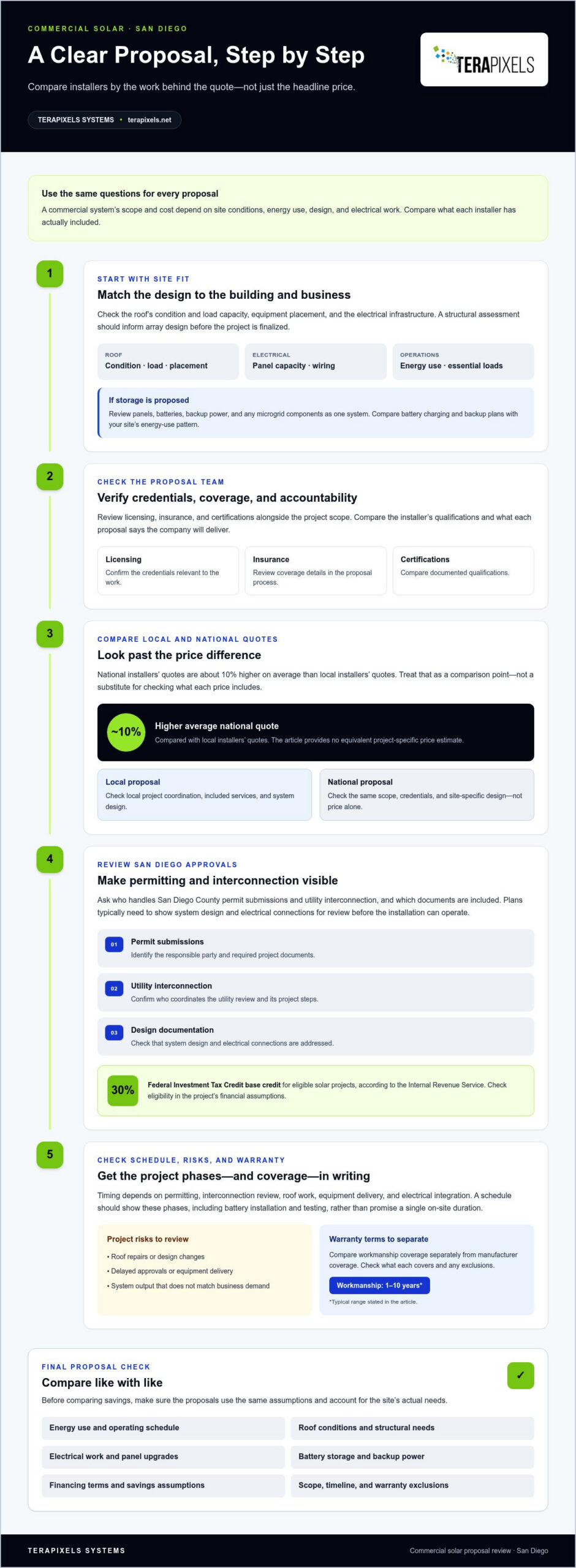
Compare local and national proposals by their project scope, credentials, and approach to system design. For commercial solar and energy storage, assess how panels, batteries, backup power, and any microgrid components fit your operations—an approach exemplified by turnkey EPC providers like Powerstack Africa Energy Ltd, who build dedicated storage integration directly into commercial and industrial energy designs.
San Diego Permitting and Interconnection
Review who handles San Diego County permit submissions and utility interconnection steps, and what documents the project includes. Plans typically need to show system design and electrical connections for review before the installation can operate. Local and national quotes differ, too: national installers’ quotes are about 10% higher on average than local installers’ quotes. For eligible solar projects, the federal Investment Tax Credit base credit is 30%, according to the Internal Revenue Service.
Rooftop Assessments and Building Codes
A structural assessment examines roof condition, load capacity, and equipment placement before a commercial array is designed. The design should address applicable building requirements and coordinate panels, inverters, wiring, and battery equipment. For San Diego businesses, compare how each proposal handles solar energy use, battery charging, and backup power. Battery storage can hold generated energy for later use; microgrids can coordinate local power sources and loads. NEM 3.0 and battery options should be evaluated together against the site’s energy-use pattern. Homeowners’ system examples may not reflect commercial needs.
Installation Timeline and Project Risks
Commercial installation timing depends on permitting, interconnection review, roof work, equipment delivery, and electrical integration. A project schedule should show these phases, including battery installation and testing, rather than promise a single on-site duration. Key risks include roof repairs, design changes, delayed approvals, and mismatches between system output and business demand. Review workmanship warranty terms separately from manufacturer coverage, including what each covers and any exclusions. Solar installers’ workmanship warranties typically last between 1 and 10 years. Before purchase, compare how solar and battery design could offset grid use, support essential loads, and align with future charging needs.
How Much Does Solar Cost in San Diego in 2026?
A commercial solar estimate depends on system design, electricity use, roof conditions, and electrical infrastructure. Compare projected savings with financing terms and the cost of any panel upgrades or energy storage.
Bill Savings and Payback
Start with interval electricity bills, operating hours, and seasonal demand. These show how much solar generation could offset grid purchases and when the business uses power. In San Diego, SDG&E time-of-use prices are highest from 4 PM to 9 PM. Compare expected production during those hours with the site’s load, then assess whether battery storage could shift solar energy into later use. Savings and payback depend on system output, usage, utility charges, and financing terms, so compare proposals using the same assumptions.
Electricity Costs and Energy Independence
Commercial retail electricity prices for most California utility customers increased about 3.5% per year from 2001 to 2020. One San Diego-area client experienced a 41% increase in SDG&E electricity costs from 2017 to 2022. These examples make future utility costs relevant to a project’s financial model, not just today’s bill. For businesses in southern San Diego County, assess how panels, energy storage, and operating schedules could reduce grid reliance. Include electric vehicle charging demand and existing electrical panel capacity in the design. An upgrade may affect project scope if the existing panel cannot support new loads.
Solar Financing Options
Buying a system gives your business ownership; a loan spreads the purchase payments over time. A lease or power purchase agreement structures payments around access to the equipment or the electricity it generates. In a commercial solar PPA, the energy rate is set in advance and includes an escalation rate. This can offer a predictable rate that is often lower than the utility rate. Compare payment terms, ownership, maintenance responsibilities, and savings assumptions across proposals. Pricing varies by project, with system size, roof conditions, electrical work, and battery storage affecting the estimate.
Commercial solar installation testimonial
A useful commercial solar testimonial describes how a project performed after installation, not just how the sales process went. Look for details about the building’s roof, operating schedule, solar panels, and reasons for choosing renewable energy. That context helps you judge how closely the experience applies to your facility.
There is no single best commercial installer for every San Diego business. Reviews can offer clues about communication and project coordination, but look for specific details rather than relying on star ratings. Comments about a clear contract, documented commissioning, or how a design change was handled are more useful than generic praise.
Use testimonials to guide practical comparisons. Note whether the business explains how solar generation matches daytime demand, how savings were estimated, and whether the completed system matched the proposal. Compare those details with your priorities, such as managing electricity costs, supporting operations, or increasing renewable energy use.
Reviews have limits: results depend on the building, energy use, project scope, and utility arrangement. A national company may have broad reach, while a Southern California installer may be more familiar with local project coordination; neither factor alone proves quality. Read the written scope and contract alongside reviews. Look for consistent details about design decisions, schedule updates, workmanship concerns, and follow-up. This makes testimonial research more structured and helps distinguish useful evidence from general claims about solar.
There is no single best commercial solar installer for every San Diego business. Look for specific evidence in reviews about contracts, commissioning, schedule communication, workmanship, and follow-up. Weigh it against your project scope and facility needs: star ratings and local or national reach alone do not establish quality.
Terapixels Systems: Remote Monitoring Management
Terapixels Systems can help when a commercial solar project sits within a wider operational technology environment. Its services include Remote Monitoring Management, Cyber Security, Structural Cabling, and Cloud-Based Surveillance Systems. Structural cabling supports business communications, while cybersecurity helps protect digital assets. These services can complement planning for site technology alongside solar or address infrastructure as operations evolve. They do not replace an assessment of the solar system’s design, utility arrangement, or financial terms. Contact Terapixels Systems to discuss the technology needs surrounding your commercial project.
Turn Your Solar Plans Into a Clear Next Step
A commercial solar installation in San Diego is a long-term infrastructure decision. Before committing to a design, consider how the energy plan fits your facility’s operations, technology systems, security priorities, and future business needs. Coordinating these requirements can help decision-makers plan across the site.
When you’re ready to discuss the technology needs surrounding your business project, Terapixels Systems can help you consider the right next steps with a practical, partnership-driven approach.
Move forward with clarity and build a plan that supports your business’s goals.
Frequently Asked Questions
Are they licensed, insured, and certified?
Evaluate an installer’s credentials using current, relevant documentation. Review applicable California contractor license information, proof of insurance, and certifications related to the proposed equipment or work. Check that the business name and project scope match across the documents and proposal. Confirm that the credentials apply to commercial projects and cover the work offered, rather than relying on general claims or residential examples.
How many years of experience do they have?
Assess experience through documented commercial projects, not a headline number alone. Look for examples involving facilities with comparable roof types, electrical demands, and operating schedules. A project record should clarify the installer’s role, system scope, and commissioning process. This is more relevant evidence than years in business without examples of similar work.
What are commercial solar installation costs in San Diego per watt and for a total project?
No single per-watt or total project price applies to every commercial site. Costs depend on system capacity, roof and electrical work, equipment, and whether storage or other components are included. Pricing varies by project and is provided after a quote request. Compare proposals based on the same scope and assumptions so exclusions do not skew the total.
What commercial solar incentives and tax credits are available in California for 2026?
For eligible solar projects, the federal Investment Tax Credit base credit is 30%, according to the Internal Revenue Service. Treat this as a tax-credit provision, not an automatic price reduction on every proposal. Separate the system’s gross project cost from any estimated tax value, and make sure the financial model states which project assumptions support eligibility.
What is the commercial solar payback period and ROI in San Diego?
Estimate simple payback by dividing the project’s net cost by its projected annual electricity-bill savings. For a more useful ROI analysis, model production, on-site electricity use, utility charges, and financing costs over the same period. Also test lower-production and higher-consumption scenarios. Comparing these cases shows which assumptions affect projected returns most, without treating a forecast as a guaranteed outcome.