CONTACT US

What if the most expensive component of your digital infrastructure isn’t the high-end hardware, but the invisible chaos hidden behind your server racks? Many business owners ask what is structured cabling when they finally tire of tracing “spaghetti” wires or dealing with intermittent signal drops that stall productivity. It’s a common frustration. You’ve likely experienced the high costs of moving a single workstation or the lag caused by interference in an unorganized system. We believe your network should be a silent, reliable partner that supports your growth without constant intervention.
This comprehensive 2026 guide will show you how a standardized cabling architecture transforms your facility from a collection of isolated devices into an integrated business asset. We’ll explore why Cat6A has become the default for horizontal runs and how the NEC 2026 reorganization impacts your infrastructure planning. You’ll learn how to build a scalable foundation that supports high-speed fiber, AI analytics, and high-power PoE++ devices while significantly lowering your long-term maintenance costs. By the end, you’ll have a clear roadmap for a clean, organized server room that’s ready for the next decade of technology.
Key Takeaways
- Define what is structured cabling as a standardized architecture that serves as the nervous system for your business technology.
- Contrast modular systems with point-to-point wiring to eliminate disorganized “spaghetti” cables and prevent unnecessary network downtime.
- Identify the six key subsystems that allow for seamless moves, adds, and changes without disrupting your entire facility’s connectivity.
- Evaluate the strategic ROI of infrastructure designed to support high-speed fiber and AI analytics for a 10 to 15 year lifecycle.
- Recognize the value of a single-source partner who integrates structural cabling with security and power systems while adhering to local building codes.
Table of Contents
- Understanding Structured Cabling: The Nervous System of Your Business
- Structured Cabling vs. Point-to-Point: Ending the "Spaghetti" Chaos
- The 6 Subsystems of a Structured Cabling Design
- Business ROI: Why Structured Cabling is a Strategic Investment
- Choosing a Structured Cabling Contractor in San Diego & Orange County
Understanding Structured Cabling: The Nervous System of Your Business
To understand what is structured cabling, think of your building as a living organism. While individual devices like AI analytics cameras or access control panels act as the eyes and hands of your business, the cabling represents the nervous system. Structured cabling is a comprehensive system of cabling and associated hardware that provides a universal telecommunications infrastructure. It isn’t just a collection of wires; it’s a planned, integrated architecture designed to carry data, voice, and video signals consistently across your entire facility.
This system follows the TIA/EIA-568 standards, which act as a universal rulebook for design and installation. These guidelines ensure that whether you’re installing fiber optic backbones or Cat6A horizontal runs, the performance remains predictable. It’s vital to distinguish between the physical medium and the architecture itself. You can have the highest grade of CAT6 cabling, but without a structured design, you still face a disorganized network that’s difficult to manage. Understanding what is structured cabling helps you see the value in the design rather than just the raw materials.
Plain Language: Why “Structured” Matters
Standardization is the primary benefit here. In the past, businesses relied on proprietary wiring that locked them into one ecosystem. If you wanted to upgrade your surveillance or phone systems, you often had to rewire the entire office. A structured approach eliminates this bottleneck. It allows for universal hardware compatibility; your infrastructure remains the same even as you swap out active equipment. Modern updates like the NEC 2026 reorganization emphasize this need for clear, labeled systems to manage “limited energy” circuits safely. Troubleshooting becomes a matter of minutes rather than hours.
The Components of a Complete System
A complete system integrates several critical hardware elements to maintain order and ensure long-term reliability. These components work together to create a scalable foundation for your digital communication:
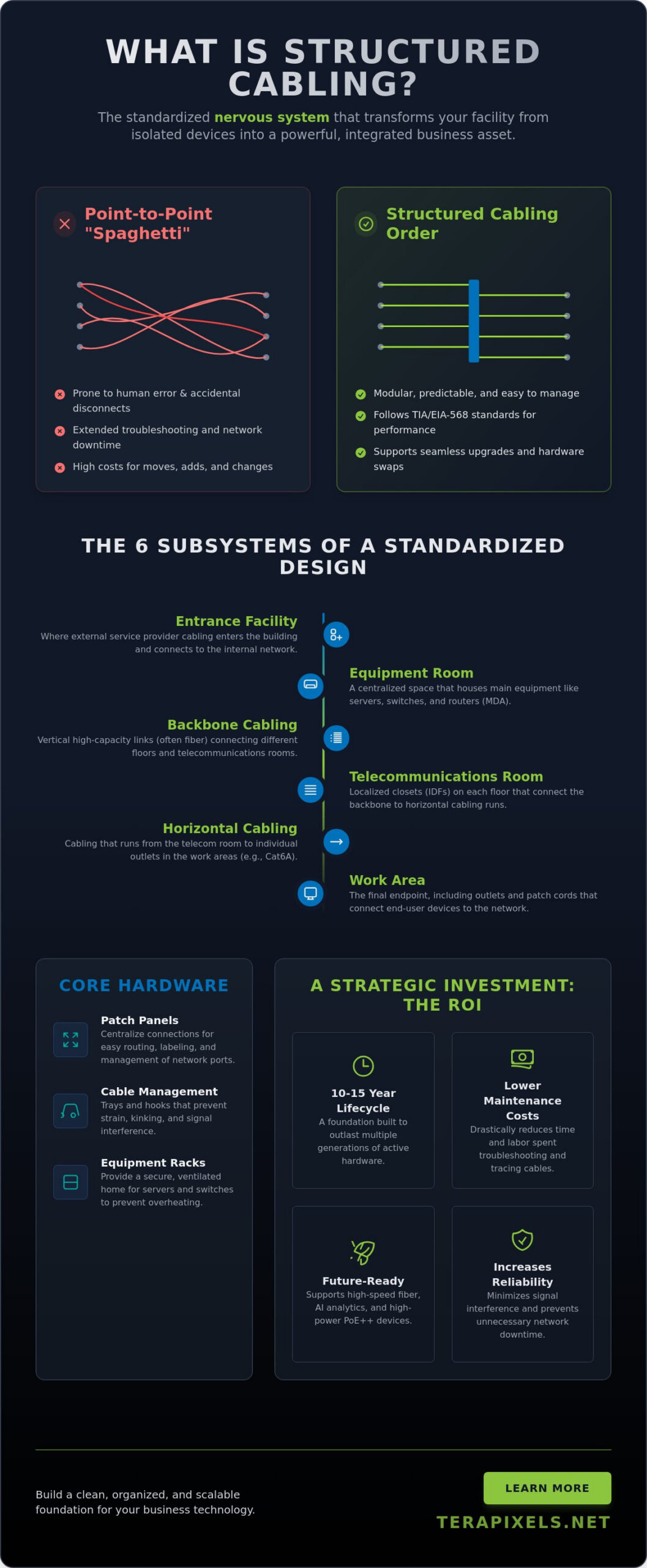
- Patch Panels: These allow for easy routing and labeling of connections, making moves and changes simple.
- Equipment Racks: These provide a secure, ventilated home for your hardware to prevent overheating.
- Cable Management: Specialized hooks and trays prevent physical strain and “kinking” of the wires.
At the heart of this design sits the Main Distribution Area (MDA). This central hub acts as the brain where all external connections meet your internal network. This robust physical foundation allows your business to support modern demands like cloud-based access control and high-bandwidth security systems without compromise. By viewing your cabling as a strategic asset rather than a utility, you set the stage for operational success. A well-designed system isn’t just about the wires you see today; it’s about the technology you haven’t even purchased yet. It ensures your facility is ready for the high-bandwidth requirements of 2026 and beyond.
Structured Cabling vs. Point-to-Point: Ending the “Spaghetti” Chaos
Imagine walking into your server room and seeing a wall of tangled, brightly colored wires. This is the “spaghetti” effect, a hallmark of point-to-point wiring. In this setup, every server, switch, and workstation connects directly to another device. It’s a fast solution for a single connection, but it quickly spirals into chaos as your business grows. When you ask what is structured cabling, you’re looking for an alternative to this mess. Structured systems use patch panels and trunk cables to create a permanent, organized path for every signal. This design eliminates the guesswork and risk associated with direct wiring.
Point-to-point setups are a major source of human error. When cables are unmanaged, technicians often struggle to identify which wire belongs to which device. This leads to accidental disconnections and extended troubleshooting windows. Understanding what is structured cabling means recognizing its role in future-proofing; it replaces direct-link confusion with a modular, predictable framework.
The High Cost of Messy Wiring
Messy wiring isn’t just an eyesore; it’s a financial drain. Tracing a single faulty connection in a tangled heap can take hours of manual labor. During that time, your team is offline. Unmanaged low-voltage wiring also creates significant fire hazards by trapping heat and blocking emergency access. It’s a liability that most modern businesses can’t afford. If you’re planning a move, following a 2026 Network Cabling Checklist for New Office Build-outs ensures you avoid these pitfalls from day one.
Reliability and Airflow Benefits
Airflow is the lifeblood of your hardware. Tangled cables block the exhaust paths of servers and switches, leading to premature equipment failure. Organized cabling ensures that cool air flows freely through the racks. Standardized layouts provide several immediate operational advantages:
- Faster identification of faulty ports.
- Improved cooling efficiency for expensive server hardware.
- Reduced risk of accidental disconnections during maintenance.
Beyond cooling, proper spacing reduces electromagnetic interference, commonly known as crosstalk. This leads to cleaner signals and faster data speeds. When Choosing a Structured Cabling Contractor, you want a partner who prioritizes these technical standards. A clean server room also signals to clients and investors that your company values operational excellence. If you’re ready to transition away from the chaos, our team can help you design a custom structural cabling solution that scales with your goals.
The 6 Subsystems of a Structured Cabling Design
Designing a network without a subsystem map is like building a skyscraper without a blueprint. When we discuss what is structured cabling, we are referring to the six distinct zones defined by the TIA/EIA standards. This modular approach ensures that a fault in one area, such as a damaged workstation cable, doesn’t paralyze your entire operation. By segmenting the infrastructure, we create a resilient environment where maintenance is simplified and scalability is built in. Structured cabling provides the framework necessary to manage these complex connections through a logical, hierarchical design that supports your business for years to come.
Entrance Facilities and Equipment Rooms
The Entrance Facility (EF) serves as the demarcation point where your Internet Service Provider (ISP) hands off the connection to your building. It contains the protection devices and cables that transition from external networks to your internal system. Moving deeper into the facility, the Equipment Room (ER) acts as the primary “brain.” This climate-controlled space houses the most critical hardware, including main distribution frames and server clusters. This central hub is the foundation for network security for small business, providing a secure, centralized location for firewalls and monitoring equipment.
Backbone and Horizontal Cabling
The backbone cabling subsystem acts as the high-capacity superhighway of your facility. It typically uses high-speed fiber optics to connect entrance facilities, equipment rooms, and telecommunications closets across different floors or separate buildings. Branching off from this core is the horizontal cabling. These are the “streets” that deliver data from the local closet to the individual user outlets. Professional CAT6 cabling installation for commercial buildings is the standard for these horizontal runs, providing the bandwidth necessary for modern workstations and high-power PoE++ devices.
Telecommunications Closets and Work Areas
In larger facilities across Orange County and San Diego, Telecommunications Closets (also known as IDFs) bridge the gap between the main equipment room and distant workstations. These closets house the patch panels and switches that manage local traffic and power delivery. Finally, the Work Area subsystem encompasses everything from the wall outlet to the user’s device. This includes patch cords, adapters, and connectors. Because the system is modular, reconfiguring an office layout is easy and cost-effective. You simply move a patch cord at the closet rather than pulling new wires through the walls. This flexibility is a core reason why understanding what is structured cabling is essential for any growing business.
Business ROI: Why Structured Cabling is a Strategic Investment
Investing in a network often feels like a race against obsolescence. Most active hardware carries a lifecycle of just three to five years before it requires a refresh. However, when you analyze what is structured cabling from a financial perspective, you see an asset with a ten to fifteen year lifespan. It outlasts your servers, switches, and workstations several times over. This longevity makes it one of the most cost-effective components of your facility’s technology stack. Beyond the hardware, modern infrastructure significantly increases the market value of commercial real estate. Prospective tenants look for “plug-and-play” readiness, and a certified Cat6A system provides exactly that.
This investment also slashes future labor costs. When you need to add a new workstation or upgrade a switch, the organized nature of the patch panels means technicians spend minutes on the task rather than hours. In a disorganized system, every “move, add, or change” becomes a discovery project that bills by the hour. By establishing a standardized architecture, you eliminate the technical debt that usually accumulates as a business grows. You’re not just buying wires; you’re buying a predictable, manageable environment that supports your operational goals without constant financial surprises.
Supporting Modern Security and Cloud Systems
Reliable data transmission is the backbone of modern safety. Cloud-based surveillance and AI analytics require the consistent bandwidth that only a structured CAT6 or fiber optic system can provide. These systems rely heavily on Power over Ethernet (PoE) technology. With the IEEE 802.3bt Type 4 standard now allowing up to 90W of power per port, your cabling must handle increased heat and power demands without degrading signal quality. This robust infrastructure is what enables effective remote monitoring management for business, ensuring your security systems stay online and accessible from anywhere. The same reliable cabling foundation is equally critical for a modern keycard access control system for business, which depends on consistent PoE delivery and low-latency data transmission to manage entry points and audit trails in real time.
Future-Proofing for 2026 and Beyond
Technology moves fast. Commercial environments are rapidly transitioning to 10Gbps and even 40Gbps speeds to handle massive data loads. A structured design allows you to integrate new technology like commercial solar monitoring or EV chargers into your facility management system without a total overhaul. It prevents the costly “rip and replace” cycle every five years by providing a scalable path for growth. By planning for these high-bandwidth applications today, you reduce future labor costs and downtime. As the number of active IoT devices continues to surge, implementing a comprehensive low voltage structured cabling system ensures your facility can support the growing demands of connected devices without bottlenecks. If you’re looking to upgrade your facility’s backbone, our team can design a strategic structural cabling plan that grows with your business. This proactive approach ensures your building remains relevant and efficient as your technology needs evolve.
Choosing a Structured Cabling Contractor in San Diego & Orange County
Selecting the right partner to implement your network infrastructure is as critical as the hardware itself. While many providers can pull wire, a true expert understands what is structured cabling in the context of local California building codes and long-term facility management. In Southern California, factors like seismic bracing requirements and specific fire-rated plenum cable standards are non-negotiable. We believe in a partnership that goes beyond the initial installation. A professional contractor doesn’t just leave you with a mess of wires; they provide comprehensive testing and certification to prove that every link meets the high-speed performance promised by the standards.
Working with a single source for your cabling, security, and power needs simplifies your project management and ensures system compatibility. When one team manages the structural cabling, the cloud-based surveillance, and the AI analytics integration, you eliminate the risk of communication gaps between different vendors. This unified approach creates a more stable foundation for your daily operations. Terapixels Systems serves as the Reliable Architect for businesses that value precision, technical expertise, and comprehensive protection.
The Terapixels Partnership Approach
Our team brings deep expertise to commercial properties throughout San Diego County and Orange County. We utilize a thorough design-build process for all low-voltage systems, ensuring that your infrastructure is tailored to your specific architectural layout. This includes the strategic integration of power solutions, such as backup generator installation for business, to ensure your network stays live during utility outages. By managing everything from the fiber backbone to the final access control panel, we provide a cohesive system that eliminates the “spaghetti” chaos common in unmanaged environments. For a deeper look at how these systems come together in modern facilities, our guide on low voltage structured cabling for modern facilities covers the full scope of design considerations and California compliance requirements.
Next Steps for Your Facility
If you’re unsure about the state of your current network, a professional cabling audit is the best place to start. Older buildings often harbor abandoned cables from previous tenants that clutter pathways and hinder airflow. We recommend a site walk-through to identify these infrastructure gaps before they cause a major outage. Whether you’re planning a new office build-out or upgrading an existing server room, a clear consultation helps define your bandwidth requirements for the next decade. We invite you to reach out for a technical assessment of your facility’s needs. Let’s build a foundation that supports your business goals with quiet confidence and technical excellence.
Building Your Facility’s Digital Future
Transitioning from the chaos of unmanaged wiring to a standardized architecture is the most significant step you can take toward operational stability. You’ve seen how a modular subsystem design eliminates “spaghetti” cables and provides a scalable foundation for high-bandwidth technology. Understanding what is structured cabling helps you recognize your infrastructure as a strategic 10 to 15 year asset rather than a recurring technical debt. By planning for the power and data needs of 2026 today, you ensure your business remains agile and protected.
As integrated security and network experts, Terapixels Systems serves as a steady partner for businesses throughout San Diego and Orange County. Our certified CAT6 and fiber optic installers specialize in creating clean, organized environments that support everything from AI analytics to cloud-based access control. We invite you to Request a Professional Structured Cabling Consultation to identify gaps in your current setup and design a roadmap for growth. Let’s work together to build a network that is as reliable as it is efficient.
Frequently Asked Questions
How much does structured cabling cost per drop in 2026?
Total project costs depend on several variables, including the type of cable selected, the complexity of your building’s architecture, and local labor rates. Factors such as whether you choose Cat6 or Cat6A and the distance of the runs will influence the final investment. Because every facility has unique requirements, it’s best to request a site-specific audit to get an accurate estimate for your business.
What is the difference between CAT6 and CAT6A for commercial use?
Cat6A is designed to support 10Gbps speeds at a full distance of 100 meters, while standard Cat6 is limited to much shorter distances for those same speeds. Cat6A also features superior shielding that significantly reduces alien crosstalk. This makes it the preferred choice for modern commercial environments that deal with high-density data and interference from other electrical systems.
Do I need fiber optic cabling for a small office?
Most small offices benefit from using fiber optic cabling for the backbone connection that links the ISP entrance to the main equipment room. While copper is excellent for connecting individual workstations, fiber provides the high-capacity “superhighway” needed to handle modern cloud services and AI analytics. Using a hybrid approach ensures your small office isn’t bottlenecked at the primary connection point.
Can I install structured cabling myself to save money?
Self-installation for commercial properties often results in poor signal performance and non-compliance with local building codes. When you consider what is structured cabling, remember it’s a certified system that requires specialized tools and testing equipment. Professional installation ensures your network meets TIA/EIA standards and provides the reliability necessary for daily business operations.
How long does a typical structured cabling installation take?
Installation timelines vary based on the number of data drops and the physical layout of your facility. A small office upgrade might be completed in a few days, whereas a comprehensive build-out for a large commercial property could take several weeks. A professional site walk-through is the most effective way to establish a realistic schedule that minimizes disruption to your team.
Does structured cabling support wireless (Wi-Fi 7) networks?
Yes, a robust physical infrastructure is the essential foundation for any high-performance wireless network. Wi-Fi 7 access points require high-bandwidth backhaul connections to deliver their multi-gigabit potential. Without a structured Cat6A system in place, your wireless network will likely suffer from latency and speed drops regardless of how advanced your routers are.
What are the most common mistakes in structured cabling design?
The most frequent errors include poor labeling, exceeding the 100-meter length limit for copper runs, and neglecting proper heat management in server rooms. Many businesses also fail to plan for future growth, leading to a “spaghetti” mess of patch cords as they add new employees. A professional design prevents these issues by creating a modular, labeled system from the start.
How do I know if my building already has structured cabling?
You can identify a structured system by looking for organized patch panels in a central equipment room and labeled wall plates at each workstation. If your wiring looks like a direct, tangled path from one device to another without clear labeling or a central hub, you likely have point-to-point wiring. Understanding what is structured cabling helps you recognize the difference between a professional architecture and a temporary fix.