CONTACT US
On May 28, 2026, nearly 7,000 California businesses and homes sat in total darkness as the regional grid buckled under early seasonal demand. When you consider that weather events cause roughly 80 percent of all major power outages, a professional backup generator installation for business is no longer an optional upgrade for San Diego and Orange County firms. It’s the primary defense against the mounting frequency of Public Safety Power Shutoffs and aging infrastructure.
You already know that even a brief interruption can lead to massive revenue loss and critical security gaps. It’s exhausting to balance the need for reliability with the complexity of SCAQMD Rule 1470 or the transition to stricter Tier 5 emission standards. This guide provides a clear path to protecting your commercial operations with a tailored, engineered power solution. You’ll learn how to achieve a turnkey system that activates automatically, integrates with your existing server infrastructure, and uses remote monitoring to provide the peace of mind you deserve. We’ll break down the latest NFPA 110 requirements and local building codes to ensure your facility remains compliant and resilient through 2026 and beyond.
Key Takeaways
- Learn how to accurately distinguish between critical and total electrical loads to optimize system capacity and reduce unnecessary capital expenditure.
- Compare the operational advantages of diesel, natural gas, and liquid propane to select the fuel source that best aligns with your facility’s infrastructure and storage capabilities.
- Discover how a professional backup generator installation for business ensures your cloud-based surveillance and access control systems remain fully operational during a total grid failure.
- Navigate the complex Southern California permitting landscape with a structured roadmap covering building, electrical, and fire department requirements for 2026.
- Understand the strategic advantage of partnering with a technology integrator to design a power architecture that prioritizes your data networks and AI-driven security systems.
The Business Case for Backup Power in Southern California
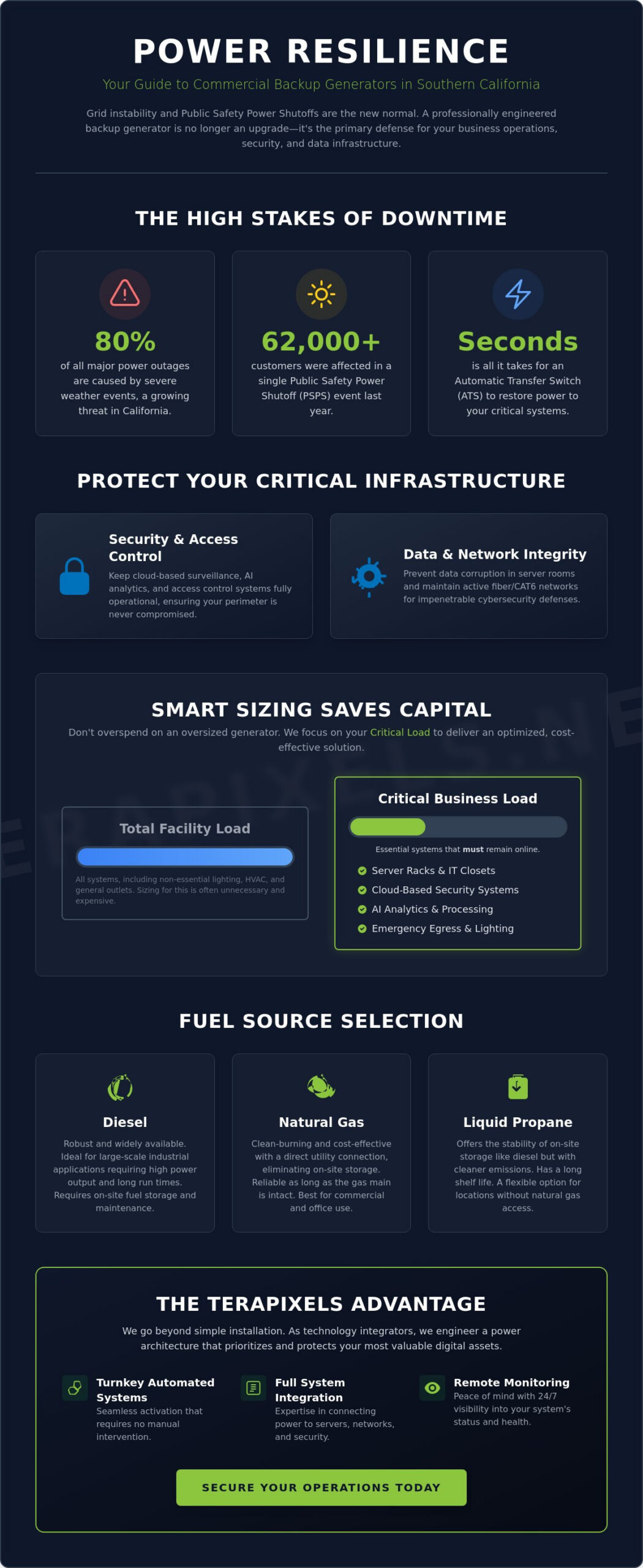
The energy landscape in Southern California has reached a critical inflection point. As of May 2026, the state continues to grapple with grid instability caused by extreme heat and the persistent threat of wildfires. For a modern enterprise, power is the lifeblood of every digital and physical operation. A single hour of downtime can cost a data-driven business thousands in lost productivity, compromised data, and interrupted security protocols. Relying on the grid without a secondary plan is a reactive approach that leaves your assets vulnerable to Public Safety Power Shutoffs (PSPS); these events, often necessitated by the vegetation hazards managed by professionals like CDA TREE AND UTILITY, affected over 62,000 customers in a single event last year. A professionally engineered backup generator installation for business transforms your facility from a vulnerable endpoint into a resilient, self-sustaining hub.
Beyond immediate revenue loss, business owners must consider the long-term impact on liability and insurance standing. Many commercial insurance providers now look favorably upon facilities that implement robust continuity plans, often seeing them as lower-risk investments. By integrating a permanent power solution, you move from a state of reactive recovery to proactive stability. To understand the technical foundation of these systems, it helps to review What is a Standby Generator? and how it differs from portable units. These fixed systems are designed to sense a power failure and respond instantly, ensuring your operations never miss a beat.
Protecting Critical IT and Security Infrastructure
Modern security relies heavily on connectivity. Your cloud-based surveillance systems and access control readers require 99.9% uptime to remain effective. If the power drops, your facility’s “eyes” go dark and your “locks” may default to a state that compromises your perimeter. An Automatic Transfer Switch (ATS) is the brain of this integration; it detects the voltage drop and signals the generator to start, usually within seconds. This seamless transition prevents data corruption in server rooms and keeps your fiber and CAT6 cabling networks active, ensuring your cybersecurity defenses remain impenetrable even when the neighborhood is in a blackout.
Industry-Specific Power Requirements
Different sectors face unique risks during a failure. In healthcare and life sciences, a generator is mandatory to protect sensitive laboratory equipment and expensive cold storage units where a two-degree temperature shift can ruin years of research. For industrial and warehousing operations, backup power keeps automated logistics and AI analytics online, preventing the massive bottlenecks that occur when sorting systems freeze. Even in corporate offices, maintaining Remote Monitoring Management (RMM) is essential so your IT team can continue to protect the network from off-site locations. A specialized backup generator installation for business ensures these specific needs are met with precision and reliability.
Sizing and Selecting Your Commercial Standby Generator
Selecting the correct equipment requires a precise understanding of your facility’s electrical demands. A common mistake is simply matching the utility service size, which often leads to over-spending on an oversized unit. Instead, we focus on differentiating between your “Critical Load” and “Total Load.” Your critical load includes essential systems like AI analytics, cloud-based access control, and server racks. By prioritizing these, you can optimize for cost while ensuring your primary business functions never falter. It’s a methodical approach that balances immediate safety with long-term financial prudence.
Industrial facilities often require three-phase power to handle heavy machinery and large motor loads. Single-phase systems are generally reserved for smaller office environments. Beyond the electrical specs, Southern California businesses must also consider acoustic enclosures. Local noise ordinances in San Diego and Orange County are strict; selecting an enclosure that dampens the decibel levels of a running engine is vital for staying compliant with your neighbors and local code. These enclosures also protect the unit from environmental factors like salt air in coastal regions.
Load Calculation and Sizing Metrics
The most accurate way to begin a backup generator installation for business is by analyzing your peak demand history. This data shows the highest amount of electricity your building has consumed at any single point over the last year. However, sizing isn’t just about the average draw. You must account for “Inrush Current,” which is the massive surge of power required to start large HVAC units or industrial motors. If your generator isn’t sized to handle this initial spike, the system may stall just when you need it most. We also recommend sizing for roughly 20% more than your current peak to allow for future facility expansions or additional high-draw hardware like EV chargers.
Fuel Source Pros and Cons for Businesses
Fuel selection is a strategic decision based on your location and operational goals. Diesel remains the gold standard for reliability because the fuel is stored on-site, making you completely independent of external utilities. However, diesel engines are subject to strict emissions monitoring by the California Air Resources Board (CARB). Natural gas units provide an almost infinite run-time through utility lines, though these lines can be vulnerable during seismic events. For organizations with strict ESG goals, bi-fuel options or renewable-integrated systems are becoming increasingly popular. Regardless of the fuel type, all installations must adhere to the NFPA 110 standard to ensure safety and performance. If you’re unsure which configuration fits your site, our team provides expert Generator Installation & Maintenance to help you make an informed choice.
Engineering for Reliability: Integration with Security and Networks
Reliability in 2026 is defined by how effectively your background systems communicate during a crisis. A backup generator installation for business shouldn’t exist as an isolated piece of hardware. Instead, it serves as the heartbeat of a unified infrastructure where power, networking, and security are inextricably linked. When the grid fails, your AI Analytics and Cloud-Based Surveillance Systems must remain active to maintain the integrity of your perimeter. Without a professionally integrated power source, these high-tech defenses become dormant precisely when your facility is most vulnerable to external threats.
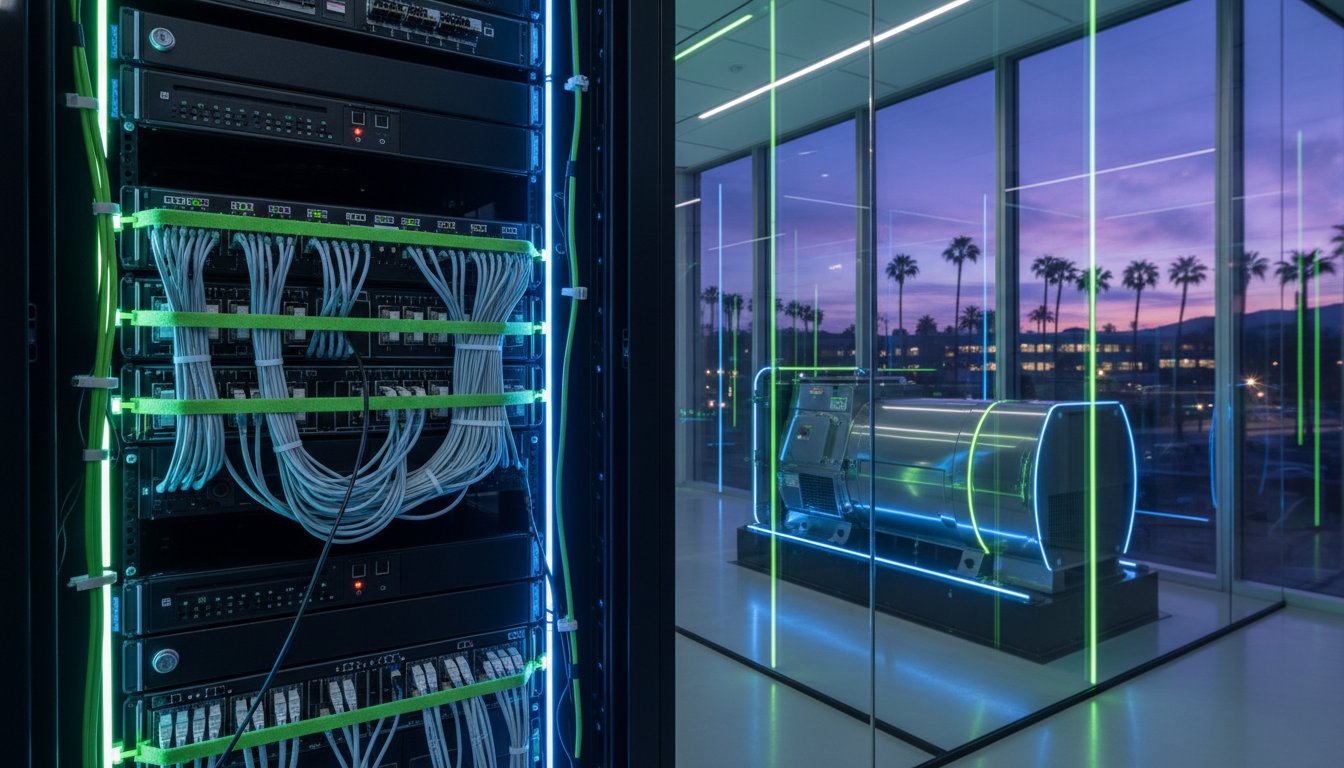
Hardening your digital environment also means protecting the physical pathways. Properly executed backup generator installation for business accounts for the delicate nature of fiber and CAT6 cabling. These networks are susceptible to power surges during the transition between utility power and standby power. A comprehensive installation includes transient voltage surge suppression to safeguard sensitive networking equipment. This ensures that when the Automatic Transfer Switch (ATS) engages, your data flow remains clean and uninterrupted. It’s about creating a seamless bridge that protects both your hardware and your data integrity. For facilities undergoing expansion or renovation, following a thorough network cabling for new office build-out plan ensures your structured cabling infrastructure is designed to withstand these power transitions from day one. Pairing this power resilience with a robust network security for small business strategy ensures your digital defenses remain fully operational even during extended grid outages.
Smart Power: IoT and Remote Monitoring
Modern systems utilize Remote Monitoring Management (RMM) to provide real-time visibility into engine health. You can track fuel levels, battery voltage, and coolant temperatures from a centralized dashboard. These systems also perform automated exercise cycles, generating digital logs that simplify compliance with local fire and safety regulations. Proactive alerts notify facility managers via mobile apps if a system requires attention, preventing a small maintenance issue from becoming a failure during a blackout. This level of transparency ensures that you’re never guessing about the readiness of your emergency power.
The Synergy of Solar, Storage, and Generators
Many Southern California firms are now adopting a tri-layered approach to energy resilience. By combining Commercial Solar with battery storage and a standby generator, you create a robust microgrid. Solar arrays offset daytime operational costs and reduce the runtime of the generator, which extends the equipment’s lifespan and lowers emissions. Managing the transition between these three sources requires a sophisticated control layer. This ensures that sensitive electronics, such as your Cloud-Based Access Control, don’t experience even a millisecond of power loss during the handoff between energy sources.
The Installation Lifecycle: From Permitting to Commissioning
A successful backup generator installation for business begins long before the equipment arrives on a flatbed. It starts with a comprehensive site survey that evaluates soil stability and clearance requirements. In Southern California, we must account for specific environmental factors like seismic activity and proximity to property lines. Our engineers inspect existing gas line capacities and electrical panels to identify necessary upgrades. To avoid complications with other underground utilities, firms often consult with San Diego Drain Guys to perform a thorough sewer line inspection before any heavy machinery arrives on-site. This methodical preparation ensures the physical installation proceeds without technical bottlenecks or unexpected structural failures during the construction phase.
Navigating the regulatory maze is often the most complex phase of a project. In regions governed by the South Coast Air Quality Management District (SCAQMD), businesses must comply with Rule 1470. This governs stationary diesel engines and requires adherence to strict CARB and EPA standards. With the transition toward Tier 5 emissions standards being finalized following the February 2026 CARB workshops, ensuring your equipment meets Level 3 Plus Diesel Particulate Filter (DPF) requirements is essential for legal operation. We manage the acquisition of the “Permit to Construct,” which is a mandatory prerequisite before any ground is broken at your facility.
Navigating Local Southern California Regulations
Compliance varies significantly between San Diego and Orange County. San Diego County enforces specific noise ordinances and setback requirements that dictate exactly where a unit can be placed on your lot. In Orange County, the focus shifts heavily toward emissions and air quality permits. You must secure approval from Building, Electrical, and Fire departments simultaneously. Our team coordinates these disparate threads, ensuring your project meets the 2025 edition of NFPA 110 standards, which remain the effective benchmark for 2026 operations.
The Physical Installation Process
The physical build begins with concrete pad engineering. Given that much of Southern California sits in Seismic Zone 4, the pad must be designed to withstand significant ground movement to prevent the generator from shifting or shearing its connections. Following the structural work, we handle the electrical integration, which involves trenching for conduit and wiring sub-panels into your existing infrastructure. The final step is commissioning, highlighted by the “Black Start” test. This real-world simulation forces a total power failure to verify the system activates and assumes the load within the required timeframe. To ensure your facility meets these rigorous standards, contact us for professional Generator Installation & Maintenance services tailored to your specific site.
The Terapixels Advantage: Comprehensive Power Integration
Choosing Terapixels Systems means partnering with a team that views power as a foundational element of your digital security. While a general electrician can handle basic wiring, a technology integrator ensures that your backup generator installation for business is fully synchronized with your Cloud-Based Access Control and AI Analytics. We don’t just install an engine; we design a resilient environment where your Cyber Security and Structural Cabling remain protected during the most volatile grid events. This unified approach eliminates the gaps that often occur when power systems and data networks are treated as separate entities. Businesses that also invest in comprehensive network security for small business gain an additional layer of protection, ensuring that restored power doesn’t expose vulnerable systems to cyberattacks during a recovery event.
Our deep roots in San Diego and Orange County commercial facilities allow us to anticipate regional challenges before they arise. We move beyond the transactional nature of hardware sales to provide a steady hand in managing your background systems. This partnership mindset ensures your technology infrastructure evolves alongside your business objectives, providing a reliable architecture for long-term growth. By acting as a singular source of truth for both your security and power needs, we simplify the management of complex systems so you can focus on your core operations.
Custom Maintenance and Load Bank Testing
Maintenance is the difference between a system that exists and a system that performs. Annual load bank testing is a critical component of our service, as it prevents “wet stacking” by burning off unburnt fuel and carbon deposits that accumulate during light-load exercises. Our 52-point inspection checklist covers everything from battery health to fuel quality, strictly adhering to the NFPA 110 requirements for annual fuel testing and monthly load tests. Managed service clients also benefit from priority emergency response, ensuring that your facility remains a priority during regional outages.
Getting Started with a Power Audit
The process begins with a detailed facility walkthrough where we evaluate your current infrastructure and identify critical load priorities. For organizations with multi-site portfolios, we develop a phased implementation plan that standardizes power resilience across every location. This structured approach ensures that your investment is both scalable and precise, avoiding the pitfalls of a one-size-fits-all solution. Schedule your commercial power and security audit today to begin designing a unified continuity strategy for your enterprise.
Building a Resilient Future for Your Commercial Operations
Achieving true operational continuity requires moving beyond simple hardware procurement. It demands a strategic alignment between your facility’s electrical demands, local regulatory mandates, and your critical digital infrastructure. By prioritizing load optimization and ensuring compliance with the latest Southern California AQMD and building codes, you protect your enterprise from the financial and physical risks of an unstable grid. A professional backup generator installation for business is the final piece in a comprehensive security and networking architecture, ensuring your AI analytics and cloud-based systems remain active when they are needed most.
Terapixels Systems provides the localized expertise and technical precision required to navigate the complexities of San Diego and Orange County installations. We act as your long-term partner, managing the intricate balance of power integration so you can remain focused on growth. Our team is ready to help you design a unified solution that bridges the gap between emergency power and high-tech security. Secure Your Business Continuity with a Terapixels Power Solution today. Your facility’s stability is within reach, and we’re here to guide you through every step of the process.
Frequently Asked Questions
Do I need a permit for a commercial backup generator in San Diego?
Yes, you must obtain several permits before beginning a backup generator installation for business in San Diego. These typically include building, electrical, and mechanical permits from the City or County departments. Fees vary based on the total project valuation. We recommend verifying current local fee schedules as they often adjust annually to match administrative costs and regulatory updates.
What is the difference between an emergency generator and a standby generator?
An emergency generator is specifically designed and code-mandated to support life-safety systems like egress lighting and fire pumps. A standby generator provides broader power to maintain business operations and data integrity. While both activate automatically, emergency systems are subject to more stringent NFPA 110 compliance standards regarding start-up times and fuel storage requirements.
How often should a commercial generator be tested and maintained?
You should perform a load test for at least 30 minutes every month to ensure system readiness. The 2025 edition of NFPA 110 also requires an annual fuel quality test to prevent engine failure. Regular inspections of battery health and coolant levels are essential components of a comprehensive maintenance program that keeps your background infrastructure reliable and compliant.
Can a backup generator power my entire office building or just critical systems?
You can choose to power either your entire facility or just specific critical systems based on your operational needs and budget. We typically analyze your peak demand history to determine if a full-building solution is necessary. Many firms opt to prioritize server rooms, cloud-based surveillance, and access control systems to maintain security while optimizing equipment costs and fuel consumption.
How long can a commercial generator run continuously during an outage?
A commercial generator can run as long as it has a continuous fuel supply and proper oil levels. Natural gas units can theoretically run indefinitely; however, diesel units are limited by the size of their on-site storage tanks. You should also consider that SCAQMD permits generally restrict non-emergency operating hours for testing and maintenance to between 20 and 50 hours per year.
What are the AQMD requirements for diesel generators in Southern California?
The South Coast Air Quality Management District (SCAQMD) enforces Rule 1470 for stationary diesel engines over 50 brake horsepower. These engines must meet specific CARB or EPA Tier standards to operate legally. Additionally, most stationary diesel engines are required to have Level 3 Plus Diesel Particulate Filters to reduce particulate matter by at least 85 percent as of 2026.
How much does it cost to install a backup generator for a small business?
The cost of a backup generator installation for business depends on several variables, including the kilowatt capacity, fuel source, and the complexity of your electrical panel. You should also account for the cost of the concrete pad, permit fees, and any necessary utility line extensions. We recommend requesting a site-specific audit to get an accurate assessment of the infrastructure requirements for your facility.
Will a backup generator protect my servers from power surges?
A backup generator provides power, but it doesn’t inherently protect your hardware from the transient surges that occur during the transfer of power. To safeguard your servers and networking equipment, you must integrate high-quality surge suppression and uninterruptible power supplies (UPS). These components work alongside your generator to ensure the electricity reaching your data racks is clean and stable.