 CONTACT US
Did you know that 43% of all cyberattacks now target small businesses? While large corporations often make the headlines, many hackers view smaller operations as high-value targets with fewer defenses. If you’ve felt the weight of confusing technical requirements or the constant fear of a data breach, you aren’t alone. It’s frustrating when unreliable Wi-Fi affects your team’s productivity or when managing remote employees feels like a security gamble. Establishing robust network security for small business is no longer a luxury; it’s a fundamental requirement for survival.
This guide provides a clear roadmap for total protection by integrating high-quality physical infrastructure with advanced digital defenses. You’ll discover how to shield your operations from evolving threats while maintaining essential regulatory compliance like SOC2 or HIPAA. We will walk through the critical components of a reliable architecture, from fiber and CAT6 cabling to cloud-based access control and proactive remote monitoring management. This comprehensive approach ensures your business remains resilient, allowing you to focus on your core objectives with complete confidence.
Key Takeaways
- Understand why modern network security for small business requires a multi-layered strategy that integrates physical infrastructure with advanced digital monitoring.
- Identify how high-performance structural cabling, including fiber and CAT6, serves as the critical backbone for secure and high-speed data transmission.
- Learn the difference between basic hardware and next-generation defenses, including the proactive role of Remote Monitoring Management (RMM).
- Gain a structured implementation roadmap to help prioritize critical security fixes and plan for long-term technological growth.
- Discover the operational advantages of partnering with a single expert for integrated cabling, surveillance, and cybersecurity needs.
Why Small Business Network Security is No Longer Optional in 2026
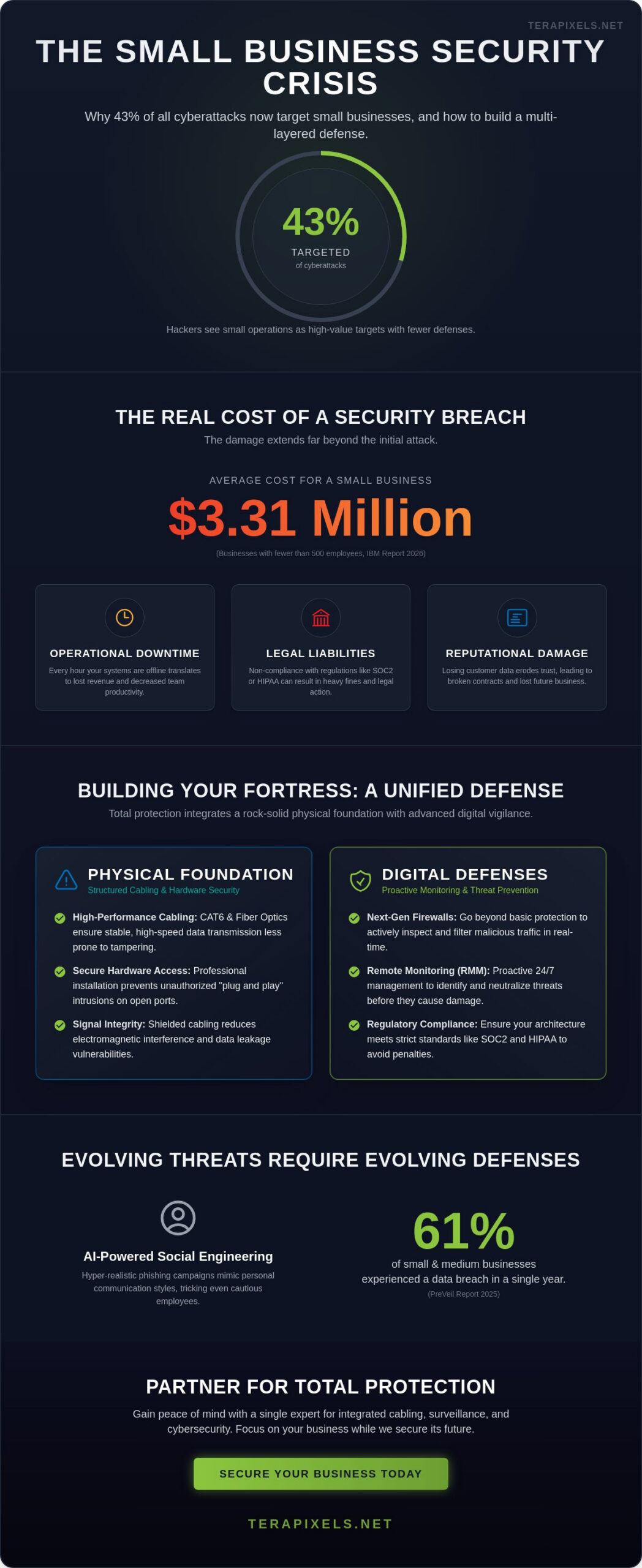
The year 2026 has brought a definitive shift in how commercial entities protect their assets. For many years, small organizations operated under the assumption that they were too small to be noticed by major cyber threats. That era of obscurity has officially ended. Today, network security is viewed as a multi-layered defense strategy that bridges the gap between physical infrastructure and digital vigilance. According to data from Verizon and Cybersecurity Magazine as of May 2026, 43% of all cyberattacks now target small businesses. This is no longer a matter of “if” an incident will occur, but “when” it will happen.
Implementing effective network security for small business is about more than just installing software. It’s about building a reliable architecture that protects your brand’s reputation. When a breach occurs, it doesn’t just halt operations; it erodes the trust you’ve spent years building with your clients. In a competitive market like Southern California, maintaining that trust is essential for long-term growth. Clients want to know that their partners are proactive architects of their own safety, not just reactive bystanders.
The Real Cost of a Security Breach
The financial damage of a breach extends far beyond immediate theft. IBM reported in May 2026 that the average cost of a data breach for a business with fewer than 500 employees has reached $3.31 million. This staggering figure reflects a variety of compounding factors that can cripple an unprepared company:
- Operational Downtime: Every hour your systems are offline represents lost revenue and decreased employee productivity.
- Legal Liabilities: Non-compliance with standards like SOC2 or HIPAA can result in heavy regulatory fines.
- Reputational Damage: Losing customer data often leads to broken contracts and a permanent loss of future business opportunities.
Evolving Threats: AI and Social Engineering
Modern threats have become significantly more sophisticated through the use of artificial intelligence. AI-generated phishing campaigns now show much higher success rates because they can mimic personal communication styles with startling accuracy. These attacks often target local employees who may not be trained to spot advanced social engineering tactics. Additionally, the rise of ransomware-as-a-service has made it easier for criminals to launch devastating attacks on the commercial sector. PreVeil reported in 2025 that 61% of small and medium-sized businesses experienced a data breach within a single year. To better understand the implications of this new era of AI-driven threats, the analysis at cyberone.security explores whether businesses are prepared for the next wave of technological disruption. Relying on being “under the radar” is a dangerous gamble. True protection requires a comprehensive approach that treats your network as a unified, secure ecosystem.
The Physical Foundation: Structured Cabling and Hardware Security
Most discussions regarding digital defense focus entirely on firewalls and antivirus software. However, the integrity of your network security for small business is fundamentally tied to its physical infrastructure. If your cabling is disorganized or your hardware is easily accessible to unauthorized individuals, your digital defenses can be bypassed in seconds. A reliable architect understands that a secure system starts with a professional installation of structural cabling. This physical layer acts as the primary conduit for every piece of data your company generates, making its stability and security paramount.
High quality CAT6 and fiber optic cabling do more than just provide speed; they ensure stable data transmission that is less susceptible to interference or physical tampering. Poorly managed wiring isn’t just an aesthetic issue. It’s a security risk. It makes it nearly impossible to identify unauthorized “plug and play” intrusions where an attacker might physically connect a rogue device to an open port. The Federal Trade Commission emphasizes the importance of securing physical assets in their guide on Cybersecurity for Small Business. Protecting the hardware that runs your network is the first step in a comprehensive defense strategy.
Structured Cabling as a Security Asset
Professional cabling reduces electromagnetic interference and signal leakage, which are subtle but real vulnerabilities. By using shielded CAT6 or fiber optics, you ensure that sensitive data stays within the wire. Organized cable management also simplifies troubleshooting. When every connection is labeled and mapped, your team can quickly spot anomalies or unauthorized changes. This level of organization future proofs your office for advanced security hardware that requires high bandwidth, stable connections. If you are planning a new workspace, following a structured network cabling checklist for your new office build-out ensures your infrastructure is scalable, secure, and compliant from day one. For commercial properties requiring a more comprehensive approach, a professional CAT6 cabling installation for commercial buildings provides the certified, high-speed backbone needed to support modern AI-driven security systems and Wi-Fi 7 environments.
Integrating Physical Access Control
Securing the server closet is just as vital as updating your password policy. Utilizing cloud-based access control allows you to restrict entry to sensitive IT areas to only authorized personnel. You can link these systems with cloud-based surveillance systems to capture visual evidence of every entry attempt. This creates a digital audit trail, ensuring you know exactly who accessed the hardware and when. Integrating these physical layers with your broader security strategy creates a comprehensive shield that software alone cannot provide. Much like a whole house water filtration system is used to protect a building’s entire infrastructure from hidden contaminants, a structured physical foundation transforms your network from a vulnerable collection of devices into a fortified business asset.
Essential Digital Defense Layers: From Firewalls to RMM
Once the physical foundation is solid, the digital layers must be meticulously architected to withstand modern pressure. A basic router with factory settings isn’t enough for robust network security for small business in 2026. Next-Generation Firewalls (NGFW) provide deep packet inspection and integrated intrusion prevention that standard consumer hardware lacks. These systems act as a sophisticated filter, identifying and blocking malicious traffic before it ever touches your internal servers. This level of protection is a baseline requirement for any commercial entity handling sensitive client data.
Data encryption and Multi-Factor Authentication (MFA) are equally vital components of a secure ecosystem. Since 95% of cybersecurity incidents are attributed to human error according to BDEmerson as of May 2026, MFA serves as a critical safety net. It ensures that even if a password is compromised, the account remains protected. The FCC provides a helpful framework in their 10 Cyber Security Tips for Small Business, which emphasizes the need for securing Wi-Fi networks and establishing clear mobile device policies. Adopting these standards creates a culture of security that protects both the business and its employees.
The Power of Remote Monitoring (RMM)
Remote Monitoring Management acts as a 24/7 digital sentry for your entire operation. Instead of waiting for a system to fail, RMM allows for proactive threat detection and automated patch management. Software and firmware updates are deployed instantly, closing vulnerabilities before hackers can exploit them. This methodical approach to maintenance prevents hardware-related downtime and ensures your systems are always running on the latest security protocols, such as WPA3 for wireless connections. It’s a partnership between technology and oversight that keeps your business operational without constant manual intervention.
Endpoint Security and Mobile Management
Securing the “Work from Home” bridge is a major priority for modern commercial sectors. Local employees often access sensitive data from various locations, making endpoint security a necessity. Managing personal devices on the corporate network (BYOD) requires strict protocols to prevent cross-contamination from unmanaged hardware. Automated backups are your ultimate insurance policy against ransomware. With 88% of small business data breaches involving ransomware according to the 2025 Verizon DBIR, having a reliable, off-site backup ensures business continuity even in a worst-case scenario. It’s about creating a resilient ecosystem where every device is a secured part of the whole.
A Practical Implementation Roadmap for SoCal Businesses
For businesses operating in the San Diego and Orange County commercial sectors, the path to resilience is methodical. It requires moving beyond quick fixes and adopting a structured approach to network security for small business. This roadmap focuses on establishing a baseline of protection that grows with your organization, ensuring that technical investments align with operational goals. By following a phased plan, you can address immediate vulnerabilities while building a foundation for long term stability.
Planning your budget is a critical part of this process. Industry standards as of May 2026 suggest that businesses should allocate between 7% and 12% of their annual IT budget specifically to cybersecurity. This investment ensures that your defenses keep pace with evolving threats without overextending your resources. Partnering with a local specialist for a professional network security audit is the most effective way to identify hidden vulnerabilities before they are exploited by bad actors.
Step 1: The Comprehensive Security Audit
The first phase involves a deep dive into your existing infrastructure to identify “shadow IT” or unauthorized devices that have bypassed your current controls. This audit includes testing the physical integrity of your CAT6 or fiber cabling and identifying Wi-Fi dead zones that might tempt employees to use insecure workarounds. Evaluating current access permissions is also vital; you must ensure that staff members only have access to the data necessary for their specific roles. This prevents internal errors from turning into widespread system compromises.
Step 2: Hardening the Perimeter
Once the audit is complete, the focus shifts to hardware. Installing managed switches and commercial grade routers allows for greater control over data flow. A key tactic is segmenting your network, which keeps guest Wi-Fi traffic entirely separate from internal business data. This ensures that a visitor’s compromised device cannot bridge over to your sensitive servers. Additionally, your systems should be configured for the WPA3 security standard, which has been a requirement for certified devices since July 2020. Setting up automated alerts for unusual network traffic provides the early warning needed to stop intrusions in their tracks.
Step 3: Policy and Culture
The final layer of defense is your team. Since human error remains a factor in 95% of security incidents, creating a “human firewall” is essential. This starts with a clear Acceptable Use Policy that outlines how employees should interact with company technology. Local businesses, especially those in the government supply chain, should be mindful of the CMMC Phase 1 deadline on November 9, 2026. Conducting quarterly phishing simulations and establishing a relationship with a local partner for emergency tech support ensures that your staff is prepared for any scenario. This proactive culture transforms security from a technical chore into a shared business value.
Partnering for Protection: The Terapixels Systems Advantage
Managing complex background systems shouldn’t distract you from your primary business objectives. Achieving total network security for small business requires a partner who understands that digital defense is inseparable from physical infrastructure. Terapixels Systems operates as a reliable architect, providing a single point of contact for everything from fiber and CAT6 cabling to advanced cyber security and remote monitoring management. This integrated approach ensures that every component of your system is designed to work in harmony, creating a stable environment where your technology supports your growth instead of hindering it.
Choosing a localized guide in San Diego and Orange County offers distinct advantages for Southern California commercial sectors. We understand the specific regulatory environment and the unique operational challenges faced by businesses in this region. Unlike “one-size-fits-all” retail solutions that offer generic hardware and minimal support, we design custom-built architectures tailored to your specific facility and workforce needs. This level of customization ensures business continuity by eliminating the weak points often found in fragmented, off-the-shelf systems.
Why a “Reliable Architect” Matters
A unified security strategy provides seamless integration between your cloud-based surveillance systems, access control, and internal IT network. When these systems are designed by a single expert, you reduce vendor friction and eliminate the gaps that often occur when multiple companies manage different parts of your infrastructure. This cohesion is vital for long-term scalability. As your firm grows, your structural cabling and digital defenses can expand without the need for costly, disruptive overhauls. You gain a steady hand to manage the technical complexities so you can focus on what you do best.
Next Steps for Your Security Strategy
Building a resilient business starts with an honest assessment of your current vulnerabilities. During a Terapixels consultation, we conduct a thorough review of your physical and digital assets to identify areas requiring immediate hardening. We look at your cabling integrity, your hardware configurations, and your remote access protocols to build a comprehensive map of your security posture. This methodical process provides the peace of mind that comes from knowing your business is shielded by professional-grade defenses.
Secure your business with a professional network audit today and take the first step toward a more stable and protected future.
Securing the Future of Your Commercial Enterprise
The evolution of cyber threats in 2026 requires a definitive shift from reactive fixes to a unified defense strategy. By integrating robust physical foundations like CAT6 cabling with proactive digital oversight, you build a resilient ecosystem that protects your reputation and your bottom line. Effective network security for small business is no longer just about software; it’s about a reliable architecture that scales with your specific goals. This comprehensive approach ensures that your infrastructure remains a stable asset rather than a liability.
As local experts in San Diego and Orange County, Terapixels Systems specializes in bridging the gap between structural cabling and remote monitoring management. We help you navigate complex requirements while ensuring your systems remain secure and efficient. Our team is dedicated to providing the stability you need to focus on your core operations without the constant distraction of technical vulnerabilities. Moving forward with a clear plan allows you to grow your firm with total peace of mind.
Get a Comprehensive Network Security Assessment for Your Business and take control of your digital environment today. With the right architect by your side, you can build a foundation of long term reliability and success.
Frequently Asked Questions
What is the most common network security threat for small businesses in 2026?
AI-powered phishing and ransomware are currently the most prevalent threats facing commercial entities. These attacks use automated tools to create highly convincing messages that trick employees into revealing sensitive credentials or downloading malicious files. Because 88% of small business breaches involve ransomware according to the 2025 Verizon DBIR, having a robust defense strategy is critical to avoid catastrophic data loss.
Do I really need a professional to install my network cabling?
Yes, professional installation is necessary to ensure signal integrity and physical security. Improperly installed wiring can lead to electromagnetic interference or disorganized ports that allow unauthorized “plug and play” intrusions to go unnoticed. A reliable architect uses CAT6 cabling installation for commercial buildings to create a stable foundation that supports high-speed data and advanced security hardware.
How does Remote Monitoring Management (RMM) differ from traditional IT support?
RMM is a proactive, 24/7 digital oversight system, whereas traditional IT support is often a reactive model. Instead of waiting for a system failure to occur, RMM uses automated patch management to close vulnerabilities before they are exploited by hackers. This continuous monitoring prevents hardware downtime and ensures your software is always running the latest security protocols without manual intervention.
Can my existing security cameras be integrated into a new network security plan?
Many existing systems can be integrated if they meet current technical standards, though transitioning to cloud-based surveillance systems is often the most secure path for modern businesses. This integration allows your cameras to work in tandem with your network defenses, providing visual verification of digital alerts. It is a key part of creating a unified security ecosystem for your commercial property.
What are the specific cybersecurity requirements for businesses in California?
California businesses must comply with the California Consumer Privacy Act (CCPA) and the CPRA, which mandate strict protections for consumer data. Depending on your specific industry, you may also need to meet SOC2 or HIPAA standards to maintain regulatory compliance. Organizations in the government supply chain should also be mindful of the CMMC Phase 1 deadline on November 9, 2026.
How often should a small business perform a network security audit?
A comprehensive audit should be performed at least once per year or whenever you make significant changes to your hardware or staff. Regular assessments help identify “shadow IT” and ensure that your access permissions remain accurate. Routine testing is a vital part of maintaining effective network security for small business as digital threats continue to evolve.
Is cloud-based access control safer than traditional key systems?
Cloud-based access control is significantly more secure because it eliminates the risks associated with physical key duplication and loss. It provides a digital audit trail that shows exactly who entered a sensitive area, such as a server closet, and when. You can instantly revoke access for former employees, ensuring your offices remain protected without the need to change physical locks.
How can I protect my network if my employees work remotely?
Protecting a distributed workforce requires a combination of Multi-Factor Authentication (MFA) and managed endpoint security. By using secure bridges and encrypted connections, you can ensure that remote devices don’t become backdoors into your corporate network. Managing these endpoints through a centralized system allows you to maintain consistent security policies regardless of where your team is located.