CONTACT US

In 2026, your building’s physical infrastructure is no longer just a utility. It’s the critical nervous system that determines whether your AI-driven security and Wi-Fi 7 systems actually perform or simply stall under pressure. If you’ve ever dealt with the frustration of “spaghetti” cabling or unexpected downtime, you know that a disorganized network is a liability. A professional CAT6 cabling installation commercial project is the foundation for a stable, high-speed environment where technology works for you, not against you.
We understand that navigating the complexities of the 2026 National Electrical Code and specific plenum requirements in San Diego or Orange County can feel overwhelming. You want a network that’s certified, labeled, and ready to support the 46 Gbps potential of Wi-Fi 7 without constant troubleshooting. This guide provides the strategic roadmap you need to build a future-proof backbone. We’ll cover everything from local code compliance to the seamless integration of cloud-based surveillance and access control, ensuring your infrastructure remains a reliable asset for years to come.
Key Takeaways
- Understand why the 250 MHz frequency of CAT6 provides the necessary stability for data-heavy commercial environments.
- Learn how to distinguish between Plenum and Riser cables to ensure your infrastructure meets strict local fire safety codes.
- Discover the critical stages of a CAT6 cabling installation commercial project, from maintaining proper bend radius to professional termination.
- Prepare your facility for the high-bandwidth demands of Wi-Fi 7 and AI-driven surveillance systems through strategic architecture.
- Identify the difference between general electrical wiring and certified data cabling to ensure every drop meets rigorous performance standards.
Table of Contents
What is CAT6 Cabling and Why is it the 2026 Commercial Standard?
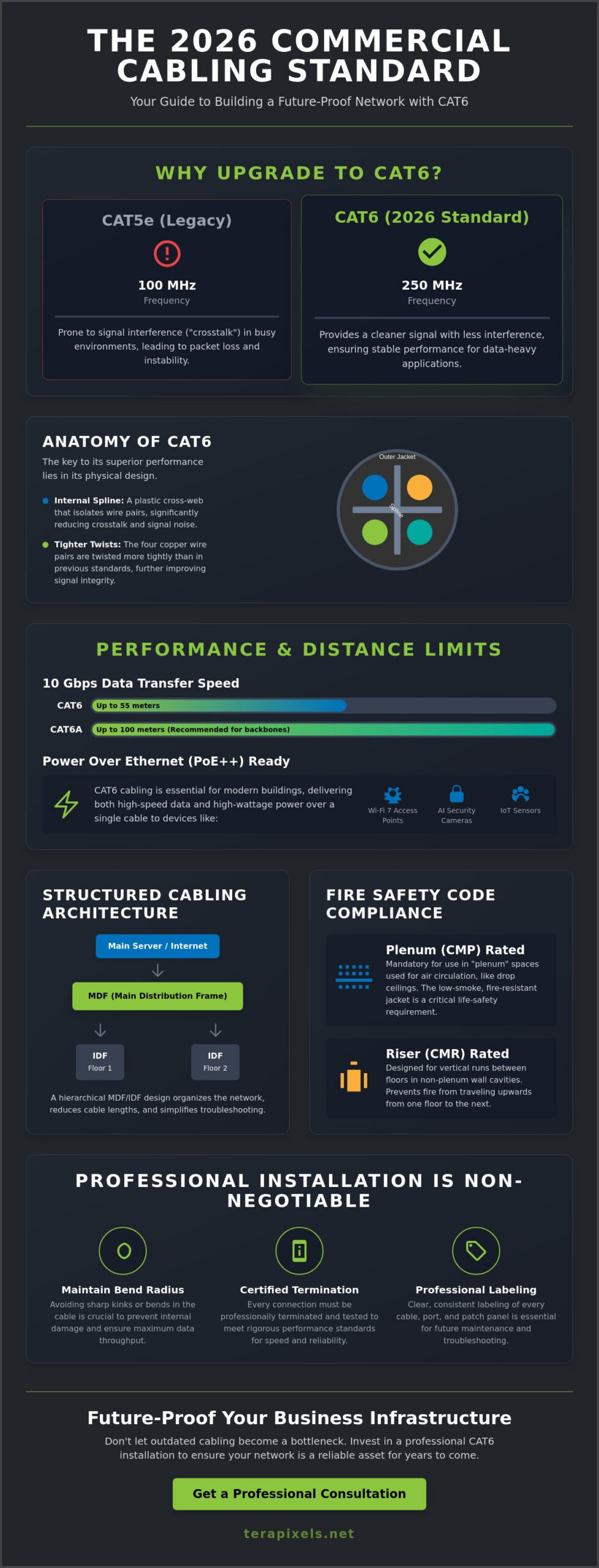
CAT6 is a standardized twisted pair cable designed for Ethernet networks, capable of supporting data transfer speeds up to 10 Gbps. While it’s often viewed as a simple wire, the Category 6 Cable Standard represents a significant leap in engineering from previous generations. It operates at a frequency of 250 MHz, which is more than double the 100 MHz found in CAT5e. In a busy commercial office, this increased frequency is vital. It provides a cleaner signal with less interference, ensuring that your data moves efficiently even when the environment is crowded with electronic noise from other devices.
One of the most important physical features of a professional CAT6 cabling installation commercial is the internal “spline.” This plastic cross-webbing separates the four pairs of copper wires inside the jacket. By keeping these pairs isolated, the cable significantly reduces near-end crosstalk (NEXT). This reduction in internal “chatter” is what allows for the reliable, high-speed performance that modern businesses require for their daily operations. It’s the difference between a network that merely functions and one that excels under heavy load.
Performance Metrics Every Business Owner Should Know
Understanding the difference between bandwidth and throughput is essential for planning your infrastructure. Bandwidth is the maximum theoretical capacity of the cable, while throughput is the actual amount of data successfully transmitted. In a business continuity context, high bandwidth ensures your network can handle spikes in traffic without slowing down. However, distance is a critical constraint. While CAT6 supports 10 Gbps, it can only do so over distances up to 55 meters. For longer runs, or for the primary backbones of your building, we often recommend stepping up to CAT6A to maintain those speeds over a full 100-meter range. Additionally, 2026 standards prioritize compatibility with Power over Ethernet (PoE++). This technology allows your cabling to deliver both data and high-wattage power to security sensors, advanced Wi-Fi 7 access points, and smart lighting systems.
CAT6 as the Foundation for Business Continuity
A high-quality cabling system prevents the intermittent packet loss that often disrupts VoIP calls and video conferencing. When cables are poorly installed or of low quality, these micro-interruptions can cause “frozen” screens and dropped audio, impacting your team’s productivity. Stable, certifiable cabling is also the prerequisite for effective Remote Monitoring Management. Without a solid physical layer, remote tools cannot accurately track the health of your network. Investing in professional-grade CAT6 cabling installation commercial services provides a long-term ROI by reducing the need for future repairs and ensuring your business stays connected to its critical cloud resources.
Planning Your Commercial Structured Cabling Architecture
A successful CAT6 cabling installation commercial project begins long before a single wire is pulled. It starts with a methodical site survey to map every data drop, Wi-Fi 7 access point location, and security zone. This blueprint ensures that your infrastructure supports the specific density of your workforce. We design these networks using a hierarchy of a Main Distribution Frame (MDF) and several Intermediate Distribution Frames (IDFs). The MDF acts as the central hub of the building, while IDFs serve specific floors or wings. This organized approach reduces cable lengths and simplifies future troubleshooting, ensuring your network remains manageable as your business scales.
In modern open-office environments, calculating drop density is more complex than it was a few years ago. We no longer just plan for one desktop per person. We must account for high-resolution video conferencing units, IoT sensors, and the high-bandwidth demands of multi-gigabit wireless backhaul. Designing a reliable structural cabling architecture requires a deep understanding of both these technical capacities and the physical constraints of your specific facility. If you’re new to these concepts, our guide on what is structured cabling provides a comprehensive foundation for understanding how a standardized cabling system transforms your facility into an integrated business asset.
Navigating Southern California Building Codes
Compliance with California Title 24 is a non-negotiable aspect of new commercial builds in San Diego and Orange County. These regulations often dictate how low-voltage cabling is integrated into the building’s energy and control systems. Fire safety is another critical pillar of your planning. We must distinguish between Plenum (CMP) and Riser (CMR) jackets. Plenum-rated cables are mandatory in spaces used for air circulation, such as drop ceilings, because they’re designed to produce less toxic smoke during a fire. In multi-tenant properties, professional fire-stopping at every wall penetration is essential to maintain the building’s safety integrity and pass local inspections.
Material Selection: Solid Copper vs. CCA
The integrity of your network depends heavily on the physical quality of the copper. We exclusively use solid copper rather than Copper Clad Aluminum (CCA). CCA is a brittle, cheaper alternative that frequently fails safety inspections and Power over Ethernet (PoE) tests. It has higher electrical resistance and is prone to internal fractures, which can lead to intermittent connectivity issues. Choosing the right jacket also depends on your environment. While standard Unshielded Twisted Pair (UTP) is sufficient for most office settings, industrial facilities with heavy machinery may require Shielded Twisted Pair (STP). This shielding protects your data from electromagnetic interference (EMI) that can cause significant packet loss and network lag.
Step-by-Step Guide to Commercial CAT6 Installation
The physical execution of a CAT6 cabling installation commercial project requires a blend of technical precision and organized labor. We break the process into four distinct stages to ensure every drop meets rigorous performance standards. The first stage, rough-in and cable pulling, is where the structural integrity of the network is established. It’s critical to maintain the proper bend radius, typically four times the cable diameter, to avoid internal fractures in the copper pairs. If a cable is pulled too tightly around a corner, the internal geometry of the twists is compromised. This leads to signal degradation that no software can fix later.
Stage two involves termination and patching. For in-wall runs, we always recommend keystone jacks over direct RJ45 crimping. Keystone jacks provide a stable, vibration-resistant connection point that protects the horizontal cabling from the wear and tear of daily use. Following termination, stage three focuses on testing and certification. We move beyond simple continuity tests that just check if the wires are connected. Instead, we perform full frequency certification to verify that each run can handle 250 MHz without excessive crosstalk. Finally, stage four is labeling and documentation. We create a logical mapping system and “as-built” diagrams that allow your IT team to identify any port in the building instantly.
Cable Pulling Best Practices for Commercial Teams
Using tension-controlled pullers is a standard practice to prevent stretching the internal copper. Stretching changes the twist rate of the pairs, which is the primary defense against electromagnetic interference. We also manage “service loops” at both ends of the run. We leave 10 feet of slack at the MDF and 12 inches at the drop. This extra length is a safeguard for future re-terminations or equipment moves. Above the ceiling grid, we utilize J-hooks and cable trays to keep the weight of the cable bundles from resting on the ceiling tiles. This maintains both structural integrity and fire code compliance.
Termination: The Art of the Punch-Down
Consistency is the most important factor when choosing between the T568A and T568B wiring standards. While neither is technically superior for CAT6, mixing them within the same facility will cause total link failure. To maintain high-speed performance, we keep pair twists within 0.5 inches of the termination point. Minimizing this untwisting is vital; even a small amount of exposed, untwisted wire can become a source of signal noise. We organize patch panels by floor or department, ensuring that data, voice, and CCTV runs are clearly segregated. This methodical approach ensures that your structural cabling remains an asset rather than a confusing web of wires.
Integrating Security, AI Analytics, and Wi-Fi 7
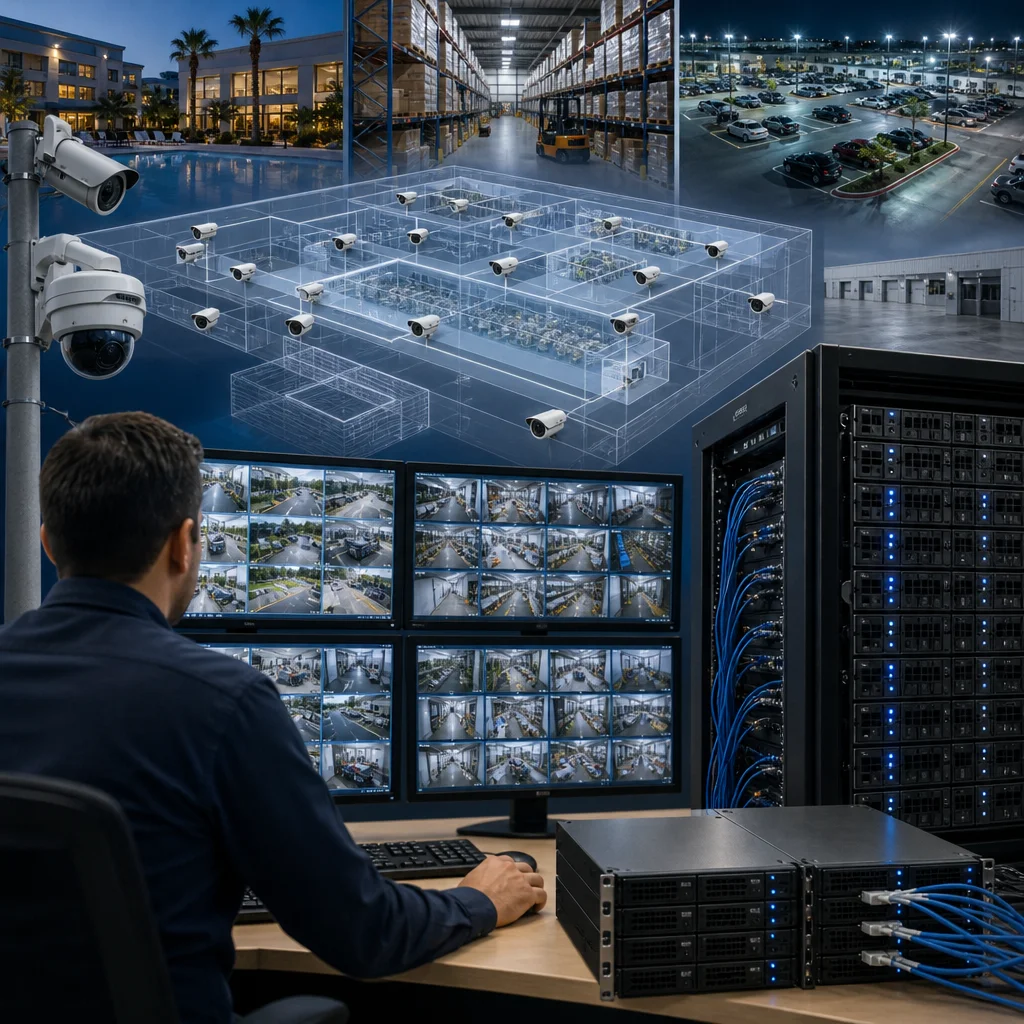
Modern business environments in 2026 require more than just a basic internet connection. A professional CAT6 cabling installation commercial project now serves as the high-speed conduit for AI-driven security systems and the latest wireless standards. To see how these complex systems are integrated, check out UTD Technology Corp. 4K security cameras utilizing real-time AI analytics generate a constant stream of high-definition data that must be processed instantly. To ensure these systems provide actionable intelligence without lag, the underlying infrastructure must be capable of sustained, high-bandwidth throughput. This physical foundation allows for the seamless operation of cloud-based surveillance and advanced threat detection software.
Wi-Fi 7 has arrived with a theoretical maximum throughput of up to 46 Gbps, which is nearly five times faster than Wi-Fi 6. To fully leverage this capacity, dual CAT6A drops are becoming the standard for enterprise-grade access points. This redundant wiring provides the necessary backhaul for Multi-Link Operation (MLO), allowing devices to transmit data across multiple bands simultaneously. We also carefully manage Power over Ethernet (PoE++) heat loads. As modern devices and security sensors demand more wattage, cable bundles can generate significant thermal energy. Our designs account for proper ventilation and bundle density to prevent signal degradation caused by heat buildup.
Backing Up Your Security Infrastructure
We recommend physically separating or color-coding security cabling to streamline troubleshooting and maintenance. This visual clarity allows your team to identify critical lines for cloud-based access control or CCTV systems instantly, reducing the time required for repairs. A well-designed cabling infrastructure also forms the backbone for a modern keycard access control system for business, providing the reliable data pathways needed for audit trails and remote management of your facility’s entry points. Reliability in these systems is also tied to power stability. A robust cabling plant works in tandem with Backup Generator Installation to ensure that your security perimeter remains active even during local grid failures. Real-time AI analytics depends entirely on a zero-packet-loss CAT6 infrastructure to process visual data without interruption.
Future-Proofing for the Next Decade
Zone cabling is a strategic choice for businesses that anticipate frequent office layout changes. By using consolidation points, we can reconfigure work areas without the need to re-pull entire backbones from the MDF. For larger commercial facilities, we often design hybrid paths that combine CAT6 for local drops with fiber optics for long-distance vertical runs. This multi-layered approach prepares your building for the full integration of smart building automation and centralized environmental controls. If you’re ready to upgrade your facility with an integrated security and data backbone, explore our Structural Cabling solutions today to ensure your network is prepared for the next generation of technology.
Choosing a Professional Structured Cabling Contractor in San Diego
Selecting the right partner for your CAT6 cabling installation commercial project is a decision that impacts your building’s operational efficiency for a decade. Many business owners mistakenly assume that any licensed electrician can handle high-speed data wiring. While electricians are experts at delivering power, data-grade structured cabling requires a different specialized skill set. It involves managing signal frequencies, minimizing crosstalk, and ensuring that the physical layer can support the multi-gigabit demands of 2026 technology. A data specialist understands that a single kink in the wire or an over-tightened zip tie can cripple a 10 Gbps link. Precision is the baseline for performance.
We believe that every installation should be backed by empirical data. This is why we prioritize Fluke Certification. Upon completion of your project, you should receive a comprehensive, printed report for every single drop in your building. This isn’t just a simple continuity check to see if the lights blink. It’s a full diagnostic of the cable’s performance across its entire frequency range. This documentation serves as the birth certificate for your network. It proves that your infrastructure meets or exceeds TIA/EIA standards and is ready for high-bandwidth applications like AI analytics and Wi-Fi 7.
Questions to Ask Your Cabling Partner
- Do you provide certified test results for every drop, or just a continuity check?
- Are you licensed and insured for commercial work in San Diego and Orange County?
- How do you handle ‘as-built’ drawings and documentation for the final handover?
The Terapixels Difference: Architecture Over Installation
At Terapixels Systems, we don’t just pull wire; we design integrated environments. We approach each project as a Reliable Architect, ensuring your CAT6 cabling installation commercial plan is built to support your broader business goals. From day one, we consider how your cabling will integrate with cloud-based surveillance and access control systems. This holistic view prevents the common siloed approach where different systems struggle to communicate. Our commitment to clean, organized server rooms and meticulous labeling means your IT team can manage the network with ease; this reduces future service costs and prevents unnecessary downtime.
Contact Terapixels Systems for a Professional Site Survey to begin building a stable, high-performance foundation for your business.
Building a Resilient Digital Foundation for Your Business
A robust network begins with the physical layer. By prioritizing a professional CAT6 cabling installation commercial project, you ensure that your facility is ready for the high-bandwidth demands of Wi-Fi 7 and real-time AI analytics. We have explored how methodical planning, adherence to Southern California fire codes, and precise termination techniques prevent the downtime that stalls growth. Your infrastructure shouldn’t just meet today’s needs; it should be an adaptable asset that supports your long-term vision and operational stability.
Terapixels Systems brings a partnership-driven approach to every build. We specialize in San Diego and Orange County commercial facilities, providing the integrated security and networking expertise required for modern operations. Every project we handle includes certified Fluke testing on every drop. This gives you the peace of mind that your backbone is stable, secure, and fully documented. We’re here to manage the technical complexities so you can focus on your core objectives without worrying about the background systems.
Schedule a Structured Cabling Consultation with Terapixels Systems today to secure your building’s future. We look forward to helping you build a network that lasts.
Frequently Asked Questions
Is CAT6 still relevant for commercial buildings in 2026?
CAT6 remains highly relevant because it provides the most cost-effective balance of speed and reliability for standard workstation drops. It handles 1 Gbps up to 100 meters, which covers the vast majority of office layouts. While 10 Gbps is possible over shorter distances, CAT6 is the reliable workhorse for standard business operations that don’t yet require the specialized overhead of CAT6A at every desk.
What is the difference between CAT6 and CAT6A for office use?
The primary difference lies in bandwidth and distance capacity for 10 Gbps speeds. CAT6 supports 10 Gbps only up to 55 meters, whereas CAT6A maintains that speed for the full 100-meter channel. For modern offices deploying Wi-Fi 7 or high-density server links, CAT6A is the preferred choice for the backbone. Standard CAT6 remains excellent for general data and voice applications where 1 Gbps is sufficient.
Do I need plenum-rated cable for my commercial ceiling?
You need plenum-rated (CMP) cable if your building uses the space above the ceiling or below the floor for air circulation. These areas, known as plenums, require cables with fire-retardant jackets that emit low smoke and no toxic fumes. If your office uses dedicated ductwork for HVAC, riser-rated (CMR) cable may be acceptable. We always verify local fire codes in San Diego and Orange County to ensure full compliance during a CAT6 cabling installation commercial project.
How much does a professional commercial CAT6 drop cost?
The investment for a CAT6 cabling installation commercial project varies based on the building’s architecture and the total number of data drops. Factors such as ceiling height, wall material, and the requirement for plenum-rated cabling will influence the final scope. We recommend a professional site survey to evaluate these variables and provide an accurate assessment that reflects your specific facility’s needs and compliance requirements.
Can CAT6 support my business security camera system?
CAT6 is an ideal choice for modern business security camera systems, including 4K units with AI analytics. It provides ample bandwidth for high-resolution video streams and fully supports Power over Ethernet (PoE) to power the cameras. This eliminates the need for separate electrical outlets at every camera location. It’s a stable foundation for cloud-based surveillance and integrated access control systems.
What happens if my cabling fails a certification test?
If a cable run fails a certification test, it indicates a physical or electrical issue that must be addressed before the network goes live. Common causes include exceeding the maximum bend radius, poor termination at the jack, or electromagnetic interference from nearby power lines. A professional contractor uses diagnostic tools to pinpoint the exact location of the fault, allowing for a precise repair that ensures every drop meets TIA/EIA standards.
How long does a typical commercial cabling installation take?
A typical installation timeline depends on the number of drops and the complexity of the building’s structure. A small office might be completed in a few days, while a multi-floor commercial complex could take several weeks. The process is divided into stages, including the site survey, rough-in, termination, and final certification. We coordinate these phases to minimize disruption to your daily business operations.
Should I install fiber instead of CAT6 for my office backbone?
Fiber optic cabling is superior for long-distance runs and building backbones, but CAT6 is usually the better choice for horizontal runs to individual devices. Fiber provides immunity to electromagnetic interference and supports much higher speeds over kilometers. However, the hardware required to terminate fiber at every desk is more expensive. Most modern commercial designs use fiber to connect IDFs to the MDF and CAT6 for the final connection to workstations.