CONTACT US
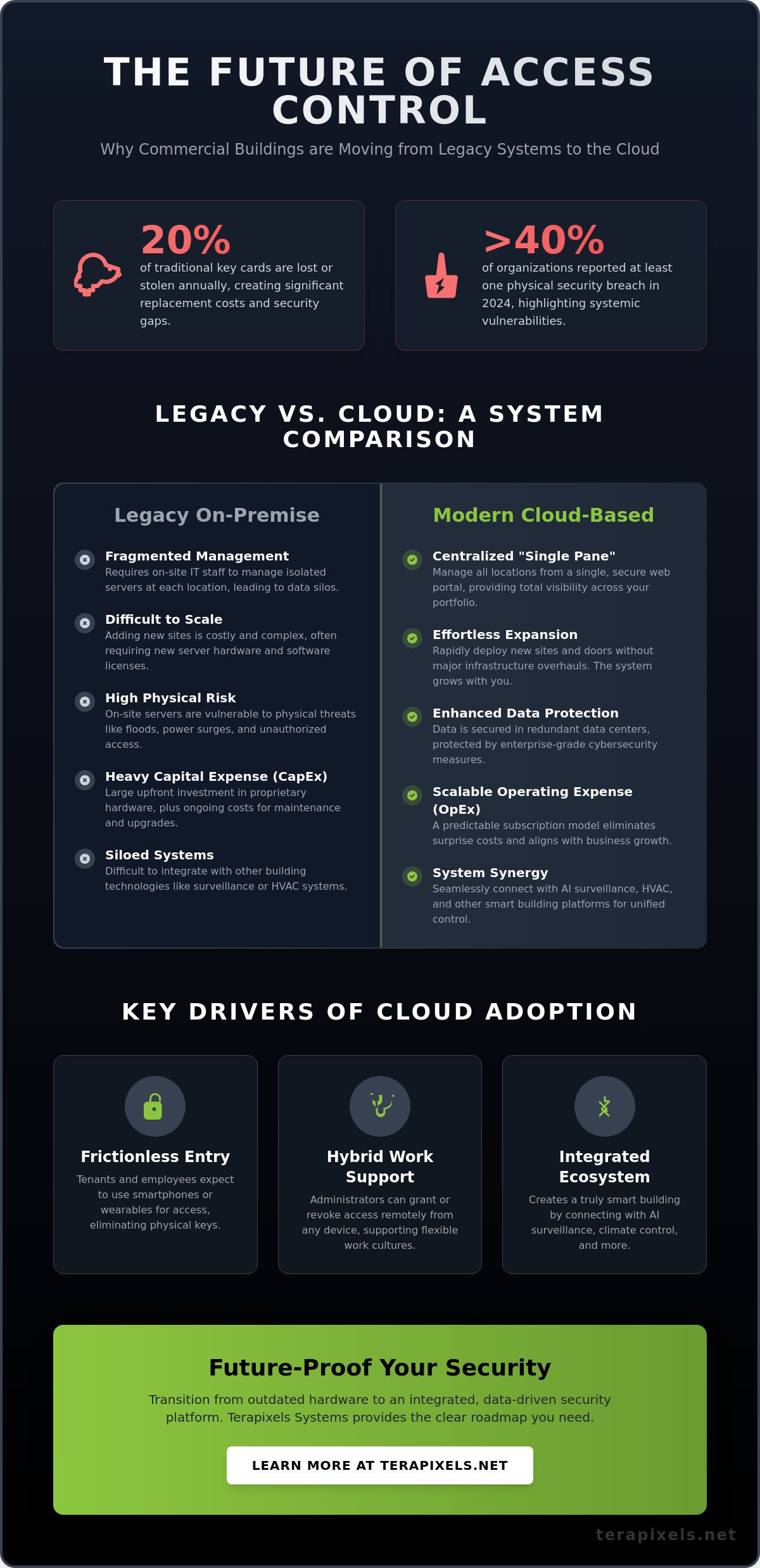
Did you know that 20% of traditional key cards are lost or stolen every year, while over 40% of organizations reported at least one physical security breach in 2024? These figures represent more than just data points; they reflect the daily frustrations of property managers who are tasked with securing their sites using outdated hardware and fragmented systems. Adopting cloud-based access control for commercial buildings is no longer just an optional upgrade; it’s a necessary step to eliminate the vulnerabilities inherent in legacy systems. You deserve a solution that provides total visibility across all your locations without adding to your technical burden.
This 2026 strategic guide demonstrates how modern technology transforms your security from a passive gatekeeper into an integrated, data-driven management system. We’ll examine the practical benefits of mobile credentialing, the impact of new standards like NIST CSF 2.0, and how to create a future-proof ecosystem that connects with your broader building tech. Our goal is to provide you with a clear roadmap for achieving centralized management and long-term operational stability. By moving your security to the cloud, you can focus on your core business goals while maintaining a steady hand over your physical infrastructure.
Key Takeaways
- Learn how to transition from siloed legacy hardware to a decentralized, software-defined security framework that enhances operational visibility.
- Understand the essential hardware and software components required to implement effective cloud-based access control for commercial buildings.
- Discover a framework for evaluating the total cost of ownership and why cloud systems offer faster deployment across multiple sites compared to on-premise servers.
- Identify the critical infrastructure requirements, such as high-bandwidth cabling, that ensure your cloud-native security remains reliable and responsive.
- Explore how a unified “single pane of glass” approach allows you to manage security and networking through a single, integrated platform.
Modernizing Physical Security: Why Commercial Buildings Are Moving to the Cloud
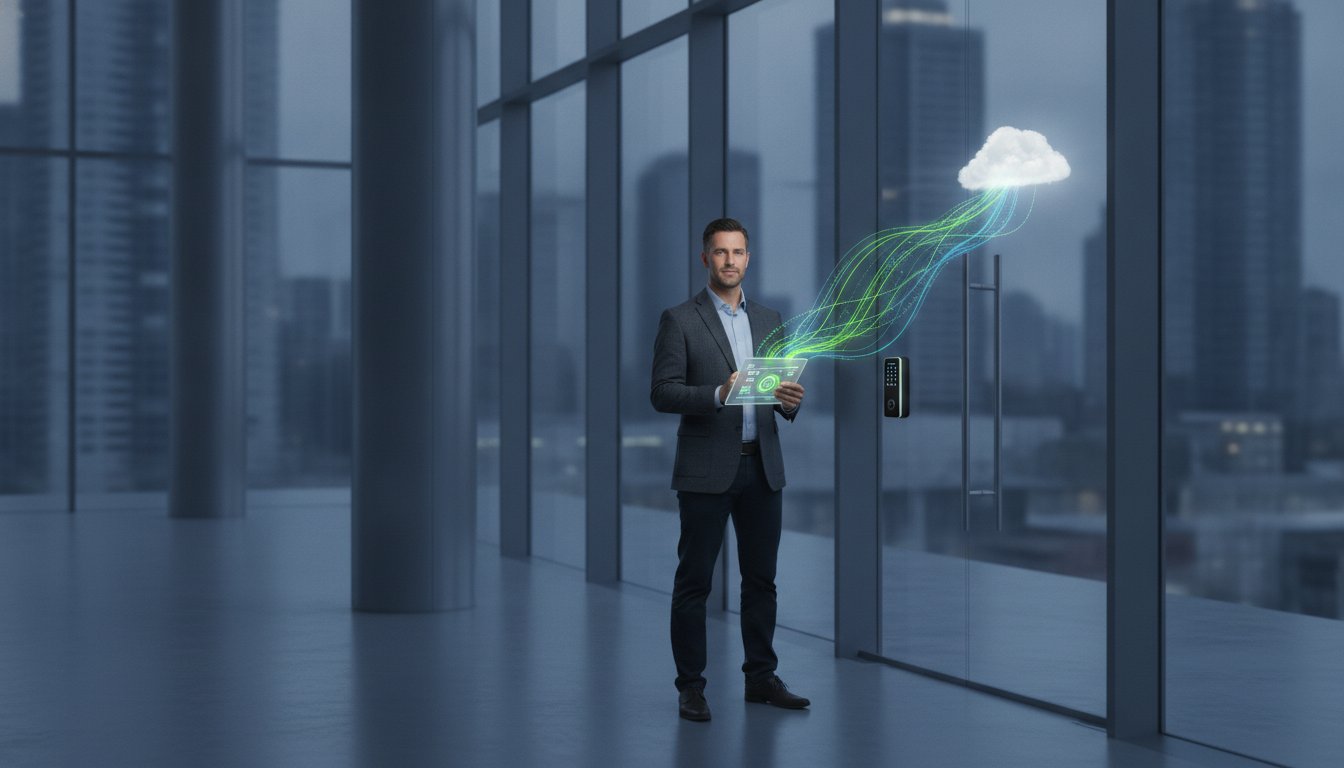
The security landscape for commercial properties has undergone a fundamental transformation. Cloud-based access control for commercial buildings is no longer defined by standalone hardware wired to a local server. Instead, it’s a decentralized, software-defined framework where intelligence lives at the edge and management happens in a secure, centralized portal. This shift moves security away from siloed systems that require manual updates at every door toward integrated platforms that communicate across your entire infrastructure.
In 2026, the industry has moved beyond reviewing logs after an incident occurs. Modern standards now prioritize real-time visibility and proactive threat detection. This transition also represents a significant financial pivot for many businesses, moving from heavy capital expenditure (CapEx) on proprietary hardware to a scalable operating expenditure (OpEx) model. By adhering to established cloud computing security principles, these systems provide a level of data protection and redundancy that local servers simply cannot match.
To better understand the shift toward modern keyless entry and real-time control, watch this helpful video:
The Limitations of Traditional On-Premise Systems
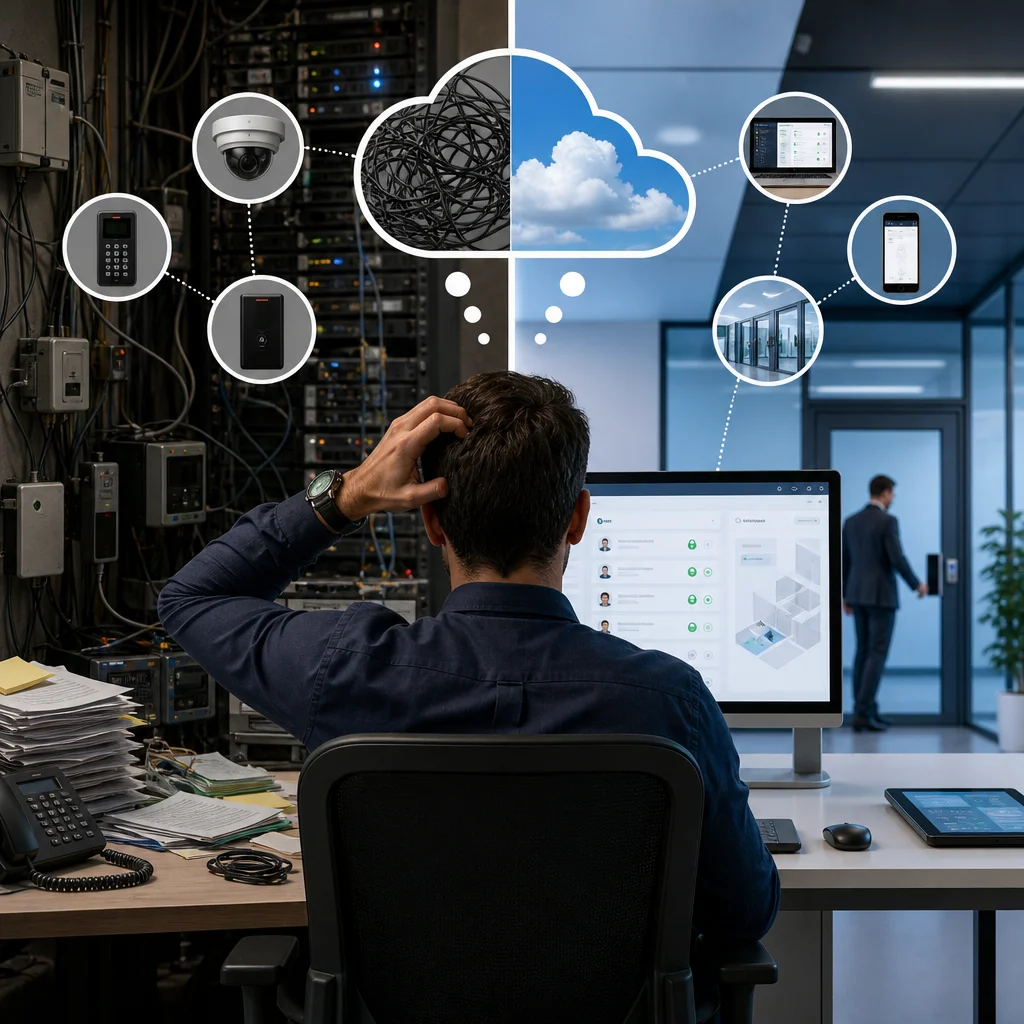
Maintaining local servers and proprietary software carries hidden burdens that often outweigh the initial purchase price. These systems require dedicated IT resources for patching, hardware refreshes, and physical security for the server room itself. If a site-specific disaster like a flood or power surge occurs, your entire security history and control mechanism could be compromised. Scaling these legacy setups across a national portfolio is notoriously difficult, as each location often ends up as an isolated island of data that doesn’t communicate with the head office. With the 2026 revision of the NIST Cybersecurity Framework (CSF 2.0), the focus has shifted toward governance and supply chain risk, making the security of your service provider just as vital as the physical lock on the door.
The Drivers of Cloud Adoption in 2026
- Frictionless Entry: Tenants and employees now expect to use smartphones or wearables for entry, eliminating the frustration of lost physical keys.
- Hybrid Work Support: With 2026 work cultures favoring flexibility, administrators need the ability to grant or revoke access remotely from any device.
- System Synergy: Modern cloud platforms allow for seamless integration with AI-driven surveillance and HVAC systems, creating a truly smart building environment.
By integrating cloud-based access control for commercial buildings, you ensure that your security system grows with your business rather than becoming a bottleneck. It’s about building a foundation of reliability that supports both your tenants’ needs and your long-term operational goals. This approach allows you to focus on your core objectives while we manage the complex background systems that keep your facility safe.
The Architecture of Cloud-Based Access Control Systems
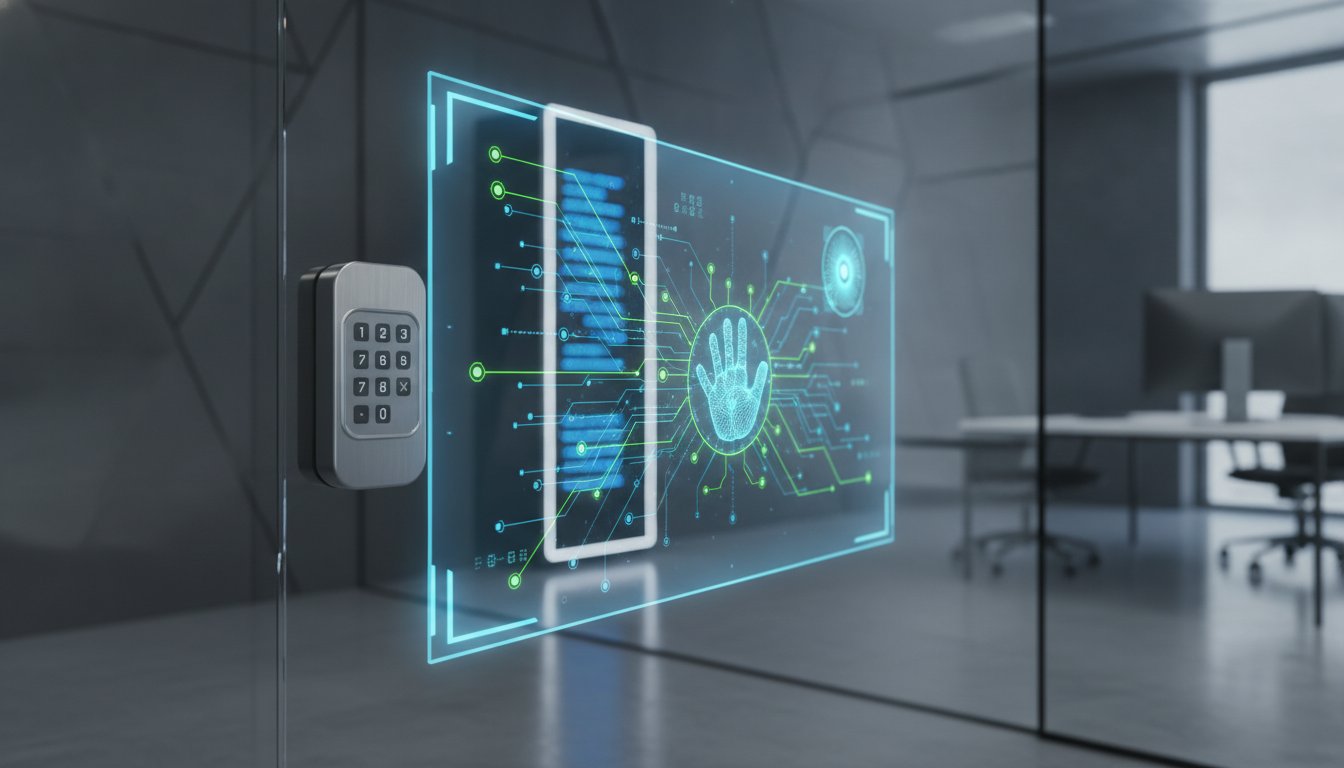
The effectiveness of cloud-based access control for commercial buildings relies on a sophisticated handshake between physical hardware and digital intelligence. This architecture is composed of three distinct layers: the hardware layer at the door, the encrypted communication protocol, and the cloud management software. At the door, smart readers interact with mobile credentials or biometric data, sending signals to intelligent edge controllers. These controllers act as the local brain of the system, managing the electronic locks that secure your perimeter. Unlike older systems, these components don’t work in isolation; they’re constantly synchronized with a central cloud portal.
Security is maintained through encrypted communication protocols that align with NIST guidance on cloud access control, ensuring that data moving between the door and the server remains protected against interception. This digital framework is further enhanced by robust APIs. These application programming interfaces allow your security system to speak to the broader building ecosystem, such as elevator controls, lighting, and visitor management platforms. As your technology partner, Terapixels Systems ensures every component of this architecture is designed for long-term stability and tailored to your specific building requirements.
Intelligent Edge Controllers and Local Caching
A common concern among property managers is whether a loss of internet connectivity will lock tenants out of the building. Modern intelligent controllers solve this by storing a local cache of permissions and user data. If the connection to the cloud is interrupted, the controller continues to grant or deny access based on its last known database. Once connectivity is restored, the system uses a “store and forward” mechanism to upload all event logs to the cloud portal. This ensures that your security remains functional and your audit trails stay complete, even during temporary network outages.
AI-Driven Analytics and Predictive Security
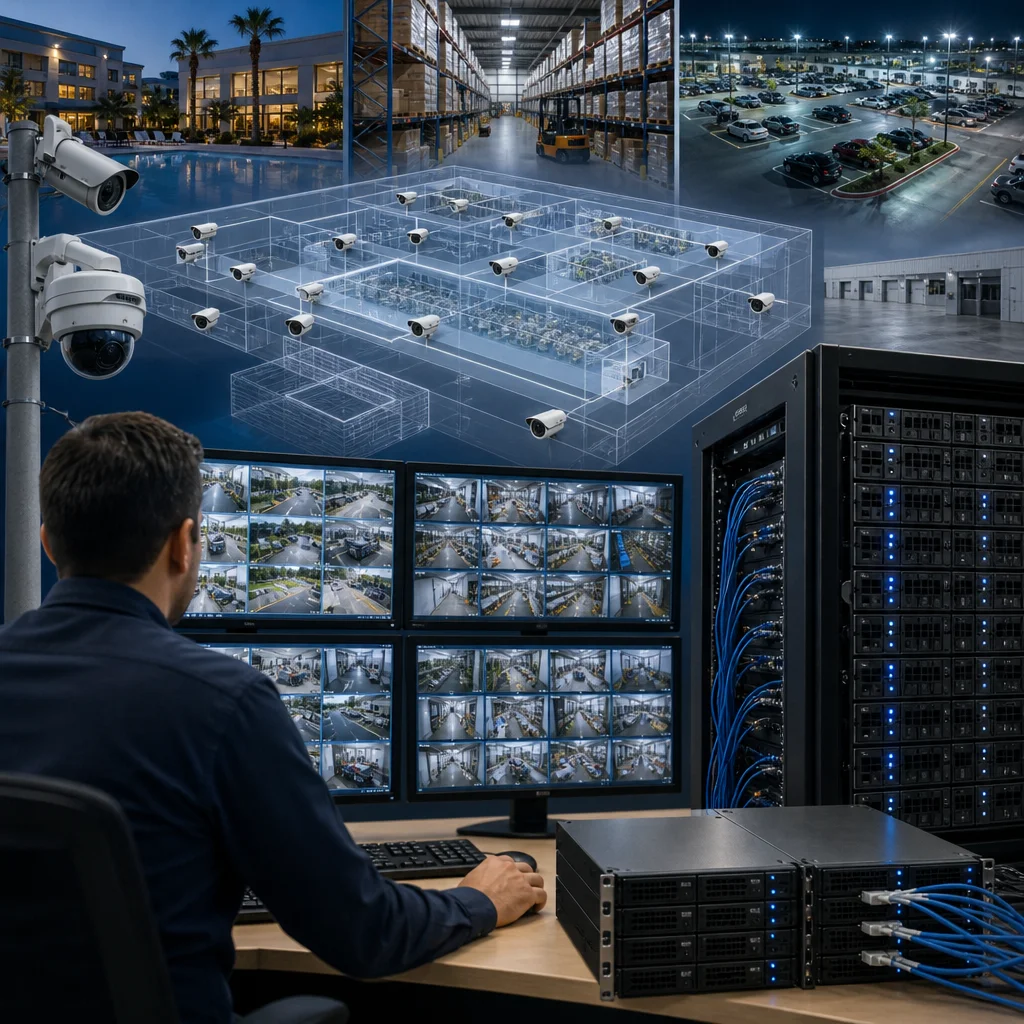
Cloud platforms now leverage artificial intelligence to transform simple entry logs into actionable insights. These systems can identify anomalous patterns, such as a credential being used at two distant locations simultaneously or frequent “tailgating” incidents where a door stays open too long. For a comprehensive security posture, integrating access logs with an AI security camera system commercial deployment creates a multi-layered verification process. Beyond security, this data helps you optimize building occupancy and energy usage by tracking which areas of your facility are most active throughout the day. This intelligence allows you to make informed decisions about your property management while maintaining a safe environment for every occupant.
Cloud vs. Legacy On-Premise Systems: A Comparative Analysis
Choosing between local hardware and cloud-based access control for commercial buildings requires a thorough look at long-term operational health. While legacy systems may seem familiar, their architectural constraints often lead to mounting technical debt. On-premise setups rely on dedicated local servers that require physical space, climate control, and constant manual oversight. In contrast, cloud platforms offer a streamlined approach where the heavy lifting of data processing and security updates happens off-site. This allows your team to focus on building management rather than troubleshooting server hardware.
Deployment speed is another area where the two architectures diverge significantly. For a national commercial portfolio, adding a new site to an on-premise network often involves complex VPN configurations and onsite server installations that can take weeks. Cloud systems allow for near-instant provisioning. Once the edge hardware is installed and connected to the network, administrators can configure permissions and push settings from a central dashboard in minutes. This agility is essential for modern businesses that need to scale operations without waiting for lengthy IT deployment cycles.
Total Cost of Ownership (TCO) Comparison
Evaluating the true cost of security requires looking beyond the initial purchase price. On-premise systems carry significant hidden expenses, including the electricity to run servers 24/7, the cost of specialized IT labor for maintenance, and inevitable hardware refreshes every five to seven years. Cloud-based models simplify budgeting by shifting these variables into a predictable subscription. This eliminates the “scalability tax” often found in legacy systems, where adding a single door might require an expensive server memory upgrade or a new software license tier. With the cloud, you pay for the capacity you use, making it easier to forecast expenses across your entire property portfolio.
Security and Cyber-Resilience
The security update cycle is perhaps the most critical difference in 2026. On-premise systems frequently fall behind on security patches because they require manual intervention from a technician. Cloud providers, however, push automated security updates across the entire network simultaneously, ensuring every door is protected against the latest vulnerabilities. To maintain this high level of reliability, Terapixels Systems utilizes RMM (Remote Monitoring Management) to monitor system health in real time. This proactive approach addresses the “single point of failure” myth; while a local server is a physical vulnerability, a cloud system with edge caching and remote monitoring ensures that your security remains robust even if a single component or connection is compromised.
The end-user experience also sees a marked improvement with cloud adoption. Tenants no longer need to carry physical fobs that are easily lost or duplicated. Instead, they utilize encrypted mobile credentials that provide a frictionless entry experience. Administrators benefit from a unified interface that provides a clear view of all access events across multiple buildings, replacing the fragmented logs of siloed legacy systems with a single source of truth.
Critical Infrastructure Requirements for Cloud Security
While the term “cloud” suggests a wireless, ethereal existence, the reality of cloud-based access control for commercial buildings is grounded in physical copper and fiber. Your security system is only as reliable as the cabling it runs on; a weak network foundation leads to lag, synchronization errors, and potential vulnerabilities. We believe that professional installation is the only way to prevent the “cabling chaos” that often plagues server rooms and undermines system integrity. Managing physical security and network security as a single entity ensures that every component performs at its peak without creating bottlenecks.
Real-time monitoring requires high-bandwidth, low-latency connections. If a tenant swipes their smartphone and waits several seconds for a response, the system has failed the user experience. More importantly, delayed event logs can hinder immediate response times during a security incident. By treating your building’s wiring as the central nervous system of your security, we ensure that data travels from the door to the cloud portal instantly and securely. To ensure your facility’s infrastructure is ready for this level of integration, contact our team for a comprehensive site assessment.
The Role of Structured Cabling (Fiber & CAT6)
Modern security architecture demands a high-performance backbone. A professional CAT6 cabling installation for commercial buildings is the gold standard for access control because it supports the high data rates required for 2026 security standards. Most modern systems now utilize Power over Ethernet (PoE), which allows a single cable to provide both data and power to door controllers and smart readers. This simplification reduces the need for local power outlets at every door, but it places a greater emphasis on the quality of your wiring. Understanding what is structured cabling helps property managers avoid the messy, unorganized patches that lead to long-term maintenance headaches and system downtime.
Power Continuity and Backup Solutions
Cloud systems require a constant connection, which makes power continuity a non-negotiable requirement. A backup generator installation for business ensures that your security perimeter remains active even during prolonged utility outages. We also implement Uninterruptible Power Supply (UPS) units for all cloud controllers to bridge the critical seconds between a power failure and generator activation. It’s equally important to define the “fail-safe” versus “fail-secure” configurations for your locks. Fail-secure locks remain locked during a power loss to maintain security, while fail-safe locks unlock to allow for emergency egress. Balancing these requirements is a core part of our architectural planning process. For property managers seeking a comprehensive strategy that integrates solar arrays, battery storage, and grid connections into a single resilient system, exploring business continuity power solutions is an essential step in protecting your commercial operations from costly downtime. For property managers looking to reduce long-term energy costs and support on-site EV charging for tenants, a commercial solar and EV charger installation can also serve as a strategic complement to your building’s power continuity planning.
By investing in the physical layer of your security, you protect the digital intelligence that manages your building. This methodical approach to infrastructure ensures that your cloud-based access control for commercial buildings remains a reliable asset for years to come. We take pride in being the steady hand that manages these complex background systems, allowing you to focus on your primary business objectives with total peace of mind.
Partnering with Terapixels for Integrated Commercial Security
Terapixels Systems positions itself as more than a service provider; we are the dedicated architect of your entire security and technology stack. We understand that a truly secure environment requires a holistic view of infrastructure. By managing every layer from the fiber and CAT6 cabling to the intelligent edge controllers, we eliminate the friction often caused by multiple uncoordinated vendors. This comprehensive oversight ensures that your background systems are robust, reliable, and perfectly tailored to support your business objectives.
Our “single pane of glass” management approach provides a unified interface for both security and networking. This level of integration is essential for effective cloud-based access control for commercial buildings, as it allows you to monitor entry events and network health from a single dashboard. We provide a steady hand to manage these complex digital systems, giving you the quiet confidence that your property is protected by a visionary yet pragmatic technical team. Our goal is to build a foundation of stability that allows you to focus on your core operations while we handle the technical intricacies; for businesses requiring specialized IT support, ZANGAARD provides managed solutions that ensure your broader technology stack remains as resilient as your physical security.
Standardized National Deployment
For multi-site commercial entities, maintaining consistent security standards is a complex challenge. Terapixels solves this through standardized deployment protocols that ensure every location operates under the same high level of protection. Whether you manage three buildings or thirty across the country, your security posture remains uniform and manageable. You benefit from a single point of contact for design, installation, and ongoing maintenance, which simplifies your operational overhead. This structure also allows for standardized reporting and analytics, giving C-suite stakeholders a clear, data-driven view of organizational safety without having to piece together fragmented reports from different local vendors.
Customized Security Architectures
Every facility has unique operational realities that require more than an “out of the box” solution. We move beyond generic setups to design customized architectures that meet your specific facility needs. This often involves integrating modern cloud access with established keycard access control systems for business to bridge the gap between existing hardware and new technology. Our commitment to stability includes proactive maintenance and 24/7 remote monitoring, ensuring that your systems remain healthy and secure long after the initial installation. By choosing Terapixels, you’re entering a long-term partnership rooted in mutual growth and comprehensive protection.
As we look toward the future of commercial property management, the convergence of physical and cyber security will only deepen. We remain committed to staying at the forefront of these technological shifts, providing you with a future-proof ecosystem that grows with your business. Let us provide the technical expertise and reliable implementation you need to secure your assets with confidence.
Securing Your Commercial Future with Confidence
The transition to cloud-based access control for commercial buildings represents a fundamental shift toward a more agile and data-driven security posture. By moving away from siloed legacy hardware and investing in a unified, software-defined framework, you gain the visibility and scalability required for modern property management. Success in this transition depends on more than just software; it requires a robust foundation of structured cabling and a strategic approach to both physical and cybersecurity. We’ve explored how these elements work together to create a resilient ecosystem that protects your assets while improving the experience for every tenant and employee.
Terapixels Systems provides the steady hand needed to navigate these complex technical requirements. Our team of certified structured cabling professionals and security experts brings a wealth of experience in national deployment and integrated protection. We are ready to serve as your reliable architect, managing the background systems so you can focus on your primary business goals. Take the first step toward a more secure and efficient facility by choosing to Consult with a Terapixels Security Architect Today. We look forward to building a long-term partnership that ensures your stability and growth for years to come.
Frequently Asked Questions
Is cloud-based access control more secure than traditional systems?
Cloud-based systems are generally more secure because they receive automated security updates that address new vulnerabilities in real time. Traditional on-premise systems often rely on manual patches that can be neglected for months or even years. By centralizing management in a secure cloud environment, you eliminate the risk of physical server tampering and benefit from enterprise-grade encryption that protects your data from end to end.
What happens to the door locks if the building loses internet connectivity?
Your door locks will continue to function normally during an internet outage thanks to intelligent edge controllers. These devices store a local cache of user permissions and access logs directly at the hardware level. Once the connection is restored, the system automatically synchronizes all event data with the cloud portal. This ensures that your security remains uninterrupted and your audit trails stay complete without any manual intervention.
Can I use my existing keycards with a new cloud-based system?
Many existing keycards and fobs can be integrated into a new cloud-based system if they use standard communication protocols like Wiegand or OSDP. However, we often recommend transitioning to encrypted mobile credentials or high-frequency smart cards to improve your overall security posture. We conduct a thorough assessment of your current hardware to determine which components can be reused and which require an upgrade to ensure system compatibility.
How does cloud access control integrate with my current security cameras?
Integration occurs through secure APIs that link your access logs directly with your surveillance video feed. This allows you to view video clips associated with specific entry events, such as an unauthorized door prop or a forced entry alarm. By combining cloud-based access control for commercial buildings with an AI-driven camera system, you create a unified platform that provides a complete visual record of every person entering your facility.
What are the bandwidth requirements for a commercial cloud access system?
Standard cloud access control systems have relatively low bandwidth requirements because they primarily transmit small text-based data packets for permissions and logs. However, maintaining low latency is critical for ensuring that doors unlock immediately upon credential presentation. If you are integrating high-resolution video or real-time AI analytics, your network will require a more robust backbone. We recommend a professional assessment of your structured cabling to ensure optimal performance.
Is a subscription fee required for cloud-based access control?
Yes, cloud-based systems typically operate on a subscription-based model that covers software hosting, automated security updates, and remote management features. This shift from a heavy upfront capital expense to a predictable operating expenditure allows for easier budgeting and ensures your system never becomes obsolete. The fee structure usually scales based on the number of doors or users managed within your commercial property portfolio.
How long does it take to transition a commercial building to the cloud?
The timeline for transitioning a commercial building depends on the size of the facility and the condition of the existing wiring. A standard installation for a mid-sized office can often be completed in a few business days. Because cloud-based access control for commercial buildings doesn’t require complex local server configurations, the deployment process is significantly faster than traditional on-premise setups. We provide a detailed project schedule during our initial architectural consultation.
Does cloud-based access control help with regulatory compliance?
Cloud-based systems significantly simplify regulatory compliance by providing automated, centralized audit logs and real-time reporting. These features are essential for meeting modern standards like the NIST Cybersecurity Framework 2.0 or industry-specific requirements for data protection. Having a single source of truth for all access events across multiple locations makes it much easier to demonstrate adherence to security protocols during both internal and external audits.