CONTACT US

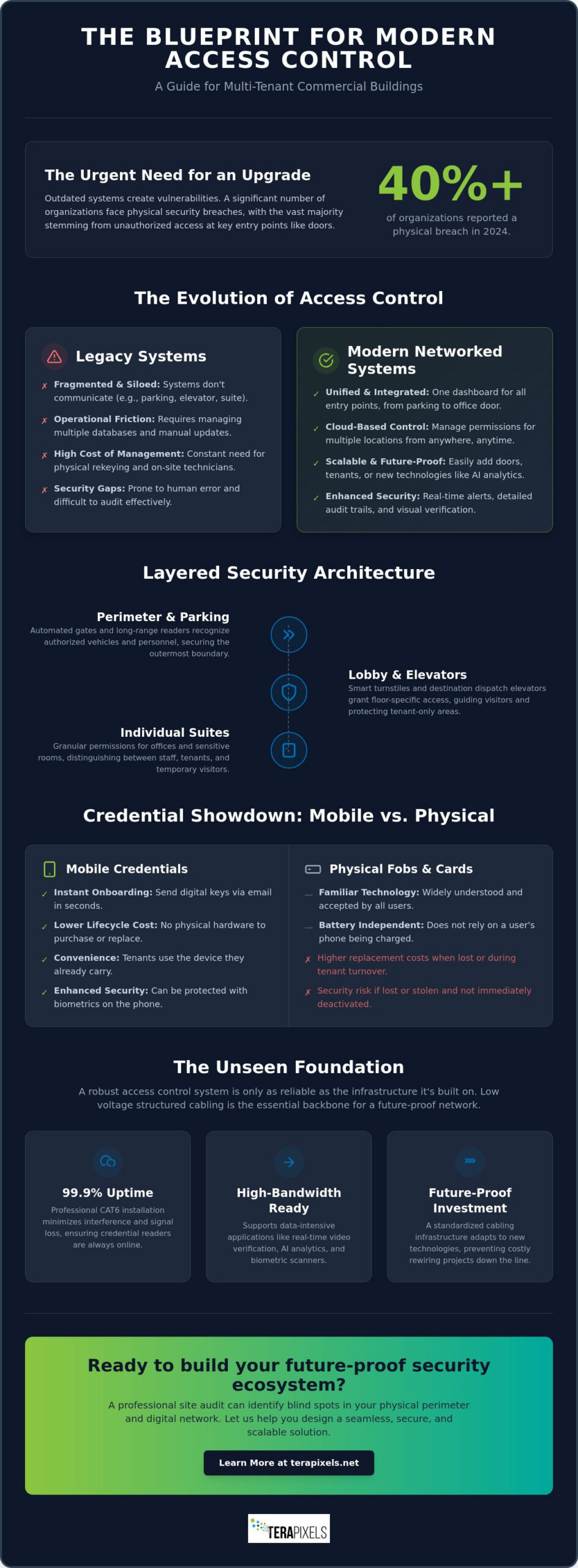
Did you know that over 40% of organizations reported at least one physical security breach in 2024, with the vast majority caused by unauthorized access through doors? If you’re managing a property today, you likely feel the weight of this reality every time a tenant loses a physical key or an unauthorized visitor slips through a closing door. Implementing effective access control for multi-tenant commercial buildings isn’t just about locking doors anymore; it’s about creating a cohesive digital and physical architecture that grows with your needs. You’re likely tired of fragmented systems that don’t talk to each other and the mounting operational costs of managing outdated fobs.
We understand that your goal is to provide a premium experience for your tenants while maintaining a rigorous security posture. In this guide, you’ll learn how to design a scalable, secure, and networked access control system that protects your property and simplifies tenant management. We’ll explore the essential components of a modern infrastructure, from unified dashboards and mobile credentials to the AI-powered analytics that are becoming the standard for 2026. By the end of this article, you’ll have a clear roadmap for building a reliable, future-proof environment where security and convenience coexist seamlessly.
Key Takeaways
- Understand why modern access control for multi-tenant commercial buildings requires a convergence of IoT hardware and structured cabling to eliminate the friction found in standalone systems.
- Learn to evaluate credential flexibility by comparing mobile-first solutions with traditional keycard systems to better serve your diverse tenant base.
- Discover how to integrate entry management with AI-driven surveillance so it’s easier to create a unified security dashboard that reduces unauthorized tailgating.
- Identify why low voltage structured cabling is the essential backbone for a future-proof network that supports AI analytics and mobile credentials.
- Recognize how a professional site audit helps you identify blind spots in both your physical perimeter and your digital network infrastructure.
Beyond the Door: The Networked Infrastructure of Multi-Tenant Access Control
Modern access control for multi-tenant commercial buildings has evolved from simple mechanical locks into a sophisticated convergence of IoT hardware and high-speed data pathways. In the past, buildings relied on standalone systems that operated in isolation. These legacy setups often created security silos; a tenant’s suite lock didn’t communicate with the lobby elevator or the parking gate. This fragmentation leads to operational friction, forcing property managers to manage multiple databases and increasing the risk of human error or security gaps.
A reliable system depends entirely on its foundation. Understanding what is structured cabling is essential for any facility manager aiming for 99.9% uptime for their credential readers. Without a standardized layout, systems become prone to interference and signal loss. Transitioning from outdated legacy wiring to a professional CAT6 cabling installation commercial grade setup ensures your infrastructure can handle the high-bandwidth data required for modern security protocols, including real-time biometric verification and mobile credentialing.
The Shift to Cloud-Based Facility Access
Property managers overseeing national portfolios can’t be everywhere at once. Cloud-based facility access allows for centralized, off-site management from a single interface. By eliminating the need for bulky on-site servers, you reduce maintenance overhead and remove a common point of hardware failure. It’s a scalable approach that grows with your property, allowing you to add doors or change permissions across multiple locations in seconds without needing a technician on-site.
Layered Security Architecture
Security is a journey from the perimeter to the office. A robust infrastructure supports a layered approach that manages access at every touchpoint. This requires distinct permission tiers to maintain order and safety:
- Parking and Perimeter: Automated gates and long-range readers that recognize authorized vehicles.
- Lobby and Elevators: Smart turnstiles and floor-specific access that guide visitors while protecting tenants.
- Individual Suites: Granular permissions that distinguish between permanent staff, temporary tenants, and delivery personnel.
This tiered architecture ensures that everyone has exactly the access they need, while your infrastructure remains organized and easy to audit.
Evaluating Multi-Tenant Solutions: A Comparison Framework
Selecting the right technology for your property requires a framework that looks past the initial hardware cost. When implementing access control for multi-tenant commercial buildings, you must evaluate how easily the system adapts to changing tenant rosters. Traditional methods, like a keycard access control system for business, remain popular for their familiarity, yet they often lack the agility of mobile-first platforms. The primary goal is to eliminate the need for physical rekeying, which is a significant operational drain and a security risk during tenant turnover.
Integration is the next critical pillar for a reliable architect. Your entry points shouldn’t operate in a vacuum. A truly unified infrastructure ensures your access logs communicate directly with your AI security camera system commercial setup. This synergy allows for visual verification of every entry event, creating an indisputable audit trail. This level of detail isn’t just for convenience; it’s often a requirement for meeting modern insurance compliance and liability standards. If you’re looking to refine your current security posture, our team can help you design cloud-based access control solutions tailored to your specific building layout.
Mobile Credentials vs. Physical Fobs
Digital keys offer a lower long-term lifecycle cost since there’s no plastic hardware to replace when lost. They simplify the onboarding process, allowing managers to send credentials via email instantly. However, a common concern is system reliability during a blackout. We address this by ensuring the facility has a robust backup generator installation for business continuity, keeping readers online even when the grid fails.
AI-Driven Analytics for Tailgating Prevention
AI analytics provide a layer of protection that manual monitoring simply can’t match. By using cameras to verify that only one person enters per valid credential swipe, you can automate the detection of unauthorized tailgating. This reduces liability by identifying propped doors or security breaches in real time. It’s a proactive way to maintain a secure environment without needing a constant security guard presence at every entrance.
Designing for Scalability: From Cabling to AI-Driven Management
A professional site audit is the prerequisite for any successful deployment of access control for multi-tenant commercial buildings. This process allows us to identify physical blind spots and network vulnerabilities before the first reader is installed. We look beyond the entry points to understand how data flows through your facility. At the heart of this design lies low voltage structured cabling. This infrastructure isn’t just about connecting wires; it’s about building a robust backbone that supports the high-frequency data exchanges required for 2026 security standards.
Terapixels Systems acts as the reliable architect for these complex background facility systems. We provide the steady hand needed to maintain long-term stability, managing the technical intricacies so you can focus on your core business objectives. Our approach ensures that your security investment is scalable, allowing for the easy addition of new tenants or advanced hardware without tearing out existing infrastructure.
When upgrading your facility’s infrastructure, it is also vital to explore Project-based electrical contracting and service fees to ensure that your electrical systems are fully prepared to support modern security hardware and data requirements.
The Role of RMM in Access Control
Reliability means knowing a system is healthy before a tenant tries their badge. By utilizing rmm, or Remote Monitoring and Management, we track the real-time status of door controllers and readers across your entire property. This proactive approach identifies network bottlenecks or hardware failures before they result in a lockout. It ensures seamless movement throughout the property while reducing the need for emergency on-site repairs.
Cybersecurity for Physical Security
Physical security is only as strong as the digital network it sits on. We ensure your access control network is firewalled and isolated from unauthorized traffic to prevent digital intrusion. An unsecured IoT door controller can easily become a gateway for a massive corporate data breach if it’s not properly hardened against external threats. Protecting these endpoints is just as vital as locking the front door.
The path forward requires close coordination between your IT department and security teams. A unified rollout ensures that every component works in perfect harmony. Transitioning to a modernized infrastructure is a long-term investment in your property’s value, safety, and tenant satisfaction.
Securing the Future of Your Commercial Property
Managing a modern facility requires more than just high-quality locks; it demands a unified infrastructure that bridges the gap between physical security and digital reliability. We’ve explored how a robust foundation of structured cabling and cloud-based management simplifies tenant turnover while significantly reducing operational friction. By integrating these background systems with AI-driven analytics, you gain enhanced liability protection and a clearer view of your building’s daily activity.
Modernizing access control for multi-tenant commercial buildings is a journey that benefits from a steady, expert hand. Terapixels Systems brings comprehensive expertise in both security hardware and the essential structured cabling that powers it. Whether you manage a single site or require national coverage for a multi-location property portfolio, our team is ready to act as your reliable architect. You don’t have to manage these complex background systems alone.
Take the first step toward a more secure and efficient facility today. Design your unified access control strategy with Terapixels Systems and experience the stability of a truly integrated security ecosystem. Your property’s protection is a shared goal, and we’re here to ensure it remains future-proof for years to come.
Frequently Asked Questions
What is the most secure type of access control for multi-tenant commercial buildings?
The most secure type of access control for multi-tenant commercial buildings utilize a multi-layered approach that combines biometric verification with encrypted mobile credentials. While traditional keycards can be lost or shared, biometrics ensure the individual entering is exactly who they claim to be. Integrating these tools with AI-driven analytics allows for real-time monitoring of entry points, which effectively prevents unauthorized tailgating and provides a higher level of liability protection for the entire facility.
How do you manage different access permissions for multiple tenants in the same building?
Managing diverse permissions is achieved through a unified, cloud-based dashboard that allows for granular control over every tenant suite and common area. Property managers can assign specific access levels to different organizations, ensuring that employees from one company can’t enter another’s private office space. This digital architecture simplifies the onboarding and offboarding process, as permissions can be updated instantly without the need for physical keys or on-site hardware changes.
Can I integrate my existing security cameras with a new access control system?
You can typically integrate existing security cameras with a modern access control system if the cameras are ONVIF compliant or utilize standardized digital protocols. This integration allows for visual verification of every access event by linking video footage directly to entry logs. It creates a more comprehensive security ecosystem where hardware from different manufacturers can communicate effectively across your established network, providing a singular source of truth for facility management.
What happens to the access control system during a power outage?
During a power outage, a professionally designed system relies on local battery backups and building-wide generator systems to maintain full functionality. Most modern door controllers include internal batteries that keep the locks and readers operational for several hours. For long-term continuity, we recommend a dedicated generator to ensure your access control for multi-tenant commercial buildings remains online even during extended utility failures, which prevents tenants from being locked out of their workspaces.