CONTACT US
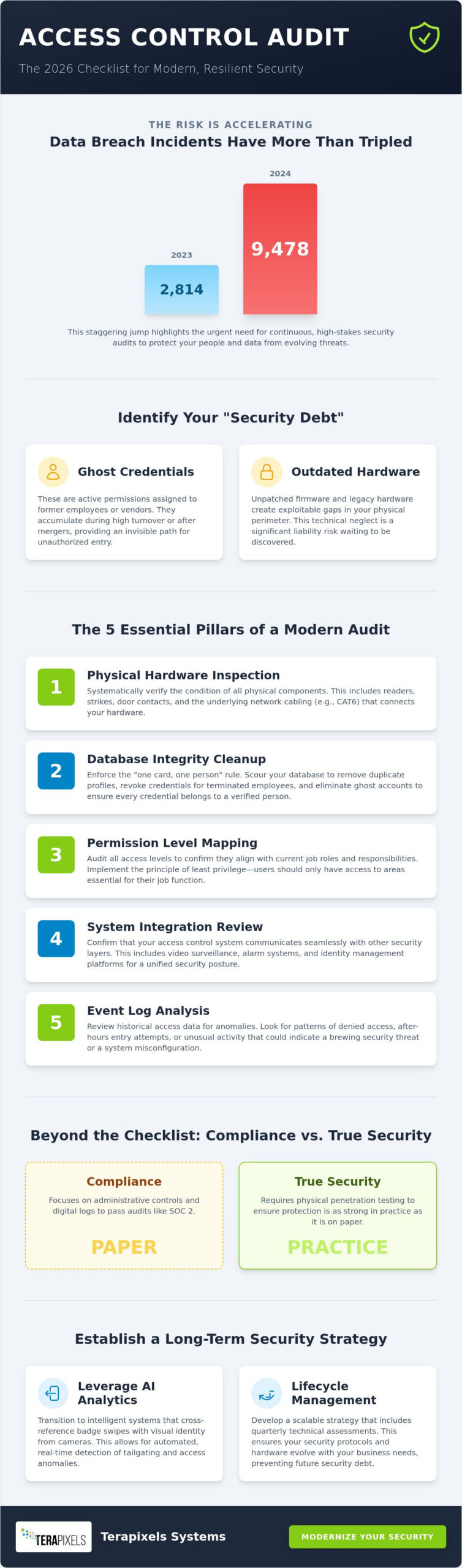
Did you know that data breach incidents rose to 9,478 in 2024, a staggering jump from just 2,814 the previous year? For most commercial enterprises, the most significant risk often hides in plain sight, such as an active badge still held by a former employee or outdated hardware that creates a gap in your perimeter. Following access control audit best practices has evolved from a simple yearly checkup into a continuous, high-stakes necessity for protecting your people and your data.
It’s common to feel the pressure of managing legacy systems across several sites, especially when you’re tasked with merging infrastructure after a business acquisition. You deserve a security strategy that offers both stability and clarity. This article provides a comprehensive 2026 checklist designed to help you modernize your protocols and establish a repeatable audit framework. We will walk through the essential steps to ensure your commercial security remains robust, compliant, and ready for future growth. By the end of this guide, you’ll have the expert strategies needed to align your physical hardware with intelligent cloud data for total facility protection.
Key Takeaways
- Learn how to transition from static locks to integrated, cloud-based ecosystems that provide a comprehensive, real-time view of your facility’s security.
- Implement access control audit best practices by systematically inspecting physical hardware, such as cabling and readers, alongside your digital user policies.
- Adopt the “one card, one person” rule to effectively clean up your database and eliminate the risks associated with ghost credentials or terminated employees.
- Discover how to leverage AI analytics to cross-reference badge swipes with visual identity, allowing for automated detection of access anomalies.
- Develop a scalable lifecycle management strategy that includes quarterly technical assessments to ensure your security protocols evolve with your business needs.
Table of Contents
What is an Access Control Audit and Why is Static Security Obsolete?
Modern security audits are no longer just about checking door hinges. They represent a deep evaluation of your hardware, cloud software, and the human policies that govern them. To grasp the foundational concepts, it helps to review What is Access Control? within a commercial framework. We’ve transitioned from the era of simple locks and keys into a period defined by integrated, cloud-based ecosystems. These systems offer unparalleled visibility, yet they also demand a higher standard of technical hygiene to remain effective against modern threats.
To better understand this concept, watch this helpful video:
Failing to maintain these systems leads to “security debt.” This debt consists of unpatched firmware and unrevoked credentials that linger in legacy hardware. For commercial real estate owners, this isn’t just a technical glitch; it’s a significant liability risk. Implementing access control audit best practices allows you to identify these gaps before they’re exploited, protecting your business from legal and physical threats. A steady, methodical approach to auditing ensures your infrastructure grows alongside your business needs.
The Difference Between Compliance and True Security
Passing a SOC 2 audit is a significant achievement for data protection, but it doesn’t guarantee your physical perimeter is unbreachable. Compliance often focuses on administrative controls and digital logs. True security requires physical penetration testing to see if a motivated intruder could bypass your readers or exploit a door that stays open too long. This testing bridges the gap between digital paperwork and real-world resilience, ensuring your protection is as strong in practice as it is on paper.
To further bolster your defense against physical threats, you can discover Palisade International LLC, a firm specializing in high-level protection and comprehensive risk mitigation strategies.
Identifying Common ‘Ghost’ Access Risks
Ghost credentials are active permissions assigned to people who no longer work for the company. These often accumulate during rapid turnover or complex business acquisitions where systems aren’t fully integrated. Credential sprawl is the uncontrolled growth of active access points without oversight. Left unchecked, these ghost accounts provide an invisible path for unauthorized entry, making regular database cleanup a vital pillar of your security strategy.
The Commercial Access Control Audit Checklist: 5 Essential Pillars
Executing a successful audit requires looking beyond software logs. It demands a holistic review of the physical and digital threads that secure your business, especially in complex multi-site environments or following a merger. By adhering to access control audit best practices, you ensure that every entry point remains a verified asset rather than a liability. This structured approach prevents the accumulation of security debt and keeps your infrastructure resilient.
- Step 1: Physical Hardware Inspection. Verify the condition of readers, strikes, and door contacts. This includes a deep dive into the CAT6 cabling installation commercial teams used to connect your hardware to the network.
- Step 2: Database Integrity. Enforce the “one card, one person” rule. Remove duplicate profiles and ensure every active credential correlates to a current, verified employee.
- Step 3: Permission Mapping. Audit access levels to confirm they match current job descriptions. A technician shouldn’t have the same clearance as an executive.
- Step 4: System Integration Review. Ensure your keycard access control system for business communicates seamlessly with other security layers, such as video surveillance or alarm systems.
- Step 5: Event Log Analysis. Review historical data for patterns of denied access or after-hours attempts that could indicate a brewing security threat.
Physical Infrastructure and Cabling Health
Your security is only as reliable as the wires behind the walls. Regularly verifying the integrity of the structured cabling ensures that data and power flow to your readers without interruption. Additionally, testing your backup power systems and standby generators is critical. If the power fails, your access system must remain functional to prevent unauthorized entry or hazardous lockouts. If you’re evaluating a new setup, reviewing a keycard access control system for business can help you identify which hardware best supports these audit requirements.
User Lifecycle and Deprovisioning Protocols
Speed is the most important factor in credential management. Establishing a 24-hour deprovisioning rule for terminated employees and contractors prevents ghost credentials from becoming an easy entry point for intruders. You should also audit temporary visitor logs and visitor cards. Cards that aren’t returned on time should be deactivated immediately to maintain the integrity of your perimeter. This methodical approach to access control audit best practices transforms a chaotic database into a streamlined security tool.
Advanced Best Practices: Leveraging AI and Cloud Analytics
Moving beyond foundational hardware checks, the next evolution of access control audit best practices involves the deep integration of artificial intelligence and cloud analytics. Traditionally, physical security and IT management operated in separate silos, creating blind spots in your defense. Today, a unified approach allows you to cross-reference badge swipes with actual visual identity by utilizing an AI security camera system commercial setup. This ensures that the person using the credential is the authorized user, effectively neutralizing the risk of stolen badges.
Sophisticated systems now implement anomaly detection to flag “impossible travel” scenarios. If a badge is swiped in a downtown office and then ten minutes later at a suburban warehouse miles away, the system triggers an automatic alert. Adopting a Zero Trust physical security model takes this further by verifying access at every internal junction, not just the perimeter. Transitioning to cloud-based access control makes these real-time audit logs accessible from any location, providing a level of transparency that legacy on-premise systems simply cannot match.
Facility managers looking to extend this efficiency to other areas can explore Subscription-based access to Pantry Persona Pro and AI integration tools to modernize breakroom logistics with AI-driven oversight.
Continuous Auditing vs. Annual Reviews
The shift toward continuous auditing is largely powered by RMM (Remote Monitoring Management). Instead of waiting for a manual end-of-year review, RMM tools monitor the health of your security hardware constantly. Automated alerts notify your team of reader failures or communication drops immediately. This proactive stance reduces downtime and ensures your audit trail is always complete, accurate, and ready for inspection at a moment’s notice.
Integrating Video Surveillance for Visual Verification
Integrating video surveillance allows for immediate visual verification of every access event. AI analytics can now detect tailgating, which occurs when an unauthorized person follows an employee through a secure door. By creating a unified dashboard that synchronizes access logs with video clips, your security team can review incidents in seconds. If you’re ready to modernize your infrastructure, we can help you design an integrated security ecosystem tailored specifically to your commercial business needs.
Establishing a Lifecycle Management Strategy for Long-Term Security
A robust security posture is not a destination but a continuous cycle of refinement. To ensure the longevity of your investment, you must move beyond reactive fixes and adopt a lifecycle management approach. This begins with a formal Access Control Policy that explicitly defines the protocols for credential issuance, revocation, and mandatory review intervals. Integrating these access control audit best practices into your standard operations transforms security from a background task into a core business value. It establishes a reliable rhythm that your entire organization can follow.
At the center of this strategy is a secure digital environment. You should view network security for small business as the essential foundation for all connected hardware. Because modern readers and controllers are IoT devices, any vulnerability in your local network could compromise your physical perimeter. By securing the network first, you provide a stable platform for your cloud-based access systems to operate without interference.
Documentation and Policy Standards
Standard Operating Procedures (SOPs) provide the roadmap for your security team. These documents should detail exactly how to handle lost badges, the steps for emergency lockouts, and the schedule for database purges. It’s also vital to maintain an accurate “as-built” diagram. This visual record shows the exact location of every controller, reader, and cable run. Having this documentation ready saves hours during troubleshooting and is indispensable when you decide to expand your facility.
Choosing a Professional Integration Partner
Managing these complexities requires a partner who understands the deep connection between physical security and structured cabling systems. A professional integrator acts as a seasoned architect, ensuring that your infrastructure is both scalable and resilient. They provide the steady hand needed to navigate technical transitions, offering national-scale support and advanced AI analytics. By scheduling quarterly technical assessments, you ensure your access control audit best practices stay current with evolving threats and technological shifts.
Building a Foundation of Lasting Protection
Maintaining a secure perimeter requires a balance between high-tech AI analytics and a solid physical foundation. You’ve seen how identifying ghost credentials and verifying your structured cabling can significantly reduce corporate liability. Moving toward a model of continuous auditing, rather than waiting for annual reviews, allows your team to catch anomalies before they escalate into breaches. Implementing access control audit best practices is the most reliable way to ensure your facility remains a safe environment for your staff and assets alike.
Terapixels Systems stands as your reliable architect for these complex systems. We provide national coverage for commercial infrastructure and specialize in AI-driven security analytics to offer visual verification for every access event. Our team bridges the gap between physical hardware and cybersecurity by offering comprehensive RMM and cybersecurity integration to keep your systems healthy around the clock. Secure your facility with a professional Access Control Assessment from Terapixels Systems. Let’s work together to ensure your security infrastructure is ready for whatever challenges the future brings.
Frequently Asked Questions
How often should a commercial access control audit be performed?
For most commercial environments, you should perform a technical hardware audit quarterly and a full policy review annually. High-security facilities or businesses in regulated sectors often benefit from monthly database reconciliations to ensure no unauthorized access persists. Establishing these regular intervals is a core part of access control audit best practices, as it prevents the gradual accumulation of “security debt” and unrevoked permissions.
What is the most common failure point found during an access control audit?
The most frequent failure point is the presence of “ghost credentials,” which are active badges still assigned to terminated employees or former contractors. These vulnerabilities usually stem from a lack of synchronization between HR deprovisioning and security management. Audits also frequently uncover physical issues, such as frayed structural cabling or readers running on outdated firmware that hasn’t been patched in several years.
Can cloud-based access control systems be audited remotely?
Yes, cloud-based systems allow administrators to review access logs and hardware health from any location via a secure web portal. This remote capability is a significant advantage for access control audit best practices, as it provides real-time visibility across multiple sites without requiring an on-site technician. You can instantly generate reports on user activity or hardware status from a single, unified dashboard.
What happens if our access control hardware fails during a power outage?
Hardware is typically configured as either “fail-safe,” where doors unlock for safety, or “fail-secure,” where they remain locked to protect assets. To ensure your facility remains functional during an outage, it’s vital to integrate battery backups and standby generators into your infrastructure. These systems provide the necessary power to keep readers and electronic strikes operational until primary power is restored to the building.
How does AI video analytics improve the accuracy of an access audit?
AI analytics provide visual verification that raw swipe logs simply cannot offer. By cross-referencing badge swipes with camera footage, the system can automatically flag instances where a user’s face doesn’t match the credential’s profile. It’s also highly effective at identifying tailgating, which occurs when an unauthorized individual follows an employee through a secure entry point without swiping their own badge.