CONTACT US

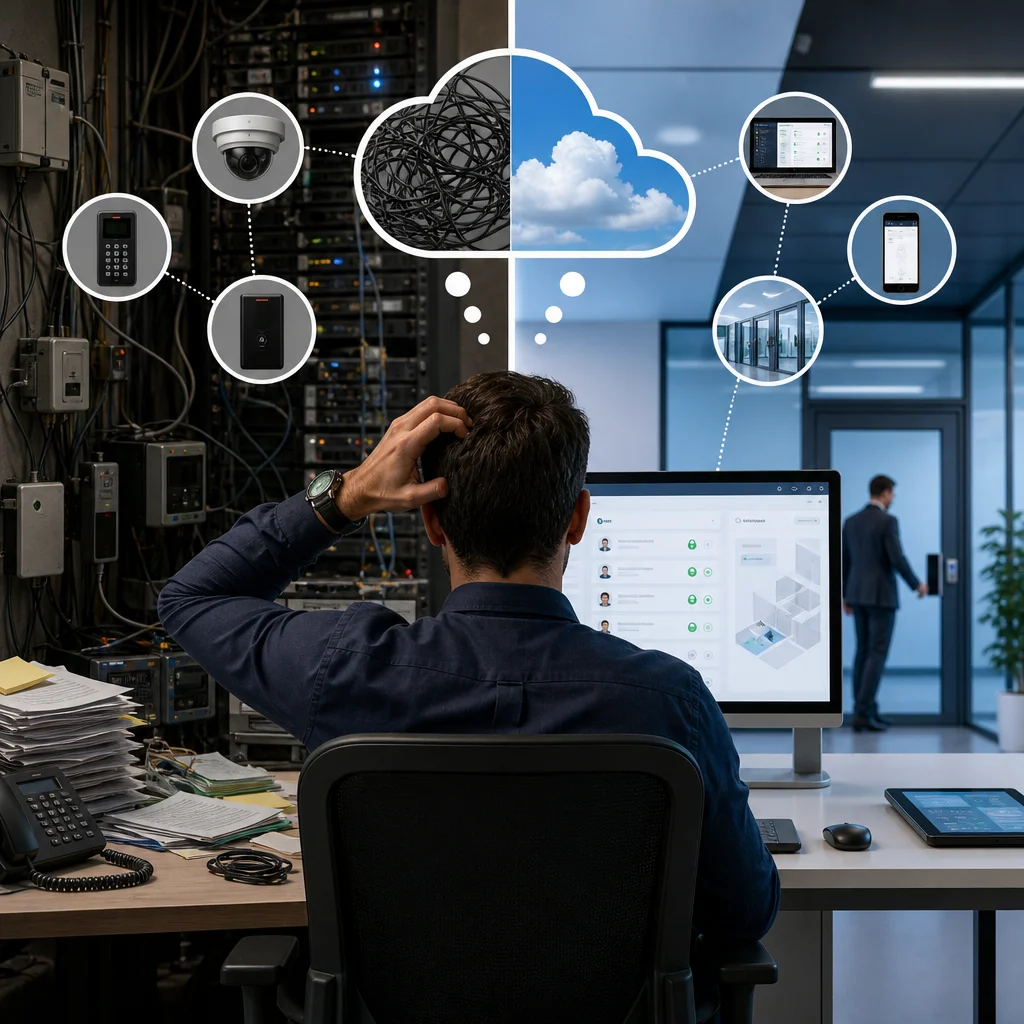
The lowest bid on your desk might actually be the most expensive line item your company faces this year. When evaluating your commercial security system installation cost, it’s easy to focus solely on the upfront hardware price, yet the true value lies in the infrastructure’s long-term stability. You’ve likely felt the frustration of unpredictable add-on fees or the complexity of weighing cloud-based access control against traditional on-premise servers. It’s a difficult balance to strike when you’re trying to protect your facility while ensuring every dollar spent contributes to business continuity.
This guide provides the clarity you need to understand the complex factors driving 2026 pricing and how to calculate a realistic budget for your organization. You’ll learn how to quantify the ROI of AI analytics and distinguish between short-term savings and scalable protection. We’ll also provide a methodical checklist for evaluating installer quotes, ensuring your chosen system supports your goals as a reliable architect of your company’s safety. Here is how to navigate the current landscape of professional security integration with confidence.
Key Takeaways
- Define the Total Cost of Ownership by evaluating long-term expenses like licensing and maintenance alongside initial hardware investments.
- Identify how the complexity of your building’s structured cabling and infrastructure serves as the most significant variable in labor estimates.
- Evaluate the financial impact of choosing between the upfront capital expenditure of on-premise systems and the flexible operational expenditure of cloud-based surveillance.
- Calculate a more accurate commercial security system installation cost by factoring in regional labor rates and local permitting requirements specific to San Diego and Orange County.
- Learn how to conduct a thorough site walk-through to identify hidden technical hurdles and select a partner who prioritizes system longevity over the lowest bid.
Table of Contents
Decoding the Total Cost of Ownership for Commercial Security
Many business owners start their budgeting process by asking for a simple price per camera. This metric is often misleading for enterprise-grade protection because it ignores the complex ecosystem required to keep those cameras operational and secure. A comprehensive commercial security system installation cost includes much more than just the glass and plastic of the lens; it encompasses the underlying network, the software intelligence, and the ongoing labor required to maintain a stable environment. When you view security as a long-term asset, the focus shifts from the initial purchase price to the Total Cost of Ownership (TCO) over a five-year period.
To build a resilient system, one must apply foundational physical security principles that prioritize detection, delay, and response. In 2026, the shift toward AI analytics means your budget now allocates more toward processing power and intelligent software than ever before. These systems don’t just record video. They identify threats in real time, which significantly reduces liability and improves business continuity. Beyond the visible hardware, you must account for variables like city-specific alarm permits, which can range from $30 to $110 per location. Network upgrades, such as transitioning to Fiber or CAT6 cabling, ensure your infrastructure can handle the high bandwidth of modern 4K streams without bottlenecks.
Hardware vs. Infrastructure: Where the Money Goes
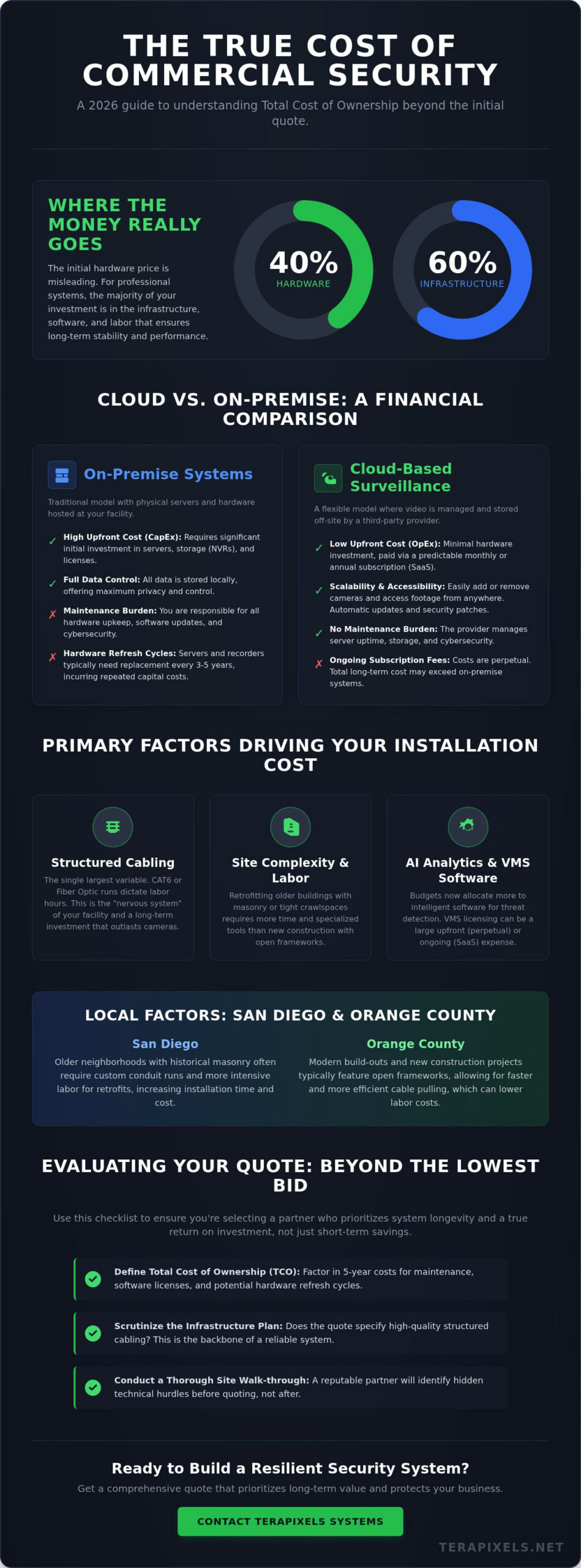
Balancing your investment between edge devices and the core architecture is essential for a stable system. While high-resolution cameras and access control readers are the most visible components, they are only one part of the equation. Hardware typically accounts for only 30-40% of a professional commercial quote, with the remainder dedicated to the critical infrastructure that powers it. Specialized equipment, like thermal imaging for perimeter protection or License Plate Recognition (LPR) for parking management, adds specific value but requires more robust backend support. Investing in high-quality switches and servers ensures that your commercial security system installation cost pays dividends through reduced downtime and fewer service calls.
Software and Licensing Models in 2026
Software models have evolved into tiered Video Management System (VMS) structures that offer different levels of analytical capability. You’ll generally choose between perpetual licenses, which require a large upfront payment, and monthly SaaS subscriptions that offer predictable operational costs. Cloud-based surveillance systems often eliminate the expensive refresh cycle associated with physical NVRs. This model ensures you always have access to the latest cybersecurity patches and firmware updates without needing to replace on-site servers every few years. By moving to the cloud, you trade high capital expenditure for a scalable model that grows alongside your business requirements.
The Infrastructure Backbone: How Cabling Dictates Your Quote
While many business owners focus on camera specifications, the most significant portion of a commercial security system installation cost often lies behind the walls and above the ceiling tiles. Structured cabling serves as the nervous system of your facility. It dictates whether your high-definition streams remain fluid or suffer from frustrating latency. Understanding what is structured cabling is essential because it represents a foundational investment that survives multiple hardware refresh cycles. A well-designed backbone ensures that as technology evolves, your building remains ready for the next generation of security innovations.
Regional architectural differences also play a major role in your final estimate. In older San Diego neighborhoods, technicians often encounter historical masonry and tight crawlspaces that require custom conduit runs and creative routing. These retrofits demand more labor hours and specialized tools compared to new construction projects in Orange County. For modern build-outs, installers can pull cables through open frameworks, which significantly lowers the hourly labor burden. Whether you choose Fiber Optic for long-distance campus connectivity or standard CAT6 for localized office needs, the quality of the path determines the reliability of the protection.
Labor Complexity and Facility Layout
Labor costs are heavily influenced by the ‘Ceiling Factor.’ Installing cameras in a standard office with drop ceilings is relatively straightforward. However, a 30-foot warehouse ceiling requires specialized scissor lifts and safety rigging, which adds to the hourly rate. Material costs also fluctuate based on local fire codes. Plenum-rated cabling is mandatory for air-handling spaces to prevent toxic smoke during a fire; it carries a higher price tag than non-plenum alternatives. For businesses deploying advanced AI analytics, CAT6 cabling installation for commercial buildings is a standard requirement to support high-bandwidth data throughput without signal degradation.
Network Readiness and Power Delivery
Your network must be ready to deliver both data and power simultaneously. Most modern systems utilize Power over Ethernet (PoE) to simplify wiring, but this requires robust network switches capable of high wattage outputs. If your switches are outdated, they won’t support the infrared LEDs that cameras use for night vision, leading to system failures when you need protection most. We frequently find that backup generator installation for business is a critical companion to high-security systems. It ensures your surveillance and access control remain active during local grid failures. If you aren’t sure if your current wiring is up to the task, our team can provide a detailed infrastructure assessment to identify potential bottlenecks before installation begins.
Cloud-Based vs. On-Premise: A Comparison of Long-Term ROI
Choosing between cloud-based and on-premise infrastructure is one of the most critical financial decisions in your security journey. On-premise systems typically demand a high initial Capital Expenditure (CapEx). You’re purchasing physical servers, network video recorders, and extensive storage arrays upfront. While this eliminates monthly subscription fees, it places the burden of firmware updates and cybersecurity patches squarely on your internal IT team. If a server fails or a hard drive crashes, your facility is left vulnerable until a technician arrives on-site to perform manual repairs.
Cloud-based surveillance systems shift the commercial security system installation cost toward an Operational Expenditure (OpEx) model. This subscription approach ensures your software is always current, with security patches deployed automatically by the provider. It also enables remote management, which significantly reduces the frequency of expensive service calls. Instead of paying for a “truck roll” every time a camera needs a reset, many issues can be resolved from a central dashboard. Hybrid models offer a pragmatic middle ground for facilities with existing on-site servers that want to integrate the scalability of the cloud without a total hardware overhaul.
AI Analytics: The New ROI Multiplier
AI analytics have transformed security from a passive expense into an active operational tool. Modern cameras can distinguish between a stray animal and a genuine intruder, which drastically reduces the costs associated with false alarms and security guard fatigue. In high-stakes environments, high-definition AI evidence provides an undeniable record of events. This level of detail can lead to significant liability reduction and potentially lower insurance premiums for California businesses. Beyond protection, these systems provide heat maps and foot traffic data that help owners optimize their floor plans, allowing the system to pay for itself through improved operational efficiency.
The Role of RMM in Security Longevity
The stability of your system depends on proactive oversight rather than reactive repairs. By utilizing remote monitoring management for business, you can identify potential failures before they result in a total blackout. This managed approach compares favorably to the high cost of emergency on-site fixes. Proactive monitoring ensures that critical access control points and surveillance nodes maintain a 99.9% uptime. It moves your security strategy away from a “fix it when it breaks” mentality toward a narrative of technological reliability and long-term business continuity.
Local Factors Influencing San Diego and Orange County Pricing
Southern California’s unique geography and market conditions significantly impact your budget. In coastal cities like Newport Beach or La Jolla, hardware must withstand constant salt-air corrosion. This environment necessitates higher-grade stainless steel housings or specialized protective coatings for outdoor cameras and readers. While these choices prevent premature failure, they do influence the initial commercial security system installation cost. Labor rates also reflect the local economy; in major metropolitan areas like San Diego and Orange County, professional labor for certified technicians typically ranges from $45 to $75 per hour.
The facility layout dictates the density of the installation. A high-density multi-housing complex in downtown San Diego requires intricate wiring through shared walls and fire-rated barriers. In contrast, a sprawling industrial park in Irvine might involve long-distance fiber runs between separate buildings. Each scenario presents different logistical hurdles that a seasoned local integrator must account for during the initial site walk-through. Regional integration projects in Orange County generally fall between $1,969.28 and $3,938.55 when accounting for materials and specialized labor.
California Regulatory Standards
California’s Title 24 requirements often influence how smart building security integrates with lighting and HVAC systems. Beyond energy efficiency, you must navigate strict data storage regulations and privacy laws that dictate how long you can retain surveillance footage. Ensuring your keycard access control system meets local ADA and fire egress codes is a non-negotiable step. Failure to comply can lead to costly delays during city inspections or significant fines during annual fire marshal reviews. Most U.S. cities also require an annual alarm permit, which typically ranges from $30 to $110 per location.
Choosing a Local Integrator vs. National Franchise
National providers often carry a hidden tax in the form of travel fees and the use of outsourced sub-contractors who may not be familiar with your specific site. Working with a local expert ensures that your network security for small business is handled by technicians who understand regional permitting nuances. Local teams provide a faster response when critical systems require calibration or troubleshooting. They possess the site-specific knowledge required to navigate Southern California’s complex building codes and environmental challenges. If you want a partner who understands the specific challenges of the Southern California landscape, you can request a localized security assessment to ensure your facility remains compliant and protected.
Selecting the Right Partner: Beyond the Lowest Bid
Selecting an integrator based solely on the bottom line often leads to the ‘Race to the Bottom’ trap. While a lower commercial security system installation cost is initially attractive, it frequently masks the use of consumer-grade components that lack the processing power for AI analytics or the durability for 24/7 operation. In a commercial environment, equipment failure doesn’t just mean a missed recording; it represents a break in your business continuity and a potential liability. A professional partner focuses on the longevity of the system, ensuring that the hardware selected today won’t be obsolete by next year.
During a site walk-through, you should ask specific questions to smoke out hidden costs that might appear later as ‘add-on’ fees. Inquire about the manufacturer’s roadmap for firmware updates, the specific labor hours allocated for cable dressing, and whether the quote includes necessary licensing for the first five years. There is immense value in choosing a unified provider who manages your structural cabling, security nodes, and energy infrastructure. This holistic approach prevents the finger-pointing that often occurs when multiple contractors are involved in a single deployment. It ensures that every component, from the server rack to the camera lens, is part of a singular, well-constructed narrative of reliability.
The Terapixels Difference: Integrated Continuity
We approach every project as a Reliable Architect, designing systems that scale alongside your organizational growth. Our team doesn’t just install cameras; we build the technical foundation that supports your entire operation. By integrating your security needs with professional office build-out cabling, we ensure a seamless deployment that minimizes disruption to your daily workflows. This partnership mindset means we stay with you long after the initial installation, providing the steady hand of remote management to keep your systems peak-performing and secure.
Securing Your Quote
Moving from a ballpark estimate to a detailed engineering plan requires clear communication and preparation. To get the most accurate proposal, have your facility floor plans ready and identify your primary security objectives, such as reducing internal shrinkage or improving perimeter detection. We provide a transparent breakdown that categorizes hardware, labor, and managed services so you can see exactly where your investment is going. This clarity allows you to make an informed decision based on value and protection rather than just a price tag. If you’re ready to move toward a more stable and comprehensive security strategy, we invite you to Request a professional site assessment from Terapixels Systems today.
Building a Resilient Future for Your Business
Designing a secure facility requires looking beyond the immediate invoice to the long-term stability of your operation. You now understand that a realistic commercial security system installation cost includes a robust cabling backbone, intelligent software licensing, and a strategy for future scalability. By prioritizing high-quality infrastructure and AI-driven cloud surveillance, you ensure your business remains protected against evolving threats while reducing operational friction. It’s about creating a system that doesn’t just record events but actively supports your business continuity through intelligent detection and reliable hardware.
As you move from planning to implementation, partner with an expert who understands the specific regulatory and environmental challenges of Southern California. Terapixels Systems provides localized expertise in San Diego and Orange County, offering a comprehensive approach that integrates IT, security, and energy systems into a singular, reliable network. We’ll manage the complex background mechanics so you can focus on your core objectives with quiet confidence. Ready to design a system that supports your growth? Request a Custom Quote for Your San Diego or Orange County Facility today. We look forward to building a safer, more efficient environment for your team and your assets.
Frequently Asked Questions
What is the average cost per camera for a commercial installation in 2026?
Professional installation for a single commercial camera typically ranges from $300 to $1,200 depending on the complexity of the environment. This includes the labor for mounting and the technical configuration of the device within your network. For a standard four camera setup, businesses often see a combined equipment and labor expense between $800 and $2,000. These figures vary based on the specific hardware capabilities and the existing infrastructure of your building.
Why is commercial security installation so much more expensive than residential systems?
Commercial systems require industrial grade hardware and must comply with strict building codes that don’t apply to homes. Unlike residential setups, commercial installations often involve fire rated cabling, complex network integration, and adherence to ADA egress requirements. The components are designed for 24/7 operation in demanding environments. This specialized approach ensures long term stability and system longevity, which is essential for protecting a high value business facility.
Do I need to pay a monthly fee for my commercial security system?
Most commercial systems involve ongoing monthly fees for professional monitoring, cloud storage, or software licensing. Subscription models for cloud based surveillance typically range from $5 to $50 per user per month. These fees cover essential services like automatic firmware updates, cybersecurity patches, and remote management. Factoring these into your commercial security system installation cost helps you understand the total cost of ownership over a five year period.
How much does it cost to upgrade an old analog system to a cloud-based IP system?
Upgrading from analog to a cloud based IP system involves replacing legacy coaxial cables with CAT6 or fiber optics and installing new IP cameras. While the upfront investment is higher than a simple repair, it eliminates the need for physical NVRs and allows for advanced AI analytics. This transition often reduces long term maintenance costs by enabling remote troubleshooting. The final price depends on whether the existing conduit can be reused for the new structured cabling.
Does structured cabling really impact the cost of my security system?
Structured cabling is often the most significant variable in your total project quote. It acts as the infrastructure backbone that determines the bandwidth and power delivery for your entire system. Using high quality CAT6 or fiber cabling prevents signal degradation and ensures your network can handle high definition video streams. Proper cabling also future proofs your facility, allowing you to add new sensors or cameras without needing to rewire the building later.
How long does a typical commercial security system installation take?
A typical commercial installation can take anywhere from a few days to several weeks depending on the facility size and layout. A small office might be completed in two to three days, while a large industrial complex with extensive cabling needs could take much longer. The complexity of the building materials, such as concrete or historical masonry, also dictates the pace. We provide a methodical schedule during the engineering phase to minimize disruption to your daily operations.
Can AI-driven security systems help reduce my business insurance costs?
AI driven security systems can lead to lower insurance premiums by providing high definition evidence and reducing liability. Many California insurance providers recognize the value of proactive threat detection in preventing large scale losses. By utilizing AI analytics to distinguish between false alarms and real intruders, you demonstrate a commitment to risk mitigation. This level of technological reliability often qualifies businesses for safety related discounts on their professional liability or property insurance policies.
What are the most common hidden fees in a security system quote?
Common hidden fees often include local alarm permit renewals, data storage expansion costs, and unexpected labor for retrofitting older structures. Most U.S. cities require an annual permit fee ranging from $30 to $110 per location. You should also account for the potential cost of false alarm fines, which average around $150 per incident in many cities. A transparent quote should clearly break down these operational expenses alongside the initial commercial security system installation cost.