CONTACT US
In 2026, relying on a plastic keycard to protect your most sensitive business assets is no longer a security strategy; it’s a liability. You’ve likely dealt with the headache of lost credentials or the fear of sophisticated spoofing attempts that bypass older systems. It’s frustrating to manage high-risk zones when you can’t be 100% certain who is actually behind the door. We understand that you need a solution that replaces guesswork with absolute verification. This guide explores how to leverage biometric access control for high-security areas to create a definitive audit trail and eliminate unauthorized entry once and for all.
You’ll discover the most effective technologies for your specific environment, from palm vein recognition to multi-modal systems that combine facial and iris scanning. We’ll also address the critical intersection of security and compliance, helping you understand how to stay ahead of the latest privacy mandates like the EU AI Act and state-specific laws. By the end of this article, you’ll have a clear roadmap for integrating advanced biometrics into your existing surveillance and network infrastructure, ensuring your facility remains both protected and compliant.
Key Takeaways
- Identify why traditional keycards fail in sensitive zones and how non-transferable biological traits offer a superior security foundation.
- Evaluate the “Big Three” modalities to find the perfect biometric access control for high-security areas based on your specific throughput and accuracy requirements.
- Discover the critical role of CAT6 and fiber-optic structured cabling in maintaining the speed and reliability of your biometric readers.
- Learn how cloud-based management allows for seamless multi-site monitoring and real-time audit trails across your entire organization.
- Gain insights into the latest 2026 compliance trends to ensure your biometric deployment respects employee privacy and meets global regulatory standards.
Transitioning to Biometric Security for Critical Business Assets
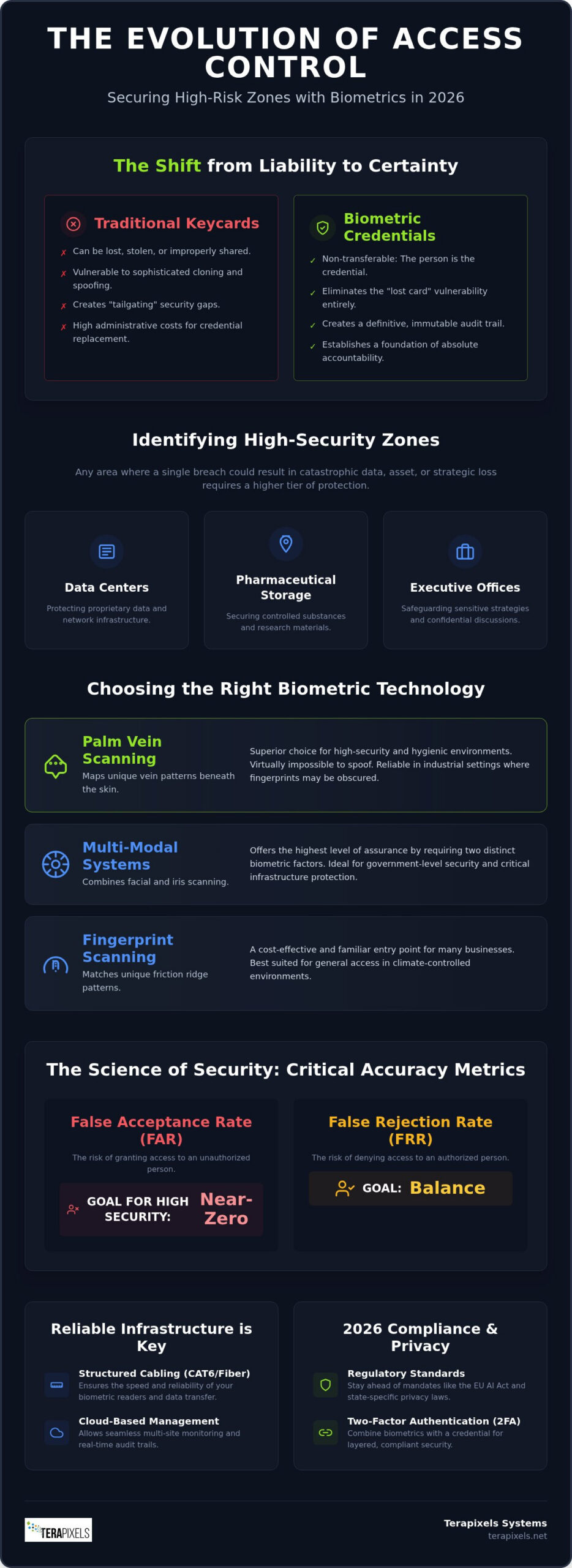
Traditional security measures often fall short when the stakes involve proprietary data or physical assets that are impossible to replace. Biometric access control offers a fundamental shift in how we verify identity. Unlike a password or a plastic token, biometrics utilize non-transferable credentials based on unique biological traits. By integrating biometric technology into your facility, you ensure that the person entering a room is exactly who they claim to be, rather than just someone who happens to possess a stolen badge.
While a standard keycard access control system for business provides an excellent first line of defense for general entry, high-value zones require more stringent verification. Biometrics eliminate the “lost card” vulnerability. When you implement biometric access control for high-security areas, you create a system where the credential cannot be shared, cloned, or forgotten. This transition is about more than just modernizing hardware; it’s about establishing a foundation of absolute accountability that protects your organization from both internal and external threats.
Modern security architectures often utilize these systems as part of a Two-Factor Authentication (2FA) strategy. By requiring both a physical credential and a biometric scan, you add a layer of protection that is significantly harder to compromise. This approach reduces organizational liability and creates an immutable audit trail. For compliance purposes, you’ll have a digital record that proves exactly who accessed a sensitive zone at any given time, providing peace of mind for both management and regulatory auditors.
The Limitations of Legacy Access Control
Legacy systems rely on the assumption that the person holding the key is authorized to use it. This creates a massive gap in security. Card cloning has become increasingly simple for bad actors, and “tailgating,” where an unauthorized individual follows an employee through a door, remains a persistent risk. Beyond the security flaws, managing physical keys and replacing lost credentials carries hidden administrative costs that quietly drain your operational budget over time.
Defining High-Security Zones in Modern Facilities
In a typical commercial environment, certain areas demand a higher tier of protection than the lobby or breakroom. We commonly see this need in data centers, pharmaceutical storage rooms, and executive offices where sensitive strategy is discussed. In these professional settings, ensuring both physical security and effective communication is key; for example, many executives explore Premium Software Subscriptions to support their presentation and broadcasting needs. A high-security zone is any area where a single breach could result in catastrophic data or asset loss. Using biometric access control for high-security areas ensures these specific rooms remain isolated from general traffic, protecting the core of your business operations.
Evaluating Biometric Modalities: Choosing the Right Technology
Selecting the ideal hardware for biometric access control for high-security areas requires a precise balance between throughput speed and verification certainty. You don’t want a system so strict that it creates a bottleneck at the server room door, nor do you want one so lax that it permits unauthorized entry. The National Institute of Standards and Technology (NIST) provides essential frameworks regarding biometric system accuracy and interoperability, which help professionals evaluate two critical metrics: the False Acceptance Rate (FAR) and the False Rejection Rate (FRR). In high-security zones, your priority is a near-zero FAR, ensuring the system never mistakenly grants access to an intruder.
Environmental conditions also play a decisive role in your technology choice. A sensor that performs perfectly in a climate-controlled executive suite might struggle in a dusty warehouse or a high-moisture manufacturing plant. We often recommend specific modalities based on these physical realities to ensure long-term reliability. If you’re unsure which hardware fits your specific floor plan, our team can help you evaluate your facility’s unique requirements to find a stable solution.
Fingerprint and Palm Vein Scanning
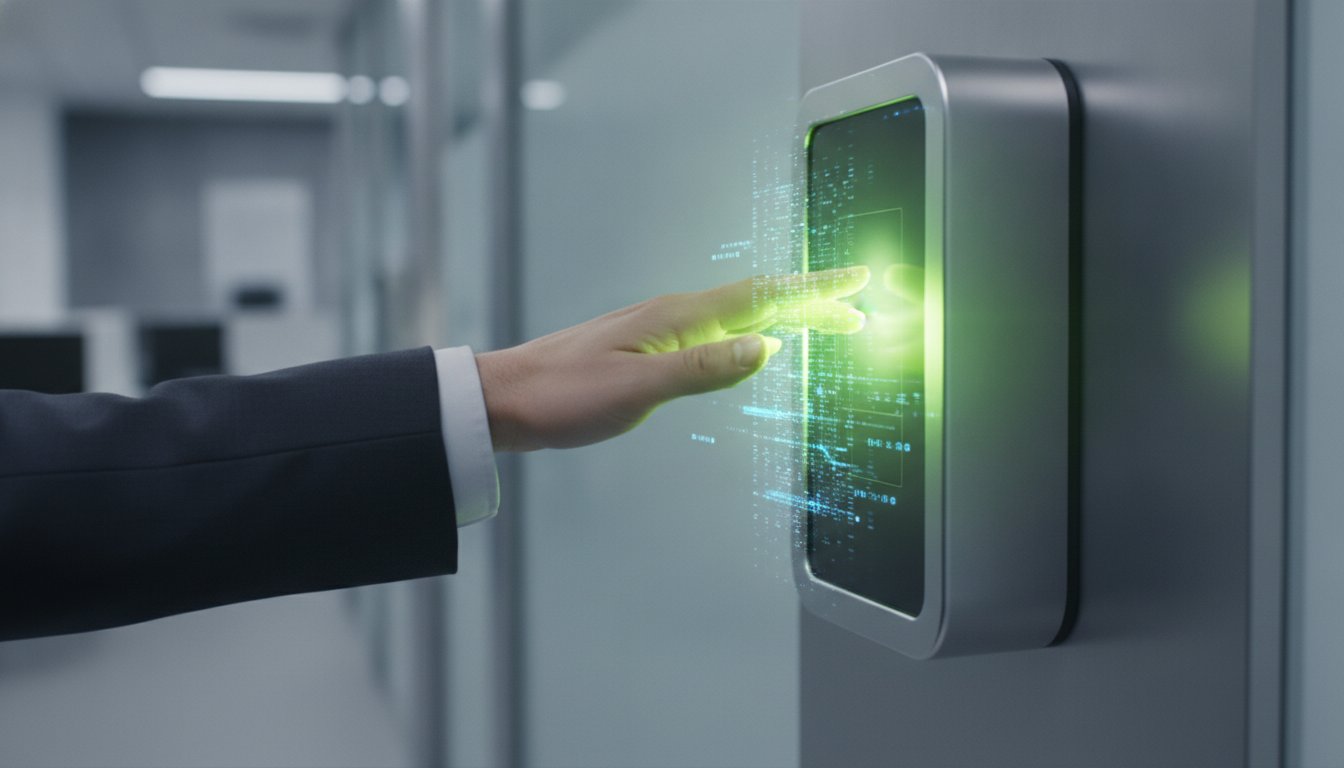
Fingerprint sensors remain a common entry point for many businesses due to their cost-effectiveness and high user familiarity. However, for environments requiring extreme hygiene or heightened security, palm vein scanning is a superior alternative. It maps the unique vein patterns beneath the skin, making it virtually impossible to spoof with a presentation attack. Because it doesn’t require the same level of surface contact as traditional fingerprinting, it’s often more reliable in industrial settings where workers might have obscured or worn fingertips.
Facial Recognition and AI Integration
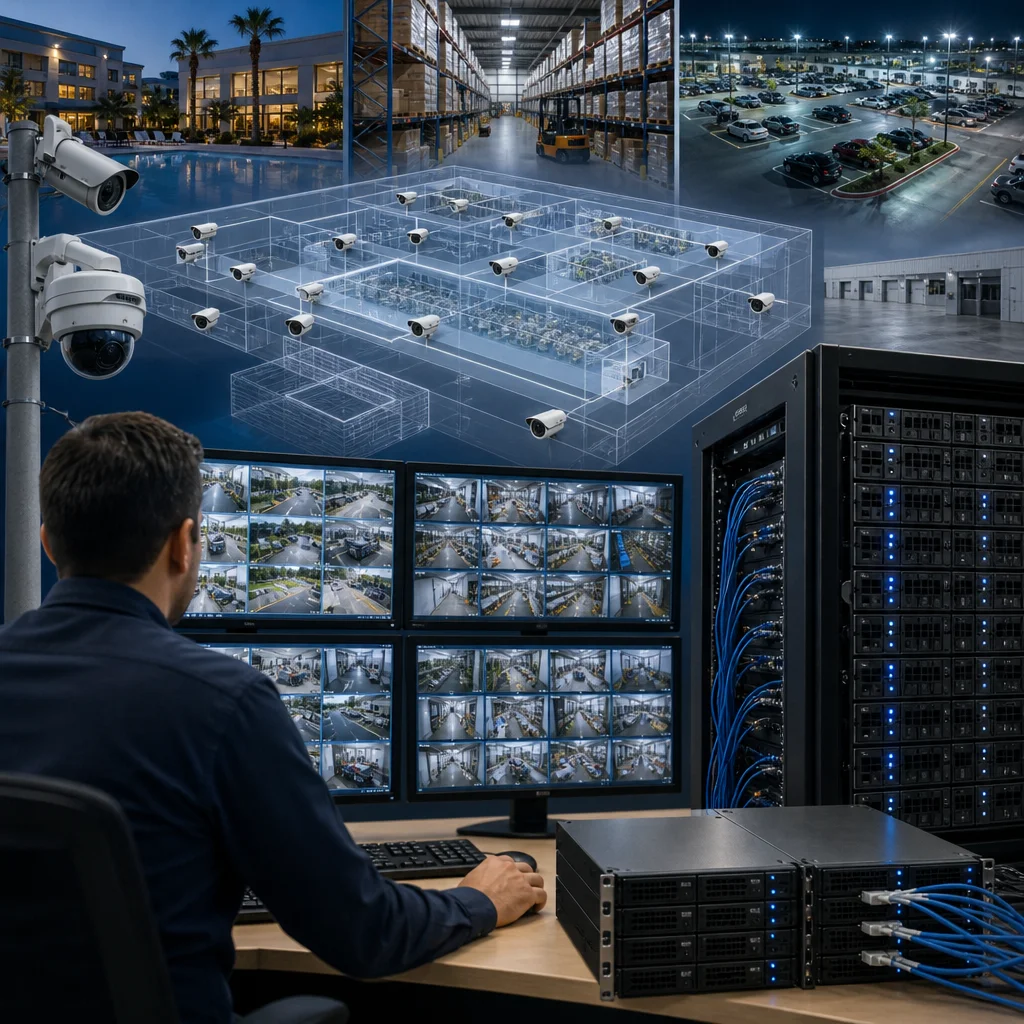
For high-traffic zones that still require strict oversight, facial recognition offers a frictionless, contactless experience. Modern systems handle varying lighting and personal accessories without compromising security. When you integrate these readers with an AI security camera system commercial deployment, the hardware does more than just unlock doors. It becomes part of a proactive threat detection network that can identify unauthorized individuals before they even reach the checkpoint.
Implementing a Scalable Biometric Infrastructure
A sophisticated biometric reader is only as reliable as the network supporting it. When deploying biometric access control for high-security areas, the physical foundation must be robust enough to handle high-bandwidth data transfers without latency. This is where structured cabling becomes the critical backbone of your security architecture. A well-designed cabling system ensures that biometric templates and real-time logs reach your management console instantly. This prevents delays that could compromise facility throughput or security response times.
Modern enterprises are increasingly shifting toward cloud-based management for multi-site monitoring. This allows security teams to manage high-security zones across different geographic locations from a single, unified interface. To maintain 99.9% uptime for these vital entry points, we utilize rmm (Remote Monitoring and Management). This proactive oversight identifies hardware glitches or network drops before they result in a lockout. It ensures your critical assets remain protected around the clock without requiring constant on-site intervention.
Security also extends to the data itself. We prioritize “privacy by design” by storing encrypted biometric templates, which are mathematical representations of a trait, rather than raw images of faces or fingerprints. This hashing process ensures that even in the event of a network breach, the stored information cannot be reconstructed into a usable biological image. It’s a vital step in protecting both the company and the individual employee.
The Role of Network Infrastructure
Facial recognition and high-resolution iris scanners generate significant data loads. Consequently, a professional CAT6 cabling installation commercial grade setup is necessary to provide the required bandwidth and signal integrity. Most modern biometric readers also utilize Power over Ethernet (PoE). This standard simplifies installation by delivering both power and data through a single cable, reducing points of failure and streamlining the integration with your broader security ecosystem.
Privacy Compliance and Employee Trust
Navigating the legal landscape is essential for any biometric deployment in 2026. With over 20 U.S. states enacting biometric privacy laws and the Illinois BIPA imposing statutory damages up to $5,000 per violation, compliance isn’t optional. In the European Union, the AI Act’s high-risk biometric identification requirements become fully binding by December 2, 2026. We help you implement transparent enrollment policies and clear data usage guidelines. This approach ensures your biometric access control for high-security areas meets every regulatory standard while maintaining the trust of your workforce.
Future-Proofing Your Facility with Definitive Identity Management
Establishing a secure environment requires more than just high-tech hardware; it demands a structured approach to identity and infrastructure. We’ve examined how transitioning from legacy credentials to unique biological traits eliminates the vulnerabilities of lost or shared cards. By matching the right modality to your specific environment and supporting it with robust network standards, you ensure that your protection is both absolute and reliable. Implementing biometric access control for high-security areas provides the immutable audit trail necessary for modern compliance and operational peace of mind.
Terapixels Systems stands as your reliable architect in this transition, offering national structured cabling expertise and sophisticated AI-driven security analytics. Our approach prioritizes cloud-based surveillance integration to create a unified, manageable ecosystem across all your locations. We manage the technical complexities so you can focus on your core business objectives with total confidence in your facility’s stability.
Your journey toward a more secure and efficient facility starts with a partnership built on stability and precision. We look forward to helping you design a system that protects your most valuable assets for years to come.
Frequently Asked Questions
Is biometric access control safer than keycards for high-security areas?
Biometrics are significantly more secure than traditional keycards because they verify the actual individual rather than just a physical token. Keycards are easily lost, stolen, or shared among employees, which creates major gaps in your defense. When you implement biometric access control for high-security areas, you eliminate these risks by requiring a unique identifier that cannot be replicated or handed off to an unauthorized person.
What happens if a biometric system fails during a power outage?
A professional installation includes Uninterruptible Power Supplies and local battery backups to ensure continuous operation during a power loss. In the event of a total system failure, doors are configured to either fail-secure, meaning they stay locked, or fail-safe, meaning they unlock for life safety. We integrate these systems with our generator maintenance services to provide a stable, multi-layered power strategy that keeps your critical zones protected regardless of the grid’s status.
How does facial recognition handle masks or lighting changes in 2026?
Modern facial recognition readers utilize advanced 3D depth sensing and AI analytics to identify authorized users even when they are wearing masks or safety gear. These systems are no longer dependent on simple 2D images. They remain effective in low-light conditions or environments with significant glare. This technological maturity ensures that biometric access control for high-security areas maintains high throughput without compromising accuracy or requiring employees to remove necessary protective equipment.
Can biometric data be stolen or hacked from the security database?
Biometric data is stored as an encrypted mathematical template rather than a raw image of a face or fingerprint. This hashing process is a one-way function. A hacker cannot reconstruct your biological features even if they gain access to the database. We prioritize cybersecurity and cloud-based encryption standards to ensure that these templates remain isolated from external threats, protecting both your facility’s integrity and your employees’ personal privacy.