CONTACT US

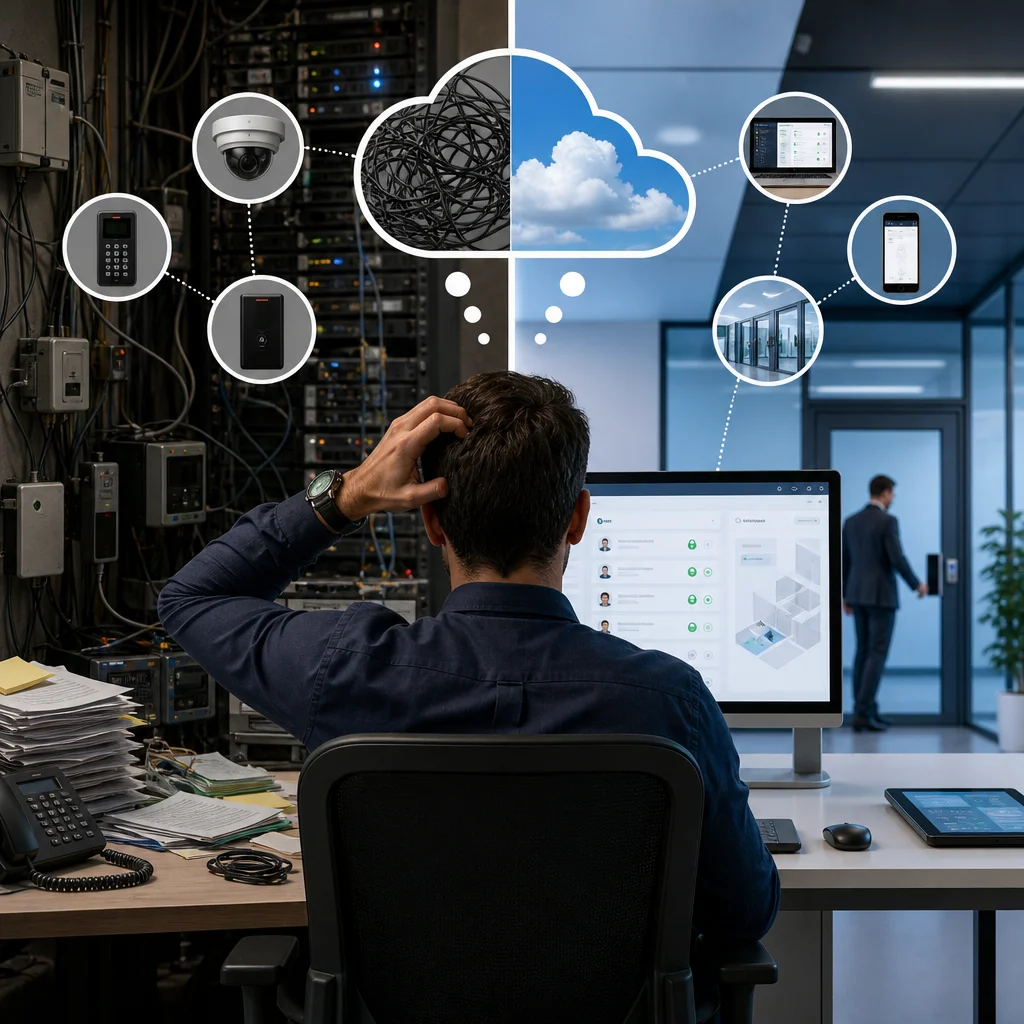
What if your commercial security system could alert you to a hardware failure before a single frame of footage is lost? You’ve likely felt the frustration of discovering a camera went offline days ago or juggling five different apps just to check your door controllers. It’s a common struggle that leads to high labor costs and unnecessary risks for your business. We understand that your priority is a stable, reliable environment where technology works as intended without constant manual oversight.
This guide reveals how using RMM to manage commercial security infrastructure transforms these fragmented tools into a unified, proactive defense system. By shifting from reactive repairs to a partnership-driven management model, you can achieve 100% uptime for your surveillance and access systems. We’ll explore how a centralized dashboard for all facility technology, from AI analytics to structural cabling, can lower your insurance premiums and provide the documented reliability your organization requires in 2026. This strategic approach ensures your physical security operates as a single, fail-safe ecosystem designed for long-term protection.
Key Takeaways
- Learn how to transition from a reactive “break-fix” mentality to an “always-on” security model that identifies system failures before they compromise your facility.
- Discover why using RMM to manage commercial security infrastructure requires a robust physical foundation of structured cabling to support high-bandwidth AI analytics.
- Address critical cybersecurity concerns by implementing a “Security-In-Depth” approach that protects your remote management layer from potential vulnerabilities.
- Identify how local environmental factors in Southern California and state-specific privacy laws impact the long-term health and compliance of your security hardware.
- Understand the benefits of a Design-Build-Manage lifecycle that combines physical infrastructure expertise with advanced remote monitoring for total system reliability.
What is RMM for Commercial Security Infrastructure?
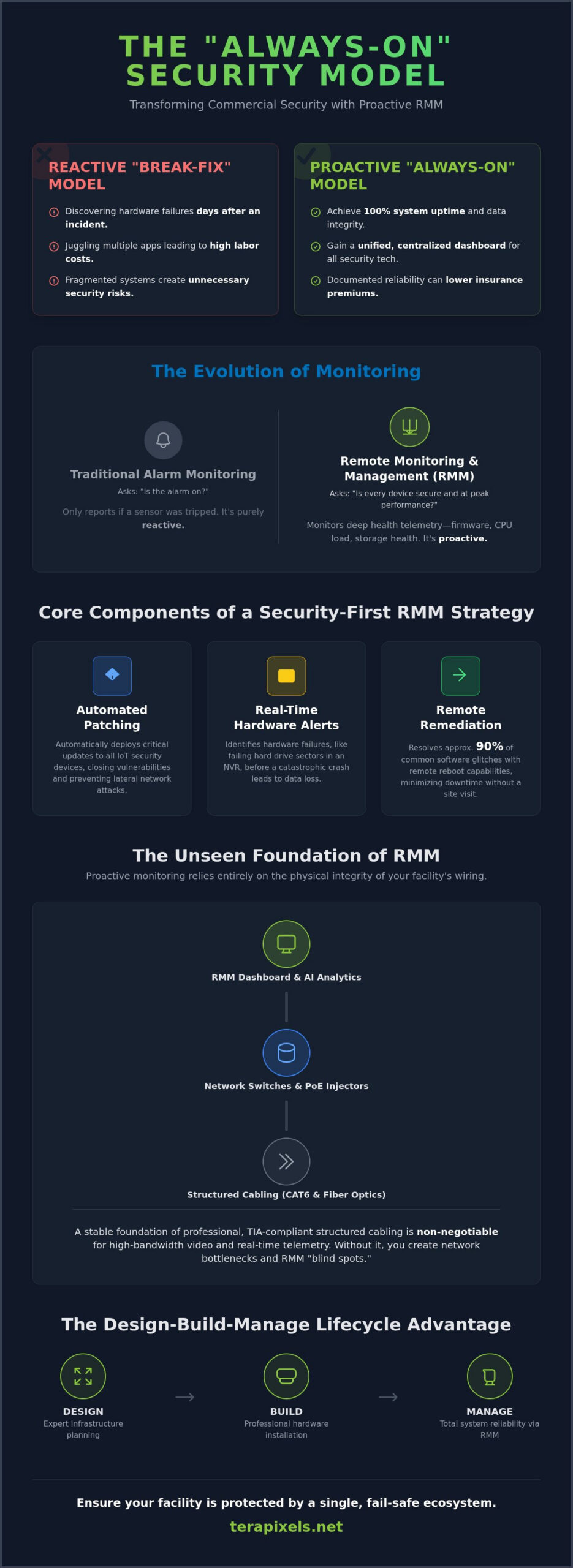
While standard Remote monitoring and management (RMM) often focuses on maintaining office workstations and servers, applying this technology to your security hardware is a specialized discipline. In this context, RMM is the proactive oversight of your surveillance cameras, access control systems, and the underlying network switches that keep them operational. It functions as a central nervous system for what are traditionally disconnected security silos. By 2026, the industry has shifted away from the “Break-Fix” model, where repairs only happen after a failure occurs. Using RMM to manage commercial security infrastructure creates an “Always-On” environment where technical health is verified every minute of the day.
This approach provides a significant business benefit by reducing liability. You don’t want to discover a camera was offline for a week only after a critical incident happens. By ensuring 100% data integrity and system uptime, you create a documented trail of reliability. This level of precision is exactly what we provide as a reliable architect for your facility’s technology. This is why using RMM to manage commercial security infrastructure has become the standard for resilient businesses that prioritize comprehensive protection over quick fixes.
RMM vs. Traditional Security Monitoring
Standard alarm monitoring is reactive; it only tells you if a sensor was tripped or an alarm was activated. It cannot tell you if your AI-driven surveillance cameras are running the latest secure firmware or if a network switch is overheating. Modern security requires deep health telemetry. RMM monitors the specific vitals of your hardware, such as processor loads and storage health on your NVRs. It moves the conversation from “is the alarm on?” to “is every device on my network secure and performing at its peak?”
The Core Components of a Security-First RMM Strategy
A sophisticated RMM strategy focuses on three critical areas to maintain system stability:
- Automated Patching: We deploy updates to IoT security devices automatically. This prevents lateral network attacks where a cybercriminal might exploit a camera’s vulnerability to reach your sensitive business data.
- Real-Time Hardware Alerts: The system identifies hardware failures, such as hard drive sectors failing in a recording server, before the drive crashes completely.
- Remote Remediation: We use remote reboot capabilities to resolve approximately 90% of common software “glitches.” This keeps your systems running without the delay of waiting for a technician to arrive on-site.
The Infrastructure Layer: Why RMM Depends on Structured Cabling
Effective remote monitoring is not a magic trick performed in the cloud. It relies entirely on the physical integrity of your facility’s wiring. When using RMM to manage commercial security infrastructure, the data you see on your dashboard is only as accurate as the cable carrying it. High-bandwidth AI analytics, which are standard in 2026, require a stable foundation to function without packet loss or frame drops. This is why a professional CAT6 cabling installation for commercial buildings is essential. It provides the necessary throughput for high-definition video and real-time telemetry from every endpoint.
In large industrial complexes, a copper-only network often fails to deliver the required performance over long distances. Signal degradation creates “blind spots” where RMM sensors might report false negatives or time out entirely. We solve this by implementing fiber optic backbones that connect remote security clusters to the main server room. This architecture follows the standards set by the Telecommunications Industry Association (TIA), specifically the ANSI/TIA-568-E guidelines. By monitoring the physical health of your network switches and PoE injectors, we ensure your power delivery is as consistent as your data stream.
Preventing Network Bottlenecks
Latency is the enemy of proactive security. If an RMM sensor takes several seconds to report a hard drive failure because of a congested network, the window for a graceful shutdown might close. Utilizing structured data cabling ensures your management traffic has a dedicated, low-latency path. Infrastructure-aware RMM is a system that monitors both software health and cable integrity. Poor cabling often manifests as intermittent “glitches” in video streaming that software updates alone cannot fix. If you suspect your current wiring is holding back your technology, consider a professional infrastructure assessment to identify hidden bottlenecks.
Scalability for Southern California Facilities
Southern California businesses often face unique growth challenges. A cabling layout designed today must accommodate the RMM expansion of tomorrow. We focus on labeled, highly organized cable management that allows for rapid remote troubleshooting. When every port is documented, our team can identify exactly which PoE injector is underperforming without stepping foot on your property. We integrate comprehensive cabling audits into every RMM deployment plan to ensure your physical layer is ready for the future. This methodical approach provides the stability you need to focus on your core business objectives while we manage the background systems.
Securing the Monitor: Addressing Cybersecurity in RMM Deployment
A common concern among property managers is whether adding a remote management layer creates a new vulnerability for hackers to exploit. It’s a valid question. If an RMM tool isn’t properly secured, it could theoretically serve as a backdoor. However, using RMM to manage commercial security infrastructure through a professional architect actually hardens your defense. We employ a “Security-In-Depth” approach that encrypts the management layer itself. This ensures that the tools used to monitor your cameras and access control systems don’t become the very thing that compromises them.
The principles found in network security for small business apply directly to these deployments. We evaluate the trade-offs between cloud-based and on-premise RMM solutions for every client. While on-premise systems offer total data sovereignty, cloud-based RMM has become the 2026 standard due to its ability to receive instant security patches and provide scalable remote access. For most commercial facilities, a cloud-managed approach offers the most resilient protection against modern threats.
Hardening Your Security IoT Devices
We don’t just watch your devices; we actively harden them against intrusion. By using RMM to manage commercial security infrastructure, we can force multi-factor authentication (MFA) across all camera and NVR logins. This simple step eliminates the risk of compromised passwords. We also automate the patching cycle to close vulnerabilities in access control panels. For instance, when ConnectWise Automate released version 2026.5 in May 2026 to address agent vulnerabilities, our systems were able to verify those updates across entire fleets of devices. Our RMM also acts as a sentry, detecting “rogue” devices that attempt to join your security network without authorization.
Compliance and Liability Management
Modern businesses must navigate a complex regulatory environment. New CCPA amendments that took effect on January 1, 2026, introduce strict requirements for cybersecurity audits and risk assessments. Our RMM platform generates the detailed logs you need to prove compliance during these audits. These records are also invaluable for insurance purposes. Documenting 100% system uptime can lead to lower premiums because it proves your facility is consistently protected. We align our management strategies with the NIST Cybersecurity Framework 2.0, specifically utilizing the “Govern” function to ensure your security policy is as robust as your hardware.
Planning RMM for San Diego and Orange County Commercial Properties
San Diego’s coastal environment presents unique challenges for hardware longevity. Salt air is highly corrosive to outdoor security enclosures and camera mounts. By using RMM to manage commercial security infrastructure, we can monitor the internal temperature and humidity of these enclosures in real-time. This localized approach is critical for businesses along the Pacific Coast Highway or near the Port of San Diego. In contrast, inland Orange County properties often deal with extreme heat in large warehouse spaces, which can stress network switches and recording servers.
California also leads the nation in regulatory complexity. Navigating the CCPA amendments that took effect on January 1, 2026, requires precise data management. These laws govern how automated decision-making technology and surveillance data are handled. A robust remote monitoring management for business strategy ensures that your monitoring practices remain compliant with state privacy mandates while protecting your assets. It provides the documented trail of risk assessments that the state now requires for larger commercial entities.
Southern California’s push for green energy has integrated commercial solar and EV charging stations into the modern facility footprint. These systems are no longer isolated; they’re part of your critical infrastructure. Our RMM platforms provide a unified view of these assets, ensuring that your EV chargers are operational and your solar arrays are performing at peak efficiency. This integration is essential for meeting state-mandated energy goals without sacrificing security. Using RMM to manage commercial security infrastructure alongside your energy assets creates a truly resilient facility that thrives under 2026 standards.
Environmental Monitoring in SoCal
Hardware failure often begins with environmental stress. We use RMM-connected sensors to track heat levels in Orange County warehouses where poor ventilation can lead to equipment thermal throttling. Coastal facilities receive proactive alerts if moisture levels rise inside security enclosures, allowing for maintenance before corrosion destroys a circuit board. Selecting hardware that thrives in the Southern California climate is only half the battle; the other half is monitoring its health daily to prevent unexpected outages.
Ensuring Continuity During Power Fluctuations
Power reliability is a major concern for local businesses during peak summer months. We integrate RMM with your backup generator installation for business to monitor fuel levels, battery health, and exercise cycles remotely. If a prolonged outage occurs, automated “safe shutdown” protocols protect your security servers from data corruption. This ensures your security stays live when the grid goes down, providing the stability your business needs to survive a crisis. If you’re concerned about your facility’s power resilience, our team can provide a comprehensive continuity audit for your Orange County or San Diego property.
The Terapixels Systems Advantage: Why a Reliable Architect Matters
Many IT firms focus exclusively on software but lack the hands-on expertise required for the physical layer of your facility. A “software-only” strategy is insufficient for commercial security because the technology relies on hardware performance. If a camera fails due to a faulty cable or a loose connection, a remote technician cannot resolve the issue. We pride ourselves on being a Reliable Architect that understands the vital relationship between digital monitoring and physical hardware. Our team bridges the gap between high-tech software and the practical realities of your building’s infrastructure.
Our Design-Build-Manage lifecycle ensures that your system is built correctly from the initial fiber pull to the final dashboard configuration. This holistic view is why using RMM to manage commercial security infrastructure with Terapixels Systems provides a level of stability that generic providers cannot match. We don’t just sell software; we provide a comprehensive defense ecosystem. We manage the complex background systems so you can focus on leading your business with the confidence that your assets are protected by a steady hand.
Comprehensive Technology Integration
We unify fiber, CAT6, AI-surveillance, and RMM into a single, manageable contract. This integration simplifies your operations and ensures absolute accountability. As a local partner in San Diego and Orange County, we’re available for on-site cabling audits that remote firms simply cannot perform. Our Architect persona focuses on long-term system stability rather than quick fixes that often lead to recurring failures. We create custom dashboards tailored specifically to the needs of Southern California property managers, providing a singular source of truth for your facility’s health.
Getting Started with a Facility Audit
We believe in a methodical approach to security. Our 3-step process, Audit, Architect, and Automate, is designed to eliminate uncertainty. We begin by identifying “invisible” risks, such as hidden network bottlenecks or outdated firmware on access control panels. By using RMM to manage commercial security infrastructure, we then automate the routine maintenance that previously required expensive manual labor. This proactive stance protects your investment and ensures your security hardware is always ready. Schedule your San Diego or Orange County site walk-through today to begin building a more resilient facility.
Securing Your Facility’s Future with Proactive Management
Transitioning to an integrated security model is a strategic investment in your organization’s long-term stability. A truly resilient system requires a balance between robust physical cabling and advanced digital oversight. We have explored how a stable CAT6 or fiber foundation supports high-bandwidth AI analytics and how modern management tools harden your IoT devices against evolving cyber threats. By using RMM to manage commercial security infrastructure, you move beyond reactive troubleshooting and gain the peace of mind that comes from documented reliability.
As certified structured cabling and security integrators with deep roots in the San Diego and Orange County commercial sectors, Terapixels Systems provides the 24/7 proactive RMM and cybersecurity support your facility demands. We understand the unique environmental and regulatory challenges facing Southern California businesses. Our team is dedicated to acting as the steady hand that manages your background technology so you can lead your business with confidence. Take the first step toward a more reliable defense system. Schedule a comprehensive facility security and RMM audit with Terapixels Systems today. We look forward to building a more stable future for your business.
Frequently Asked Questions
What is the difference between RMM and standard IT support?
RMM is a proactive management tool that uses automated software agents to monitor system health, whereas standard IT support is often a reactive “break-fix” service. While traditional support waits for you to report a problem, RMM identifies hardware failures or software vulnerabilities in real-time. This allows for immediate remediation, often before your team even notices a disruption in your security coverage.
Can RMM manage my existing analog security cameras?
RMM can manage analog systems by monitoring the network-connected Digital Video Recorders (DVRs) or encoders that digitize the footage. While the software cannot directly communicate with an analog BNC cable, it tracks the health of the recording hardware, storage drives, and power supplies. This ensures your legacy hardware remains as reliable as possible while you plan a transition to modern IP-based systems.
How does RMM help reduce my commercial insurance premiums?
Using RMM to manage commercial security infrastructure helps lower insurance premiums by providing verifiable proof of system reliability and maintenance. Insurance providers often offer better rates to businesses that can document high uptime and proactive patching of security vulnerabilities. These logs serve as a digital record that proves your facility took every reasonable step to prevent a security breach or data loss.
Is RMM software secure enough for high-security facilities in San Diego?
Modern RMM solutions are highly secure when implemented by a reliable architect using encrypted management layers and multi-factor authentication (MFA). In high-security San Diego facilities, we use “Security-In-Depth” protocols to ensure the management tool itself is hardened against intrusion. This approach aligns with the NIST Cybersecurity Framework 2.0, turning your management software into a defensive asset rather than a liability.
What happens to my security system if the RMM connection is lost?
If your RMM connection is lost, your physical security hardware like cameras and access control panels will continue to operate locally. Your system won’t stop recording or locking doors; however, you’ll lose remote visibility and proactive health alerts until the connection is restored. Once the link is back up, the RMM agent automatically syncs all data and logs collected during the downtime.
Does RMM help with California’s privacy compliance for surveillance?
RMM assists with California’s privacy compliance by automating data retention policies and providing detailed access logs required by the CCPA 2026 amendments. It ensures that only authorized personnel can view surveillance footage and tracks every interaction with the system. This level of oversight is essential for meeting the strict cybersecurity audit and risk assessment requirements now mandated for many California businesses.
How much does it cost to implement RMM for a commercial building?
The cost of implementing RMM for a commercial building varies based on the number of endpoints, the complexity of your network, and the specific security hardware involved. We don’t offer a one-size-fits-all price because every facility has unique infrastructure needs. Instead, we recommend a comprehensive site audit to evaluate your current system and provide an accurate proposal tailored to your specific operational goals.
Why is structured cabling mentioned in an RMM guide?
Structured cabling is the physical foundation that carries the data RMM needs to monitor your system. Using RMM to manage commercial security infrastructure is only effective if the underlying CAT6 or fiber optic lines are healthy and capable of high-bandwidth transmission. Poor cabling causes signal drops that RMM might misinterpret as hardware failure, making a stable physical layer vital for accurate remote management.