CONTACT US
The most expensive security system you’ll ever buy is the one you have to replace in three years because it simply can’t keep pace with your growth. While many organizations focus purely on camera specs, true resilience is found in scalable business security systems that prioritize a robust cabling backbone and cloud-first management. If you’ve felt the frustration of managing fragmented data across multiple sites or faced the high costs of replacing legacy hardware, you’re already aware of the limitations of traditional, siloed technology.
We believe that security should be a foundation for growth, not a technical hurdle. This guide provides a strategic roadmap for building a future-proof infrastructure that expands seamlessly while reducing your long-term total cost of ownership. You’ll learn how to achieve a unified dashboard for all locations and why the integration of physical and cyber security is no longer optional. We’ll examine the shift toward AI-powered analytics and cloud-based access control, providing the clarity you need to act as a reliable architect for your company’s safety and stability.
Key Takeaways
- Understand how decoupling hardware from storage allows your security infrastructure to expand seamlessly without requiring a total system overhaul.
- Discover why the transition from localized NVRs to cloud-based surveillance systems is essential for managing multiple sites through a single interface.
- Learn to leverage AI analytics and unified access control to transform standard video feeds into proactive business intelligence and visual verification.
- Identify the critical role of a professional CAT6 cabling installation in providing the high-speed backbone required for modern scalable business security systems.
- Gain a step-by-step framework for conducting facility audits to ensure your network infrastructure can support advanced security technologies.
Defining Scalability in Modern Commercial Security Infrastructure
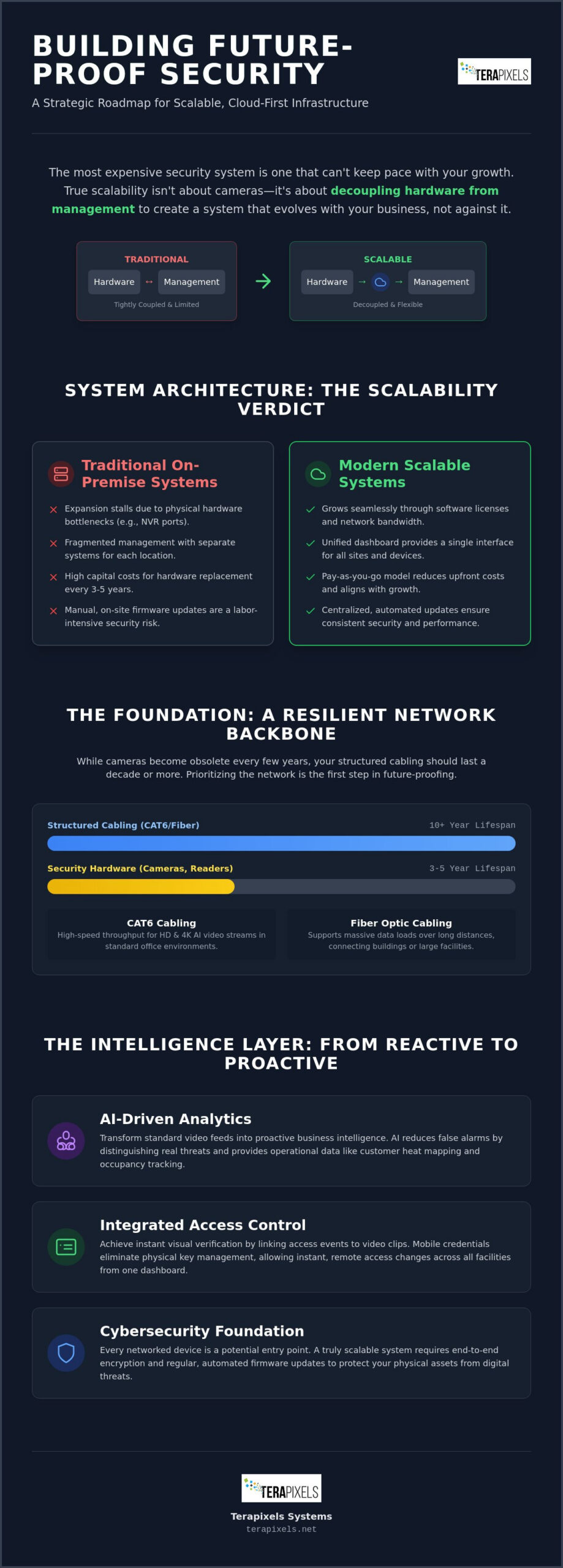
True scalability in scalable business security systems isn’t measured by how many cameras you can plug into a box today. It’s defined by the decoupling of physical hardware from storage and management functions. When you move away from localized Network Video Recorders (NVRs) toward cloud-based surveillance systems, you remove the physical bottlenecks that often stall expansion. Instead of being limited by the number of ports on a single piece of hardware, your system grows through software licenses and network bandwidth.
This transition relies heavily on low voltage structured cabling. This infrastructure acts as the literal backbone of your security ecosystem. It ensures that when you need to add environmental sensors, biometric readers, or additional 4K cameras in the future, the physical pathway for data is already established. Without this foundation, adding new technology often requires expensive, invasive rewiring.
The Infrastructure First Approach
Understanding what is structured cabling is more critical than selecting a specific camera brand. While cameras become obsolete every few years, your cabling should last a decade or more. Planning for bandwidth is the first step in future-proofing. Fiber optic cabling supports massive data loads over long distances, while CAT6 cabling provides high-speed throughput for high-definition AI video streams in standard office environments.
Cloud vs. On-Premise: The Scalability Verdict
On-premise systems often hide their true costs. You might face hardware failures, limited recording ports, and the manual labor required for firmware updates. Cloud-based access control eliminates these hurdles. It allows for instant credential management across one or one thousand sites from a single interface. This centralized oversight ensures that as your business footprint expands, your security management remains simple and unified. Choosing scalable business security systems that utilize cloud architecture ensures you pay only for the capacity you use today while maintaining the ability to double your coverage tomorrow.
Essential Features for a Scalable Security Ecosystem
A truly modern security strategy moves beyond simple recording. High-performance scalable business security systems now act as intelligent sensors that provide actionable data. This shift requires a focus on interoperability. By choosing systems built on Open API architecture, you ensure your current investment can communicate with future third-party software and evolving business tools. This prevents the vendor lock-in that often forces companies to scrap perfectly functional hardware just to gain new software capabilities.
AI-Driven Surveillance and Analytics
The primary benefit of an AI security camera system commercial deployment is the transition from reactive to proactive monitoring. AI reduces the noise of false alarms by distinguishing between a harmless shadow and a genuine security breach. Beyond protection, these systems offer significant business intelligence. You can use heat mapping to understand customer flow or occupancy sensors to optimize HVAC usage. If you’re looking to enhance your operational oversight, our team can help you design an AI-integrated system tailored to your specific facility needs.
Integrated Access Control
Managing physical entry points shouldn’t be a fragmented process. Modern keycard access control systems for business now integrate directly with video surveillance. This allows for instant visual verification; when a card is swiped, the system automatically tags the corresponding video clip. Moving toward mobile-first credentials further enhances scalability. It eliminates the logistical burden and recurring costs of physical key management, allowing administrators to grant or revoke access across multiple remote facilities instantly from a central dashboard.
Finally, cybersecurity must be treated as a core component of your physical security. Every networked camera or door controller is a potential entry point for digital threats. A scalable system must include end-to-end encryption and regular, automated firmware updates. This ensures your physical protection measures don’t inadvertently create a backdoor for hackers, maintaining the integrity of your entire corporate network. By treating physical and digital safety as a single, unified discipline, you create a foundation that is as secure as it is flexible.
Strategic Implementation: From Structured Cabling to Managed Oversight
Implementing scalable business security systems requires a methodical approach that prioritizes the physical layer before layering on digital management. The process begins with a comprehensive facility audit and network capacity test. This assessment ensures that your current infrastructure can handle the increased data throughput of high-definition surveillance without compromising other business operations. It’s a pragmatic first step that prevents performance bottlenecks before they occur.
Once the capacity is verified, the next step is to deploy a standardized CAT6 cabling installation commercial grade backbone. A standardized approach across all facilities prevents the technical debt often caused by mismatched hardware and cabling. With this foundation in place, you can integrate a centralized cloud dashboard. This provides real-time administrative oversight for every location in your portfolio, allowing for seamless credential management and video access from a single pane of glass.
The Role of RMM in Security Uptime
A security system is only effective if it’s operational. This is why remote monitoring management for business is the secret to 24/7 reliability. While traditional systems rely on manual checks, RMM provides automated alerts for camera offline status, hard drive failures, or power issues. It shifts your maintenance model from reactive repairs to proactive health management. This ensures that critical footage is never lost due to an unnoticed technical glitch, providing a level of continuity that standard CCTV setups can’t match.
Choosing a Long-Term Technology Partner
Building a Foundation for Resilient Growth
Building a resilient enterprise requires a shift from viewing security as a series of isolated cameras to seeing it as a unified, intelligent ecosystem. We’ve explored how a robust physical foundation, starting with structured cabling, allows for the seamless expansion of scalable business security systems without the need for costly hardware overhauls. By integrating AI-driven analytics and cloud-based access control, your organization transforms reactive monitoring into a source of proactive business intelligence.
Stability is maintained through constant oversight. Our expertise in AI-driven analytics and national coverage for structured cabling ensures that your infrastructure is both sophisticated and consistent across all locations. When you layer in comprehensive Remote Monitoring Management, you achieve the 24/7 business continuity required in a modern environment. We’re here to act as your reliable architect, managing the technical complexities so you can focus on your own core objectives.
Design your scalable security roadmap with Terapixels Systems and take the first step toward a future-proof environment that grows with you. We look forward to building a secure foundation for your continued success.
Frequently Asked Questions
What is the difference between a modular and a scalable security system?
A modular system allows you to add specific hardware components like building blocks, but it’s often still limited by the capacity of the original physical controller. In contrast, scalable business security systems are designed to expand in both capacity and performance without requiring a complete redesign of the core infrastructure. While modularity focuses on adding parts, scalability ensures the entire ecosystem remains stable as you add hundreds of cameras or multiple new sites.
Can I use my existing cabling for a new scalable security system?
Your ability to reuse existing cabling depends entirely on the grade and physical condition of your current network. Older CAT5 cabling typically doesn’t provide the bandwidth necessary for high-definition 4K video or complex AI analytics, which can lead to dropped frames and system instability. We recommend a network capacity test to see if your backbone can handle modern data loads or if upgrading to CAT6 is required for long-term reliability.
Your ability to reuse existing cabling depends entirely on the grade and physical condition of your current network. Older CAT5 cabling typically doesn’t provide the bandwidth necessary for high-definition 4K video or complex AI analytics, which can lead to dropped frames and system instability. We recommend a network capacity test to see if your backbone can handle modern data loads or if upgrading to CAT6 is required for long-term reliability; learn more about professional installation services that can help you evaluate and upgrade your infrastructure.
How does cloud-based surveillance handle internet outages?
Professional cloud-based surveillance systems handle internet outages through a process called edge storage. Most cameras include internal SD cards or local caching mechanisms that continue recording footage even when the connection is lost. Once the internet service is restored, the system automatically uploads the stored data to the central cloud dashboard. This ensures that your facility remains protected and your evidence is preserved regardless of your network status.
Is an AI-driven security system worth the investment for a small business?
AI-driven systems are a significant asset for small businesses because they function as a force multiplier for smaller teams. By distinguishing between routine activity and genuine threats, these systems eliminate the cost of false alarms and allow owners to focus on their core operations. The added benefit of operational data, such as customer occupancy and traffic flow, provides small businesses with the same high-level intelligence used by large corporations to improve efficiency.