 CONTACT US
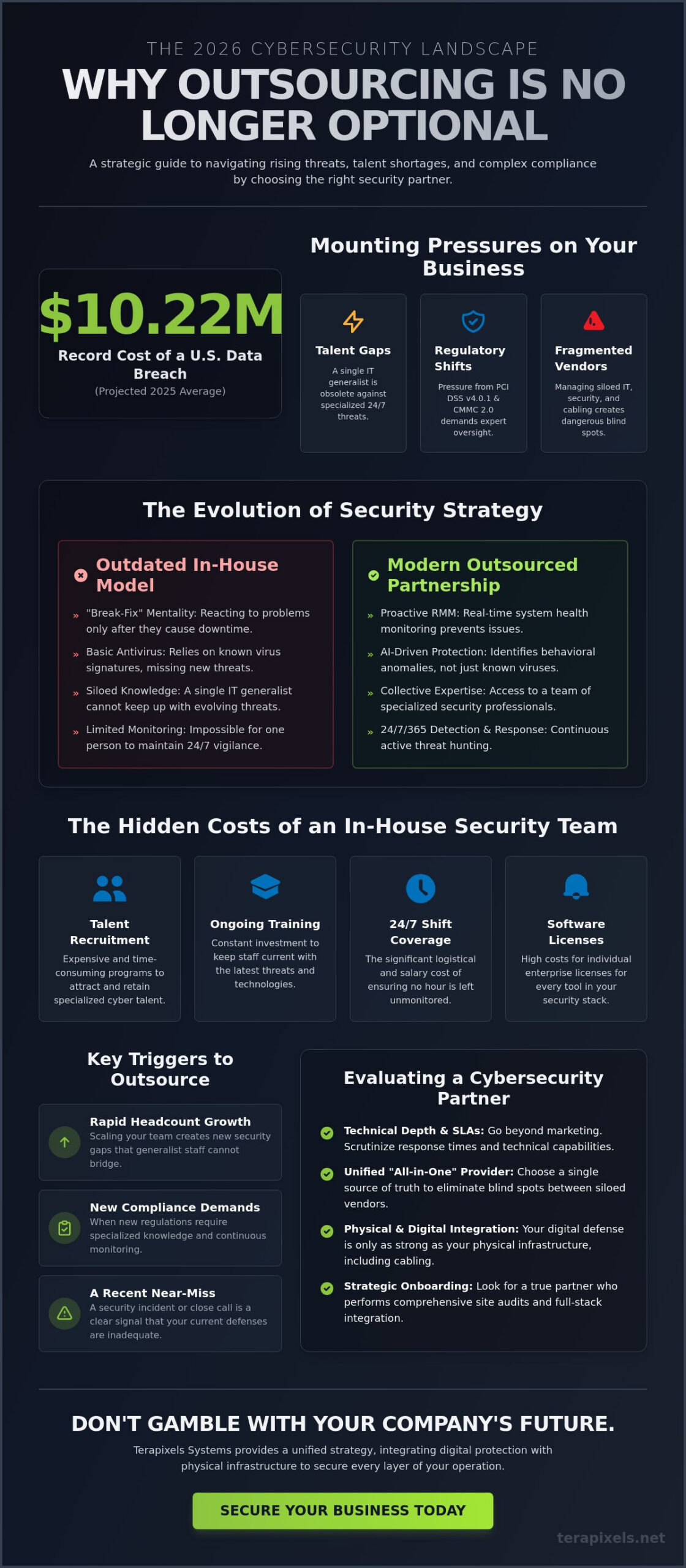
With the average cost of a data breach in the United States reaching a record $10.22 million in 2025, many leaders are looking for outsourced cybersecurity services for business to close their defense gaps. It’s exhausting to manage a fragmented web of IT vendors, security contractors, and cabling specialists while trying to keep up with the high cost of hiring specialized talent. You likely feel the pressure of shifting regulations like PCI DSS v4.0.1 and the upcoming CMMC 2.0 assessments, knowing that a single oversight could lead to heavy penalties or a total loss of trust.
Securing your digital assets shouldn’t feel like a gamble with your company’s future. We understand that you need a steady hand to manage complex background systems so you can focus on your core objectives. This guide will show you how to evaluate and select a partner that integrates digital protection with physical infrastructure to secure every layer of your operation. We’ll walk through the essential criteria for 2026, from continuous compliance monitoring to the importance of establishing a singular source of truth for all your security and technical needs.
Key Takeaways
- Understand why the 2026 cyber talent gap makes it impossible for a single IT hire to manage modern threats, necessitating a move toward continuous detection and response.
- Learn how to evaluate outsourced cybersecurity services for business by prioritizing technical depth and “all-in-one” providers that offer unified visibility across your entire network.
- Discover why your digital defense is only as strong as your physical infrastructure and how your cabling dictates the security of your hardware layer.
- Explore the strategic onboarding process that transforms a service provider into a long-term partner through comprehensive site audits and full-stack integration.
Why Businesses are Moving to Outsourced Cybersecurity Services in 2026
The concept of security has evolved from a static software installation into a dynamic, around-the-clock partnership. Modern Managed security services (MSS) provide the continuous threat detection and rapid response capabilities required to protect a company’s reputation. Relying on outsourced cybersecurity services for business ensures that your organization isn’t just reacting to alarms but actively hunting for vulnerabilities before they’re exploited. By 2026, the sheer volume of sophisticated threats has made the traditional model of hiring a single IT generalist to handle security completely obsolete. No individual can maintain 24/7 vigilance while staying updated on the latest ransomware variants and zero-day exploits.
To see how these strategies are applied in the current market, watch this helpful video:
A major shift in 2026 is the movement away from the “break-fix” mentality, where problems are addressed only after they cause downtime. Instead, businesses now rely on proactive Remote Monitoring Management to maintain system health in real-time. This transition also involves replacing basic antivirus software with AI-driven endpoint protection that identifies behavioral anomalies rather than just matching known virus signatures. It’s a fundamental change that prioritizes stability over emergency repairs.
The Hidden Costs of In-House Security Teams
Building an internal department involves significant expenses that go far beyond a simple salary. You have to account for:
- Expensive recruitment and retention programs for specialized cyber talent.
- Ongoing training to keep staff current with evolving threats.
- The logistical cost of 24/7 shift coverage to ensure no hour is left unmonitored.
- Individual enterprise software licenses for every tool in the security stack.
Security ROI is best measured as the total value of avoided breach costs and the prevention of operational downtime.
When to Trigger the Outsourcing Decision
Certain milestones indicate it’s time to transition to outsourced cybersecurity services for business. Rapid headcount growth often creates security gaps that generalist IT staff can’t bridge, especially when facing specialized ransomware threats. New compliance requirements or a recent near-miss incident should also serve as a signal that your current infrastructure needs professional, scalable oversight. A specialized partner acts as a steady hand, managing these complex background systems, and you can check out IT Works for strategic digital solutions so you can focus on your own core objectives.
Evaluating Cybersecurity Consulting Services: A Strategic Buying Guide
Selecting a partner for your digital defense requires looking beyond a standard marketing deck. You need to assess technical depth and response time Service Level Agreements (SLAs) with the same rigor you’d apply to any other critical infrastructure project. Effective outsourced cybersecurity services for business must offer more than just a help desk; they should act as a reliable architect for your entire digital environment. This includes ensuring that your network security for small business is robust enough to handle modern traffic without compromising safety, even if your company isn’t in a high-tech industry.
Siloed software vendors often create blind spots that hackers are quick to exploit. When one company handles your firewall and another manages your cloud access, critical data can fall through the cracks. All-in-one providers eliminate these gaps by offering a unified view of your entire infrastructure. This holistic approach aligns with the Federal Trade Commission cybersecurity framework, which emphasizes the need for comprehensive risk assessment across all business operations. If your business operates across multiple locations, a provider with a national service footprint ensures consistent protection and local support regardless of where you expand.
Critical Service Components to Look For
To achieve this level of technical depth, businesses often partner with specialized firms like Test Triangle, which provides global IT services in software testing and DevOps to ensure that security is a core component of the application lifecycle.
Vetting the Provider’s Security Pedigree
Verify certifications and a history of managing complex, critical infrastructure projects. A reliable partner should have a clear, documented strategy for disaster recovery and business continuity planning that doesn’t just focus on data backups but on how quickly your operations can return to normal. If you’re ready to strengthen your defenses, exploring our range of integrated security solutions is an excellent starting point for establishing a long-term partnership. We focus on the technical background so you can focus on your core objectives with quiet confidence.
Beyond the Firewall: Integrating Physical and Digital Infrastructure
Digital defenses often focus on remote threats, yet a compromised physical access point remains the ultimate backdoor for a motivated intruder. When evaluating outsourced cybersecurity services for business, it’s vital to choose a partner that understands the symbiotic relationship between your network and the room it lives in. If a malicious actor gains physical entry to your server room, even the most sophisticated encryption can be bypassed with a direct hardware connection. True security requires a steady hand to manage both the software and the physical environment where that software resides.
High-quality infrastructure starts with understanding what is structured cabling and how it dictates the security of your hardware layer. Messy, unmanaged network closets and outdated low-voltage wiring create “shadow” access points that are difficult to monitor and easy to exploit. By implementing cloud-based access control, you create a digital audit trail essential for meeting compliance frameworks like SOC2 and HIPAA. This ensures that every entry into sensitive areas is logged, verified, and restricted to authorized personnel only, reducing liability through professional monitoring.
Securing the Physical Layer: Cabling and Access Control
Unsecured network hubs are often the weakest link in a company’s defense strategy. Beyond just organization, proper cabling ensures that hardware remains tamper-evident and that unauthorized devices can’t be easily added to the network. Cloud-based access control systems extend this protection by allowing administrators to revoke permissions instantly across multiple sites, providing a level of scalability that grows with the business.
Converged Security: The Future of Commercial Protection
Converged security is the unification of IT, physical security, and building management into a singular source of truth. Integrating an AI security camera system commercial setup allows you to feed visual data directly into your broader cybersecurity dashboard for real-time analysis. This integration enables AI video analytics to automatically trigger digital lockdowns of specific network segments the moment a physical breach is detected by a camera. To ensure your physical and digital layers are perfectly aligned, consult with Terapixels Systems about our integrated security solutions to build a more resilient foundation.
Implementing a Managed Security Strategy with Terapixels Systems
Implementing a managed strategy requires a methodical approach that aligns your technical infrastructure with your long-term goals. At Terapixels Systems, our onboarding process begins with a comprehensive site audit, moving through custom design and full-stack integration. This partnership model ensures we manage the intricate technical background of your security environment, allowing you to focus on your core business objectives with quiet confidence. By choosing outsourced cybersecurity services for business, you’re not just buying software; you’re gaining a reliable architect for your company’s stability.
Our approach creates a powerful synergy between digital oversight and physical hardware. We utilize Remote Monitoring Management to maintain the health of your entire network while simultaneously overseeing physical assets like cloud-based access control and surveillance systems. This unified strategy ensures that every component of your defense works in harmony, providing a singular source of truth for your security needs.
Customizing Your Security Roadmap
We recognize that a commercial property manager has different priorities than an industrial facility operator. While property managers might focus on high-traffic access control and AI analytics for tenant safety, industrial operators often require specialized perimeter surveillance and generator maintenance. To support these varied needs, we emphasize the installation of scalable fiber and CAT6 infrastructure. This high-bandwidth foundation is essential for supporting the advanced security technologies of 2026 and beyond.
Ongoing Maintenance and Proactive Support
In 2026, a effective maintenance cycle must cover both software patches and physical hardware reliability. Our proactive support includes regular health checks for security cameras, access control points, and backup generators to prevent failure before it occurs. This continuous vigilance ensures your systems remain resilient against evolving threats. Security isn’t a one-time product; it’s a continuous state of readiness that grows with your business. Terapixels Systems stands ready to be the steady hand that guides your technological reliability for the long term.
Securing Your Path to Long-Term Stability
The shift toward a converged security model represents a fundamental change in how modern organizations protect their assets. By unifying IT oversight with physical infrastructure, you eliminate the blind spots that siloed vendors often leave behind. This strategic alignment ensures that your business isn’t just reacting to incidents but maintaining a continuous state of readiness through professional monitoring and AI-driven security analytics.
Investing in outsourced cybersecurity services for business allows you to leverage national coverage for commercial technology solutions while maintaining a localized, partnership-driven approach. This integration of digital and physical security infrastructure creates a singular source of truth for all your technical needs, from structured cabling to cloud-based access control.
Secure your business with a comprehensive cybersecurity audit from Terapixels Systems. Let us act as the steady hand that manages your complex background systems, providing the comprehensive protection you need to focus on growth and innovation. Your future stability starts with a foundation built on precision and expert planning.
Frequently Asked Questions
What is the average cost of outsourced cybersecurity services for a mid-sized business?
The cost of security oversight varies based on your total user count, the volume of data being protected, and the complexity of your physical infrastructure. Most providers structure their fees around the specific level of monitoring and the number of endpoints required to secure your network. It’s best to view these services as a scalable investment that grows with your company rather than a one-size-fits-all expense.
Can an outsourced provider help with regulatory compliance like GDPR or CCPA?
Yes, a professional partner implements the technical safeguards and encryption protocols necessary to meet the requirements of GDPR, CCPA, and other modern privacy laws. By utilizing outsourced cybersecurity services for business, you establish a continuous audit trail for all data access and physical entries. This level of documentation is essential for proving compliance during regulatory reviews and reducing your organization’s liability.
How does outsourced cybersecurity differ from a standard managed service provider (MSP)?
While a standard MSP focuses on general IT health, help desk support, and system uptime, a cybersecurity provider specializes in threat hunting and risk mitigation. A standard provider ensures your systems are operational, but a security partner focuses on ensuring those systems aren’t compromised by sophisticated actors. It’s a shift from general maintenance to an active defense strategy that protects your digital and physical assets.
Is it possible to outsource only specific parts of our security infrastructure?
You can certainly choose a co-managed model where you outsource specific high-level tasks like 24/7 SOC monitoring while keeping routine IT tasks in-house. This allows you to leverage specialized AI analytics and technical depth without replacing your existing staff. It’s a flexible approach that provides a steady hand for complex systems while your internal team focuses on daily business objectives.
What happens to our security during a total power outage or network failure?
A well-designed security architecture includes physical redundancies like generator maintenance and battery backups to ensure your defenses remain active. Cloud-based surveillance and access control systems are typically built with local storage and processing capabilities that continue to function even during a network disconnect. These fail-safes ensure that your physical perimeter remains secure and your data stays protected until full connectivity is restored.