CONTACT US

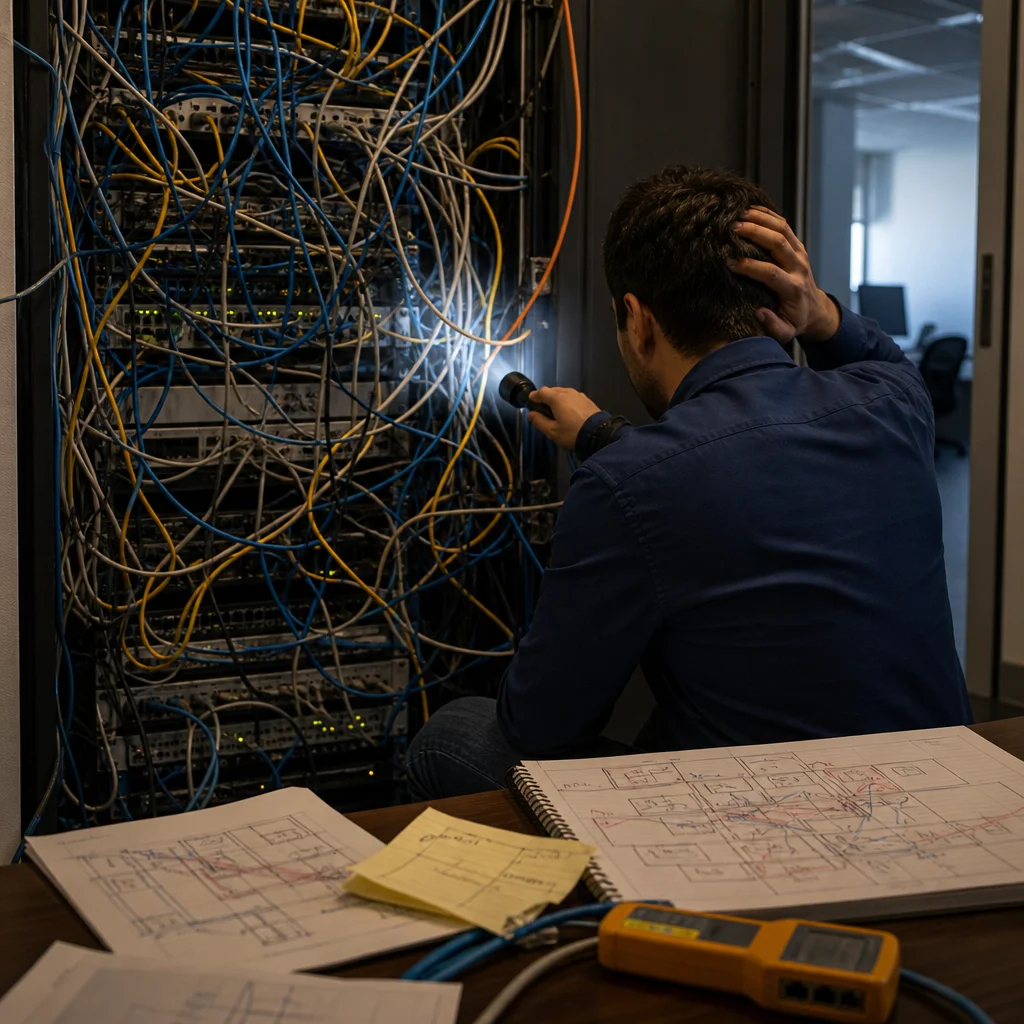
With the number of active IoT devices projected to exceed 25.4 billion by 2030, your building’s infrastructure is no longer just a set of wires; it’s the essential nervous system of your entire operation. You’ve likely felt the frustration of messy “spaghetti” wiring in the server room or experienced the lag that disrupts a critical security feed. These obstacles don’t just cause downtime. They signal that your current setup can’t keep pace with the high-bandwidth demands of modern business. By implementing a high-performance low voltage structured cabling system, you can eliminate these bottlenecks and create a stable foundation for your security and data needs.
We understand that staying ahead of technology shifts is a constant challenge for any facility manager. This guide will show you how to build a scalable, organized network that supports AI analytics and high-power PoE devices while ensuring you meet the requirements of the 2025 California Electrical Code. You’ll discover the strategic advantages of transitioning to Cat6a and fiber optics to support your facility’s long-term growth and technical reliability. We’ll walk through the essential standards and trends that define modern infrastructure for 2026 and beyond.
Key Takeaways
- Learn how a standardized low voltage structured cabling architecture replaces disorganized point-to-point wiring to create a reliable foundation for your business.
- Identify the specific scenarios where Cat6A copper cabling provides the best value and when your facility should transition to high-speed fiber optics.
- Discover the practical steps to ensure your infrastructure complies with the 2025 California Electrical Code and local standards in San Diego and Orange County.
- See how an organized network reduces maintenance downtime and provides the bandwidth necessary for advanced AI analytics and cloud-based security tools.
- Understand the importance of a unified design that integrates power monitoring, access control, and data systems into one manageable ecosystem.
Table of Contents
Understanding Low Voltage Structured Cabling for Modern Facilities
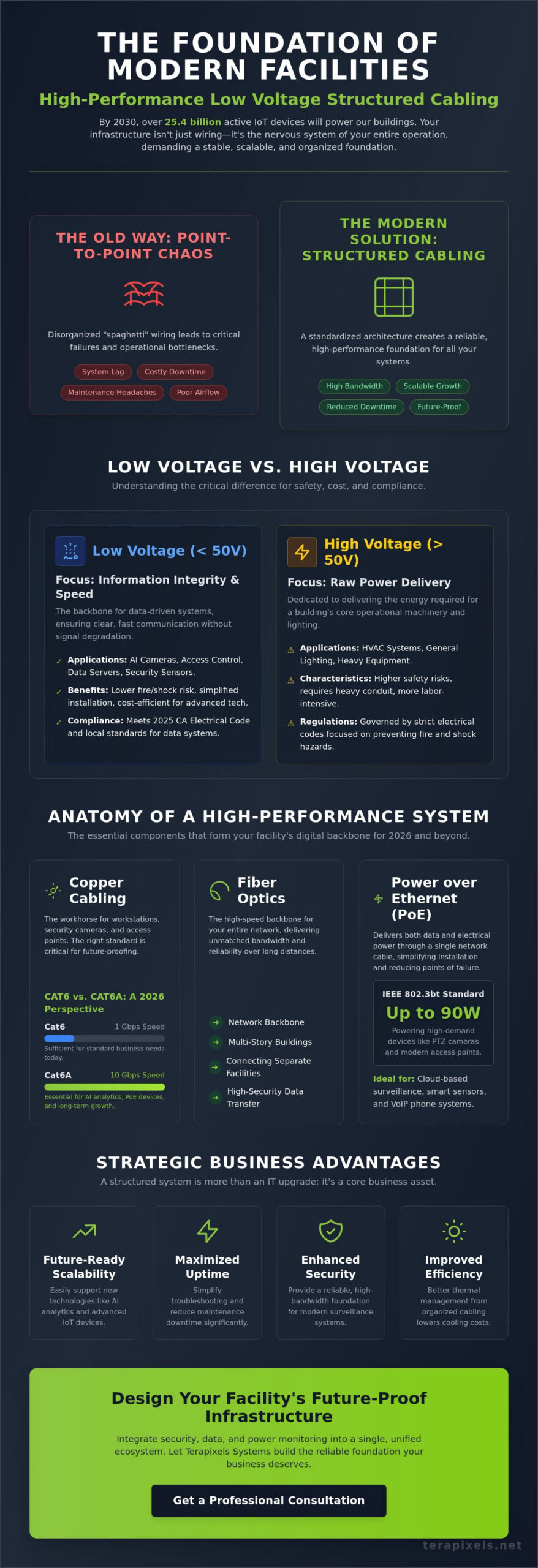
In a modern commercial facility, the infrastructure that powers your high-definition cameras and data servers is fundamentally different from the lines that power your HVAC or lighting. By definition, low voltage systems operate at 50 volts or less. While high-voltage electrical work focuses on energy delivery, low voltage structured cabling focuses on the integrity and speed of information. By 2026, facilities require more than just basic connectivity; they need dedicated, high-performance pathways capable of supporting AI-driven analytics and cloud-based systems without signal degradation.
At the center of this ecosystem sits the Main Distribution Area (MDA). This hub acts as the central nervous system where all external service provider lines meet your internal network. Instead of a chaotic web of point-to-point connections, a structured approach uses the MDA to distribute signals through a standardized hierarchy. This methodical organization ensures that if one component fails or requires an upgrade, the rest of your facility remains operational and secure. It’s the difference between a reactive “fix-it” culture and a proactive, scalable business environment.
The Digital Backbone: Beyond Basic Wiring
Moving away from “spaghetti” wiring isn’t just about aesthetics; it’s a strategic business decision. This structured cabling overview highlights how subsystems work together to create a unified environment for data, voice, and security. Beyond organization, a structured layout significantly improves thermal management. When cables are neatly bundled and routed through dedicated pathways, they don’t obstruct the airflow of your server racks. This leads to lower cooling costs and extends the lifespan of your expensive hardware. Structured cabling serves as the fundamental physical infrastructure that supports every technological application within a modern facility.
Low Voltage vs. High Voltage: Knowing the Difference
Safety is the primary driver behind the distinction between these two systems. Low voltage cabling carries a significantly lower risk of fire and electrical shock, which simplifies the physical installation process. However, don’t mistake simplicity for a lack of regulation. In California, commercial properties must navigate specific permitting nuances that vary between jurisdictions like San Diego and Orange County. Utilizing low voltage for specialized sensors, AI cameras, and access control points is highly cost-efficient. It allows for the deployment of sophisticated technology without the heavy conduit and labor costs associated with high-voltage power lines. This distinction ensures your facility remains compliant while maximizing your budget for advanced security and networking tools.
The Anatomy of a High-Performance Low Voltage System
Building a resilient network requires a precise mix of physical media tailored to your facility’s specific operational demands. A high-performance low voltage structured cabling system relies on four primary components: copper, fiber, coaxial, and Power over Ethernet (PoE) technology. While copper handles the majority of workstation and security camera connections, fiber optics provide the high-speed backbone necessary for multi-story buildings. In 2026, we’re seeing an increased need for specialized cabling that integrates with renewable energy systems, such as commercial solar arrays and EV charging stations, ensuring that data from these green energy assets flows seamlessly to your management dashboard.
PoE technology has become a cornerstone of modern facility design. By delivering both data and up to 90W of electricity through a single cable, it follows the IEEE 802.3bt standard to eliminate the need for separate electrical outlets at every camera or sensor location. This integration is particularly valuable when deploying cloud-based surveillance systems, as it simplifies the installation and provides a cleaner, more reliable power source for your security hardware. It’s a methodical way to reduce the number of failure points in your infrastructure while supporting the high-power demands of modern AI security camera system commercial deployments.
Copper Standards: CAT6 vs. CAT6A in 2026
Copper remains the workhorse of the modern office, but the choice between standards has significant long-term implications. Cat6 supports 1Gbps speeds, which is sufficient for many standard business applications. However, for 4K surveillance feeds and high-density environments, CAT6 cabling installation for commercial buildings increasingly favors Cat6A. This standard supports 10Gbps speeds and features superior shielding (STP) to mitigate electromagnetic interference. Following the Whole Building Design Guide for telecommunications, selecting the right shielding ensures your data remains clear even in environments with heavy machinery or high-voltage lines.
Fiber Optics for Campus and Multi-Story Facilities
When distances exceed 100 meters, fiber optics become the essential choice for backbone connectivity. Multi-mode fiber is ideal for shorter runs within a single building, while single-mode fiber offers virtually unlimited bandwidth for campus-wide links. This infrastructure is critical for supporting remote monitoring management for business, allowing for real-time oversight of disparate systems from a central hub. Investing in fiber today is a 25-year strategy; it provides the headroom needed for future AI analytics and high-speed networking without requiring a complete rip-and-replace of your physical pathways. If you’re planning a facility upgrade, we can help you design a customized cabling layout that balances performance with budget.
Strategic Benefits: Why Structured Cabling is a Business Asset
Viewing your facility’s infrastructure as a static expense is a common oversight. In reality, a high-quality low voltage structured cabling system is a dynamic business asset that directly impacts your bottom line. Scalability is perhaps the most immediate benefit. When your cabling is organized into standardized zones, adding new workstations or high-definition cameras doesn’t require tearing out walls or disruptive construction. It’s a plug-and-play approach that allows your physical space to evolve alongside your personnel needs without the high costs of retrofitting outdated wiring.
System reliability is another critical factor. Organized labeling and rigorous testing, performed according to BICSI cabling standards, significantly reduce the time required to identify and resolve network issues. When every cable is documented and mapped, your technical team can bypass the “search and rescue” phase of troubleshooting. This precision minimizes downtime, ensuring that your operations remain steady and your security monitoring stays live. For commercial real estate owners, this modern infrastructure also increases property value, as prospective tenants prioritize buildings that are ready for immediate, high-bandwidth occupancy.
Future-Proofing for AI and IoT
We’re rapidly moving toward the “Smart Building” era, where every device from HVAC sensors to lights is networked. With the number of active IoT devices projected to exceed 25.4 billion by 2030, your backbone must be ready for massive data throughput. This infrastructure is essential for a successful business security camera installation, as AI-driven analytics require high-bitrate pathways to process visual data in real-time. A robust structured cabling foundation is equally critical for deploying a fully integrated commercial AI security camera system that can deliver proactive, data-driven threat detection across your entire facility. Similarly, robust cabling supports advanced keycard access control systems for business, ensuring that entry points remain responsive and integrated with your broader security ecosystem.
Optimizing Business Continuity and RMM
The physical quality of your cable runs has a direct correlation with your digital network security for small business. Poorly shielded or improperly installed cables can lead to signal interference, which creates vulnerabilities and system lag. By utilizing low voltage structured cabling, you ensure that Remote Monitoring Management (RMM) tools receive accurate, real-time data from every corner of your facility. This reduces signal latency, which is vital for real-time operations and automated threat responses. A well-constructed network doesn’t just connect devices; it provides the stability needed for your business to grow with confidence.
Planning and Compliance in San Diego and Orange County
Compliance in Southern California requires more than just technical skill; it demands a deep understanding of evolving state and local regulations. Starting January 1, 2026, the 2025 California Electrical Code (Title 24, Part 3) becomes mandatory for all new construction and major renovations. This update is based on the 2023 National Electrical Code (NEC) but includes specific California amendments that facility managers must follow. In jurisdictions like San Diego and Orange County, local building departments often adopt even more restrictive amendments based on local climatic or geological conditions. Working with an experienced structured cabling contractor in San Diego ensures your project stays on schedule and avoids the high costs of failed inspections or required rework.
Proper documentation is the foundation of a compliant system. We prioritize professional CAD design and detailed “as-built” documentation for every project. This isn’t just a best practice; it’s a necessity for maintaining your facility’s long-term safety and operational efficiency. When your infrastructure is clearly mapped, future upgrades to your security or data systems become significantly easier to manage. It’s a partnership-driven approach that values precision and long-term planning over quick, temporary fixes.
California Building Codes and Title 24 Requirements
The 2025 edition of Title 24 places a heavy emphasis on electrification and energy efficiency. This shift directly impacts how we design low voltage structured cabling for networked lighting, automated controls, and environmental sensors. One of the most critical code requirements involves fire safety standards in air handling spaces. You must use plenum-rated cabling in these areas to prevent the spread of toxic smoke in the event of a fire. Additionally, the code mandates proper physical support for all cable runs. Utilizing specialized J-hooks and cable trays prevents the structural sag that can lead to signal degradation or safety violations. These small details are vital for maintaining the integrity of your facility’s digital backbone.
The Build-out Process: From Design to Certification
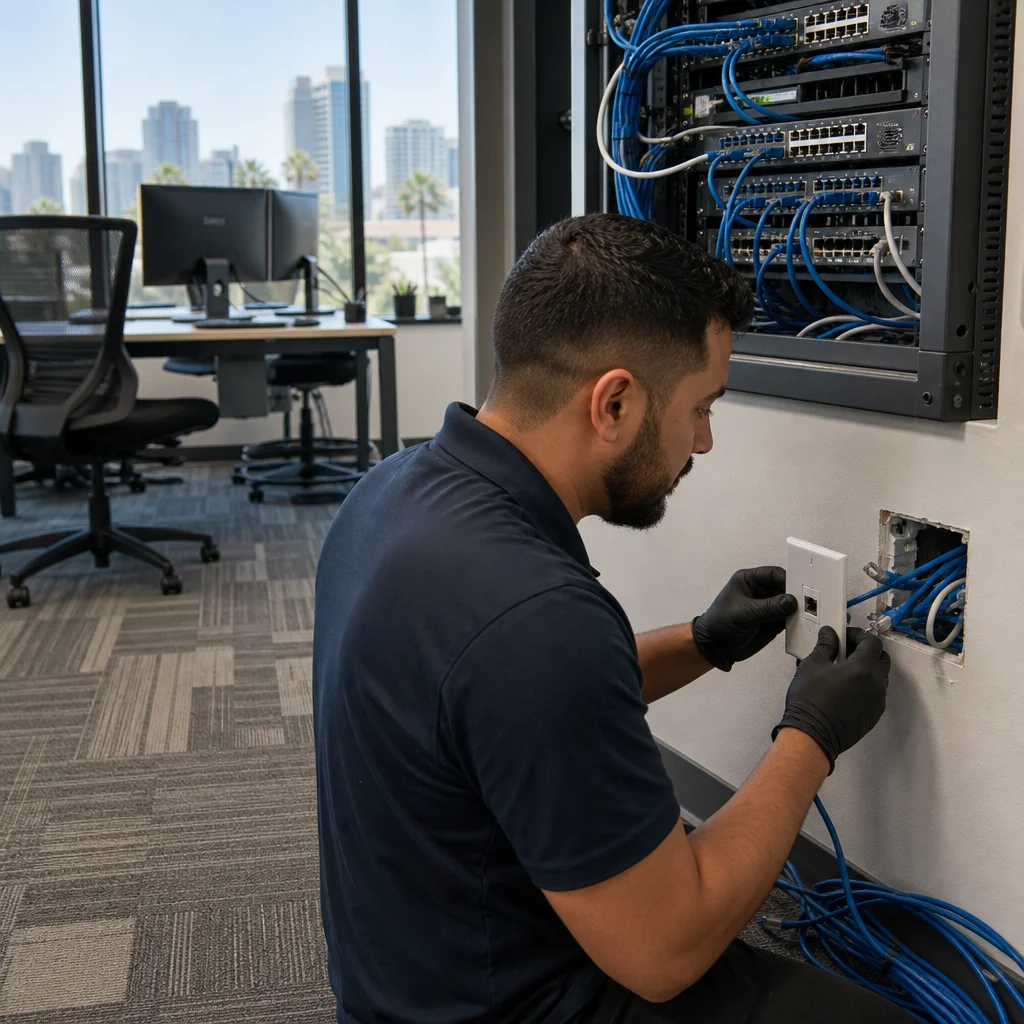
A successful installation begins with a comprehensive site survey to identify the unique architectural challenges often found in older Southern California commercial buildings. We use these surveys to create a roadmap that bypasses potential bottlenecks. Once the physical installation is complete, every cable drop undergoes rigorous testing and certification. We provide a Fluke test report for each connection to verify that it meets the required bandwidth and performance standards. Finally, we adhere to the TIA/EIA-606-B labeling standard for all components. This methodical approach ensures that your low voltage structured cabling remains organized and easy to troubleshoot for years to come. If you’re ready to ensure your facility meets these new standards, contact Terapixels Systems for a professional compliance assessment.
Designing Your Infrastructure with Terapixels Systems
Terapixels Systems approaches every facility as a unique technological ecosystem where every component must work in harmony. We don’t just pull wires; we act as a reliable architect to ensure your low voltage structured cabling serves as a robust foundation for your entire operation. By integrating security, networking, and energy management under one roof, we eliminate the friction of dealing with multiple disconnected vendors. This holistic approach is especially critical for specialized needs like backup generator installation for business, where real-time monitoring via your data network ensures your continuity plan is always ready to activate.
Our partnership-driven mindset means we stay with you long after the initial installation is complete. We provide ongoing maintenance and Remote Monitoring Management (RMM) platform solutions to ensure your systems maintain 2026-level performance throughout their lifecycle. This proactive stance allows us to identify potential bottlenecks before they impact your productivity, providing a level of stability that lets you focus on your core business objectives. It’s a steady, methodical approach to infrastructure that values precision over quick fixes.
Cabling for Security and Access Control
Designing a network for physical security requires a sophisticated understanding of data prioritization. We implement dedicated VLANs via your low voltage structured cabling to ensure cloud-based surveillance traffic remains separate from your standard business data. This separation is vital for maintaining zero-latency performance for AI-driven facial recognition and advanced analytics. Whether we are installing a multi-door access control system or a complex CCTV network, our designs ensure that every security endpoint has the high-bandwidth pathway it needs to function reliably under any conditions. This level of technical precision is also a cornerstone of high-end residential automation; you can discover PREMIERE SYSTEMS DESIGN to see how custom integration creates a similar level of harmony in luxury home environments.
The Energy Connection: Solar and EV Monitoring
Beyond traditional IT, modern facilities must manage an increasing number of electrified assets. The 2025 California Building Standards Code emphasizes a move toward all-electric systems, making the integration of energy monitoring more important than ever. Our cabling solutions connect your commercial solar arrays and smart EV charging stations directly to your central management hub. This allows for precise load balancing and performance tracking, ensuring your renewable energy investments are operating at peak efficiency. Terapixels Systems serves as the singular, all-encompassing source for the integrated infrastructure that powers your security, data, and sustainable energy systems.
Building a Resilient Future for Your Facility
Modern infrastructure is no longer a luxury but a necessity for operational continuity. We’ve explored how a standardized low voltage structured cabling system eliminates data bottlenecks and prepares your facility for the high-bandwidth demands of AI analytics and cloud-based surveillance. By aligning your physical pathways with the 2025 California Electrical Code, you ensure long-term compliance and safety. This methodical approach protects your investment and provides the scalability needed to integrate emerging technologies like smart EV charging and commercial solar monitoring.
Terapixels Systems serves as your dedicated partner in this transition. Our BICSI Certified Technicians specialize in the specific commercial codes of San Diego and Orange County; we ensure every installation meets the highest industry standards. As experts in both security and energy integration, we provide a singular source of truth for your most complex technical needs. It’s time to replace outdated wiring with a stable, high-performance backbone that supports your long-term growth. Schedule your low voltage infrastructure consultation with Terapixels Systems today to start designing a more reliable tomorrow.
Frequently Asked Questions
What is the difference between low voltage and structured cabling?
Low voltage refers to the electrical category of systems that operate at 50V or less, while structured cabling is the standardized architecture used to organize those systems. Think of low voltage as the type of power being used and low voltage structured cabling as the specific blueprint that ensures your data, security, and voice networks remain manageable and scalable. Without a structured approach, low voltage wiring often becomes a disorganized “spaghetti” mess that’s difficult to maintain.
Does my low voltage project in San Diego require a permit?
Most commercial projects in San Diego and Orange County require a permit to ensure they comply with the 2025 California Electrical Code. Requirements often depend on whether the installation involves plenum-rated air spaces or requires new pathways through fire-rated walls. We handle the technical documentation necessary for these permits to ensure your facility meets all local safety and energy standards from the start.
How long does a typical low voltage cabling installation take?
The timeline for low voltage structured cabling depends on the facility’s square footage and the total number of cable drops required. A standard office suite might be completed in a few days, while a multi-story industrial facility or campus could take several weeks. We establish a clear project schedule after our initial site survey to ensure the installation process doesn’t disrupt your daily business operations.
Can I use existing Cat5e for my 2026 security system upgrade?
Cat5e is considered outdated for 2026 installations because it lacks the bandwidth to support 10Gbps speeds or high-power PoE requirements. Modern AI-driven security cameras and 4K surveillance systems require the superior performance of Cat6a or fiber optics. Reusing old Cat5e often leads to system lag and prevents you from utilizing the latest security analytics and cloud-based features; you can learn more about professional-grade hardware designed for these advanced networks.
What is the lifespan of a fiber optic structured cabling system?
A professionally installed fiber optic system typically has a functional lifespan of 25 years or more. While the active hardware like switches and cameras may be replaced every few years, the glass fiber backbone provides nearly unlimited bandwidth headroom for future technologies. This longevity makes fiber the most cost-effective long-term investment for any facility’s digital infrastructure.
Why is professional labeling so important for low voltage systems?
Professional labeling according to the TIA/EIA-606-B standard is the key to reducing long-term maintenance costs and downtime. When every cable and port is clearly identified, your technical team can troubleshoot and resolve connectivity issues in minutes rather than hours. This organized approach eliminates the guesswork that typically leads to human error during system upgrades or repairs.
Does Terapixels Systems provide as-built drawings after installation?
Yes, we provide comprehensive as-built drawings and CAD documentation as a standard part of our partnership. These documents act as a permanent map of your facility’s infrastructure, showing exactly where every cable is routed and where every endpoint is located. This level of detail is essential for future expansions and ensures that any subsequent technical work is performed with total accuracy.
How does PoE (Power over Ethernet) benefit my facility’s low voltage design?
PoE allows you to deliver both high-speed data and electrical power through a single cable to devices like cameras, sensors, and access control points. By following the IEEE 802.3bt standard, we can provide up to 90W of power to high-demand AI tools without installing separate electrical outlets. This integration simplifies your building’s design, reduces material costs, and creates a cleaner, more efficient infrastructure.