CONTACT US
In 2026, the copper cabling running through your office walls is no longer just a passive utility; it is the thermal and power foundation for your entire AI-driven infrastructure. Most business leaders recognize that a network upgrade is a significant capital investment, and there is a valid concern that today’s cost-saving measures might lead to an expensive rip-and-replace project in just a few years. It’s a high-stakes decision where the labor costs of installation often outweigh the price of the materials themselves.
This strategic guide clarifies the CAT6 vs CAT6a for future-proofing office network debate by analyzing how each standard handles 10Gbps speeds, high-density PoE++, and the rigorous bandwidth demands of Wi-Fi 7. You will discover the technical and financial nuances required to build a resilient physical layer that supports your long-term growth. We’ll examine total cost of ownership and heat dissipation specs to ensure your network remains a reliable asset for the next decade.
Key Takeaways
- Identify the critical distance limitations of CAT6 at 10Gbps speeds and why CAT6a is the only copper standard that guarantees high-performance data delivery across a full 100-meter run.
- Explore how CAT6a’s thicker 23 AWG conductors manage the heat generated by PoE++ to safely power advanced AI security camera systems and modern Wi-Fi 7 hardware.
- Analyze the financial logic of the CAT6 vs CAT6a for future-proofing office network choice, focusing on how a slightly higher initial investment prevents the prohibitive labor costs of a future rip-and-replace.
- Understand the role of professional cabling certification in verifying that your physical layer is truly capable of supporting the next decade of cloud-based applications and AI analytics.
Technical Comparison: Speed, Bandwidth, and Distance Limits
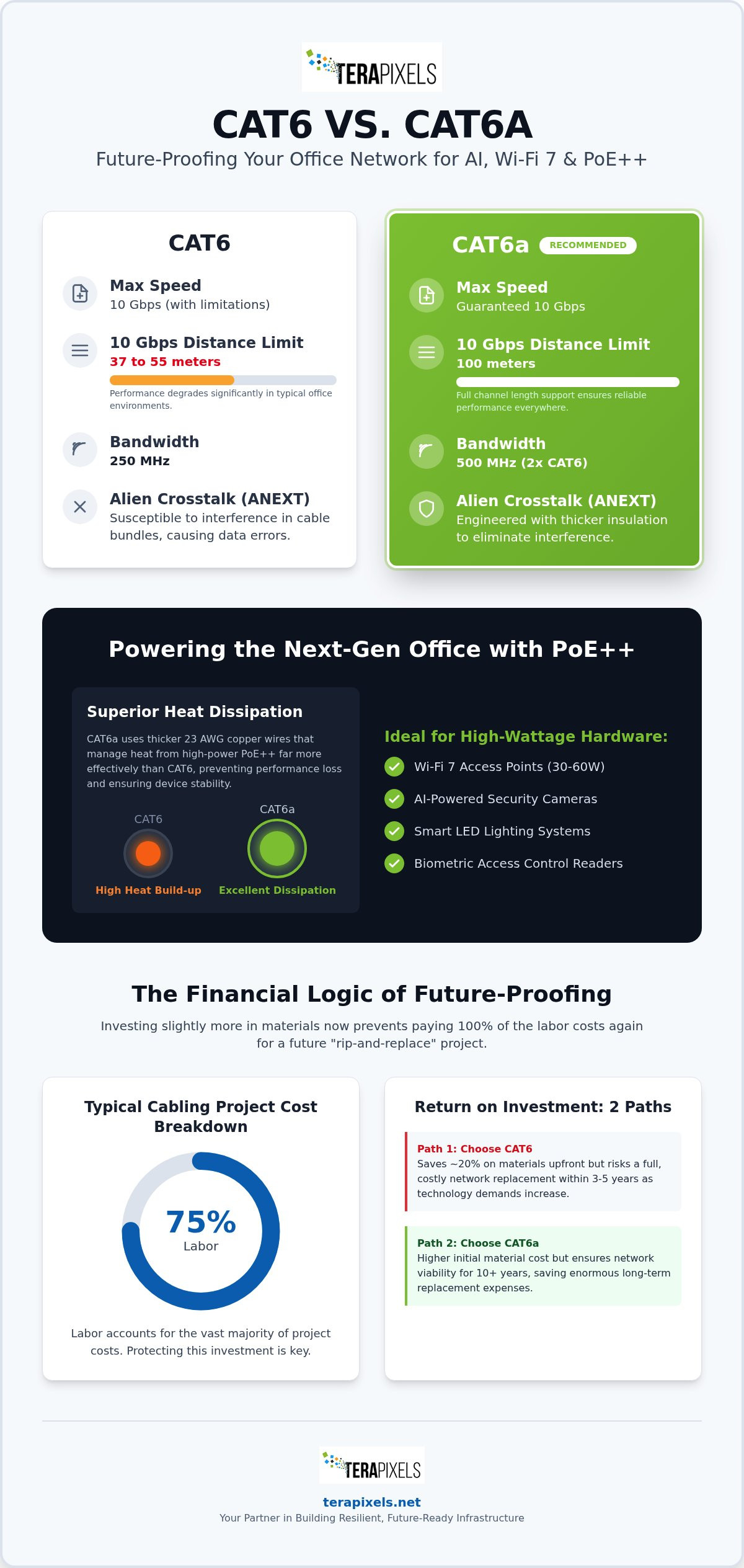
Choosing between copper standards requires looking closely at raw data capacity. CAT6 operates at a frequency of 250 MHz, while CAT6a doubles that performance to 500 MHz. In 2026, this bandwidth gap is critical because modern AI applications and high-resolution data streams require a wider pipe to prevent latency. When you evaluate CAT6 vs CAT6a for future-proofing office network needs, the most immediate difference is the 10Gbps distance limitation. Standard CAT6 can only support 10Gbps speeds up to 37 to 55 meters, depending on the surrounding interference. In contrast, CAT6a guarantees 10Gbps performance across the full 100-meter channel length.
This reliability is why understanding what is structured cabling matters so much for your long-term architecture. If your office layout requires runs longer than 50 meters, opting for CAT6 creates an immediate performance ceiling. You’ll likely face expensive hardware workarounds or a full cable replacement much sooner than expected.
The 10GBASE-T Standard and Alien Crosstalk
CAT6a was specifically engineered to meet the 10GBASE-T standard without compromise. The primary technical hurdle it solves is Alien Crosstalk, or ANEXT. This occurs when signals from one cable interfere with those in an adjacent cable within the same bundle. Because CAT6a features tighter internal twists and thicker insulation, it effectively neutralizes this interference. The larger physical diameter of CAT6a ensures that copper pairs are spaced far enough apart to maintain signal integrity in high-density office trays. While CAT6 might work for 10Gbps in a laboratory setting, it often fails in real-world commercial bundles where dozens of cables run side-by-side. CAT6a provides the quiet, stable environment required for high-speed data transmission across your entire facility. This level of reliability is essential for specialized systems like those from TechArts, where professional audio, video, and lighting integrations require a pristine signal path to function at their peak.
Beyond Speed: PoE Efficiency and Support for AI Infrastructure
Modern office networks do more than just move bits; they distribute power. The rise of PoE++ (802.3bt) has transformed the physical layer into a power grid for smart lighting and high-performance hardware. When weighing CAT6 vs CAT6a for future-proofing office network infrastructure, you must consider the power requirements of a modern AI security camera system commercial deployment. These advanced sensors and Wi-Fi 7 access points demand significantly more wattage than previous generations.
Reliable power delivery is the foundation of effective remote monitoring management for business. If the cabling can’t handle the load, your hardware may reboot or fail during peak usage. This stability is equally vital for maintaining robust network security for small business, as physical layer failures often create vulnerabilities that software can’t fix.
Thermal Management in High-Density Cable Bundles
The physical construction of the cable determines how it handles heat. CAT6a utilizes 23 AWG conductors, which are thicker than the wires typically found in CAT6. This extra copper is essential for heat dissipation when cables are tightly packed in bundles. Running high-wattage PoE through thinner wires causes a temperature rise that can degrade data performance or even damage the cable jacket over time. For businesses looking to optimize their wireless performance with these standards, you can learn more about KINETIX IT Infrastructure and their professional mesh network solutions.
Consider this checklist for 2026 hardware that performs best on CAT6a:
- Wi-Fi 7 Access Points requiring 30W to 60W of power.
- High-resolution AI analytics cameras with motorized pan-tilt-zoom.
- Smart LED lighting systems integrated into the building’s automation.
- Biometric access control readers with integrated video displays.
Investing in the right physical layer ensures these systems remain operational without the risk of thermal throttling. Maintaining a stable physical layer is the first step toward achieving comprehensive network protection for your facility.
Strategic Implementation: Maximizing ROI in Commercial Environments
Decision-makers often hesitate at the higher material cost of CAT6a, yet this perspective misses the broader financial picture. In most commercial projects, labor accounts for 70% to 80% of the total expenditure. When you evaluate CAT6 vs CAT6a for future-proofing office network systems, you’re really protecting that labor investment. Spending roughly 20% more on high-grade materials now saves you from paying 100% of those labor costs again during a mid-decade retrofit. It’s a pragmatic choice that prioritizes long-term stability over short-term savings.
Looking ahead to 2030, the demands of edge computing and localized AI processing will likely push networks toward 25G and 40G standards. CAT6a offers the necessary headroom to handle these transitions without immediate infrastructure failure. To streamline this process, it’s wise to review a 2026 network cabling checklist for new office build-outs during the early design phase. This ensures your physical layer is prepared for the next generation of hardware before the walls are closed.
Why Professional Certification and RMM Readiness Matter
Reliable performance requires more than just high-quality spools. A certified CAT6 cabling installation commercial standard involves rigorous Fluke testing to verify that each run meets strict 10Gbps requirements. This level of precision in low voltage structured cabling ensures that your remote monitoring and cybersecurity tools have a consistent, error-free physical layer. Professional certification provides the documented proof that your network is ready for the high-bandwidth challenges of the next decade, giving you the confidence that your infrastructure won’t become a bottleneck as your business grows.
Securing Your Infrastructure for the Decade Ahead
Building a network that supports the next generation of AI and high-speed data requires a shift from short-term savings to long-term architectural stability. By choosing CAT6a, you ensure your facility can handle the heat of high-density PoE++ bundles and the bandwidth of Wi-Fi 7 without performance degradation. The choice of CAT6 vs CAT6a for future-proofing office network infrastructure ultimately rests on protecting your labor investment and ensuring business continuity. This physical layer is the silent partner in your company’s growth, providing the quiet confidence that your systems will remain online as technology evolves.
As national commercial technology experts, we specialize in certified 10Gbps network testing and comprehensive security and AI integration. We’re ready to help you design a foundation that remains reliable well into the 2030s.
Frequently Asked Questions
Is CAT6a backwards compatible with CAT6 and CAT5e hardware?
Yes, CAT6a is fully backwards compatible with existing CAT6 and CAT5e hardware. It uses the standard RJ45 connector, ensuring it fits into your current switches, patch panels, and wall jacks. While the cable is capable of 500 MHz frequencies, it’ll operate at the maximum speed of the connected legacy device until you eventually upgrade your active network hardware to 10Gbps standards.
Can CAT6 really handle 10Gbps speeds in a standard office environment?
Standard CAT6 can only support 10Gbps speeds under ideal conditions and across limited distances of 37 to 55 meters. In real-world commercial settings where cables are bundled together, interference often reduces this range further. When evaluating CAT6 vs CAT6a for future-proofing office network goals, CAT6a is the superior choice because it provides a guaranteed 10Gbps connection across the entire 100-meter channel.
What are the physical installation challenges of CAT6a compared to CAT6?
CAT6a is noticeably thicker and heavier than CAT6, which presents specific challenges during installation. It requires a larger bend radius to prevent internal wire damage and takes up more volume in conduits and cable trays. These physical traits mean that existing infrastructure might need larger support systems, and installers must use more precision to ensure the cable’s performance isn’t compromised by improper handling.
How does cabling choice impact the performance of AI-driven security cameras?
AI-driven security cameras demand high-wattage power via PoE++ and consistent bandwidth for 4K video analytics. CAT6a uses thicker 23 AWG conductors that dissipate heat better than the thinner wires in CAT6. This prevents the thermal throttling or power loss that can cause cameras to reboot. Choosing the right cable ensures your AI sensors operate at peak performance without the risk of signal degradation.