CONTACT US

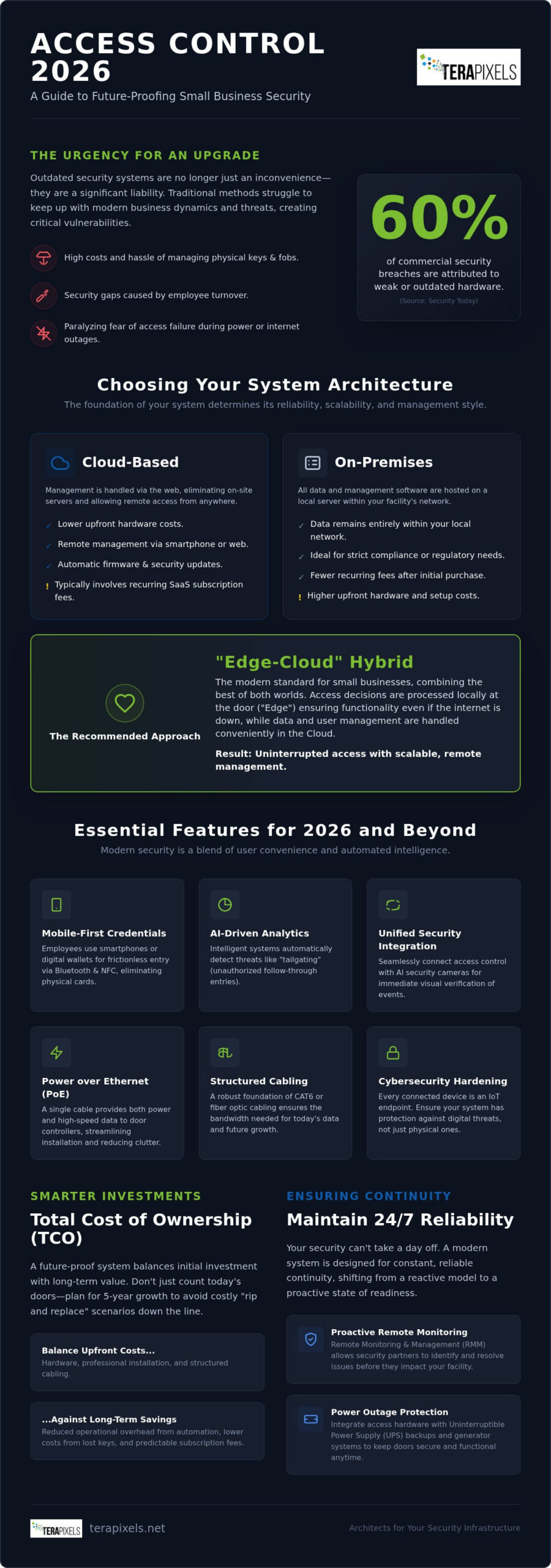
Over 60% of security breaches in commercial buildings are now attributed to weak or outdated hardware, according to research from Security Today. For many owners, the search for the best access control systems for small business 2026 is born from a deep frustration with physical keys, high employee turnover, and the fear of security gaps during a power or internet outage. You likely want a system that remains stable and supportive, allowing you to focus on your core objectives while the technology manages the perimeter with quiet confidence.
This guide helps you discover how to choose a future-proof access control system that integrates seamlessly with your business infrastructure and security goals. We’ll examine the transition to smartphone credentials, the role of AI analytics in site monitoring, and why open architecture is vital for integrating with your existing security cameras and networks. By the end, you’ll understand how to achieve a reliable, keyless entry system that lowers long-term operational costs through smart automation and professional architectural planning.
Key Takeaways
- Learn how “Edge-Cloud” architecture provides the stability of local processing with the scalability of cloud management for your facility.
- Discover the key features that define the best access control systems for small business 2026, including mobile-first credentials and automated tailgating detection.
- Master the Total Cost of Ownership analysis to balance upfront hardware costs against long-term subscription fees and operational savings.
- Understand how proactive remote monitoring and management (RMM) shifts your security from a reactive model to a state of constant, reliable continuity.
- Explore how to maintain physical security during power outages by integrating your access hardware with reliable backup power and generator systems.
Table of Contents
Evaluating Access Control Architectures: Cloud vs. On-Premises in 2026
Selecting the right architecture is the foundational step in securing your facility. In 2026, the industry has largely transitioned toward “Edge-Cloud” architecture. This hybrid model processes access permissions locally at the door while managing data and logs in the cloud. It provides a vital safety net; your doors remain functional even during a total network outage. Determining the best access control systems for small business 2026 requires balancing this local reliability with the ease of remote oversight.
To better understand these modern architectural shifts, watch this helpful overview:
A strategic Total Cost of Ownership (TCO) analysis is essential. While cloud systems often require lower initial hardware investments, they involve monthly SaaS subscriptions. Conversely, on-premises systems have higher upfront costs but fewer recurring fees. However, the best access control systems for small business 2026 are those that account for five-year growth. Don’t just count your current doors. Plan for future expansions to ensure your infrastructure scales without requiring a complete hardware “rip and replace” later.
Cloud-Based Access Control: The Small Business Standard
Cloud management effectively eliminates the “server in the closet,” reducing the burden on your IT staff. Owners can manage permissions or lock doors remotely from a smartphone, which is perfect for those who aren’t always on-site. Security is maintained through automatic firmware updates and integrated managed cybersecurity for commercial properties, ensuring your physical entry points aren’t vulnerable to digital threats.
When On-Premises Systems Still Make Sense
On-premises systems remain relevant for businesses with strict compliance mandates, such as those in defense or highly regulated sectors. These organizations often require data to stay within a local network. Understanding Access control basics helps in recognizing when to utilize existing structured cabling to support legacy hardware upgrades while maintaining a closed, high-security loop.
Essential Features for Small Business Security and Scalability
Modern security goes beyond simple door locks; it requires a sophisticated blend of user convenience and automated oversight. The best access control systems for small business 2026 prioritize mobile-first credentialing, allowing employees to use smartphones or digital wallets for frictionless entry. This shift eliminates the logistical burden of physical fobs and cards, which are frequently lost or stolen. By leveraging Bluetooth and NFC technology, your team gains secure access while you maintain a digital audit trail that updates in real time.
Automation plays a critical role in proactive protection. AI-driven analytics now identify unauthorized entry patterns, such as “tailgating,” where an individual follows an authorized user through a door without scanning. To achieve total site awareness, these systems should be integrated with AI security camera systems for immediate visual verification. Implementing Power over Ethernet (PoE) hardware further streamlines this setup, as it allows a single cable to provide both high-speed data and power to your door controllers. Partnering with a reliable architect for your security infrastructure ensures these advanced features work in harmony from day one.
The Role of Structured Cabling in Access Control
Physical security is only as stable as the wires behind the walls. Expert CAT6 cabling installation for commercial buildings provides the necessary bandwidth to support high-definition video and rapid credential processing. For businesses planning long-term growth, high-bandwidth fiber optic trunks offer a future-proof foundation that can handle increasing data loads as you add more doors or sensors to your network.
Cybersecurity Hardening for Physical Security
Every connected door controller is an IoT device that requires protection from digital threats. The best access control systems for small business 2026 utilize end-to-end encryption, securing data from the moment a reader scans a phone until it reaches the management software. This hardening prevents bad actors from using your physical security hardware as an entry point into your broader corporate network.
Implementing a Unified Security Infrastructure: The Path to 2026 Continuity
The deployment of the best access control systems for small business 2026 isn’t a one-time event; it’s the beginning of a long-term commitment to your facility’s operational health. Moving beyond a “set and forget” mindset is essential for maintaining true security. Modern systems must be actively managed through remote monitoring management for business to ensure every reader and controller remains online. This proactive approach also involves designing for physical resilience. Integrating your access hardware with backup power systems and generators ensures that doors remain secure and functional even during regional power grid failures.
A unified infrastructure ensures your security data doesn’t live in a silo. The most effective implementations create an integration roadmap that connects access logs with HR platforms and communication tools like Slack or Microsoft Teams. This allows for automated onboarding and offboarding; when an employee is removed from the HR system, their building access is revoked instantly. Choosing a partnership-driven integrator ensures these complex software handshakes are handled correctly, providing a level of reliability that DIY software-only solutions can’t match.
Uptime and Maintenance: The RMM Advantage
System downtime can lead to frustrated employees or significant security gaps. Utilizing RMM allows for real-time alerts regarding offline controllers or battery failures before they result in a lockout. This oversight ensures that critical security patches are applied automatically, keeping your hardware protected against the latest digital vulnerabilities without requiring manual intervention from your team. It’s the difference between reacting to a failure and preventing one entirely.
Choosing the Right Partner for National Implementation
Scaling the best access control systems for small business 2026 across multiple locations requires an integrator capable of managing both low-voltage cabling and high-level cybersecurity. A single point of contact for your surveillance, access, and network infrastructure reduces friction and ensures that your systems are designed to work together. This holistic architectural approach provides the peace of mind that your business is protected by a stable, well-constructed foundation of technological reliability.
Building a Resilient Foundation for Your Business Security
The transition toward more intelligent, connected environments requires a deliberate shift in how you view your building’s perimeter. Selecting the best access control systems for small business 2026 involves more than picking a software interface; it requires a strategic architectural plan that prioritizes local reliability through edge-cloud processing and high-bandwidth cabling. By integrating smartphone credentials and AI-driven analytics, you effectively eliminate the friction of legacy keys while gaining real-time visibility into your facility’s safety.
True stability is achieved when your security hardware is backed by comprehensive remote monitoring and robust cybersecurity support. This partnership ensures your systems remain online and protected against evolving digital threats without adding to your daily management burden. Terapixels Systems serves as a national expert in infrastructure and security, specializing in AI-driven cloud surveillance and access solutions designed specifically for long-term business continuity.
Investing in the right technology today secures your growth for years to come. You deserve a security partner that provides the steady hand and technical vision needed to protect your future.
Frequently Asked Questions
What is the best access control system for a small business with under 50 employees?
Cloud-based platforms that prioritize mobile-first credentials are typically the best access control systems for small business 2026 when managing a smaller workforce. These systems allow owners to manage permissions directly from a smartphone app without the need for a dedicated on-site server or complex IT infrastructure. This setup provides a professional, keyless experience that is easy to scale as your team grows.
How much does a commercial access control system cost per door in 2026?
Total investment per door is influenced by several factors, including the chosen hardware, the complexity of the locking mechanism, and the required cabling infrastructure. Ongoing software licensing fees also play a role in the long-term budget. To understand the true financial impact, you should evaluate the Total Cost of Ownership over a five-year period rather than focusing solely on the initial installation price.
Can I use my existing keycards with a new cloud-based access control system?
You can often retain your current credentials if you select multi-technology readers that support both legacy cards and modern mobile signals. It’s vital to identify whether your cards use low-frequency or high-frequency technology during the planning phase. This compatibility allows for a phased transition to mobile entry, which reduces the immediate logistical burden of reissuing credentials to every employee.
What happens to my electronic locks if the power or internet goes out?
Modern edge-cloud architecture ensures that your doors remain functional during an internet outage because access permissions are stored locally on the door controller. For power disruptions, integrated battery backups or generator systems provide the necessary electricity to keep the locks operational. This redundant design ensures that your facility remains secure and accessible even when external utilities fail.
Is a cloud-based access control system more secure than a traditional one?
Cloud-based systems offer superior security because they receive automatic firmware updates and patches to defend against emerging digital threats. Traditional on-premises systems often suffer from neglected maintenance, which can leave them vulnerable to both physical and cyber exploits. A managed cloud approach also utilizes end-to-end encryption to protect sensitive data as it moves between the reader and the management platform.
Do I need special cabling like CAT6 for my access control installation?
High-quality CAT6 cabling is the recommended backbone for the best access control systems for small business 2026. This cabling supports Power over Ethernet (PoE), allowing a single line to deliver both data and power to your door hardware. Using CAT6 ensures your infrastructure has the bandwidth necessary to support advanced features like AI-driven analytics and integrated surveillance cameras without performance lag.