What if the security hardware you purchased today effectively stopped working the moment you decided to change software providers? Many organizations are realizing that the convenience of a “walled garden” comes with the hidden risk of license-dependent hardware that bricks upon expiration. If you’ve felt the pressure of rising subscription costs or the frustration of being unable to integrate your existing ONVIF cameras, you’re not alone. Evaluating Verkada competitors has become a strategic priority for businesses seeking to balance modern cloud features with long-term financial stability and asset ownership.
A robust security infrastructure should serve as a permanent asset rather than a recurring liability. You’ll discover the architectural and financial reasons why industry leaders are moving toward open, managed ecosystems that prioritize flexibility. This evaluation previews how transitioning to a platform-agnostic model can lower your total cost of ownership, ensure business continuity, and provide the freedom to scale your system without proprietary constraints.
Key Takeaways
- Understand the operational risks of proprietary “bricking” and how to maintain full ownership of your physical security assets after a license expires.
- Evaluate the market of Verkada competitors to find hardware-agnostic solutions that support open-standard ONVIF compatibility and third-party integrations.
- Discover how a hybrid-cloud architecture balances the immediate accessibility of the cloud with the long-term reliability of local storage.
- Learn why the stability of your surveillance system depends on professional structured cabling and dedicated remote monitoring management for consistent uptime.
The Hidden Impact of Proprietary ‘Walled Garden’ Ecosystems
Selecting a security platform often involves a trade-off between immediate ease of use and long-term operational freedom. Many organizations find themselves trapped in proprietary ‘walled garden’ ecosystems where the hardware and software are inseparable. While this integration feels seamless during the initial deployment, it creates a significant business continuity risk. If a vendor implements a sudden price hike, like the increases seen in June 2026, your options are limited. This is why many procurement officers now prioritize Verkada competitors that offer open-standard compatibility.
The Reality of License-Dependent Hardware
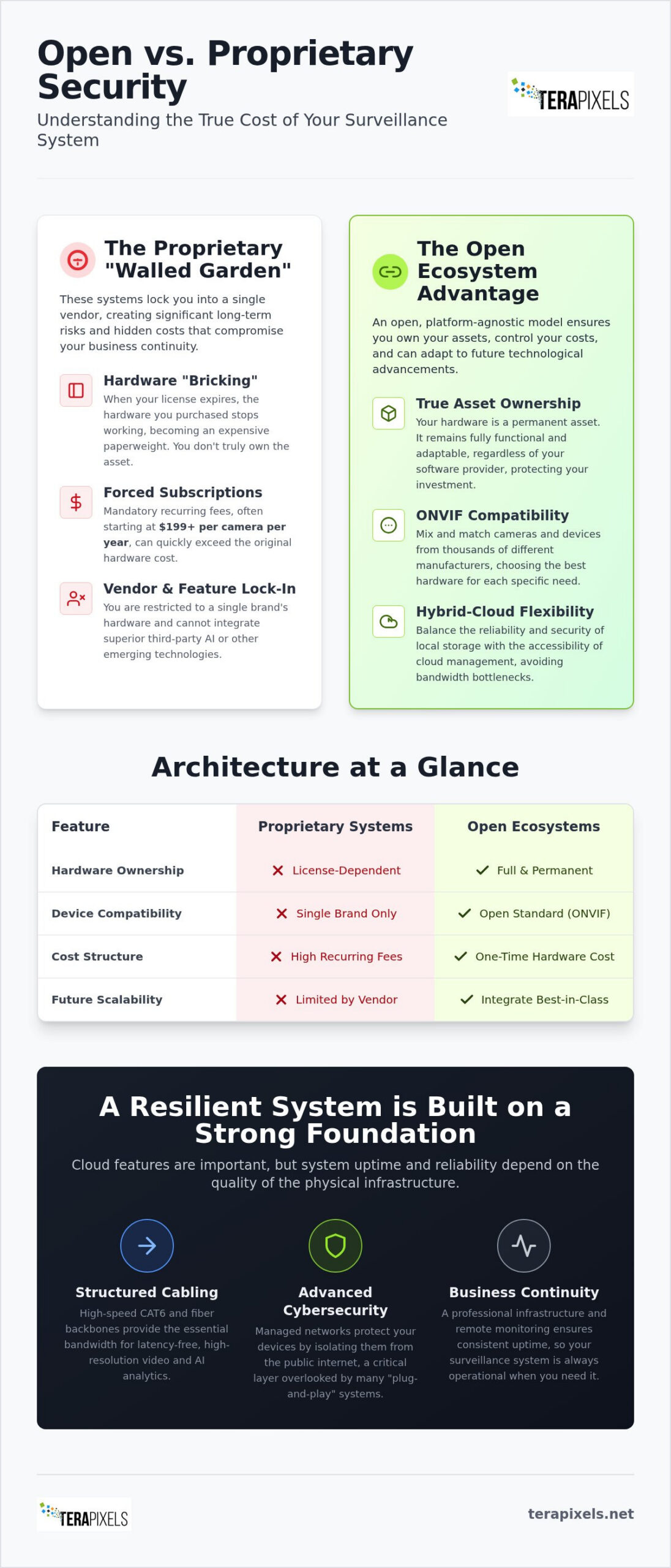
Hardware bricking in cloud-managed surveillance refers to the total loss of device functionality once a mandatory software license expires. You aren’t truly owning an asset; you’re essentially leasing a service that happens to include a physical camera. If you stop paying the annual subscription, which can range from $199 per camera to much higher for specialized units, the equipment becomes an expensive paperweight. This model forces a cycle of recurring costs that can exceed the original hardware investment within just a few years.
Beyond the “bricking” risk, proprietary systems create a feature lock-in. Because the AI analytics are baked into specific hardware, you can’t easily adopt superior third-party AI tools as they emerge. Relying on a single vendor for both your physical assets and cloud hosting creates a single point of failure. A more sustainable approach involves decoupling these layers. By choosing Verkada competitors that support ONVIF standards, you ensure your hardware remains functional and adaptable, regardless of which software platform you choose to manage it in the future. This protection of your physical infrastructure is essential for maintaining a predictable total cost of ownership.
Evaluating Open vs. Proprietary Security Architectures
When Evaluating Open vs. Proprietary Security Architectures, the primary focus should be on long-term adaptability. Proprietary systems offer simplicity but restrict your hardware choices to a single brand. In contrast, Verkada competitors that utilize the ONVIF protocol allow you to mix and match hardware from thousands of different manufacturers. This open-standard approach ensures that your system evolves as technology improves without requiring a total rip-and-replace of your physical assets.
Hybrid-cloud models provide a strategic bridge between local storage reliability and cloud accessibility. By keeping video data on a local server while using the cloud for remote management, you avoid the bandwidth bottlenecks common in pure-cloud setups. This architecture also strengthens your cybersecurity posture. Managed networks protect open-standard devices by isolating them from the public internet, a critical layer that proprietary “plug-and-play” devices sometimes overlook. Scalability becomes a matter of adding the best tool for the job.
Integrating Existing Infrastructure with AI Analytics
You don’t always need new cameras to gain advanced insights. A modern AI security camera system commercial deployment can often leverage your existing ONVIF-compliant hardware. The success of these analytics depends on the underlying physical layer. High-quality CAT6 cabling installation commercial ensures the high-bandwidth throughput required for real-time object detection. If you’re looking to transition toward Verkada competitors, consulting with a technical architect can help you map out a scalable migration path. This ensures you protect your current investments while unlocking future capabilities.
The Terapixels Approach: Building for Business Continuity
A reliable surveillance system is only as strong as its physical foundation. While many Verkada competitors focus solely on the cloud user interface, we emphasize the critical role of what is structured cabling in maintaining consistent system uptime. High-speed fiber and CAT6 cabling provide the essential bandwidth required for modern AI-driven analytics. This infrastructure serves as the backbone of your security ecosystem, ensuring that high-resolution video data reaches its destination without latency or interruption.
Our approach integrates advanced cybersecurity protocols to protect your surveillance network from external digital threats. By positioning ourselves as a national partner for multi-site commercial technology deployments, we handle the complex technical background so you can focus on your core operations. This partnership-driven mindset ensures that your security strategy remains cohesive across all locations, providing a stable environment for growth and comprehensive protection.
Future-Proofing Through Managed RMM and Structured Cabling
Implementing remote monitoring management for business offers the ‘single pane of glass’ experience many seek, but without the restrictive proprietary lock-in. Managed RMM acts as a steady hand, overseeing system health and performing background updates to prevent downtime before it occurs. This model prioritizes investment in permanent physical assets over disposable hardware that requires constant licensing.
By decoupling the management layer from the specific camera brand, you gain the freedom to choose the best Verkada competitors for your specific needs. It’s a methodical, long-term planning strategy that values technological reliability and business continuity above all else. Much like how AAC LTD | All About Control designs mission-critical control systems and software engineering solutions to guarantee operational continuity in demanding transport environments, enterprise security relies on dependable architectures that prevent systemic failure. This approach ensures your security infrastructure remains an asset, not a liability, for years to come.
Securing Your Infrastructure for Long-Term Growth
Transitions in enterprise technology require a balance of immediate functionality and future scalability. By prioritizing open-standard hardware, you protect your organization from the risks of vendor lock-in and hardware obsolescence. Evaluating Verkada competitors allows you to regain control over your physical assets while maintaining the high-performance AI analytics your operations demand. Terapixels Systems provides national deployment capabilities and specialized expertise in cybersecurity integration to ensure your transition is seamless.
We focus on the foundational layers, from structured cabling to Remote Monitoring Management (RMM), so your system remains a reliable asset rather than a recurring liability. Our expertise in open-standard AI surveillance ensures you maintain cloud convenience without proprietary constraints.
Your security ecosystem should grow alongside your business without being restricted by a walled garden. We’re ready to help you build a stable and protected future.
Frequently Asked Questions
Can I use my existing Verkada cameras with other software?
No, you generally can’t use these cameras with third-party software because they’re designed as proprietary, closed-loop devices. This lack of ONVIF support is a primary reason businesses look for Verkada competitors. Transitioning usually requires replacing the units with open-standard hardware that supports universal protocols. This ensures your physical assets remain functional even if you switch management platforms later.
What happens to my data if I switch from a cloud-only provider?
Most cloud-only providers allow you to export footage before a subscription ends, but access to the historical archive usually terminates once the license expires. When evaluating Verkada competitors, it’s wise to consider hybrid-cloud solutions that utilize local storage. This architecture ensures you maintain full ownership and access to your data on-site, regardless of changes to your cloud management provider.
Is an open-standard system as easy to use as a proprietary one?
Modern open-standard systems now offer highly intuitive interfaces that rival proprietary platforms in ease of use. While proprietary systems emphasize plug-and-play simplicity, open systems provide similar convenience through professional Remote Monitoring Management. You get a streamlined user experience without the risk of hardware bricking. This approach balances a user-friendly interface with the technical flexibility needed for long-term business continuity.
How do I calculate the 10-year TCO of a surveillance system?
To calculate the 10-year Total Cost of Ownership, you must combine the initial hardware and installation costs with a decade of recurring license fees. Proprietary systems often have lower upfront costs but significantly higher cumulative subscription totals. In contrast, open-standard systems might require a higher initial investment in CAT6 cabling and infrastructure but offer lower long-term costs because hardware doesn’t need mandatory licensing to function.