 CONTACT US


With over 21 billion IoT devices active in 2026, your network’s physical foundation is no longer just a utility; it’s the nervous system of your entire operation. Most leaders recognize the frustration of network downtime caused by disorganized wiring or the high costs of retrofitting systems that weren’t built to scale. You shouldn’t have to worry about whether your infrastructure can handle the next wave of AI analytics or cloud security updates.
This guide helps you master the essential structured cabling standards for businesses to ensure your network remains reliable and ready for 2026 demands. We’ll examine the shift to Cat6A as a baseline, the integration of high-power PoE, and the critical ANSI/TIA-568 updates that define modern infrastructure. By aligning with these architectural frameworks, you create a scalable environment where technology supports your core objectives without compromise.
Key Takeaways
- Understand the primary structured cabling standards for businesses to ensure your network hardware remains vendor-neutral and seamlessly integrated.
- Learn how a standards-compliant foundation supports high-bandwidth 2026 technologies, including 8K surveillance and remote monitoring management.
- Identify the optimal 2026 hardware hierarchy, utilizing fiber optic backbones and CAT6A cabling to achieve a 10Gbps-ready environment.
- Discover why professional installation and industry certifications are essential for reducing long-term maintenance costs and preventing network downtime.
The Foundation of Business Connectivity: Core Structured Cabling Standards
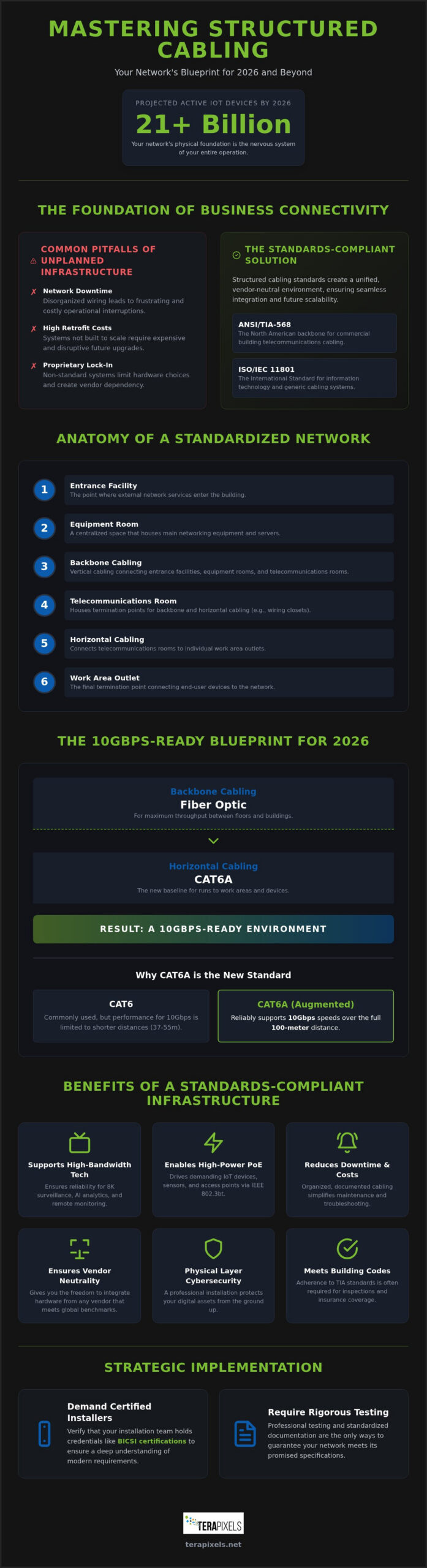
Structured cabling standards for businesses serve as the universal rules that keep modern commerce moving. They ensure that networking equipment from various vendors works together seamlessly, creating a unified environment. Two primary bodies govern these regulations: the Telecommunications Industry Association (TIA) with its ANSI/TIA-568 series and the International Organization for Standardization (ISO) via ISO/IEC 11801. For a comprehensive Structured cabling overview, these frameworks specify the performance and safety parameters for every component in your facility.
A standard installation divides the network into six logical subsystems: the entrance facility, equipment room, backbone cabling, telecommunications room, horizontal cabling, and the work area outlet. This methodical organization allows for easy upgrades and isolates potential points of failure. Understanding what is structured cabling ensures your business avoids proprietary lock-in, giving you the freedom to integrate any hardware that meets these global benchmarks.
The ANSI/TIA-568 Standard: The North American Business Backbone
The ANSI/TIA-568.2-E standard dictates the specific requirements for copper and fiber optic media used in commercial buildings. While CAT6 is common, CAT6A has become the standard for new builds to support 10Gbps speeds over full 100-meter distances. Adhering to these TIA guidelines isn’t just about performance; it’s often a prerequisite for passing building inspections and maintaining insurance coverage. Beyond compliance, standardized labeling and rigorous documentation create a reliable map of your network, which significantly reduces the time and cost associated with long-term maintenance.
Why Standards-Compliant Infrastructure is Critical for 2026 Technologies
The stability of your business operations relies heavily on the physical layer of your network. High-performance cabling ensures the reliability of remote monitoring management for business, providing the steady data flow required for proactive system health checks. Leading key structured cabling standards organizations like IEEE and TIA have developed frameworks that allow for seamless integration between hardware and software. Without these structured cabling standards for businesses, high-bandwidth applications like 8K surveillance would suffer from crippling latency and frame loss.
Modern infrastructure must also support high-power Power over Ethernet (PoE) standards, specifically IEEE 802.3bt, to drive IoT devices and sustainable energy monitoring. Whether you’re integrating EV chargers or commercial solar arrays, a standardized fiber optic backbone provides the necessary throughput for real-time data collection. Adhering to recognized structured cabling standards for businesses ensures that power delivery and data transmission coexist without interference. If you’re planning a facility upgrade, consulting with a reliable architect ensures your systems are ready for these 2026 demands.
Supporting AI Analytics and High-Density Security Systems
AI-driven video analytics require precision that substandard or legacy cabling simply cannot provide. High packet loss often causes AI algorithms to fail, leading to missed security events or false alarms. Modern AI security camera system commercial deployments rely on cloud-based authentication, which demands consistent, low-latency connectivity to verify credentials in real-time. Ultimately, a professional CAT6 cabling installation commercial serves as the physical layer for cybersecurity, protecting your digital assets from the ground up.
Strategic Implementation: Future-Proofing Your Business Network
Effective implementation requires a clear hardware hierarchy to meet 2026 performance benchmarks. The current strategic model utilizes fiber optic cabling for vertical backbones and CAT6A for horizontal runs to ensure 10Gbps readiness. Adhering to these structured cabling standards for businesses provides a reliable foundation that won’t require expensive retrofits in the near future. It’s essential to verify that your installation team holds BICSI certifications. These credentials signify a deep understanding of the complex low voltage structured cabling requirements found in modern commercial facilities.
Testing remains the only way to guarantee your network meets its promised specifications. Always require detailed certification reports, such as Fluke test results, as a final project deliverable. These reports provide empirical proof that each cable run satisfies the electrical requirements of the specified structured cabling standards for businesses. Without this documentation, you don’t have a reliable way to verify that your infrastructure can support high-density data traffic without packet loss or latency issues.
Best Practices for Professional Installation and Lifecycle Management
Selecting the right partner is critical for long-term success. Use this three-step checklist to evaluate potential contractors:
- Documentation: Do they provide detailed CAD drawings and comprehensive labeling schemes?
- Certification: Can they prove their team holds active BICSI or manufacturer-specific credentials?
- Future-Ready Materials: Are they proposing CAT6A or better to ensure 10Gbps capacity?
A key concept in modern design is “headroom.” This refers to installing cabling with performance levels that exceed current hardware needs. By leaving this extra capacity, you allow for future technology refreshes without the massive expense of re-wiring. This proactive approach directly supports your network security for small business, as high-performance physical layers are less prone to the data bottlenecks that can leave security systems vulnerable.
Building a Resilient Foundation for Future Innovation
A standards-compliant network is the most critical investment your organization can make in its physical infrastructure. By adhering to modern structured cabling standards for businesses, you eliminate the risks of proprietary lock-in and ensure your facility is ready for the high-bandwidth demands of 2026. This architectural approach supports everything from AI-driven security analytics to seamless cloud-based access control. As a national provider, Terapixels Systems specializes in high-density fiber and CAT6 cabling that integrates directly with advanced cyber security and remote monitoring management (RMM).
Taking the step to standardize your infrastructure today provides the steady hand your business needs to grow with confidence. We’re here to ensure your network remains a silent, powerful partner in your long-term success.
Frequently Asked Questions
Are structured cabling standards legally required for my business?
While structured cabling standards for businesses aren’t federal laws, they’re often mandatory within building codes and National Electrical Code (NEC) requirements. Compliance ensures your facility meets fire safety and insurance standards. Following these guidelines protects your business from liability and ensures that your infrastructure remains eligible for manufacturer warranties, which typically require certified, standards-based installation for coverage.
What is the difference between CAT6 and CAT6A in terms of industry standards?
The primary difference lies in bandwidth capacity and transmission distance. CAT6 is rated for 1Gbps speeds up to 100 meters, but it only supports 10Gbps at shorter distances, typically around 55 meters. In contrast, CAT6A is the 2026 baseline for new commercial builds. It supports 10Gbps speeds across the full 100-meter range while providing superior protection against crosstalk in high-density environments.
How long should a standards-compliant structured cabling system last?
A professionally installed, standards-compliant system typically has a lifecycle of 15 to 20 years. While active hardware like routers or switches might be replaced every five years, the underlying copper and fiber optic cabling should remain viable through multiple technology refreshes. Investing in high-performance structured cabling standards for businesses ensures your physical layer can handle the increased data demands of future AI applications.
Do I need different cabling standards for security cameras versus office computers?
You don’t need different standards, and using a unified approach is actually recommended for modern facilities. Both security cameras and office computers benefit from the same high-speed CAT6A infrastructure. However, security systems often require specific Power over Ethernet (PoE) support to deliver both data and electricity. A unified cabling plant simplifies maintenance and allows you to reconfigure your workspace easily.
While these standards are essential for the workplace, those looking to bring professional-grade automation to their residences can discover FoxyHome by PCMNow for expert smart home and security installations.
Furthermore, ensuring your home network meets these standards is the best way to support high-demand services like a premium IPTV subscription Canada, which requires consistent bandwidth for a superior viewing experience.