CONTACT US
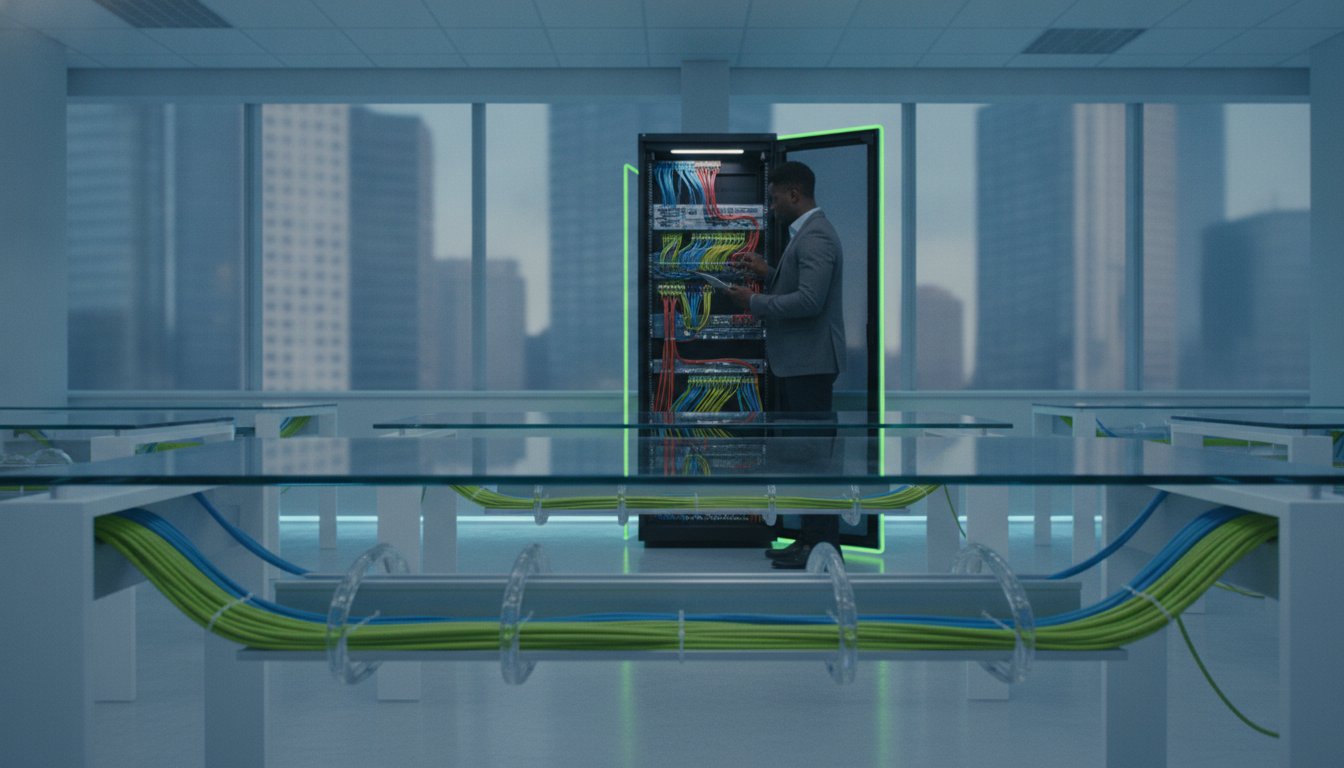
What if the most significant threat to your office’s 2026 efficiency isn’t a cyberattack, but the disorganized “spaghetti” of wires beneath your workstations? You’ve likely felt the frustration of trying to trace a single faulty connection through a chaotic, unlabelled mess. It’s more than just an eyesore; it’s a safety risk and a major hurdle for IT troubleshooting. We understand that a reliable network requires more than just high-speed hardware; it needs a foundation of order and precision.
This guide demonstrates how professional cable management solutions for office spaces can transform your current clutter into a high-performance, secure network. You’ll learn how strategic structural cabling, utilizing CAT6 and fiber, provides the stability your business needs to scale. We’ll walk through the essential steps to create a clean, professional environment that improves network reliability and simplifies future growth.
Key Takeaways
- Identify how disorganized wiring causes electromagnetic interference and increases IT maintenance costs, directly impacting your network’s daily performance.
- Learn why effective cable management solutions for office spaces require a robust structural cabling backbone rather than just superficial desktop organizers.
- Discover the essential audit process for mapping data drops and identifying bottlenecks to ensure your infrastructure is prepared for future technological demands.
- Explore advanced pathway designs using J-hooks and cable trays that protect your fiber and CAT6 investments while allowing for seamless future expansion.
Beyond the Clutter: Why Professional Cable Management Matters for Modern Offices
Disorganized wiring is more than a visual nuisance; it’s a silent drain on your operational budget. When IT technicians must untangle a “spaghetti” of wires to identify a single point of failure, troubleshooting times skyrocket. These delays translate directly into lost billable hours and decreased system availability. Implementing professional cable management solutions for office spaces ensures that every connection is mapped and accessible, turning reactive maintenance into a streamlined, cost-effective process. Engaging a technology partner like ITS Canada Inc can help you leverage these infrastructure improvements as part of a comprehensive IT advisory strategy.
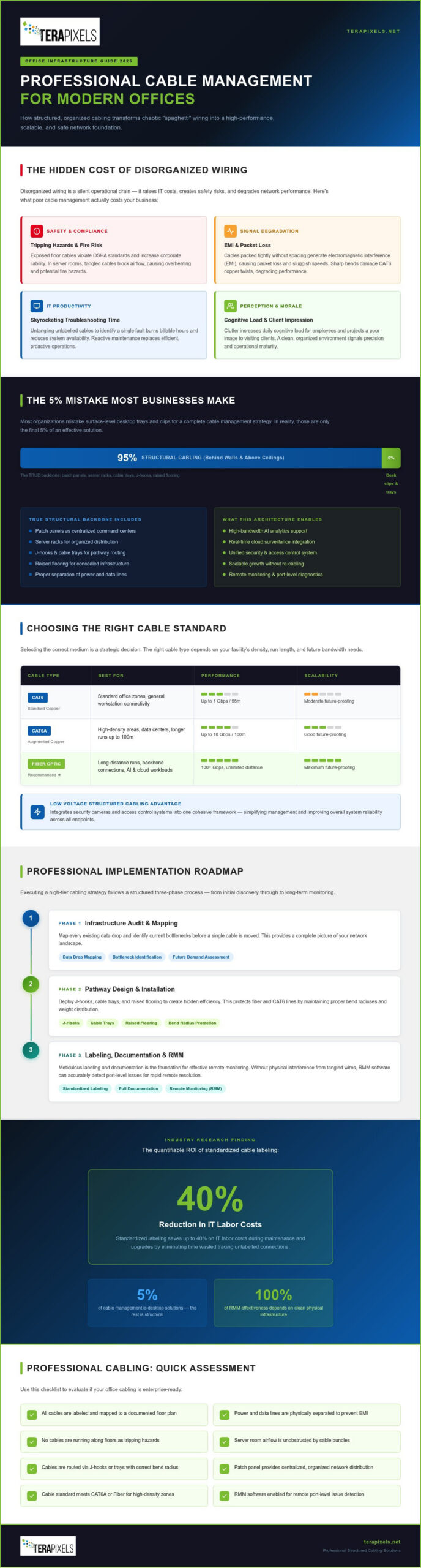
Safety and compliance also demand your attention. Exposed bundles on the floor create significant tripping hazards that conflict with OSHA standards and increase corporate liability. In server rooms, poorly managed cables often obstruct essential airflow, which leads to equipment overheating and potential fire risks. A clean, organized environment also has a profound psychological impact. A clutter-free workspace reduces the daily cognitive load for your employees and projects a sense of precision and stability to visiting clients and partners.
The Technical Risks of Poor Cable Organization
Signal integrity often suffers in disorganized environments. High-performance data transmission relies on maintaining specific physical standards that “quick fixes” often ignore. For instance, excessive tension or sharp bends can severely degrade CAT6 cabling installation commercial performance by damaging the internal copper twists. When cables are packed too tightly without proper spacing, electromagnetic interference (EMI) occurs. This leads to frustrating packet loss and sluggish network speeds. Professional management separates power and data lines, ensuring your infrastructure operates at its full rated capacity while maintaining long-term hardware health.
Structural Cabling vs. Desktop Solutions: Building a Scalable Infrastructure
Many businesses mistake desk trays and clips for a complete strategy. In reality, these are just the final 5% of effective cable management solutions for office spaces. The true “backbone” exists behind the walls and above the ceilings. Understanding what is structured cabling is essential because it centralizes your entire network. Patch panels and server racks serve as the command center; they allow for organized distribution that prevents the chaotic “nest” often found in unmanaged facilities.
As we look toward 2026, your infrastructure must do more than just connect computers. It needs to support high-bandwidth AI analytics and real-time cloud surveillance. A disorganized system can’t handle these heavy data loads without experiencing significant latency. By investing in a professional architectural approach now, you ensure your facility is ready for the next generation of business technology. Our experts can help you design a scalable cabling architecture that grows alongside your company.
Choosing the Right Cable Standards for Your Facility
Selecting the correct medium is a strategic decision. CAT6 remains a standard for many office zones, but CAT6A or Fiber Optic solutions are increasingly necessary for high-density areas or long-distance runs. Utilizing low voltage structured cabling allows you to integrate security cameras and access control systems into one cohesive framework. This unified approach simplifies management and improves overall system reliability, ensuring that every endpoint receives consistent, high-speed connectivity.
Implementing a Professional Cabling Strategy for 2026 and Beyond
Executing a high-tier strategy begins with a thorough audit. We map every existing data drop and identify current bottlenecks before a single cable is moved. Once the landscape is clear, we focus on pathway design. Utilizing J-hooks, cable trays, and raised flooring creates hidden efficiency that protects your physical assets. These cable management solutions for office spaces prevent the physical degradation of sensitive fiber and CAT6 lines by maintaining proper bend radiuses and weight distribution.
The final phase involves meticulous labeling and documentation. Industry research suggests that standardized labeling can reduce future IT labor costs by as much as 40% during maintenance or upgrades. This level of organization is the foundation for effective remote monitoring management for business. Without physical interference from tangled wires, your RMM software can accurately detect port-level issues. This allows for rapid, remote resolution without needing an on-site technician to hunt through a mess of unlabelled cables.
Integrating Security and Power into Your Cable Plan
A comprehensive strategy also accounts for specialized hardware. We ensure strategic placement for AI security camera system commercial hardware to avoid signal crossover with high-voltage power lines. This prevents video interference and ensures clear analytics. Additionally, we coordinate data line pathways with your backup generator routes. This deliberate separation protects your network’s integrity, ensuring 100% uptime and seamless continuity during unexpected power failures.
Securing Your Office Infrastructure for the Future
Professional cable management is a strategic investment in your facility’s long-term stability. By moving beyond surface-level fixes and prioritizing a robust structural cabling backbone, you eliminate the hidden costs of network interference and extended IT downtime. For organizations planning a larger commercial renovation or multi-site retail refresh, you can discover Synergized Tradesman to manage the complex multi-trade coordination required for such rollout programs. Meticulous documentation and pathway design ensure that your environment remains adaptable as your business scales. Comprehensive cable management solutions for office spaces provide more than just a clean aesthetic; they create the necessary foundation for advanced security and remote management systems.
Terapixels Systems serves as your nationwide structural cabling expert, providing professional CAT6 and fiber installation. We focus on integrated security and RMM solutions that protect your hardware while maximizing network speeds. Our team is ready to help you transition to a high-performance facility. Let’s build a reliable architecture that supports your growth well into 2026 and beyond.
Frequently Asked Questions
What is the difference between desk cable management and structural cable management?
Desk cable management addresses the final few feet of connectivity at individual workstations using clips and sleeves. In contrast, structural management involves the facility’s permanent backbone, including CAT6 or fiber optic lines running through walls and ceilings to central patch panels. While desk solutions improve aesthetics, it’s the structural management that ensures the long-term integrity and scalability of your entire network infrastructure.
How often should a commercial office cabling system be audited or reorganized?
A professional audit of your office cabling should occur every two to three years or whenever you undergo a significant hardware upgrade. Regular assessments help identify physical wear, outdated standards, or bottlenecks caused by shifting office layouts. It’s a proactive approach that ensures your cable management solutions for office spaces remain aligned with your current bandwidth needs and safety compliance standards.
Is it better to use wireless solutions instead of extensive office cabling?
Wireless technology offers flexibility for mobile devices, but physical cabling remains superior for speed, security, and reliability. High-bandwidth applications like cloud surveillance and AI analytics require the stable throughput that only fiber or CAT6 can provide. It’s often best to use a hybrid approach; use structural cabling for fixed endpoints while reserving wireless for guest access and roaming users.
Can poor cable management actually slow down my internet speed?
Physical cable disorganization can directly degrade network performance through electromagnetic interference (EMI) and signal crosstalk. When data lines are bundled too tightly with power cables or bent at sharp angles, the internal copper twists are compromised. This leads to packet loss and increased latency, which effectively slows down your overall internet speeds. It’s a technical risk that professional organization avoids.
What are the most common mistakes businesses make when installing new office cabling?
Many businesses rely on plastic zip ties that can pinch and damage sensitive data lines over time. Another frequent error is failing to implement a standardized labeling system, which makes future troubleshooting significantly more expensive. It’s important to plan for future growth. Utilizing modular cable management solutions for office spaces helps avoid these pitfalls by allowing for easy, damage-free adjustments during future expansions.