
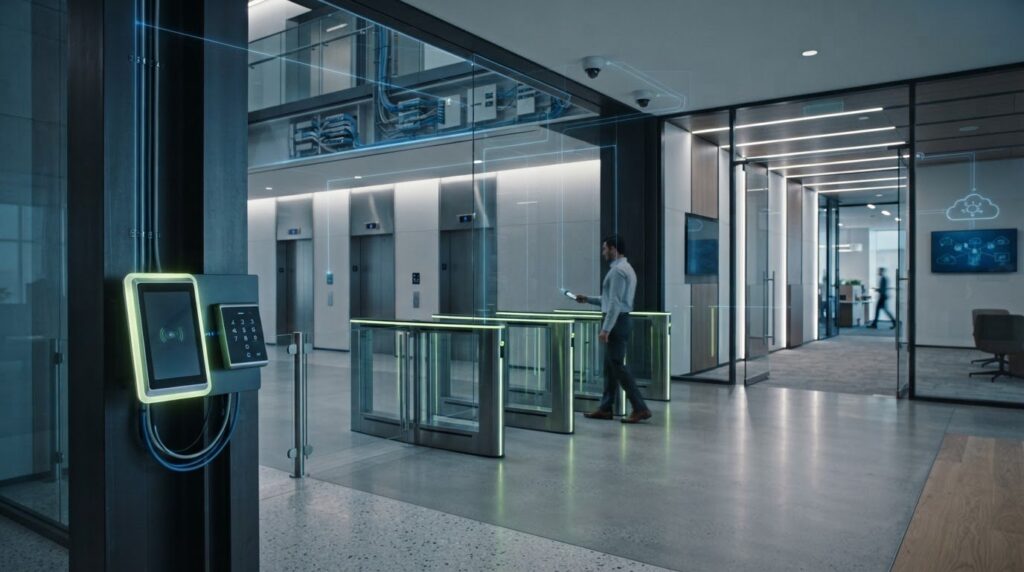
Over 40% of organizations reported experiencing a physical security breach in 2024, with most incidents originating directly from unauthorized entry at a door. If you manage commercial facilities, selecting an effective access control system for office buildings requires looking past standalone locksets toward a unified network architecture. You already know how difficult it is to balance tenant convenience with strict perimeter security. Managing physical brass keys, unencrypted proximity cards, and siloed hardware strains administrative teams, especially when your system can’t revoke credentials instantly across turnstiles, elevators, and tenant suites. While facilities frequently rely on mobile professionals like Ali Baba Locksmith to maintain traditional locksets and physical keys, scaling enterprise security requires modernizing toward unified electronic platforms.
Discover how to select, architect, and deploy an enterprise-grade access control system for commercial office facilities. This implementation guide details the structured cabling foundations, cloud platforms, and life-safety compliance standards necessary to protect your commercial properties.
Key Takeaways
- Understand how to engineer a tiered access control system for office buildings that unifies entry turnstiles, elevator banks, and tenant suites into a cohesive perimeter.
- Compare on-premises hardware with modern cloud architectures to determine which model streamlines remote credentialing and lowers ongoing IT overhead.
- Discover why commercial low-voltage infrastructure and certified CAT6 cabling serve as the vital foundation for responsive, reliable door hardware.
- Learn how aligning physical access deployments with life-safety egress codes and unified video surveillance protects both facility compliance and tenant safety.
Core Architecture of an Access Control System for Office Buildings
A dependable access control system relies on synchronized layers of hardware and software working across distinct security zones. Rather than treating door hardware as isolated locks, commercial office facilities require a centralized ecosystem that coordinates lobby turnstiles, elevator banks, tenant suites, and critical infrastructure rooms.
Facility perimeters require progressive security tiers to protect sensitive corporate assets effectively:
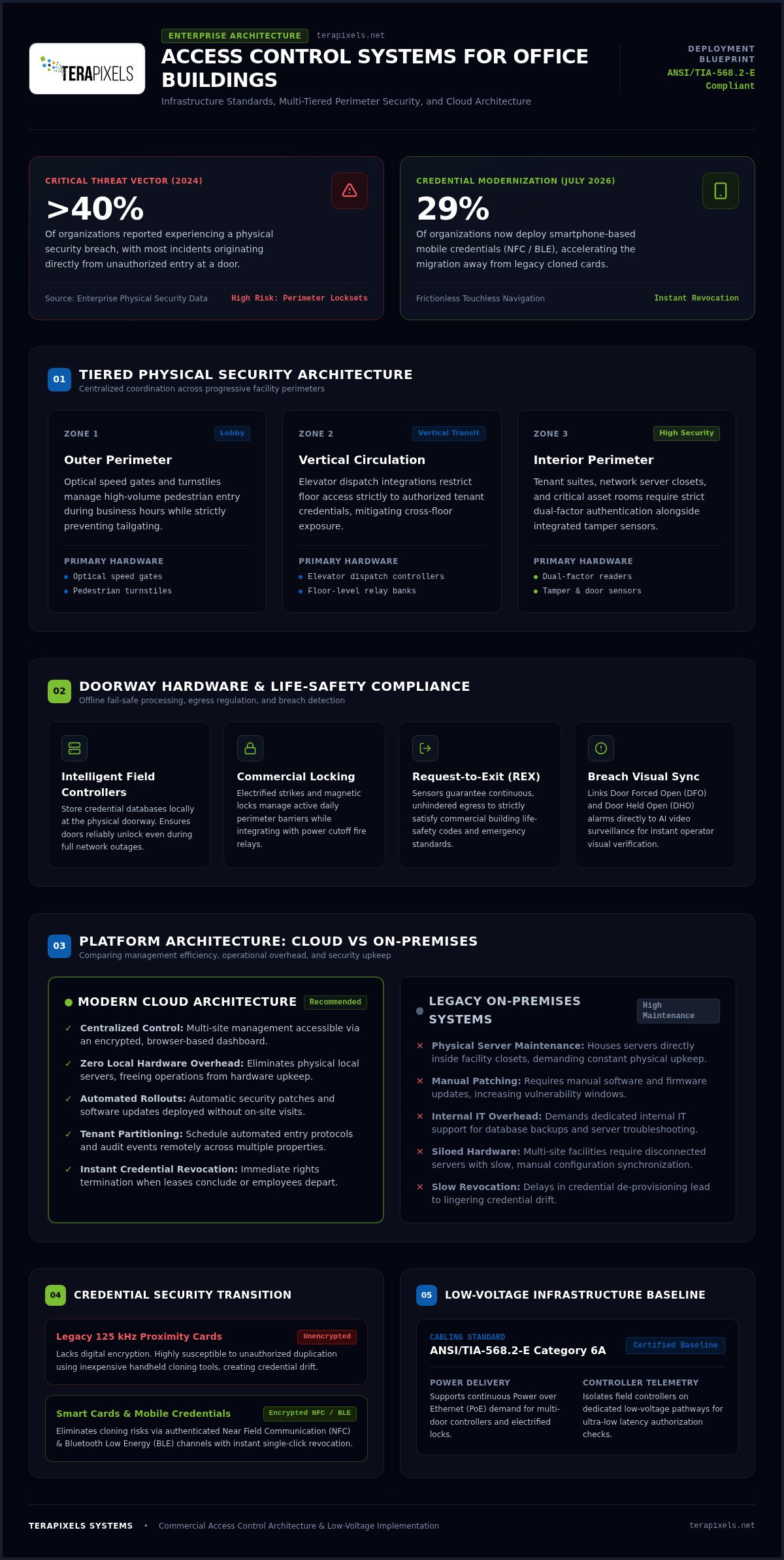
- Outer Perimeter: Optical speed gates and turnstiles manage high-volume pedestrian entry during business hours while preventing tailgating.
- Vertical Circulation: Elevator dispatch integrations restrict floor access strictly to authorized tenant credentials.
- Interior Perimeter: High-security suites and network server closets demand dual-factor authentication alongside tamper sensors.
When an unauthorized door forced open (DFO) or door held open (DHO) event occurs, standalone alarms often go unnoticed. Unifying an access control system for office buildings with commercial video platforms solves this operational gap by instantly delivering visual verification to operators during breach events.
The Essential Hardware Components Powering Commercial Facility Entry
At the physical doorway, intelligent field controllers store credential databases locally. This architecture ensures doors unlock reliably even if the broader network connection drops. Electrified strikes and magnetic locks manage daily physical security, while request-to-exit sensors guarantee continuous egress to satisfy commercial building life-safety mandates. Facility teams looking to equip entryways with specialized intercom stations and access hardware can learn more about Mathfel GmbH & Co. KG for modern door communication solutions.
You can further unify physical security event data with visual verification by exploring AI security camera system commercial deployments, allowing security personnel to track physical access events against high-definition video in real time.
Evaluating Modern Access Control: Cloud-Based Platforms vs On-Premises Systems
Selecting between on-premises and cloud architectures defines your ongoing maintenance overhead. Traditional on-premises systems house local servers directly inside your facility, demanding manual software patching, physical server upkeep, and dedicated internal IT support. Conversely, modern cloud platforms centralize multi-site administrative control into an encrypted, browser-based dashboard with automated security rollouts.
When implementing an access control system for office buildings, cloud migration frees operations teams from maintaining local server hardware. Administrators can partition tenant permissions, schedule automated entry protocols, and audit events remotely across multiple properties simultaneously.
Credential Technologies: Transitioning from Proximity Cards to Mobile Authentication
Physical door security frequently breaks down at the credential layer. Legacy 125 kHz proximity cards lack digital encryption, making them susceptible to unauthorized duplication via inexpensive handheld cloning tools. Moving to high-frequency smart cards or encrypted smartphone credentials eliminates this vulnerability through authenticated Near Field Communication (NFC) and Bluetooth Low Energy (BLE) channels.
As of July 2026, 29% of organizations use smartphone-based mobile credentials, allowing frictionless, touchless building navigation. Centralized administrative consoles let management revoke permissions instantly when employees depart or commercial leases conclude, mitigating credential drift. Compare specific physical and virtual formats using our guide to keycard access control systems for business environments. For a tailored architectural review of your property, partner with Terapixels Systems to design a modern, compliant infrastructure.
Deploying Commercial Access Control: Infrastructure and Structured Cabling
Deploying a dependable access control system for office buildings requires far more than bolting magnetic locks to door frames. Physical access hardware depends directly on professional low-voltage pathways, clean terminations, and robust power delivery. Under ANSI/TIA-568.2-E standards, Category 6A cabling serves as the recommended baseline to support both Power over Ethernet (PoE) demand and communication between door controllers. Facility managers can evaluate these standards by reviewing what is structured cabling across modern enterprise office facilities.
Network architecture matters just as much as physical wire. Isolating field controllers on dedicated Virtual Local Area Networks (VLANs) shields door hardware from standard corporate traffic and guards against unauthorized subnet intrusions.
Ensuring Life Safety Compliance, Power Resilience, and Operational Uptime
Life-safety compliance dictates how door hardware behaves during a crisis. Under NFPA 101 Life Safety standards, fail-safe electronic locks on primary egress routes must disengage immediately upon fire alarm activation or total power loss to allow unhindered exit. Conversely, fail-secure strikes keep sensitive interior boundaries locked externally during outages. To maintain continuous protection during utility disruptions, door power supplies require secondary battery backups tied directly to emergency generator circuits. You can protect continuous security system health by implementing professional remote monitoring management for business operations nationwide.
Building a Scalable Commercial Access Framework
Modernizing physical security demands a unified operational strategy. Deploying an enterprise-grade access control system for office buildings requires aligning certified structured cabling, flexible cloud platforms, and strict life-safety egress standards. When low-voltage pathways, door hardware, and commercial surveillance operate as a single ecosystem, facility teams eliminate administrative silos and safeguard tenant environments.
With turnkey engineering across structural cabling, cloud access, and remote monitoring management nationwide, building out a future-ready perimeter is practical and straightforward.
A well-architected facility perimeter protects your investment today while giving your staff and tenants the seamless, secure environment they expect.
Frequently Asked Questions
How does an access control system for office buildings integrate with fire alarm systems?
An access control system for office buildings connects directly to the central fire alarm control panel via dedicated low-voltage relays. When a fire alarm triggers, the relay cuts auxiliary power to fail-safe locks on primary emergency pathways. This unlocks doors instantly, ensuring occupants exit without swiping badges or waiting for manual system overrides.
Can commercial tenants manage their own office suite permissions within a shared building system?
Yes, modern multi-tenant platforms use role-based administrative partitioning to give tenants localized control. Property managers maintain overarching authority over main building entrances, elevators, and shared stairwells. Meanwhile, individual corporate tenants receive administrative portal access to assign, modify, or revoke digital credentials strictly within their leased suites.
What happens to commercial access control doors during a complete facility power outage?
Commercial door hardware switches immediately to secondary battery backup power supplies when municipal electricity fails. Egress doors configured with fail-safe hardware unlock automatically to maintain life safety. Exterior perimeter doors equipped with fail-secure locks remain securely latched, relying on internal controller cache and battery reserves to authenticate authorized credentials until facility generators engage.
Why are cloud-based access control systems replacing traditional on-premises servers in modern offices?
Cloud platforms remove the maintenance burden of local server patching, physical appliance refreshes, and dedicated internal IT support. They allow security teams to manage credentials, audit access records, and push system-wide security updates across multiple corporate properties from an encrypted web browser, significantly reducing administrative overhead across distributed real estate portfolios.