CONTACT US

What if the very footage meant to protect your enterprise becomes a legal liability simply because you hit delete twenty-four hours too soon? It’s a common anxiety for leaders caught between the high costs of expanding server storage and the complex web of varying regulations. Establishing a clear CCTV footage retention policy for business is no longer just a technical choice; it’s a vital safeguard for your organization’s stability and long-term protection.
This guide provides a roadmap for mastering video data to ensure compliance and reduce liability. We’ll examine the technology needed to support your data, the impact of US privacy laws, and how to optimize your infrastructure to reduce costs. You’ll learn to align storage duration with actual risk profiles so your security system remains a reliable, high-tech asset that supports your core business objectives.
Key Takeaways
- Learn how to balance incident discovery windows with privacy regulations to determine the ideal retention duration for your specific industry risks.
- Discover how to manage the storage demands of high-resolution surveillance by analyzing the trade-offs between cloud-based systems and on-premise NVRs.
- Establish a secure CCTV footage retention policy for business that utilizes remote monitoring management to ensure your storage infrastructure remains operational and compliant.
- Master the use of automated data lifecycle protocols to streamline the deletion of expired footage and reduce long-term liability under evolving privacy laws.
Establishing a CCTV Footage Retention Policy for Your Business
Designing a professional Closed-circuit television (CCTV) strategy requires more than just high-quality hardware; it’s a process that demands a structured approach to data management. A retention period is the duration data remains accessible before being overwritten. A formal CCTV footage retention policy for business serves as a balancing act between effective evidence collection, strict privacy compliance, and the practicalities of hardware limitations.
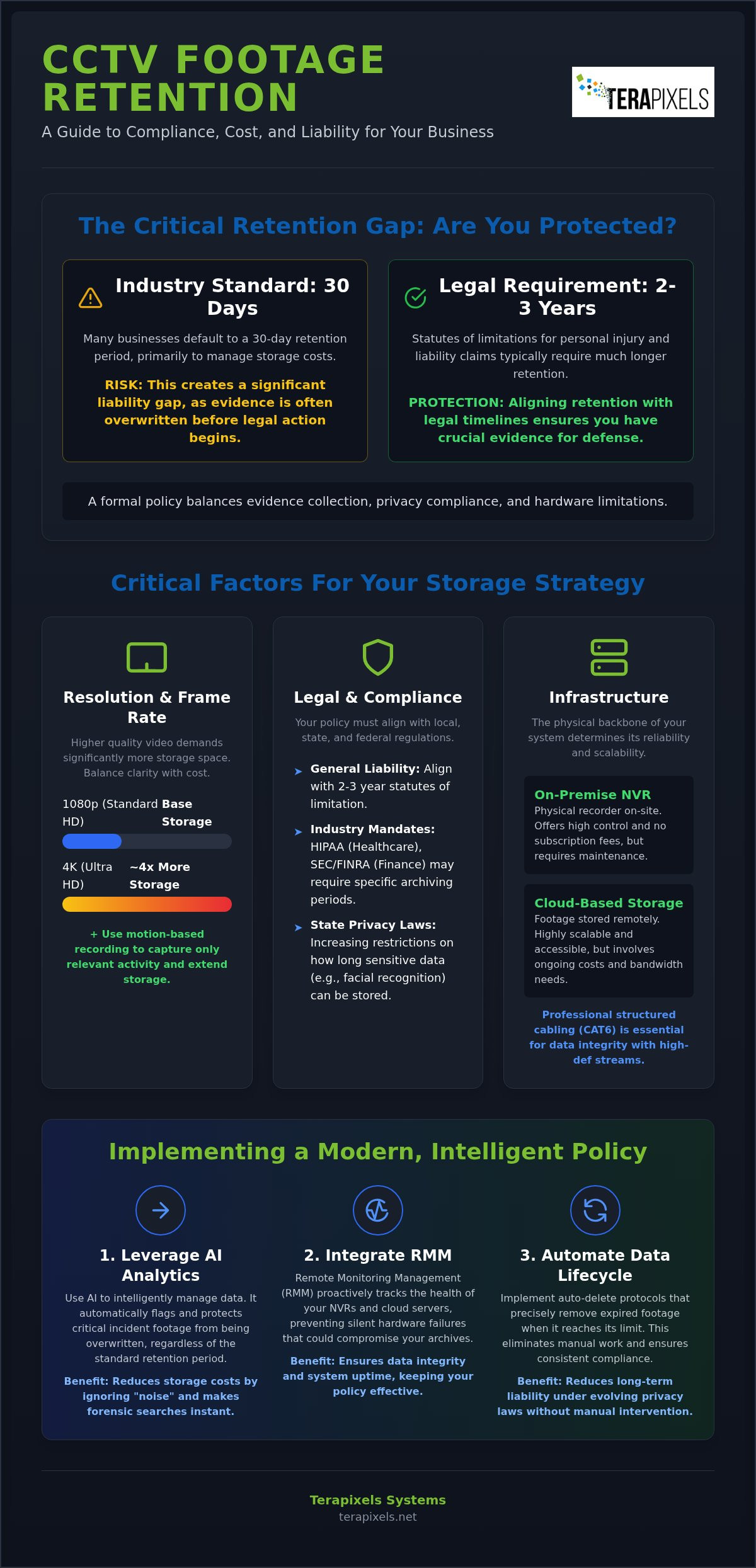
While many businesses default to a 30-day window, this industry standard often falls short when facing legal claims. If a slip-and-fall incident occurs, the plaintiff might not file a lawsuit for months. If the system’s already overwritten the evidence, you lose your primary defense. A robust CCTV footage retention policy for business should clearly outline who has access to the archives, the specific protocols for handling incidents, and the automated methods used for data deletion.
Legal and Regulatory Compliance Requirements
Your storage duration must align with the legal realities of your operating area. In the United States, the statute of limitations for general liability and personal injury claims typically ranges from two to three years. Storing footage for only a month creates a significant gap in protection. Additionally, specific sectors face tighter mandates. Financial institutions governed by SEC or FINRA rules, and healthcare providers under HIPAA, often require specialized archiving periods. You must also consider state-level privacy laws, which increasingly restrict how long you can legally store sensitive data like facial recognition profiles. These requirements ensure your architecture remains both functional and legally defensible.
Critical Factors Influencing Your Storage Strategy
High-resolution 4K surveillance offers unparalleled detail, but it significantly expands your storage footprint compared to standard 1080p. Balancing resolution with frame rates is essential for a sustainable CCTV footage retention policy for business. To maintain data integrity during high-bandwidth transfers, professional CAT6 cabling installation commercial is required. This infrastructure ensures that high-definition streams reach your on-premise NVR or cloud-based surveillance system without packet loss. Many organizations look to a government surveillance technology policy for guidance on balancing these technical needs with operational goals. Motion-based recording serves as another strategic tool, allowing you to capture only relevant activity and extend your retention window without investing in additional hard drives.
Leveraging AI Analytics to Optimize Retention
Implementing an AI security camera system commercial setup allows for intelligent data management. Modern AI analytics can automatically flag critical incidents, protecting that specific footage from being overwritten even if the standard retention period expires. By storing metadata, the searchable “event data,” longer than the raw video files, you can conduct forensic searches in seconds rather than hours. This smart filtering also reduces storage costs by ignoring “noise” like moving shadows or wind-blown debris. If you’re ready to refine your architecture, the experts at Terapixels Systems can design a custom solution that prioritizes both clarity and efficiency.
Implementing and Managing Your Policy with Terapixels Systems
Successful execution requires more than just setting a duration; it’s a process that demands active oversight. By integrating remote monitoring management for business, we ensure your storage drives never fail silently. RMM tracks the health of your NVRs and cloud servers, alerting our team before a hardware failure compromises your archives. This proactive approach keeps your CCTV footage retention policy for business intact by maintaining the physical integrity of your data. We also automate the data lifecycle through auto-delete protocols. These scripts remove expired files precisely when they hit their limit, keeping you compliant with privacy laws without manual intervention.
Future-proofing your system is equally vital. Professional structured cabling provides the high-bandwidth backbone needed for future storage expansion. As your business grows, this organized infrastructure allows for seamless upgrades to your recording capacity. We recommend conducting regular audits to ensure your CCTV footage retention policy for business still matches your actual operational risks. A policy that worked last year might not cover new regulatory changes or site expansions.
Reducing Liability through Proactive Data Management
Liability reduction depends on how you handle specific events. Incident-based locking allows you to “freeze” specific footage during a legal hold, preventing it from being overwritten. This ensures critical evidence remains available for years. Simultaneously, we implement robust cybersecurity to protect archives from ransomware or unauthorized access. Partnering with a systems integrator ensures your architecture evolves alongside 2026 technology trends, providing a stable foundation for your organization’s long-term protection.
Securing Your Enterprise with Strategic Data Retention
Establishing a robust CCTV footage retention policy for business ensures your organization remains prepared for legal challenges while maintaining peak operational efficiency. By leveraging AI-driven analytics to prioritize critical events and implementing remote monitoring management to safeguard hardware health, you create a system that works autonomously. High-bandwidth structured cabling provides the necessary foundation for this high-resolution data, allowing your security infrastructure to scale as your needs evolve.
As a national leader in security and infrastructure integration, Terapixels Systems specializes in AI-driven surveillance and RMM. Our expert consultants work alongside you to reduce commercial liability through precision-engineered solutions. We provide the steady hand needed to manage these complex background systems so you can focus on your primary business objectives with absolute confidence.
We look forward to building a reliable architecture that protects your assets and supports your long-term growth.
Frequently Asked Questions
How long do most businesses keep their security camera footage?
Most commercial organizations maintain a 30 day window for their archives. High risk sectors, such as banking or critical infrastructure, often extend this period to 90 days to account for delayed incident discovery. You can learn more about specialized monitoring solutions for these critical environments to ensure your data integrity is never compromised. Your specific duration should reflect your site’s risk profile. We help clients analyze their operational needs to determine if a longer window is necessary for their stability.
Is there a legal minimum for CCTV retention in the United States?
There isn’t a universal federal law that sets a minimum duration for all enterprises. Instead, requirements are dictated by industry specific regulations and state laws. For example, gaming and cannabis industries often face strict state mandates. You should ensure your CCTV footage retention policy for business aligns with the specific legal statutes governing your particular sector and operating area.
What happens to CCTV footage after the retention period ends?
Can I store my business CCTV footage indefinitely in the cloud?
While cloud technology allows for indefinite storage, hoarding data indefinitely often creates significant legal liabilities and unnecessary costs. Many privacy laws require that data be destroyed once it no longer serves its original purpose. A professional CCTV footage retention policy for business focuses on purposeful archiving. This approach maintains compliance while ensuring your storage infrastructure remains cost-effective and manageable.