CONTACT US

What if the one moment you need your surveillance footage most is the exact moment you discover your system overwrote it? It’s a common anxiety for security-conscious leaders who must navigate complex CCTV camera storage requirements for business. You invest in high-resolution hardware, yet the fear of running out of space during a critical incident remains. Balancing the clarity of 4K video with the reality of hardware costs often feels like a losing battle.
This guide will help you master the technical and regulatory variables of surveillance storage, ensuring you never lose critical forensic evidence. We’ll explore how the adoption of the AV1 codec can reduce bitrates by 40 percent, comply with the latest 2026 data retention standards, and provide a defensible plan to optimize your infrastructure. You’ll move from storage uncertainty to a position of quiet confidence in your system’s reliability.
Key Takeaways
- Balance high-resolution forensic clarity with storage efficiency by optimizing frame rates and utilizing advanced video compression.
- Develop a defensible data retention plan that meets legal standards and specific CCTV camera storage requirements for business without overextending your hardware budget.
- Evaluate the long-term benefits of hybrid and cloud-based surveillance models to ensure your security infrastructure scales seamlessly as your operations grow.
- Identify how high-performance structural cabling, such as Fiber and CAT6, supports the bandwidth needed for reliable 4K video recording and storage.
The Technical Variables of Business CCTV Storage Requirements
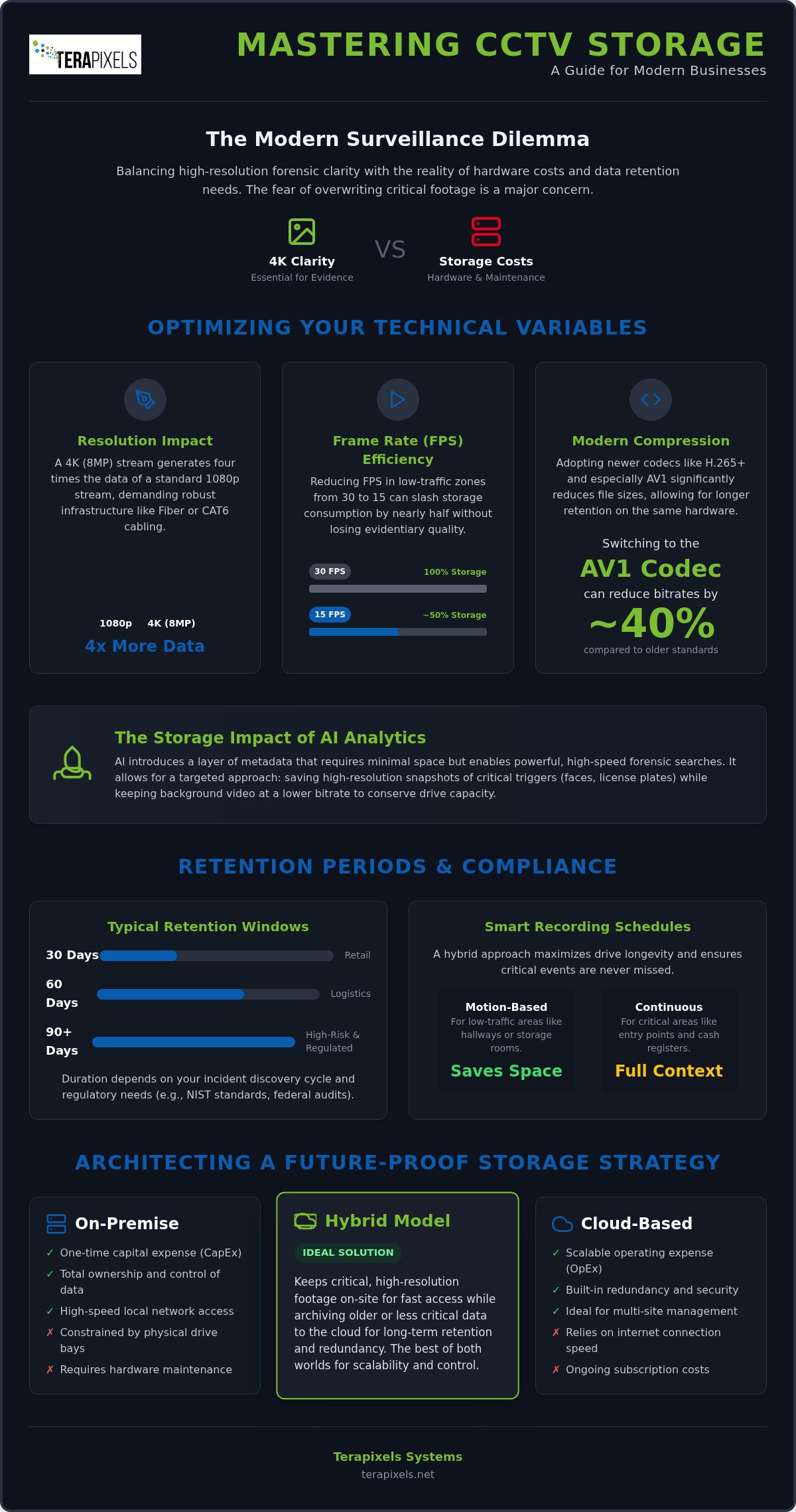
Understanding CCTV camera storage requirements for business begins with the trade-off between image clarity and data volume. A 4K (8MP) sensor provides the forensic detail necessary for identification, yet it generates four times the data of a standard 1080p stream. To support these high-bandwidth streams, your infrastructure relies on robust Fiber or CAT6 cabling—often maintained through managed IT services like those from HJS Technology Ltd—to prevent data bottlenecks and ensure every frame reaches the recorder intact.
Frame rate optimization serves as your next lever for efficiency. While 30 frames per second (FPS) offers fluid motion, it’s rarely necessary for every hallway or storage room. Reducing to 15 FPS in low-traffic zones can slash storage consumption by nearly half while maintaining evidentiary quality. It’s a pragmatic way to extend your retention window without adding extra physical drives to your rack.
Modern compression is the final pillar. The transition to H.265+ and the emerging AV1 codec allows for significant savings. Industry benchmarks show that switching to the AV1 codec can reduce bitrates by approximately 40 percent compared to older standards. This efficiency lets you retain high-resolution footage for longer periods without expanding your physical hardware array. Balancing these variables is the first step in meeting the specific CCTV camera storage requirements for business without overspending on hardware.
The Storage Impact of AI Analytics and Metadata
Integrating AI analytics introduces a layer of metadata that simplifies forensic searches. This text-based data requires minimal space but needs high-speed indexing for quick retrieval. Smart systems now use object recognition to save high-resolution snapshots of specific triggers, like a human face or license plate, while keeping the background video at a lower bitrate. This targeted approach ensures you have the sharpest details where they matter most while conserving overall drive capacity.
Calculating Retention Periods: Compliance and Operational Needs
Determining the ideal duration for footage storage depends on your specific incident discovery cycle. While a 30-day window is standard for routine retail operations, businesses in high-risk sectors often require 60 or 90 days to account for delayed reporting or internal audits. Adhering to NIST standards for video storage ensures that when you do need to export evidence, the forensic integrity remains intact for legal or insurance discovery. Data that is corrupted or poorly indexed is functionally useless during a trial.
Smart scheduling is a primary strategy to manage CCTV camera storage requirements for business. By utilizing motion-based recording for low-traffic areas and continuous recording for primary entry points, you maximize drive longevity. This hybrid approach ensures you don’t waste terabytes on empty hallways while guaranteeing critical events are captured with full context. It’s a pragmatic way to balance technical capability with budgetary constraints.
Regulatory Standards for Commercial Surveillance Data
Specific industries face strict mandates that dictate data longevity. For instance, cannabis facilities often require 90 days of continuous high-resolution footage, while financial institutions must meet specific federal audit cycles. Maintaining this volume of data requires constant oversight of your hardware’s performance. Implementing remote monitoring management for business provides the necessary storage health checks and uptime alerts to ensure you remain in compliance. If you’re unsure which tier applies to your facility, evaluating your current infrastructure with a specialist can clarify your regulatory roadmap.
Cloud vs. Local: Architecting a Future-Proof Storage Strategy
Choosing between on-premise and cloud storage involves weighing immediate control against long-term flexibility. On-premise NVR systems are favored by organizations that prefer a one-time capital expenditure (CapEx) and total ownership of their data. While these systems offer high-speed local access, they’re ultimately constrained by physical drive bays and hardware maintenance cycles. If your needs grow, you’re often forced to replace entire units to accommodate new cameras or higher resolutions.
Cloud-based surveillance shifts the focus to a scalable operating expense (OpEx) model. This architecture provides built-in redundancy, ensuring that a single hardware failure doesn’t result in lost evidence. It’s particularly effective for multi-site management, allowing security leaders to centralize their CCTV camera storage requirements for business through a single interface. For many, the hybrid model is the ideal solution. It keeps critical high-resolution footage local for instant playback while offloading long-term archives to the cloud for disaster recovery. To ensure your network can handle these data loads, you can learn more about JP Technical and their managed IT services for business infrastructure.
The Role of Structured Cabling in Video Data Transmission
Your storage strategy is only as reliable as the wires connecting your cameras to the recorder. Professional CAT6 cabling installation for commercial environments provides the necessary bandwidth to handle 4K streams without congestion. When you consider what is structured cabling, it’s helpful to view it as a standardized system that prevents packet loss and video artifacts. Without this stable foundation, high-bitrate data can drop during transmission, leading to “stuttering” video or missing frames. A well-designed cabling infrastructure ensures your CCTV camera storage requirements for business are met with 100 percent data integrity from the lens to the drive.
Securing Your Forensic Future
Modern surveillance is more than just a set of hard drives; it’s a strategic alignment of hardware, software, and physical infrastructure. By optimizing your resolution and compression settings, you can meet the essential CCTV camera storage requirements for business while maintaining the forensic clarity needed for identification. Whether you choose a scalable cloud model or a robust on-premise NVR, your system’s reliability depends on high-quality structured cabling and a proactive cybersecurity stance. Terapixels Systems brings national expertise in AI-driven surveillance integration to ensure your data remains a reliable asset rather than an operational liability.
Investing in a well-architected storage plan today provides the stability your organization needs to focus on its core objectives tomorrow. We are here to help you design a system that grows alongside your business.
Frequently Asked Questions
How much storage does a 4K business security camera use per day?
A single 4K camera at 15 FPS using H.265+ compression typically consumes between 40 GB and 80 GB per day depending on the scene’s complexity. If you record continuously at higher bitrates or 30 FPS, this number can easily double. Understanding these metrics is vital when calculating the overall CCTV camera storage requirements for business.
What is the standard retention period for commercial CCTV footage?
Most commercial operations adopt a 30-day retention standard for routine monitoring, though high-risk industries like finance often mandate 90 days. This duration ensures enough time for incident discovery and forensic retrieval. Your specific legal obligations and insurance policies will ultimately dictate the necessary storage capacity to maintain compliance and protect your organization from potential liability.
Does AI video analytics increase my storage requirements?
Does AI video analytics increase my storage requirements?
Cloud-based surveillance is generally superior for multi-location businesses because it centralizes management and eliminates the need for on-site server maintenance at every branch. It simplifies the process of meeting CCTV camera storage requirements for business by offering a scalable model that grows with your footprint. Local NVRs remain a valid choice for single-site facilities where high-speed local playback is the priority.