CONTACT US
Could a single misplaced microphone or an unannounced AI upgrade turn your security asset into a significant legal liability? Many professionals invest in surveillance to safeguard their assets, but they often struggle with the friction between effective monitoring and evolving privacy mandates. You want to protect your team and property without the constant worry of accidental wiretapping charges or non-compliance fines. Understanding the current landscape of business security camera laws and regulations doesn’t have to be a source of stress. We’ve designed this 2026 guide to help you build a transparent, compliant architecture that respects individual rights while maintaining total site visibility.
We’ll provide a structured framework for federal and state compliance, focusing on workplace privacy and the legal implications of AI analytics. You’ll also learn how secure, cloud-based storage and clear policy templates can reduce your liability and streamline your daily operations.
Key Takeaways
- Navigate the complex hierarchy of federal and state business security camera laws and regulations by identifying the specific privacy standards required for your commercial property.
- Understand why audio recording often triggers strict wiretapping statutes and how to implement clear, conspicuous signage to maintain legal transparency.
- Discover how AI-driven analytics can enhance site security through privacy masking, ensuring you protect individual rights while maintaining high-level operational oversight.
- See how integrating remote monitoring and management ensures your surveillance system maintains the continuous audit logs and uptime necessary for legal discovery.
Navigating the Federal and State Landscape of Commercial Surveillance
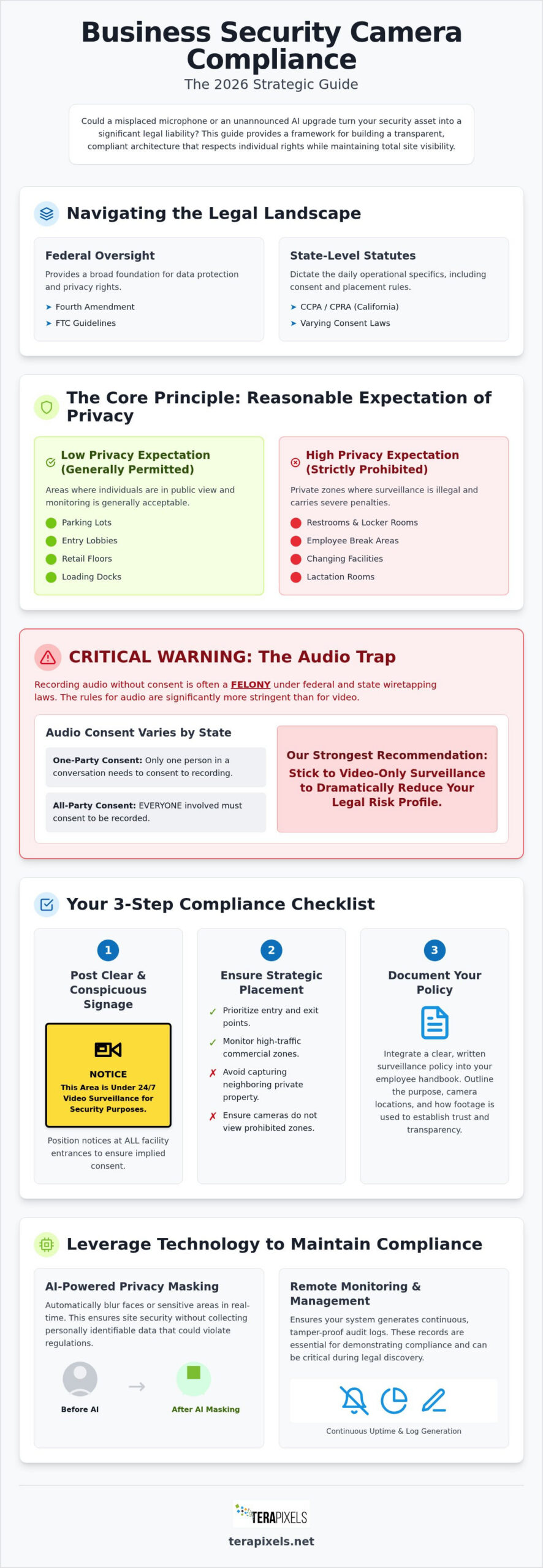
Compliance begins with a clear understanding of the “reasonable expectation of privacy.” This legal standard acts as the primary yardstick for camera placement under business security camera laws and regulations. While federal oversight, such as the Fourth Amendment and FTC guidelines, provides a broad foundation for data protection, state-level statutes often dictate the daily operational specifics. Courts generally find that public-facing areas, including parking lots and entry lobbies, have a lower privacy threshold because individuals are already in public view. However, as we move through 2026, updated frameworks like the CCPA and CPRA demand higher transparency regarding how visual data is captured and stored.
Understanding State-Specific Consent and Privacy Laws
State laws vary significantly when it comes to consent. “One-party” states require only one person in a conversation to consent to recording, whereas “all-party” states require everyone present to agree. While this often applies to audio, it influences how businesses approach video surveillance in sensitive areas. Regardless of your location, certain zones are strictly prohibited from monitoring to avoid severe legal penalties. These include:
- Restrooms and locker rooms
- Employee break areas where privacy is expected
- Changing facilities or lactation rooms
It’s not enough to simply follow the law; you must document your compliance. Integrating a clear, written surveillance policy into your employee handbook is a critical step. This document should outline the purpose of the cameras, where they are located, and how the footage is used. By being proactive, you establish a partnership of trust with your staff while shielding your business from liability.
Practical Compliance: Audio Recording and Signage Requirements
While video recording is a standard security practice, many owners unknowingly fall into the “Audio Trap.” Recording sound is often classified as a felony under federal and state wiretapping laws if it’s captured without the explicit consent of all parties involved. Because audio laws are significantly more stringent than those for visual data, sticking to video-only surveillance dramatically reduces your legal risk profile. To maintain full alignment with business security camera laws and regulations, you must prioritize “Clear and Conspicuous” signage. These notices should be positioned at all facility entrances, ensuring no visitor or employee enters the premises without being properly informed of the monitoring.
Maintaining a compliant environment requires a strategic approach to hardware placement. Follow this checklist for legally sound camera positioning:
- Prioritize primary entry and exit points to document all arrivals and departures.
- Monitor high-traffic commercial zones like retail floors, loading docks, or office lobbies.
- Avoid any camera angle that inadvertently captures private areas of neighboring properties.
- Ensure cameras are visible to reinforce the physical notice provided by your signage.
Best Practices for Employee and Customer Notification
Establishing best practices for notification is a cornerstone of following business security camera laws and regulations. Implied consent occurs when a visitor, having been notified by visible signage, chooses to enter and remain within a monitored facility. A legally sound notice should include the primary purpose of the surveillance, your company’s contact information, and a brief statement on how the recorded data is used. Integrating these notification standards with keycard access control systems for business helps establish a clear, secure perimeter where surveillance begins. Our team at Terapixels Systems can help you audit your signage placement for maximum visibility.
Leveraging Technology to Maintain Legal Compliance
Modern surveillance isn’t just about recording; it’s about intelligent management. An AI security camera system commercial deployment utilizes dynamic privacy masking to automatically blur faces or sensitive areas in real-time. This ensures your site remains secure without inadvertently collecting identifiable data that violates business security camera laws and regulations. It’s a proactive way to respect individual privacy while maintaining high-level operational intelligence.
System reliability is equally vital for legal protection. Utilizing rmm ensures your system generates continuous audit logs, which are essential during legal discovery. A strategic technological approach involves several layers of protection:
- Tamper-proof storage: Cloud-based surveillance prevents unauthorized local access to footage, maintaining a clear “chain of custody” for evidence.
- Precision placement: Professional business security camera installation ensures lenses don’t capture off-site private property or prohibited zones.
- Automated reporting: Continuous monitoring ensures your system is legally operational when incidents occur, preventing gaps in your security record.
Secure Data Storage and Access Control Protocols
Legal compliance extends to how you store and destroy data. You should establish clear data retention periods that align with industry standards and ensure a secure “end-of-life” disposal process for old hardware. Leveraging managed IT monitoring services commercial protects your footage from cyber breaches that could lead to massive privacy lawsuits. Finally, adopt the principle of “Least Privilege” access. This protocol ensures only authorized personnel can view sensitive footage, significantly reducing your internal liability and protecting employee confidentiality. This architectural approach keeps your operations within the bounds of business security camera laws and regulations while providing the security your business needs.
Securing Your Future with Compliant Surveillance
Maintaining a robust security posture requires more than just high-definition lenses. It demands a deep alignment with the evolving landscape of business security camera laws and regulations. We’ve explored how precision placement and clear signage form the foundation of legal transparency. By integrating AI-driven privacy masking and cloud-based storage, you don’t just record events; you protect individual rights while securing your data against unauthorized access. Our team specializes in cloud-based surveillance and secure data management, providing nationwide support for advanced security infrastructure. We’re here to help you implement AI-driven liability reduction strategies that keep your operations running smoothly. This partnership between advanced technology and legal foresight ensures your business remains resilient in 2026 and beyond. For those managing international regulatory requirements, such as European tax compliance, you can visit CiDATax SRL for specialized support.
Taking these proactive steps today creates a stable environment where your team feels protected and your assets remain secure. We look forward to helping you build a surveillance system that meets the highest standards of compliance and reliability.
Frequently Asked Questions
Is it legal to have security cameras with audio in my business?
Audio recording is strictly regulated and often requires all-party consent to avoid felony wiretapping charges. While video is standard, adding audio significantly increases your legal risk. It’s usually safer to disable audio features entirely to stay within the bounds of business security camera laws and regulations unless you’ve secured explicit legal counsel and written consent from all recorded individuals.
Do I have to post a sign if I use security cameras in a commercial building?
Yes, posting clear and conspicuous signage is essential for establishing implied consent. When visitors or employees see a notice at the entrance, their decision to enter the facility serves as an agreement to be monitored. This practice provides a critical layer of protection against privacy claims while ensuring your business remains transparent about its security protocols.
Can employees sue for invasion of privacy if there are cameras in the office?
Employees can sue if cameras are placed in areas where there’s a “reasonable expectation of privacy.” Prohibited zones include restrooms, locker rooms, and designated changing areas. To mitigate this risk, keep cameras in common areas like hallways or lobbies and include a comprehensive surveillance policy in your employee handbook to set clear expectations from day one.
How long are businesses legally required to keep security camera footage?
Retention requirements vary based on your specific industry and state statutes. Many commercial entities retain footage for 30 to 90 days, though certain sectors like banking, healthcare, or the cannabis industry might require longer periods; for those in the cannabis sector, PROTEUS420 offers specialized insights into these complex compliance standards. Using cloud-based surveillance systems helps automate these retention cycles, ensuring you meet data protection standards without manual intervention or the risk of premature deletion.
Are hidden cameras legal in a professional business environment?
Hidden cameras are generally illegal in areas where people have a high expectation of privacy. In a professional setting, transparency is the best policy for liability reduction. Using visible hardware combined with proper signage is more effective for deterrence and ensures your business security camera laws and regulations compliance remains intact throughout your facility.
Do I need a permit to install commercial security cameras?
Permit requirements depend on your local municipality and the scope of the installation. If the project involves structural cabling or high-voltage work, you’ll likely need a building permit. It’s best to consult with a professional installer who understands local codes to ensure your hardware is mounted safely and in full compliance with regional electrical and safety standards.