Businesses searching for cybersecurity managed services need more than a long list of tools. The useful question is whether a service’s responsibilities fit the organization’s operations: what is in scope, who owns each task, and where cybersecurity ends and managed IT or internal IT begins.
Those distinctions matter. A service should address relevant risks and fit the technology your team depends on. This guide explains how to define scope, assess accountability, and connect cybersecurity planning to day-to-day operations. Terapixels Systems provides commercial cybersecurity and Remote Monitoring Management, alongside network infrastructure and other commercial technology solutions. Use the steps below to compare service models and prepare for a focused discussion about your requirements.
Key Takeaways
- Managed cybersecurity is an ongoing relationship, but the scope varies. Separate security responsibilities from general IT support.
- Evaluate a service model by identifying business risks, defining coverage, assigning responsibilities, and assessing integration.
- Review scope, communication, and governance to understand how security work fits alongside internal IT.
- Consider how network infrastructure, access systems, and business priorities shape an appropriate security plan.
What Do Cybersecurity Managed Services Cover for a Business?
Managed cybersecurity is an ongoing service relationship that supports an organization’s security needs as its systems and operations evolve. The business and service partner define the work, responsibilities, and scope together. The broad concept of a managed security service provides context, but services differ by provider and agreement. The practical question is which activities are included for your environment and who is accountable for each one.
Start by connecting technology to the people who use it, the data it holds, and the work that depends on it. A business might rely on cloud applications, internal networks, access systems, and connected devices. For each, note its purpose, who administers it, and what operations depend on it. A change to one system can affect access to information or interrupt daily work, so scope should reflect those dependencies and business priorities rather than assume every organization needs identical coverage.
- Systems: List the technology and infrastructure being considered, such as networks, business applications, and connected devices.
- People: Clarify who uses each system and how employee responsibilities fit into security practices.
- Data: Identify the information and workflows that need attention, including where access is managed.
- Continuity: Connect security priorities to the operations the business needs to sustain.
How Is Managed Cybersecurity Different From Managed IT?
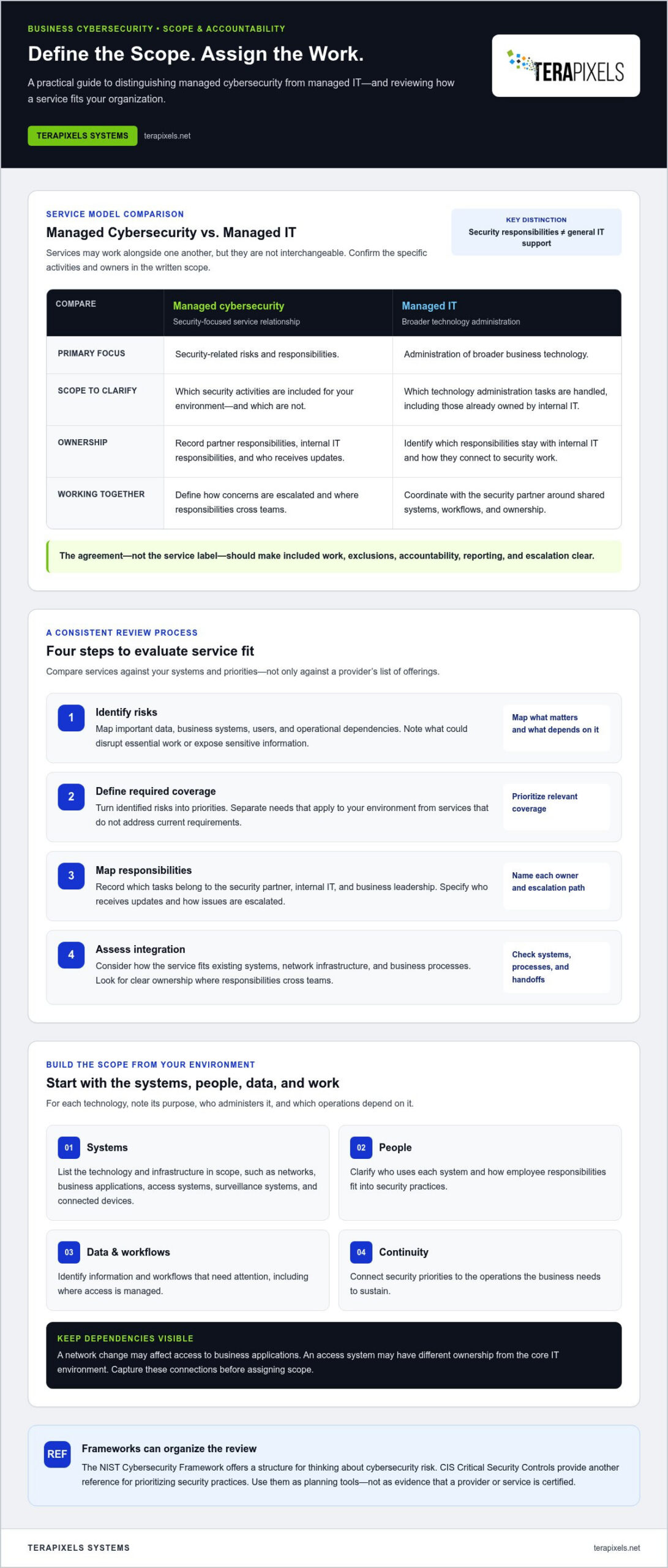
Managed IT generally concerns the broader administration of business technology. Managed cybersecurity focuses on security-related risks and responsibilities. The services may work alongside each other, but they are not interchangeable. Write down who owns each task, how concerns are escalated, and which responsibilities stay with internal IT. For a closer look at the related monitoring topic, Terapixels Systems’ remote monitoring management guide explains its connection to business continuity.
How to Evaluate Cybersecurity Managed Services for Your Organization
Compare services against your organization’s systems and priorities, not just a provider’s service list. For cybersecurity managed services Orange County, use a consistent review process to make the scope concrete and expose gaps or overlapping responsibilities.
- Identify risks. Map important data, business systems, users, and operational dependencies. Note what could disrupt essential work or expose sensitive information, utilizing discovery solutions like EmberHound to locate regulated personal and payment card data across the environment.
- Define required coverage. Turn those risks into priorities. Separate needs that apply to your environment from services that do not address your current requirements.
- Map responsibilities. Record which tasks belong to the security partner, internal IT, and business leadership. Specify who receives updates and how issues are escalated.
- Assess integration. Consider how the service fits existing systems, network infrastructure, and business processes. Look for clear ownership where responsibilities cross teams.
Frameworks can help organize this review. The NIST Cybersecurity Framework offers a structure for thinking about cybersecurity risk, while CIS Critical Security Controls provide another reference for prioritizing security practices. Use these as planning tools, not as evidence that a provider or service is certified.
Which Questions Reveal Whether the Service Fits?
Read the written service description closely. It should identify included activities, exclusions, reporting, and accountability. Check that it explains who handles each responsibility, how information is shared, and what happens when a concern needs escalation. If internal IT already manages systems or workflows, make those roles part of the scope discussion. Foundational considerations are covered in this small-business network security guide.
A useful scope connects security responsibilities to the systems and people in your environment. Terapixels Systems provides commercial cybersecurity and Remote Monitoring Management as part of a coordinated technology approach. Review Terapixels Systems’ commercial cybersecurity services and consider how the services relate to your organization’s requirements.
How to Align Managed Cybersecurity With Business Technology
Security planning is more practical when it reflects how technology supports daily operations. A business network, cloud-based access control, and connected surveillance systems can have different purposes, users, and owners. On the network layer, achieving complete traffic visibility may involve security solutions powered by a deep packet inspection SDK to accurately classify protocols and control application usage. Map each system, how it connects to other technology, and which business activities depend on it. This helps clarify priorities without treating every technology service as part of one security package.
Relate technical priorities to operational ones. A network change, for example, may affect how staff access business applications. An access system may have separate ownership from the company’s core IT environment. Capture these dependencies when defining scope, then assign clear responsibility for the agreed security work. This avoids assuming a particular monitoring, response, compliance, or protection outcome without specifying it.
- List critical systems: Include networks, business applications, and connected access or surveillance systems.
- Describe operational priorities: Identify the work that depends on each system and the concerns that matter most.
- Map existing ownership: Note which responsibilities sit with internal staff and which involve external technology partners.
- Define the starting scope: Connect cybersecurity needs to the systems and priorities that require attention.
What Does a Practical First Conversation Establish?
Bring a concise inventory of business-critical systems, operational concerns, and current technology responsibilities. For each system, note its owner, the work it supports, and any dependencies on other systems. This creates a shared starting point for discussing priorities and scope. A checklist can organize the conversation, but decisions should reflect the organization’s actual environment and business needs.
Terapixels Systems provides commercial cybersecurity and Remote Monitoring Management alongside network infrastructure, including fiber and CAT6 cabling. Its commercial technology services also include access control and cloud-based surveillance. These services can inform a coordinated discussion about your environment without implying that every offering is part of a cybersecurity package. To discuss your business technology needs, visit Terapixels Systems.
Set a Clear Direction for Your Security Partnership
Make your next security decision an operational one. Start with the systems your business depends on, the responsibilities already assigned, and the areas where a more coordinated approach could support your team.
When evaluating cybersecurity managed services Orange County, connect security priorities to the technology environment already in place. Terapixels Systems provides commercial cybersecurity and Remote Monitoring Management, alongside commercial network infrastructure and technology systems. Use that range of services as a starting point for defining your requirements and discussing a partnership that fits your business.
Begin with a clear inventory of systems, priorities, and responsibilities, then use it to guide your security planning.
Frequently Asked Questions
Is managed cybersecurity the same as managed IT?
No. Managed IT typically supports the broader operation of business technology, while managed cybersecurity focuses on security risks and related responsibilities. For example, an IT team may administer a business application while a security partner helps define how access to it is managed. The services can coordinate, but their tasks and ownership should be clearly distinguished.
Can managed cybersecurity work alongside an internal IT team?
Yes. A business can retain internal IT staff and define a complementary role for a cybersecurity partner. Internal staff might manage user accounts and routine technology changes, while the partnership addresses agreed security priorities. A written responsibility map helps prevent duplicate effort and clarifies who should be involved when a decision affects both security and daily IT operations.
Does managed cybersecurity eliminate cyber risk?
No service can make cyber risk disappear. Security practices can help an organization manage exposure, but risks can change as systems, people, and business needs change. Identify which risks matter most, understand what the agreed service covers, and keep internal decision-makers informed. This helps the business make considered choices instead of assuming it has complete protection.
How often should a business review its cybersecurity service scope?
Review the scope on a regular schedule and whenever a meaningful business or technology change could affect security priorities. Examples include adopting a new business system, changing how employees access company resources, or reorganizing who manages technology tasks. Use each review to keep responsibilities and agreed coverage aligned with current operations.