CONTACT US

Did you know that regular professional maintenance can reduce unexpected system failures by 75% and extend your equipment’s lifespan by up to seven years? For many Southern California businesses, commercial security system maintenance is often treated as a reactive task rather than a core operational strategy. It’s easy to assume that once AI-powered cameras or cloud-based access control systems are installed, they’ll simply function without intervention. However, neglecting these complex ecosystems leads to liability gaps and sudden repair costs that can disrupt your daily operations.
You likely recognize that your security infrastructure is a significant investment that deserves consistent protection. We’ll show you how a proactive approach to your integrated systems eliminates downtime and safeguards your commercial property. This article previews the 2026 strategy for business continuity, covering everything from cybersecurity hardening to maintaining compliance with local California regulations and insurance mandates. By shifting to a partnership-driven maintenance model, you can ensure your technology remains a steady hand in your business growth.
Key Takeaways
- Learn how transitioning from a “break-fix” model to a proactive continuity strategy prevents liability gaps and unexpected repair costs.
- Identify the three essential pillars of commercial security system maintenance to ensure hardware, software, and physical infrastructure remain fully optimized.
- Discover how Remote Monitoring Management and AI analytics provide digital oversight to predict and prevent component failures before they occur.
- Address specific Southern California environmental challenges, such as coastal salt air corrosion and inland heat management for outdoor electronics.
- Understand the value of a partnership-driven provider who integrates security, structural cabling, and power solutions into a single source of truth.
Why Proactive Commercial Security System Maintenance is Essential in 2026
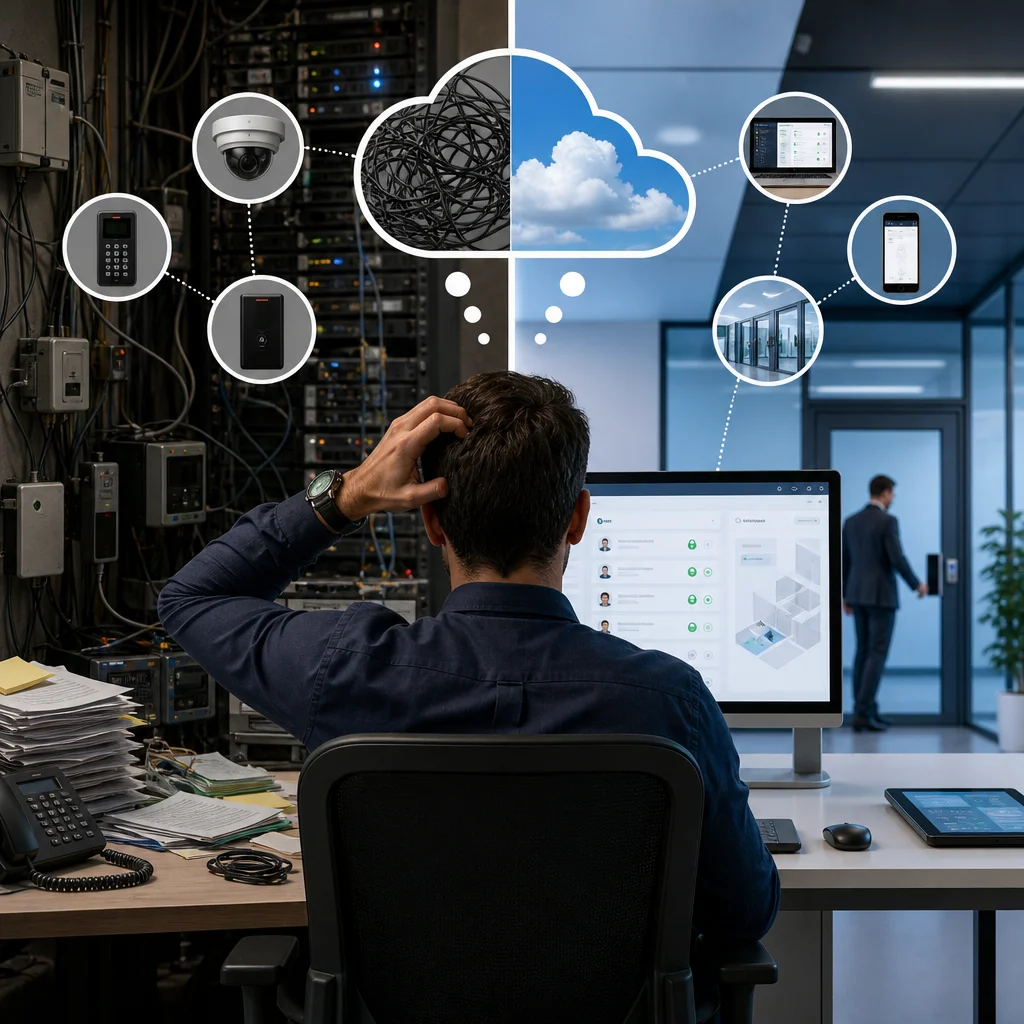
In the current business environment, the definition of security has shifted from simple surveillance to total operational continuity. Traditional commercial security system maintenance was once viewed as a “break-fix” service, where a technician was only called after a component failed. By 2026, this reactive approach has become a significant risk. Modern security relies on a sophisticated web of AI analytics, cloud-based access control, and high-speed networking. When one link in this chain weakens, it doesn’t just create a technical glitch; it creates a vulnerability that can lead to theft, data breaches, or physical safety hazards.
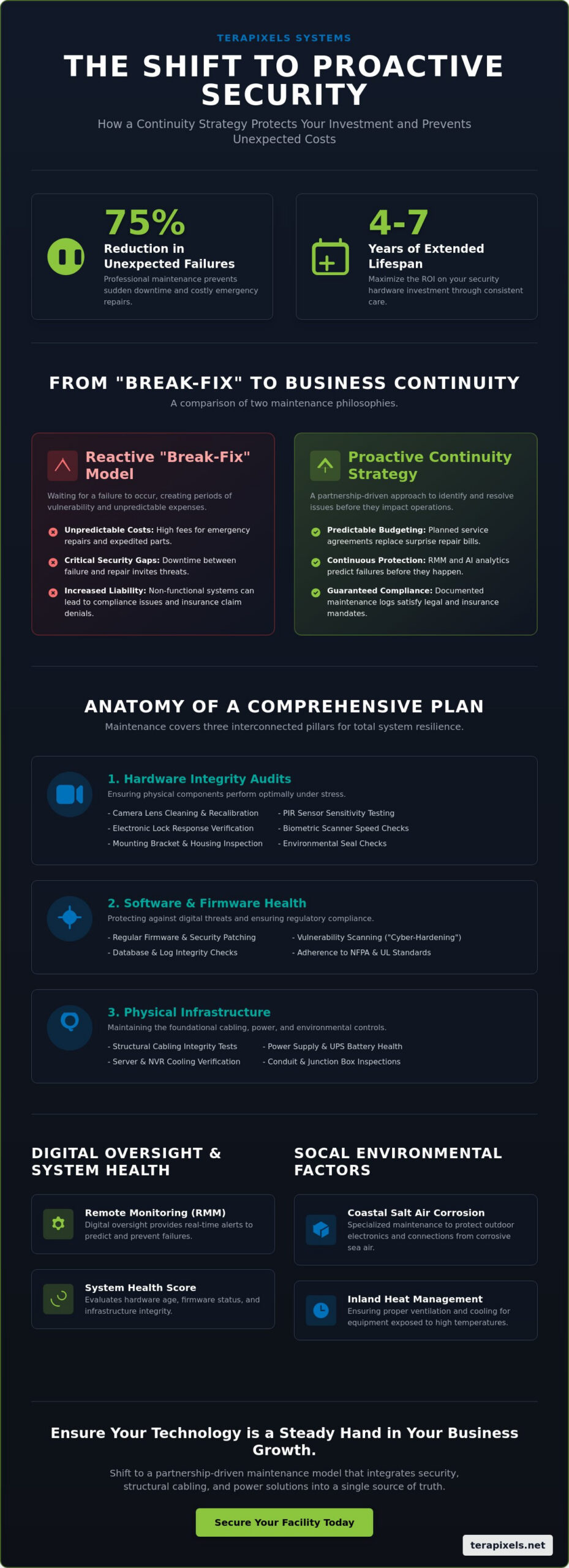
Proactive maintenance is a preventative strategy designed to identify and resolve these weaknesses before they result in system downtime. Industry data shows that regular professional maintenance can reduce unexpected system failures by 75% and extend the operational lifespan of your equipment by four to seven years. For a business owner, this means your high-end AI cameras and integrated sensors remain assets rather than becoming liabilities. It’s about moving away from emergency repairs and toward a steady state of technological reliability.
The Shift from Reactive to Proactive Protection
Waiting for a system failure creates what security professionals call a “security gap.” This is the window of time between a component failing and a repair being completed. Criminals often look for these gaps, such as a flickering camera or a malfunctioning card reader, as an invitation to act. Beyond the immediate physical risk, the financial burden of the reactive model is unpredictable. Emergency repair fees and expedited shipping for parts can quickly exceed the cost of a planned service agreement.
To help business owners manage this, we often look at a “System Health Score.” This metric evaluates the age of your hardware, the status of your firmware, and the integrity of your Physical security systems. By maintaining a high health score through scheduled inspections, you ensure that your security infrastructure remains resilient and your budget remains predictable.
Reducing Liability and Ensuring Insurance Compliance
The legal landscape for Southern California businesses has become increasingly stringent. In 2026, a non-functional security camera is not just a technical failure; it is a legal liability. If an incident occurs and your surveillance logs are incomplete due to poor maintenance, your business may face challenges during legal disputes or insurance claims. Documented maintenance logs serve as proof that you have taken reasonable steps to protect your employees and visitors.
Adhering to modern standards like NFPA 72 for signaling and UL 268 for smoke detection is also critical for staying compliant with local regulations. Insurance providers are now more frequently requiring proof of “cyber-hardened” physical security systems to maintain coverage. Proactive commercial security system maintenance ensures that your firmware is patched against vulnerabilities, protecting your physical assets and your digital network simultaneously.
The Anatomy of a Comprehensive Maintenance Plan
Effective commercial security system maintenance requires a holistic view of your facility’s technology. It’s not enough to verify that a camera is recording; you must ensure the entire ecosystem is resilient. We categorize a comprehensive plan into three distinct pillars: hardware integrity, software and firmware health, and the physical infrastructure. By treating these as interconnected layers, you move away from the “break-fix” model and toward a state of total business continuity.
Surveillance and Access Control Hardware Audits
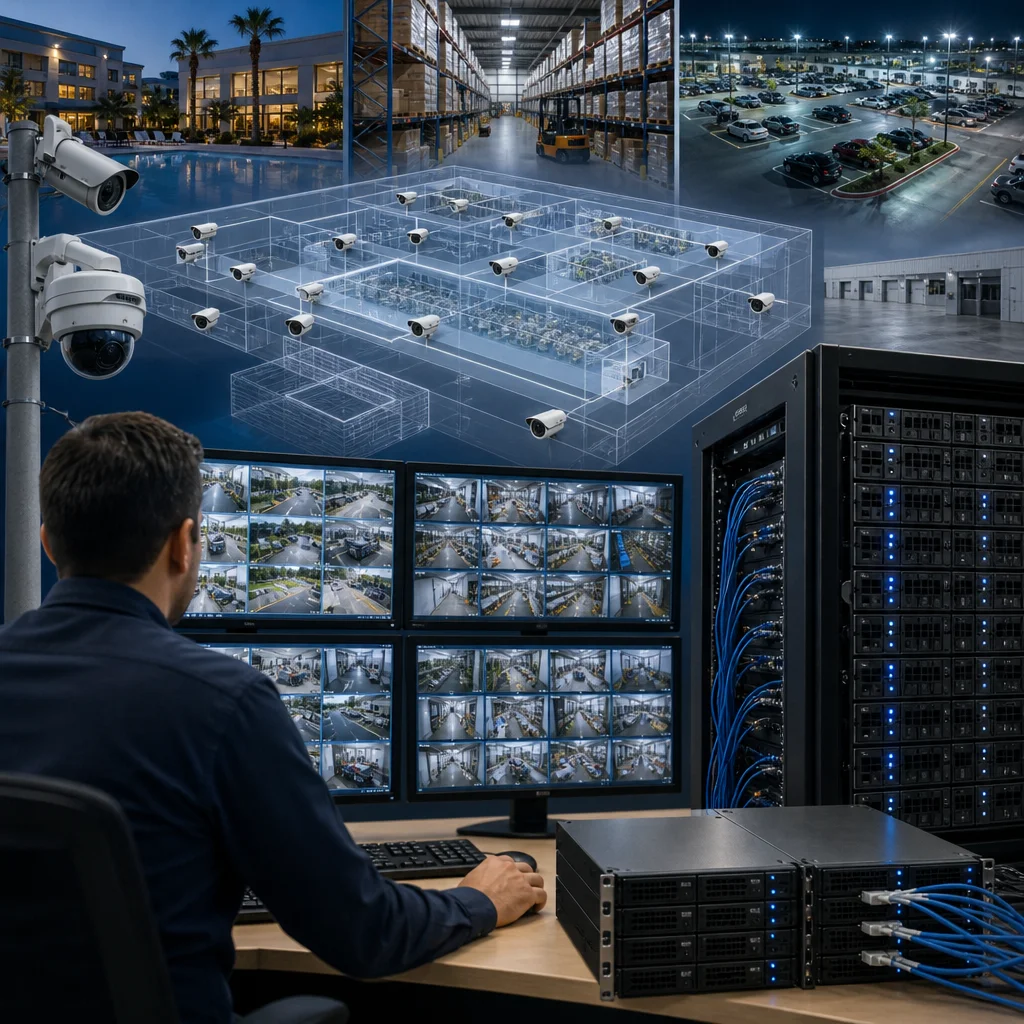
High-traffic commercial zones put immense stress on physical components. During a professional audit, we look at more than just the image quality. Technicians must clean lenses and recalibrate the focus to ensure AI analytics can accurately identify behavioral precursors to incidents. PIR (Passive Infrared) sensors require sensitivity testing to minimize false alarms, which currently account for 94 to 98 percent of alarm calls nationally. We also verify the response times of biometric scanners and electronic locks, ensuring authorized personnel move efficiently while unauthorized access remains blocked. Inspecting mounting brackets for wear or loosening is also vital, as even slight shifts can create blind spots in your surveillance coverage.
Firmware updates are frequently the most neglected aspect of system health. These updates don’t just add new features; they patch critical vulnerabilities that could allow your physical security to become a vector for cyber-attacks. This is where network security for small business serves as a vital maintenance layer. Keeping your cloud-based surveillance systems updated ensures they remain cyber-hardened, a requirement that many commercial insurance policies now strictly enforce. If you’re looking to audit your current setup, a professional assessment of your integrated systems can pinpoint hidden vulnerabilities in your infrastructure.
Infrastructure: Cabling and Power Supply Checks
The backbone of your security is the cabling and power supply. Over time, environmental factors can degrade the performance of CAT6 and fiber optic backbones, leading to packet loss or delayed video feeds. We test for signal integrity across these lines to ensure your AI-powered analytics receive clear data without latency. Power failover is equally critical. We test Uninterruptible Power Supplies (UPS) and backup batteries to ensure they can sustain your system during a primary power loss. For businesses requiring absolute continuity, integrating backup generator installation for business ensures that your security remains active even during prolonged local outages. This integrated approach ensures that your security remains a steady, reliable shield for your commercial investment.
Leveraging Remote Monitoring Management (RMM) for System Health
Modern security isn’t just about the physical hardware you can see and touch; it’s about the data flowing through your network. In the context of commercial security system maintenance, Remote Monitoring Management (RMM) serves as the digital central nervous system of your facility. It provides 24/7 oversight of every component in your integrated security stack, from AI cameras to access control readers. This technology allows us to maintain a steady hand on your systems, identifying potential issues before they escalate into operational disruptions. It represents the shift from manual inspections to a state of constant, digital vigilance.
One of the most significant advantages of RMM is the ability to perform remote patching. In the past, updating firmware or fixing a software bug required a “truck roll,” where a technician had to physically visit your site. Today, we can deploy critical security patches and software updates across your entire infrastructure instantly. This ensures your system is always running the latest, most secure versions without the need for scheduled downtime or on-site visits. This digital oversight is the foundation of remote monitoring management for business, ensuring your continuity isn’t interrupted by preventable technical glitches.
Real-Time Alerts and Predictive Analytics
Traditional maintenance models are often blind to failures until someone notices a dark screen. RMM changes this by utilizing AI-driven analytics to monitor the health of your hardware in real time. For example, the system can analyze the spin-up time and vibration patterns of a hard drive in your NVR. If the AI detects a deviation from the norm, it can predict a failure weeks before it happens. We also monitor environmental factors like temperature and power consumption within your server racks. If a cooling fan fails and temperatures rise, we receive an alert immediately. This proactive data significantly reduces the Mean Time to Repair (MTTR) because we often arrive with the necessary replacement parts before you even realize there’s a problem.
Cybersecurity Maintenance: The Digital Perimeter
As physical security systems become more integrated with the cloud, they become prime targets for botnets and cyber-attacks. An unpatched security camera is a gateway into your entire corporate network. Digital commercial security system maintenance includes rigorous “cyber-hardening” of your physical assets. We manage regular password rotations and ensure that multi-factor authentication (MFA) is active across all user accounts. By verifying that your cloud-based surveillance systems utilize end-to-end encryption, we protect your visual data from unauthorized access. This layer of maintenance ensures that your security system remains a shield for your business rather than a vulnerability for your IT department.
Local Maintenance Factors in San Diego and Orange County
Southern California’s unique microclimates present distinct physical challenges for security infrastructure. While the region’s weather is generally mild, the proximity to the Pacific Ocean and the extreme heat of inland valleys require a specialized approach to commercial security system maintenance. A generic maintenance checklist often fails to account for the accelerated degradation of outdoor components in these specific environments. Partnering with a local expert ensures that your system is hardened against the exact stressors it faces daily, from saline mist to high-intensity UV exposure.
Proximity to a local technician is also a vital component of business continuity. While digital tools like RMM handle many software issues, physical damage from environmental factors requires rapid on-site support. Having a team that understands the geography of San Diego and Orange County means your “security gap” is minimized when hardware needs physical intervention. This localized knowledge allows for more precise planning, ensuring that your system remains a steady, reliable shield for your commercial property.
Environmental Protection for Southern California Facilities
For coastal properties in San Diego and Orange County, salt air is the primary threat to equipment longevity. Saline mist can penetrate standard camera housings, leading to rapid corrosion of internal circuit boards and mounting hardware. Maintenance for these facilities must include specific anti-corrosion treatments and the verification of nitrogen-sealed enclosures to keep moisture out. Inland, warehouses in areas like Anaheim or Irvine face a different challenge: extreme heat. High temperatures can cause thermal throttling in outdoor electronics, leading to dropped frames or sensor lag in AI analytics. Regular inspections ensure that cooling systems are functional and that dust hasn’t clogged the ventilation of server racks in industrial parks. In San Diego, the combination of high UV exposure and seasonal humidity can significantly shorten the lifespan of outdoor CAT6 cabling if the protective jacketing isn’t inspected for cracking or brittleness.
Compliance with Local Commercial Ordinances
California’s regulatory landscape demands strict technical adherence to protect both the business and the public. Maintenance routines must verify that your cloud-based access control systems integrate seamlessly with California fire egress codes, ensuring that doors fail-safe during an emergency without compromising security. We also focus on maintaining compliance with the California Consumer Privacy Act (CCPA). This involves auditing your “right to privacy” masks in surveillance software, especially in shared commercial office spaces where capturing footage of adjacent properties or public walkways is restricted. Finally, we ensure your surveillance storage meets the evidentiary standards required by local law enforcement, confirming that retention periods and video quality are sufficient for legal use. To ensure your facility remains compliant and resilient against local environmental stressors, you can schedule a local site audit with our Southern California team.
Choosing a Partnership-Driven Maintenance Provider
Selecting a partner for your security needs is a decision that impacts your long-term operational stability. Many businesses view a service provider as a mere vendor, called only when a camera fails or a door lock sticks. By 2026, the complexity of integrated systems requires a shift in perspective. You need a Reliable Architect who understands the symbiotic relationship between your hardware, your network, and your power supply. Comprehensive commercial security system maintenance is most effective when managed by a single source of truth that can see the entire technological landscape of your facility.
Terapixels Systems approaches maintenance with this holistic mindset. We don’t just look at the individual device; we evaluate the infrastructure that supports it. Our background in structural cabling and fiber optics ensures that your data transmission is as reliable as the cameras themselves. When one team manages your cloud-based surveillance systems, access control, and cybersecurity, you eliminate the finger-pointing that often occurs between multiple contractors. This integrated expertise leads to a more resilient system and a predictable security budget.
The Terapixels Systems Difference: Integrated Expertise
Our commitment to the San Diego and Orange County business communities is built on technical precision and localized support. We integrate AI analytics into our standard maintenance cycles to provide a level of oversight that manual inspections simply can’t match. This allows us to monitor the health of your security camera systems and networking components in real time. Because we design and install the CAT6 and fiber backbones ourselves, we know exactly how to maintain them for peak performance. This all-encompassing approach ensures that your security remains a silent, steady hand that allows you to focus on your core business objectives.
Next Steps: Securing Your Business Continuity
Every commercial facility has a unique risk profile and environmental challenges. During a Terapixels maintenance consultation, we perform a thorough health audit of your current setup. We evaluate everything from the physical integrity of your outdoor enclosures to the firmware status of your sensors. Based on this data, we customize maintenance tiers that align with your facility size and operational requirements. This ensures you aren’t paying for unnecessary services while still achieving the goal of zero system downtime. If you’re ready to protect your investment with a proactive strategy, Contact Terapixels Systems for a Commercial Security Maintenance Quote and let us help you build a more stable future.
Achieving Total Operational Continuity for Your Business
Securing a commercial property in 2026 requires more than high-end hardware; it demands a strategic commitment to technological health. By moving from a reactive repair model to a proactive continuity plan, you eliminate the security gaps that lead to liability and loss. Whether you’re managing salt air corrosion in San Diego or heat-related stress in inland Orange County, a localized approach ensures your infrastructure remains a reliable asset. Integrating AI-driven Remote Monitoring Management allows you to resolve vulnerabilities before they impact your daily operations.
Terapixels Systems serves as your Reliable Architect, offering deep expertise across security, networking, and energy systems. We specialize in Southern California commercial infrastructure, ensuring your surveillance and access control platforms are fully optimized and compliant with local regulations. Our team is ready to help you transition to a smarter, more stable way of protecting your investments through consistent commercial security system maintenance. To ensure your facility is prepared for the challenges of the coming year, Schedule your 2026 Commercial Security System Audit with Terapixels Systems. We look forward to building a resilient partnership that supports your long-term growth.
Frequently Asked Questions
How often should a commercial security system be maintained?
Professional standards recommend a comprehensive physical inspection at least once or twice per year, depending on your facility’s environment. While digital health checks via Remote Monitoring Management should occur continuously, a physical audit is necessary to address environmental wear. High-traffic or coastal facilities in Southern California often require more frequent attention to mitigate the effects of salt air and heavy usage on hardware components.
What is included in a typical commercial security maintenance contract?
A standard contract covers hardware cleaning, sensor recalibration, and infrastructure testing for fiber or CAT6 cabling. It also includes software-side tasks such as firmware updates, database backups for access control, and verifying the integrity of AI analytics. By bundling these services into a single agreement, businesses ensure their entire integrated ecosystem remains functional and compliant without the need to manage multiple vendors.
Can remote monitoring replace on-site maintenance visits?
Remote Monitoring Management complements but does not entirely replace physical site visits. While RMM handles software patches, digital diagnostics, and cybersecurity hardening, it cannot clean a salt-crusted camera lens or repair a loose mounting bracket. A balanced approach uses digital oversight to catch issues early and scheduled on-site visits to maintain the physical integrity of your surveillance and access points.
Why is firmware updating considered part of security maintenance?
Firmware updates are critical for patching security vulnerabilities that could allow unauthorized access to your network. These updates also improve the performance of features like AI analytics and ensure compatibility with new cloud-based surveillance systems. Neglecting firmware is one of the most common causes of system instability and cybersecurity breaches in modern commercial environments, making it a core pillar of any maintenance plan.
How does regular maintenance help with insurance premiums for businesses?
Insurance providers often offer lower premiums or better coverage terms to businesses that can provide documented logs of commercial security system maintenance. These records prove that you are taking proactive steps to mitigate risk and ensure your life-safety systems, such as smoke detectors and fire egress access controls, are fully operational. Many policies in 2026 now explicitly require proof of cyber-hardened systems to maintain liability coverage.
What are the signs that my commercial security system needs immediate service?
Immediate service is required if you notice flickering video feeds, delayed response times in your access control readers, or frequent false alarms. Other red flags include visible corrosion on outdoor enclosures or disk error notifications on your recording servers. If your AI analytics fail to trigger alerts for obvious motion, it indicates a calibration or software issue that requires professional intervention to restore your security posture.
Does maintenance include cybersecurity checks for IP cameras?
Yes, modern commercial security system maintenance must include a dedicated cybersecurity layer to protect your digital perimeter. This involves rotating administrative passwords, verifying that encryption protocols are active, and ensuring that multi-factor authentication is enabled for all users. We also check for unauthorized devices on the security network and close unused ports that could serve as entry points for potential cyber-attacks.
Are there specific California regulations for security system upkeep?
California businesses must adhere to fire egress codes and privacy laws like the CCPA, which impact how security systems are maintained. Maintenance visits ensure that electronic locks fail-safe during fire emergencies as required by local ordinances. Technicians also verify that surveillance privacy masks remain correctly configured to prevent the recording of public spaces or adjacent properties, protecting your business from potential legal disputes or privacy claims.