CONTACT US
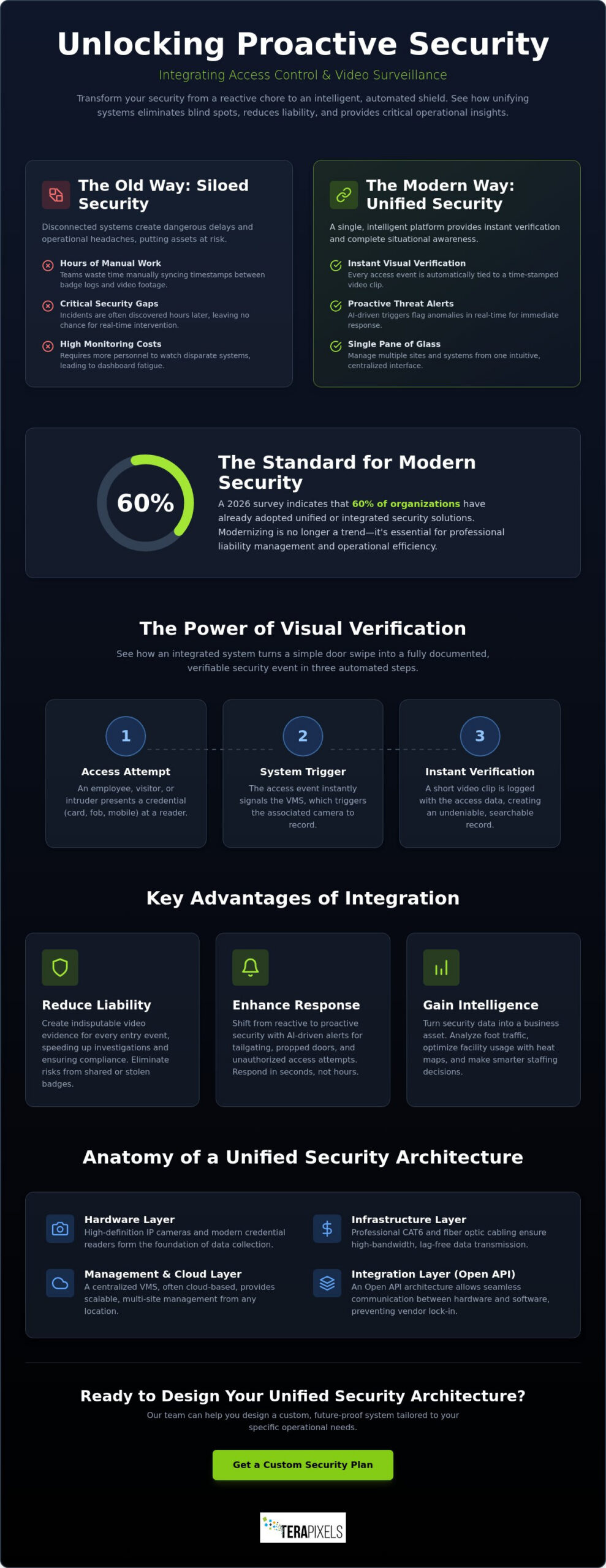
Last Tuesday, a regional operations manager discovered an unauthorized entry at their warehouse three hours after it occurred. They spent the entire morning manually syncing timestamps from a badge reader with footage from a separate, siloed camera system. This delay isn’t just a nuisance; it’s a gap in protection that puts your assets at risk. You likely understand the exhaustion of managing disconnected platforms where blind spots are common and manual monitoring costs continue to climb. With a 2026 survey indicating that 60% of organizations have already moved toward unified or integrated security solutions, the pressure to modernize is more than just a trend; it’s a standard for professional liability management.
This article serves as your strategic guide to access control system integration with video surveillance. You’ll discover how unifying these technologies creates a proactive security shield that reduces liability and enhances operational intelligence for your commercial property. By the end of this guide, you’ll understand how to achieve a single pane of glass for all security events, providing instant video verification for every door swipe and potentially reducing insurance premiums through better documentation. We will walk through the architectural shift from siloed hardware to a unified, intelligent infrastructure designed for long-term reliability.
Key Takeaways
- Understand how Visual Verification eliminates security blind spots by automatically syncing every door swipe with real-time video clips.
- Discover the architectural requirements for successful access control system integration with video surveillance, from credential readers to centralized management platforms.
- Learn why cloud-based infrastructure provides the most scalable and flexible backbone for managing multi-site commercial security in 2026.
- Identify strategies to prevent dashboard fatigue by consolidating disparate security alerts into a single, intuitive user interface.
- Gain insights into developing a phased rollout plan that effectively bridges the gap between legacy hardware and modern, AI-enhanced security systems.
The Strategic Value of Access Control System Integration with Video Surveillance
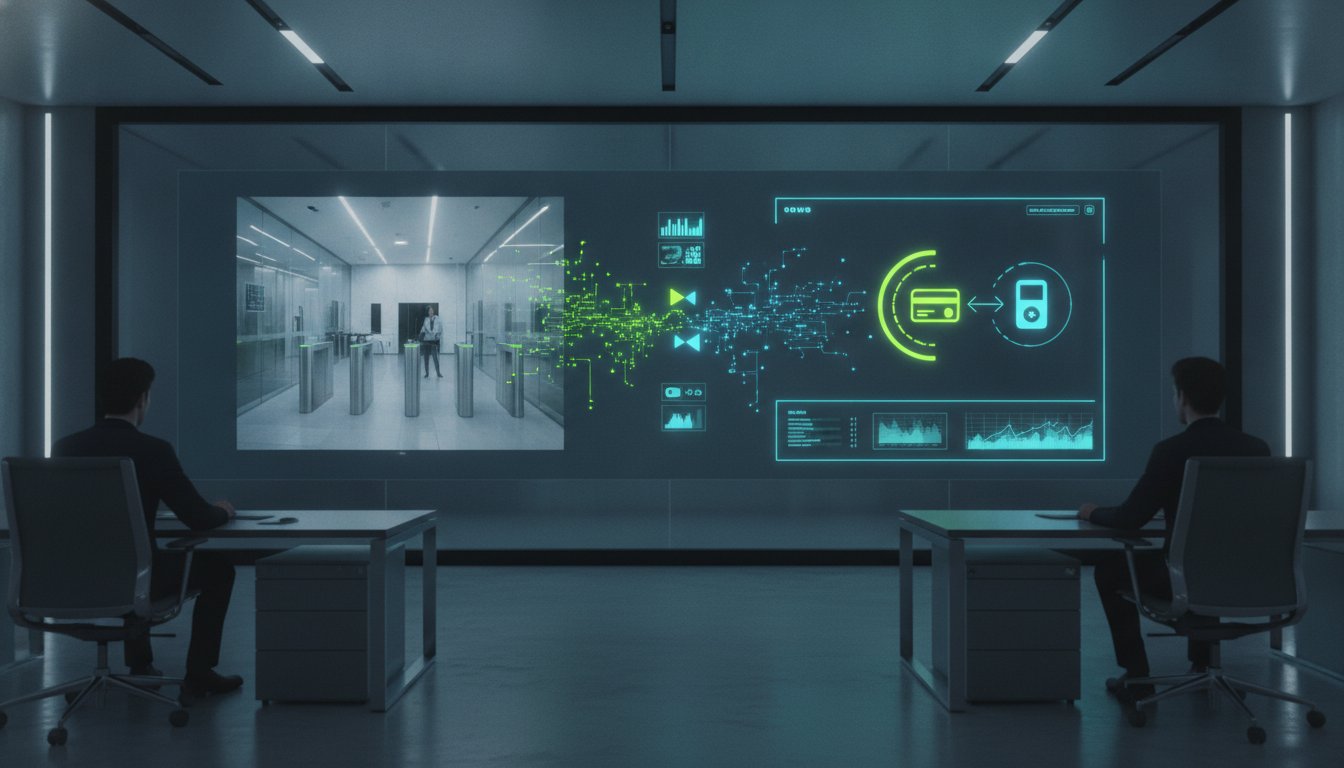
Integrated security is more than just having two systems running on the same network. It’s the synchronization of entry events with real-time visual data. When you implement access control system integration with video surveillance, you’re building a unified architecture where every physical interaction is documented visually. This creates a “Visual Verification” loop. Instead of just seeing a log entry that says “User ID 402 entered at 9:00 AM,” you receive a brief video clip of the person at the door. This ensures the person using the credential is the authorized owner, effectively eliminating the risk of shared badges or lost keys.
To see how these systems work together in a real-world environment, watch this brief overview:
Traditionally, security was reactive. You’d check the tapes after a theft occurred. Modern integrated systems shift this toward proactive threat detection. By using AI-driven triggers, the system can flag anomalies, such as a door being propped open or a tailgating event, and alert your team instantly. This centralized management reduces the need for multiple on-site security personnel, as a single operator can manage several locations from one interface with full situational awareness.
Reducing Liability and Enhancing Incident Response
Forensic investigations become significantly faster when time-stamped video evidence is tied directly to access logs. You don’t have to hunt for the right camera or the right minute; the system does it for you. This level of documentation is critical for meeting compliance standards in high-security commercial facilities. Instant alerts ensure your security team can respond to unauthorized access attempts in seconds, providing a level of protection that manual monitoring simply can’t match.
Operational Intelligence Beyond Security
The benefits of an AI security camera system commercial deployment extend into business operations. By analyzing data from integrated systems, you can optimize foot traffic and facility usage. Heat mapping and dwell time analytics, when integrated with employee access patterns, help you understand how your space is actually used. This allows for better staffing decisions and more efficient building management, turning your security investment into a source of actionable business intelligence.
Designing a Unified Security Architecture: Cloud, AI, and Infrastructure
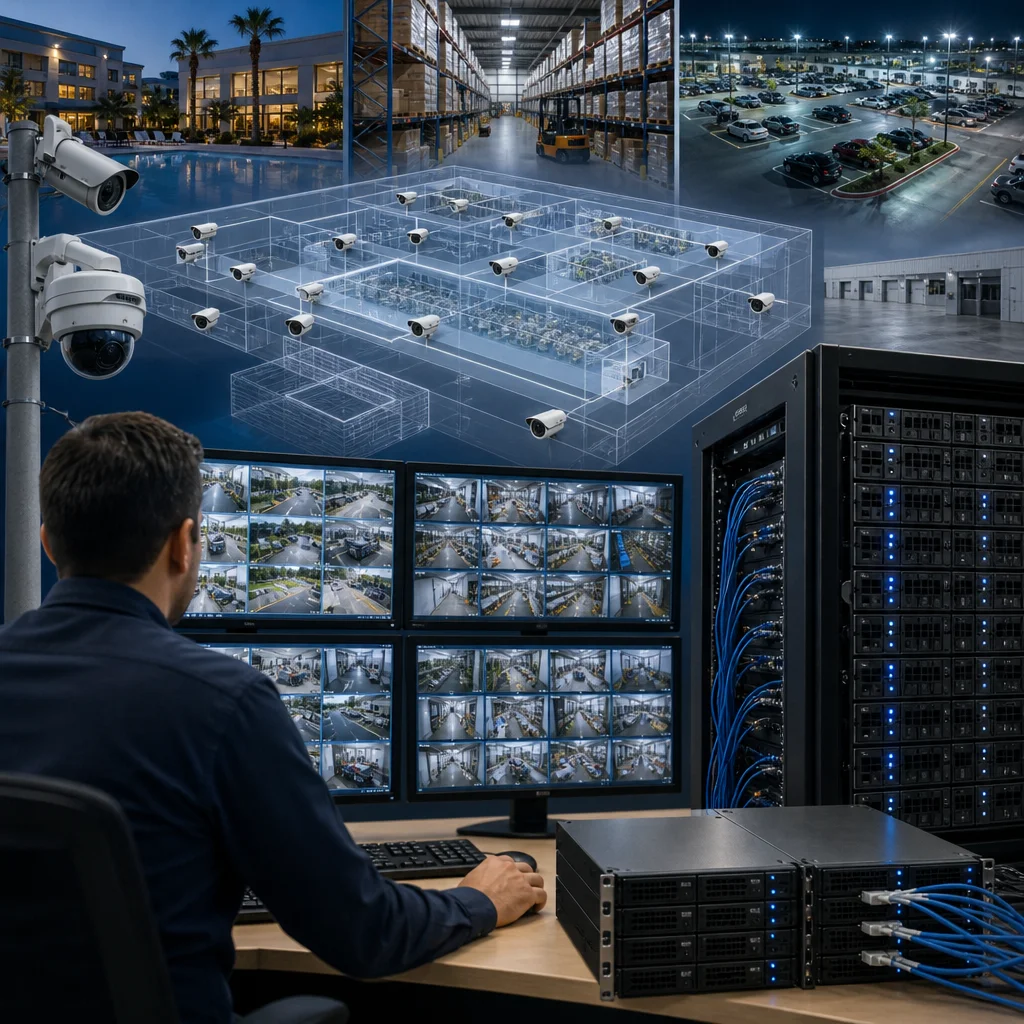
Building a unified security architecture requires looking beyond software interfaces to the physical and digital foundation of your facility. The hardware-to-software stack typically includes high-definition IP cameras, credential readers, and a centralized Video Management System (VMS) that acts as the brain of the operation. To ensure your investment remains viable as technology evolves, an Open API architecture is essential. This allows different hardware brands to communicate seamlessly, preventing vendor lock-in. Managing the resulting data flow is a significant undertaking. High-definition video streams require substantial bandwidth to operate alongside real-time access control data without lag. Planning these complex systems is a collaborative process, and our team is ready to help you design a custom security architecture tailored to your specific operational needs.
The Essential Role of Structured Cabling and Fiber Optics
A high-performance access control system integration with video surveillance is only as reliable as the wires behind the walls. Professional CAT6 cabling installation commercial standards are now the baseline for supporting the 4K streams and rapid data bursts required by modern security hardware. For large-scale facilities, a fiber optic backbone is necessary to ensure low-latency transmission over long distances. Power over Ethernet (PoE) simplifies this infrastructure by providing both data and power to cameras and controllers through a single cable, reducing installation complexity and points of failure.
Cloud vs. Hybrid Integration Frameworks
In 2026, cloud-based surveillance is the preferred backbone for multi-site integration. It offers unmatched scalability and allows managers to view every location from a single mobile app. However, some enterprise environments prefer a hybrid framework that maintains on-premise storage for critical footage while using the cloud for management. This is particularly relevant for keycard access control system for business deployments, where remote credential management is a daily necessity. A hybrid approach ensures that if the internet connection fluctuates, your local recording and door functions remain fully operational.
Implementation and Scalability: Future-Proofing Your Commercial Security
Implementing a unified security strategy doesn’t require an overnight overhaul of your entire facility. A phased rollout plan allows you to integrate existing legacy cameras with new cloud-based access control modules, protecting your previous investments while upgrading your capabilities. This transition is most successful when managed through a unified user interface. By consolidating alerts and video feeds into a single dashboard, facility managers can avoid the dashboard fatigue that occurs when toggling between disconnected security apps.
Maximizing Uptime with Remote Monitoring Management (RMM)
A sophisticated security system is only effective if it remains online. Utilizing remote monitoring management for business ensures that your cameras and readers are constantly supervised. Proactive firmware updates and automated health checks act as the steady hand of your security architecture, identifying potential hardware failures before they result in a security blind spot. This constant oversight provides the stability needed for long-term protection.
Choosing a Comprehensive Integration Partner
Building a Resilient Foundation for Your Commercial Security
Transitioning to a unified security model represents a significant step toward total operational awareness. By bridging the gap between entry events and visual data, you move beyond reactive monitoring into a proactive stance powered by AI-driven analytics. It’s an evolution that relies on a robust physical layer of CAT6 or fiber cabling and a flexible cloud architecture that scales alongside your business. When these components work in harmony, you’ll find that security transforms from a background necessity into a valuable source of actionable business intelligence.
Achieving a seamless access control system integration with video surveillance is the most effective way to eliminate operational blind spots while reducing long-term liability. As a national provider of comprehensive technology solutions, Terapixels Systems brings specialized expertise in both cloud-based surveillance and the structural cabling required for high-bandwidth performance. We invite you to Schedule a Security Integration Consultation with Terapixels Systems to explore how a tailored architecture can protect your commercial property. We look forward to being the steady hand that manages your complex systems, ensuring you have the stability and protection needed to focus on your own growth.
Frequently Asked Questions
What are the primary benefits of integrating access control with video surveillance?
The primary benefits include the elimination of security blind spots through visual verification and a significant reduction in liability. By syncing entry logs with real-time video, your team can confirm that the person using a credential is the authorized user. This integration also streamlines incident investigations by providing time-stamped evidence, saving hours of manual review. It’s a fundamental step toward building a proactive security shield for any commercial property.
Can I integrate my existing CCTV cameras with a new cloud-based access control system?
Yes, most existing CCTV cameras can be integrated using an open-platform Video Management System (VMS) or ONVIF-conformant hardware. This approach allows you to leverage your current equipment while upgrading to a modern, cloud-based access control platform. It’s a cost-effective way to achieve access control system integration with video surveillance without a full hardware replacement. A phased rollout ensures your legacy systems remain functional during the transition.
Does integrating security systems require a specialized network infrastructure?
Integrating these systems requires a robust network infrastructure capable of handling high-definition video streams and real-time data simultaneously. Professional CAT6 or fiber optic cabling is the standard for ensuring low latency and high reliability across large commercial facilities. Additionally, Power over Ethernet (PoE) is typically used to simplify the deployment by providing power and data through a single cable, which reduces potential points of failure.
How does AI enhance the integration of access control and video surveillance?
AI enhances integration by shifting security from a reactive to a proactive posture through real-time anomaly detection. It can automatically flag events like tailgating or unauthorized entry attempts and send instant alerts to your management team. Beyond security, AI analytics provide operational intelligence by tracking occupancy patterns and facility usage. This data helps you optimize space and staffing based on actual employee behavior and movement throughout the day.