CONTACT US
What if your security system could identify a sophisticated threat before your team even received the first alert? Most business leaders feel buried under a mountain of false alarms and disconnected security tools that simply do not communicate. It is exhausting to manage cyber defenses in one silo and physical surveillance in another, especially when modern “zero-day” attacks are designed to slip through these very cracks. You deserve a system that acts as a steady, silent partner rather than a source of constant noise.
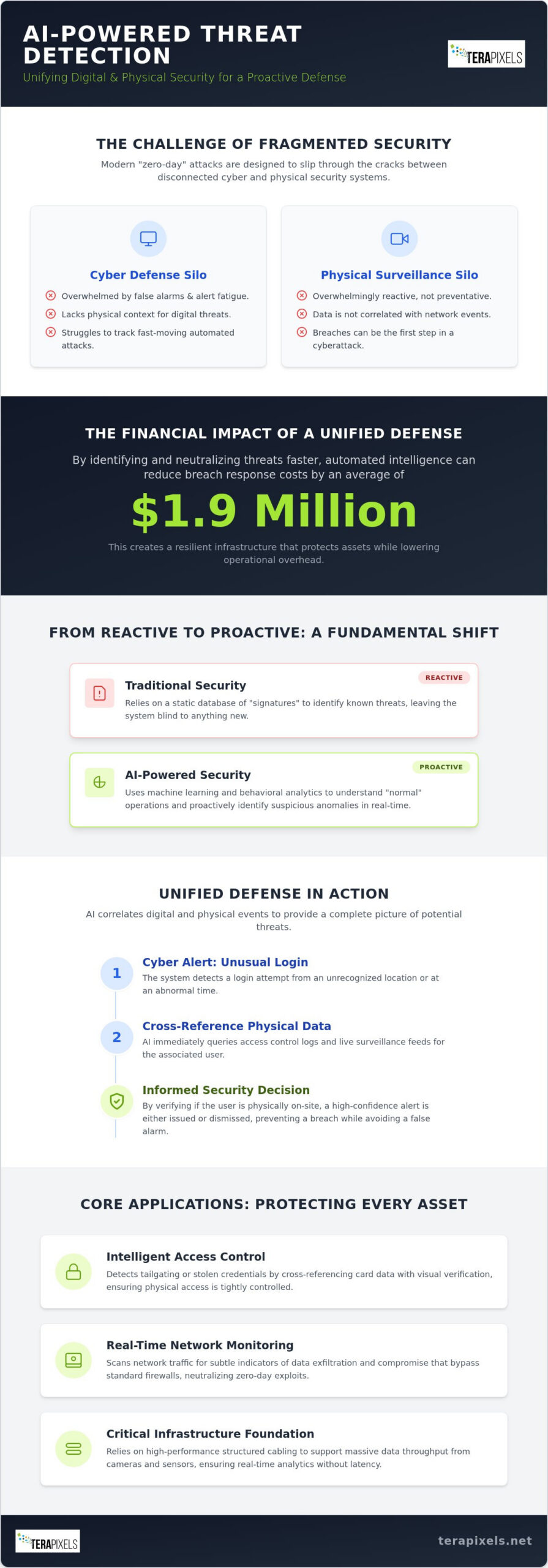
This comprehensive guide explores how AI-powered threat detection for business is moving beyond reactive monitoring to create a unified, proactive shield for your entire organization. We will examine the latest 2026 regulatory shifts, the convergence of digital and physical security, and how automated intelligence can reduce breach response costs by an average of $1.9 million. By the end, you will understand how to build a resilient, integrated infrastructure that protects your assets while lowering operational overhead.
Key Takeaways
- Learn how behavioral analytics and machine learning enable AI-powered threat detection for business to identify anomalies that traditional signature-based systems often miss.
- Understand the critical role of high-performance structural cabling in supporting the massive data throughput required for real-time AI analytics and surveillance.
- Discover how a unified security ecosystem protects diverse assets, ranging from sensitive digital data and operational uptime to physical property.
- Explore the five-step implementation process designed to transition your organization from fragmented monitoring to a managed, proactive security architecture.
Table of Contents
Understanding AI-Powered Threat Detection: Beyond Traditional Security
Traditional security relies on “signatures,” which are essentially digital fingerprints of known threats. If a virus or malware isn’t already in the database, the system misses it. Modern AI-powered threat detection for business operates on a different plane. It utilizes machine learning to understand the context of your operations, identifying anomalies based on behavior rather than a static list of “bad” files. As we move through 2026, this real-time processing is essential. Automated attack vectors now move faster than any human team can track, making predictive modeling a requirement for operational survival.
To better understand this concept, watch this helpful video:
A truly robust security posture requires a Unified Defense Strategy. This approach ensures your digital and physical security layers aren’t just running side-by-side; they’re communicating. When your network detects an unusual login attempt, an integrated system can immediately verify if that user is physically present in the building. This synergy, often enhanced by the professional physical protection provided by Stone Security Services, creates a comprehensive source of truth for your entire security ecosystem.
From Reactive to Proactive: The Behavioral Analytics Shift
AI systems establish a baseline for “normal” network behavior. By analyzing everything from login times to data transfer volumes, the system spots subtle deviations that suggest a compromised account. This technology shares roots with AI content detection, which analyzes patterns to distinguish between standard and anomalous data structures. This shift significantly reduces false positives. Instead of chasing a hundred minor alerts, your team focuses on the few high-priority incidents that actually represent a risk.
The Convergence of Physical and Cyber AI
The line between digital and physical threats has blurred. An unauthorized person entering a server room is a physical breach, but it’s often the first step in a cyberattack. Integrated systems use AI-driven surveillance to flag suspicious physical behavior, such as loitering near a secure entrance. To support these data-heavy analytics, businesses rely on high-performance low voltage structured cabling. This infrastructure ensures that high-definition video feeds and sensor data reach the AI engine without latency, allowing cloud-based access control to respond in milliseconds.
Core Applications: How AI Protects Modern Business Assets
Protecting business assets in 2026 requires a multi-layered approach that addresses digital and physical vulnerabilities simultaneously. AI-powered threat detection for business safeguards your data, your physical property, and your operational uptime by acting as a silent, vigilant architect of your security ecosystem. By identifying previously unknown “zero-day” exploits, AI neutralizes malware before it can encrypt files or disrupt essential services. This technology significantly reduces the burden on cyber analysts by filtering out background noise and highlighting only the genuine risks that threaten business continuity.
Intelligent Surveillance and Access Control
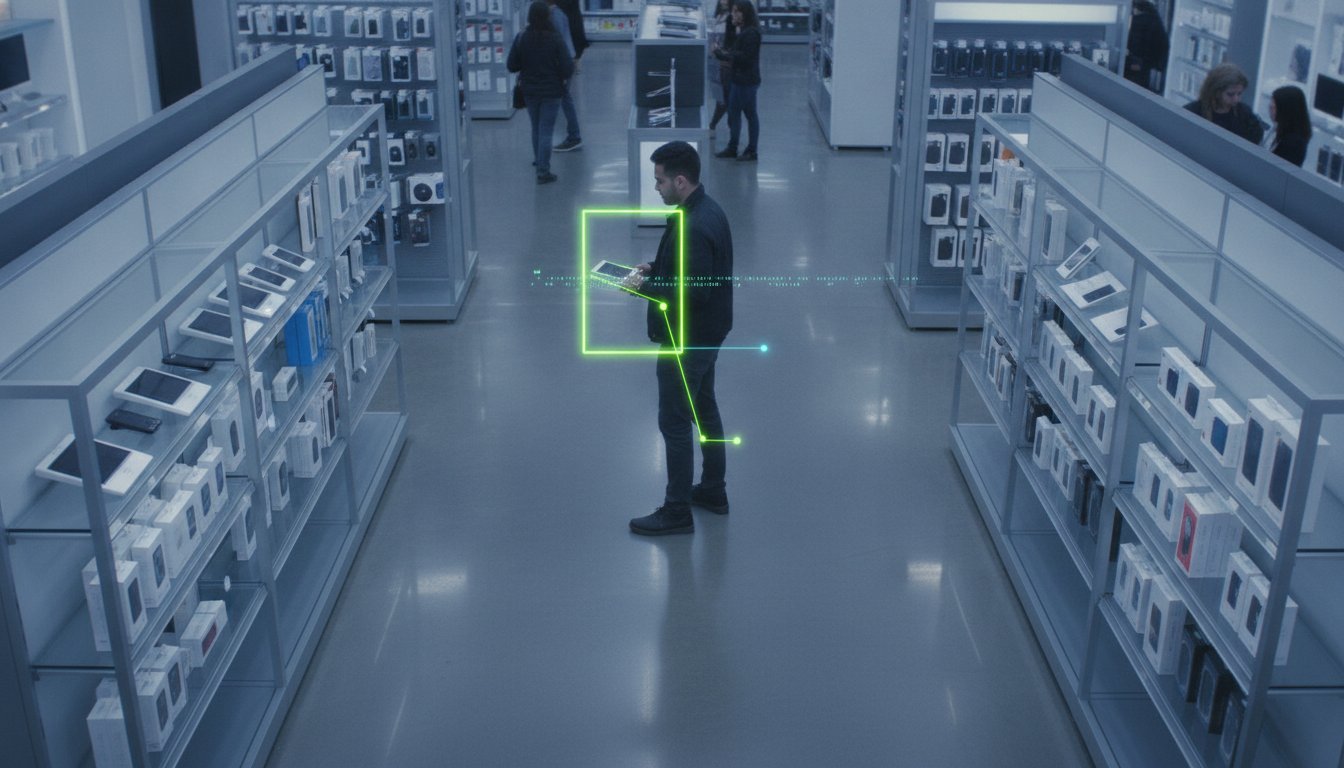
Traditional cameras simply record footage, often leaving security teams to react after an incident has occurred. An AI security camera system commercial installation goes much further by identifying specific suspicious behaviors, such as a person loitering near a restricted exit or an object left unattended in a high-traffic area. These analytics reduce liability by providing clear, intelligent evidence of incidents. When integrated with keycard access control systems for business, the AI can detect tailgating or the use of stolen credentials by cross-referencing card data with visual verification. This ensures that physical access is as tightly controlled as your digital network.
Real-Time Network and Endpoint Monitoring
On the digital front, AI scans network traffic for subtle indicators of data exfiltration that might bypass standard firewalls. It watches for large, unauthorized transfers to unknown IP addresses or unusual after-hours activity that deviates from established baselines. In 2026, AI identifies phishing attempts by analyzing natural language patterns to spot deceptive intent that human eyes often miss. This constant vigilance ensures that threats are neutralized at the endpoint before they can spread through the network. A stable security environment is the foundation of growth; if you’re looking to unify these layers, exploring integrated security solutions can help you achieve long-term system stability.
Implementing AI Threat Detection: Infrastructure and Management
Successful deployment of AI-powered threat detection for business depends on more than just selecting a software provider. It requires a physical foundation capable of handling massive, constant data streams. AI is notoriously data-hungry; it processes thousands of data points every second to identify anomalies in real time. Without high-performance low voltage structured cabling, even the most advanced algorithms will suffer from lag and missed detections. Think of the professional contractor as a reliable architect who ensures the hardware is robust enough to support the visionary software layer.
The implementation process follows a methodical five-step path to ensure long-term stability:
- Assessment: Identifying existing vulnerabilities in both physical and digital perimeters.
- Infrastructure Upgrade: Strengthening the physical network to support high-speed analytics.
- Integration: Connecting disparate systems like surveillance and access control into a unified view.
- Training: Ensuring your team understands how to interpret and act on AI-generated insights.
- Managed Oversight: Utilizing Remote Monitoring Management (RMM) to maintain system health and continuity.
The Backbone: Structured Cabling and Bandwidth
Modern AI video analytics require significant bandwidth to function without interruption. For most facilities, CAT6 cabling installation for commercial buildings has become the minimum standard. While older cabling might suffice for basic internet, it lacks the throughput needed for real-time AI processing of multiple high-definition video feeds. For larger campuses or facilities with high-density data needs, fiber optics are used to prevent latency. This speed is critical when defending against AI-powered cyberattacks that can compromise a system in seconds if the response isn’t instantaneous.
Continuous Management through RMM
Installing the system is only the beginning of the partnership. The health of your security ecosystem relies on remote monitoring management for business to ensure every sensor and software patch is current. This is where the “Human-in-the-Loop” model becomes essential. While the AI detects the threat with unmatched speed, professional management validates the alert and executes the final response strategy. This ensures that your protection is both automated for efficiency and human-verified for absolute accuracy.
Securing Your Enterprise with a Unified Strategic Foundation
The transition toward a unified security ecosystem is a vital step for any organization prioritizing long-term stability. By moving away from reactive, siloed monitoring and embracing proactive behavioral analytics, you create an environment where threats are neutralized before they disrupt your operations. We have explored how the strength of your digital defense is inseparable from your physical infrastructure, requiring a methodical approach to both cabling and managed oversight.
Implementing AI-powered threat detection for business ensures that your assets remain protected by a system that learns and adapts to the evolving landscape of 2026. As a reliable architect for commercial technology, Terapixels Systems offers the comprehensive expertise needed to bridge the gap between complex cyber defenses and physical security infrastructure. Our national reach and focus on specialized 2026 security standards provide the steady hand your business needs to stay resilient.
Secure your business with a unified AI threat detection strategy from Terapixels Systems. With the right systems in place, you can lead your organization with confidence, knowing your security is managed by experts dedicated to your long-term protection.
Frequently Asked Questions
How does AI-powered threat detection differ from traditional antivirus software?
Traditional antivirus relies on a database of known signatures to block threats. If a virus isn’t in that database, the software won’t see it. In contrast, AI-powered threat detection for business analyzes behavioral patterns to identify anomalies as they happen. This allows the system to detect “zero-day” attacks or sophisticated insider threats that haven’t been cataloged yet. It focuses on intent and activity rather than just checking a file against a static list.
Can AI threat detection help my business meet compliance requirements like SOC2 or HIPAA?
Yes, AI-driven systems are instrumental in achieving and maintaining compliance with modern standards. These frameworks often require continuous monitoring and rapid incident response capabilities that manual processes can’t match. AI provides the automated logging and real-time detection needed to prove your organization is taking proactive steps to protect sensitive data. It transforms compliance from a periodic audit into a constant state of readiness for your entire infrastructure.
Does implementing AI-driven security require replacing all our existing cameras and hardware?
You don’t always need to replace every piece of hardware to benefit from advanced analytics. Many existing CCTV cameras can be integrated into a modern AI ecosystem through upgraded network video recorders or cloud-based software layers. However, the performance of these systems depends heavily on your underlying network. Upgrading to CAT6 or fiber cabling ensures that your current hardware can transmit the high-quality data required for accurate, real-time threat detection.
What happens if the AI makes a mistake or flags a legitimate business activity as a threat?
The “human-in-the-loop” model ensures that legitimate activities aren’t accidentally blocked. While AI-powered threat detection for business is highly accurate, it’s designed to flag anomalies for professional review rather than making every final decision in a vacuum. Our remote monitoring management teams validate these alerts in real time. This partnership between machine intelligence and human expertise prevents “false positives” from disrupting your daily operations or causing unnecessary downtime.