CONTACT US
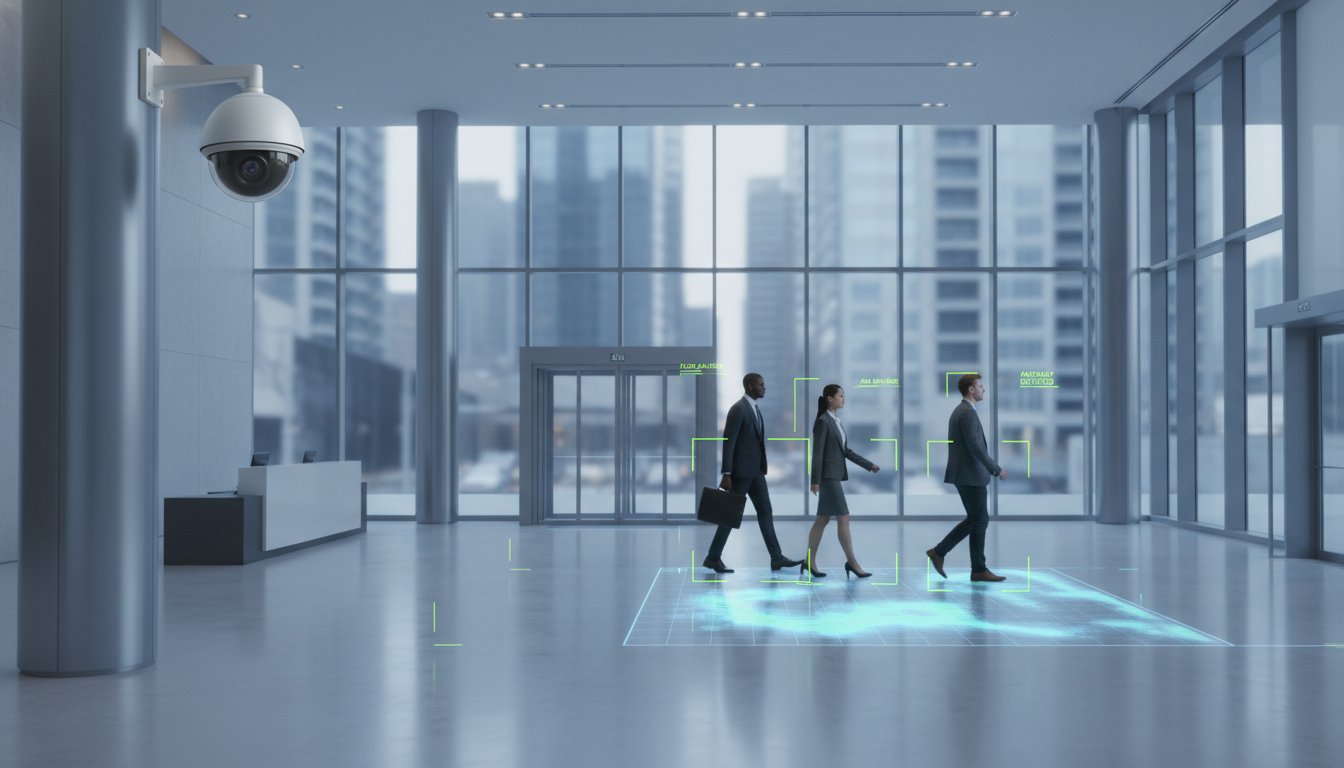
Global AI server orders surged by 287% in the first quarter of 2026, signaling a definitive shift in how businesses protect their physical assets. Most facility managers understand the frustration of monitoring dozens of video feeds only to find that traditional systems produce more false alarms than actionable leads. It’s exhausting to manage security gaps when your current infrastructure feels reactive rather than protective. By integrating a sophisticated AI security camera system commercial solution, you can move beyond simple recording and turn your surveillance into a proactive, data-driven asset for your facility.
This strategic guide explores how AI-driven analytics transform security from a background cost into a tool for operational excellence. You’ll discover how to achieve faster response times to genuine threats and gain valuable insights into occupancy and traffic patterns. We’ll walk through the technical requirements for a scalable infrastructure, including the role of structured cabling and cloud-based management; this ensures your system remains compliant with the complex 2026 regulatory environment while providing the stability your business deserves.
Key Takeaways
- Transition from traditional reactive models to a proactive AI security camera system commercial framework that prioritizes real-time threat detection over simple forensic review.
- Evaluate the differences between cloud-based and hybrid architectures to determine which deployment model offers the best scalability and remote access for your specific facility.
- Recognize why high-quality structural cabling, such as fiber or CAT6, is the essential foundation for maintaining the high-bandwidth requirements of advanced AI analytics.
- Learn to leverage video data as a strategic asset by integrating surveillance with cloud-based access control for a unified, intelligent security environment.
- Gain a clear roadmap for professional system integration that ensures your security infrastructure remains compliant with 2026 regulations while supporting long-term growth.
Table of Contents
- Beyond Passive Recording: Defining the Commercial AI Security Camera System
- Core AI Analytics: Turning Video Data into Actionable Intelligence
- Cloud vs. Edge Processing: Architecture for Scalable Commercial Surveillance
- Infrastructure Readiness: Why Structured Cabling and Network Security Drive AI Performance
- Implementing Your AI Surveillance Strategy: The Professional Integration Path
Beyond Passive Recording: Defining the Commercial AI Security Camera System
A modern AI security camera system commercial setup is no longer just a digital witness to events after they occur. It’s an active participant in your facility’s safety strategy. While traditional systems rely on human eyes to catch incidents, AI-driven systems use computer vision and deep learning to identify threats as they happen. This shift from forensic “record-and-review” models to proactive “detect-and-alert” models fundamentally changes how businesses manage risk and protect their assets.
The foundation of this technology lies in its ability to understand what it sees. By moving beyond the basic capabilities of traditional Closed-circuit television (CCTV), these systems can distinguish between a flickering light and a person attempting to breach a perimeter. This intelligence transforms your security infrastructure into a sophisticated ecosystem that integrates seamlessly with access control and your existing network cabling.
To better understand this concept, watch this helpful video:
One of the most significant benefits for facility managers is the reduction of operator fatigue. It’s a documented challenge in the industry; after only twenty minutes of monitoring multiple video feeds, a human’s attention span drops significantly. AI analytics solve this by filtering out up to 90% of irrelevant motion, such as swaying trees or passing animals. By only alerting staff to genuine threats, you significantly reduce business liability and ensure that critical incidents aren’t missed due to a deluge of false alarms.
The Evolution of Video Surveillance Technology
We’ve transitioned from grainy analog tapes to high-definition IP cameras, and now to AI-integrated optics. The year 2026 marks a tipping point for adoption because edge computing has become more accessible. This allows the AI security camera system commercial hardware to process data locally on the device. Faster object classification means your security response happens in seconds, not minutes, without overwhelming your internal bandwidth.
Commercial vs. Consumer AI Security
It’s vital to distinguish between residential “smart” cameras and enterprise-grade AI analytics. Commercial systems are designed for durability, high-bitrate streaming, and complex multi-site management. They also prioritize compliance with standards like the NDAA, which is a requirement for many government and high-security facilities. These professional systems offer a level of stability and comprehensive protection that consumer-grade hardware simply cannot match, ensuring your investment is future-proof and scalable.
Core AI Analytics: Turning Video Data into Actionable Intelligence
The true power of an AI security camera system commercial installation lies in its ability to process massive amounts of visual data into clear, actionable insights. In the past, security was largely reactive; teams would review footage only after a theft or accident occurred. Today, high-resolution sensors act as precision data collectors, feeding deep-learning algorithms that recognize patterns in real-time. This transition to preventative security allows your team to intervene before a situation escalates, rather than just documenting the aftermath.
By moving beyond passive observation, these analytics serve departments across your entire organization. Operations managers can monitor workflows, while marketing teams gain insights into customer behavior. Exploring how AI Analytics can serve your specific facility is a critical step in maximizing your technological return on investment.
Object Detection and Behavioral Analysis
Modern systems use sophisticated computer vision to distinguish between a person, a vehicle, or a stray animal. This granular classification is what eliminates the nuisance of false alerts that plague older systems. Beyond simple detection, behavioral analysis allows for loitering detection and virtual line crossing. If someone remains in a restricted zone for an unusual duration, the system triggers an immediate alert. These systems also learn site-specific patterns over time, identifying unusual activity that doesn’t fit the standard operational rhythm of your facility.
Advanced Identification: LPR and Facial Recognition
Advanced identification tools like License Plate Recognition (LPR) streamline logistics by automating gate access and tracking vehicle flow through parking structures. In high-security environments, facial recognition provides a layer of protection by identifying authorized personnel or VIP guests instantly. To ensure these advanced identification features are deployed responsibly, it’s best to align your policies with the NIST AI Risk Management Framework. This approach ensures that your use of biometric data remains secure and respects current privacy standards.
Operational Intelligence: People Counting and Heatmapping
AI cameras provide value far beyond the security office. For operations managers, people counting analytics ensure fire code compliance by monitoring real-time occupancy levels in large facilities. Marketing teams use heatmapping to visualize foot traffic, identifying which areas of a retail floor or office lobby attract the most engagement. These automated reports allow management to make data-driven decisions about staffing, facility layouts, and resource allocation, effectively turning your AI security camera system commercial infrastructure into a comprehensive business intelligence tool.
Cloud vs. Edge Processing: Architecture for Scalable Commercial Surveillance
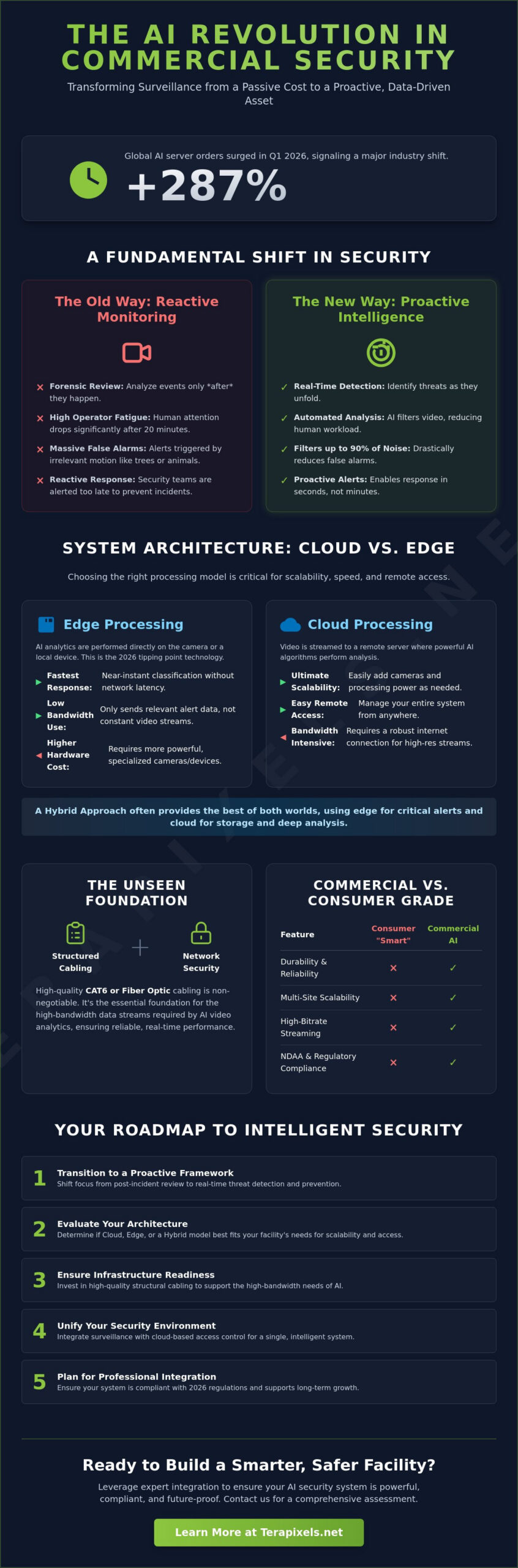
Choosing the right architecture is just as critical as selecting the cameras themselves. For a modern AI security camera system commercial deployment, the decision generally falls between three models: on-premise, cloud-based, or a hybrid approach. Each of these has distinct implications for your network’s performance and your team’s ability to manage security across multiple sites. In the 2026 security environment, the goal is to balance processing speed with the flexibility of remote management.
Edge processing has revolutionized this field by allowing the “thinking” to happen directly on the camera hardware. By processing AI analytics at the source, you reduce the strain on your central network and ensure that real-time alerts aren’t delayed by internet latency. This decentralized approach is particularly valuable for facilities that require immediate object classification without investing in massive on-site server rooms. It makes your system more resilient; even if the external internet connection dips, the camera continues to detect threats and log data locally.
The Advantages of Cloud-Based Surveillance
One of the primary benefits of moving to the cloud is the elimination of the “single point of failure.” Traditional local NVRs are vulnerable to hardware crashes, disk failures, or even physical theft. If the recorder is compromised, your evidence is lost. With Cloud-Based Surveillance Systems, your data is securely off-site and accessible from any authorized device. This model also simplifies long-term maintenance. Automatic firmware updates and cybersecurity patches are delivered directly via the cloud, ensuring your system is always protected against the latest threats. It’s an ideal choice for businesses with multiple locations that need a unified, scalable view of their security posture without maintaining local hardware at every branch.
Hybrid AI Solutions: The Best of Both Worlds
A hybrid model often serves as the most practical path for large-scale enterprises. It keeps critical, high-bandwidth data stored locally for maximum efficiency while utilizing the cloud for remote management and long-term storage. This setup is especially useful for industries with high-retention requirements, where storing months of high-resolution footage solely in the cloud might be cost-prohibitive. To ensure these complex systems remain operational, we recommend utilizing Remote Monitoring Management. This allows for the real-time health monitoring of your hybrid system, identifying potential issues before they lead to a security gap. It’s a methodical way to build a resilient, scalable foundation that grows alongside your business objectives.
Infrastructure Readiness: Why Structured Cabling and Network Security Drive AI Performance
Many facility managers focus exclusively on camera specifications while overlooking the physical backbone that makes the technology work. An AI security camera system commercial installation produces high-bandwidth streams that can quickly saturate an outdated network. If your infrastructure lacks the necessary throughput, you’ll experience dropped frames and inaccurate AI metadata. A reliable architect ensures the physical layer is robust enough to handle the 2026 standards required by high-performance AI sensors. Without this foundation, even the most expensive optics will fail to deliver their promised proactive benefits.
The symbiotic relationship between hardware and the network is most visible in the power requirements of modern sensors. High-performance AI cameras often utilize advanced Power over Ethernet (PoE) standards to support their onboard processing. This simplifies installation by using a single cable for both data and power, but it requires a network switch capable of delivering consistent wattage. To ensure your facility is prepared for these demands, you can explore our comprehensive Structural Cabling services to audit your current capacity.
The Role of Structured Cabling
High-speed data requires high-speed pathways. A professional CAT6 cabling installation is now the baseline for any AI surveillance project. While older CAT5e cables might handle standard video, they struggle with the high-bitrate metadata streams generated by deep-learning algorithms. For larger campuses or long-distance perimeter cameras, fiber optics provide the necessary reach without signal degradation. Poor cabling leads to latency, which directly impacts how quickly your system can classify objects or trigger alerts. This lag can be the difference between stopping a breach and merely recording it.
Securing the Surveillance Network
Every connected camera is a potential entry point for unauthorized access. Implementing comprehensive Cyber Security measures is non-negotiable for IoT-heavy environments. Network segmentation is a critical strategy here; it keeps your security traffic isolated from your general business data. This ensures that even if one device is compromised, the rest of your corporate network remains protected. It’s about creating layers of stability that prevent minor vulnerabilities from becoming major liabilities.
Maintaining this security posture requires more than just initial setup. Utilizing RMM services allows for continuous uptime monitoring and automated security patching. This methodical approach ensures your hardware remains protected against evolving digital threats while maintaining peak performance. By managing these complex background systems, we allow you to focus on your core business objectives with the confidence that your facility is fully protected.
Implementing Your AI Surveillance Strategy: The Professional Integration Path
Moving from hardware selection to a fully operational environment is the most critical phase of your security upgrade. An AI security camera system commercial project isn’t merely a purchase; it’s a strategic deployment that requires a reliable architect. Terapixels Systems serves as your single source of truth, managing the complex interactions between high-speed optics, network infrastructure, and digital intelligence. By choosing a partner who understands the entire technology stack, you ensure that your facility benefits from a seamless, stable, and comprehensive protection plan.
A primary advantage of professional integration is the ability to connect video analytics with Access Control Systems. When these technologies work in tandem, your security posture becomes significantly more robust. For instance, the system can automatically cross-reference facial recognition data with keycard logs to verify identity in real-time. This unified approach reduces business liability and closes the security gaps often found in siloed, traditional setups.
Site Assessment and System Design
Success begins with a methodical assessment of your facility. We analyze camera placement to ensure the optimal field of view for AI object classification, as poor lighting or awkward angles can degrade metadata accuracy. We also calculate precise storage and bandwidth requirements to prevent network congestion. In 2026, compliance is equally important. Whether you’re navigating the Colorado AI Act requirements effective June 30, 2026, or California’s pre-use notice mandates, our design process ensures your surveillance strategy meets all transparency and risk mitigation standards.
Professional Installation and Ongoing Management
There’s a vast difference between a basic “handyman” installation and certified structural cabling. Professional integration ensures that every fiber and CAT6 connection is tested for the high-bitrate demands of AI video. Once the hardware is live, we provide post-installation training so your security teams can manage AI alerts without feeling overwhelmed. Long-term reliability is maintained through Remote Monitoring Management, which provides the steady hand needed to handle security patching and hardware health. This lifecycle approach ensures your investment remains a future-proof asset rather than a depreciating expense.
Architecting Your Proactive Security Future
Building a resilient security infrastructure is a long-term investment in your facility’s operational stability. We’ve explored how a modern AI security camera system commercial deployment moves beyond simple video storage to provide real-time, actionable intelligence. Success in 2026 relies on the synergy between advanced AI analytics, high-bandwidth structured cabling, and robust network security. It’s about ensuring your physical assets are protected by a system that thinks and reacts as quickly as your business does.
Terapixels Systems stands as a comprehensive integrator, managing every layer of your technology stack from cabling to cloud-based surveillance. Our national reach and professional project management ensure that your system is not only compliant with evolving regulations but also scalable for future growth. We’re ready to provide the expertise in cloud-based and AI-driven analytics your facility requires to thrive in a complex threat landscape.
We look forward to helping you design a safer, more intelligent foundation for your organization’s continued success.
Frequently Asked Questions
What is the main difference between AI security cameras and standard IP cameras?
AI cameras utilize onboard computer vision and deep learning to classify objects like people, vehicles, or animals in real-time. While standard IP cameras simply record video or trigger alerts based on basic pixel changes, an AI security camera system commercial setup understands the context of what it sees. This intelligence allows the system to filter out environmental noise and focus only on genuine security threats.
Can commercial AI security cameras work with my existing network cabling?
Most modern AI cameras are compatible with standard Ethernet cabling, but their performance depends on the cable’s category and condition. While older CAT5e might function, we recommend CAT6 or fiber optics to handle the high-bitrate metadata and power requirements generated by advanced AI analytics. A professional infrastructure audit can determine if your current cabling supports the bandwidth and Power over Ethernet (PoE) standards required by 2026 sensors.
How does AI video analytics reduce liability for property managers?
AI video analytics reduce liability by providing proactive alerts that allow for immediate intervention before an incident escalates. Instead of relying on forensic review after an accident occurs, property managers can address loitering or unauthorized access in seconds. The accuracy of AI metadata also provides indisputable evidence for insurance claims and legal disputes, ensuring your facility is protected by a verifiable, high-resolution data trail.
Do AI security camera systems require a constant internet connection?
These systems don’t necessarily require a constant internet connection to perform core AI functions if they utilize edge processing. Edge-based cameras process analytics locally on the device, allowing them to detect threats and log data even during a network outage. However, a stable connection is required for cloud-based management, remote monitoring, and receiving real-time mobile alerts. A hybrid architecture often provides the best balance of local resilience and cloud flexibility.
What is the typical ROI for a commercial AI security camera system?
ROI for a commercial AI surveillance system is typically realized through reduced operational costs and improved facility efficiency. By filtering out the vast majority of false alarms, your security team can focus on genuine incidents, which often reduces the need for extensive on-site patrols. Additionally, operational data like heatmapping and people counting provides business intelligence that helps optimize facility layouts and staffing levels, turning a security cost into an operational asset.
Is facial recognition legal for commercial use in my facility?
The legality of facial recognition depends on your specific state and local jurisdiction. For example, the Colorado AI Act and California’s 2026 regulations require businesses to provide transparency notices and opt-out mechanisms for certain automated technologies. It’s essential to implement a privacy-first approach and ensure your deployment complies with the latest regulatory frameworks. We recommend consulting with legal experts to align your technology use with local privacy mandates.
How much bandwidth does an AI security camera system consume?
Bandwidth consumption varies based on resolution, frame rate, and the number of active analytics running on the network. While the AI metadata itself is relatively small, the high-resolution video streams required for accurate analysis can be significant. Utilizing edge processing helps mitigate this by analyzing data on the camera and only sending relevant alerts or compressed footage over the network, preventing your internal bandwidth from becoming a bottleneck during peak hours.
Can AI cameras integrate with my existing access control system?
Yes, AI cameras integrate seamlessly with modern access control systems to create a unified and intelligent security environment. This integration allows for visual verification of every entry event, such as matching a face to a specific keycard scan. By connecting these two layers, you can automate responses like locking doors during a loitering alert or granting vehicle access through license plate recognition, significantly streamlining your facility’s daily security operations.