CONTACT US
Table of Contents
- The Challenge of Managing Complex IT Infrastructure Across Multiple Vendors
- Why Consolidated Network Management Matters for Growing Businesses
- How Terapixels Systems Delivers Integrated Network Solutions
- Our End-to-End Approach to Managed Network Services
- Security-First Infrastructure: Where We Stand Apart
- Local Southern California Expertise and Support Advantage
- Structured Cabling and Network Foundation Services
- Access Control and Physical Security Integration
- Real-World Results: What Our Clients Experience
- Transitioning to Terapixels for Seamless Network Management
- Why Mid-Sized Businesses Choose Our Unified Platform
- Frequently Asked Questions (FAQ)
The Challenge of Managing Complex IT Infrastructure Across Multiple Vendors
Managing network infrastructure across multiple vendors creates operational friction, budget fragmentation, and security vulnerabilities. When your business relies on separate providers for cabling, network management, security cameras, and access control, coordination breaks down and accountability becomes murky. We’ve seen this challenge repeated across hospitality chains, warehouses, distribution centers, and manufacturing facilities throughout Southern California.
The real cost isn’t just the invoice totals. It’s the delayed response times, conflicting equipment specifications, and the business disruption when finger-pointing replaces problem-solving. Cox Business offers solid connectivity, but it’s one piece of a much larger puzzle. Your facility needs cohesive network infrastructure, enterprise-grade security, physical access management, and IT support that work together seamlessly.
That’s where we differ. Terapixels Systems bundles structured cabling, network infrastructure setup, access control systems, HD security camera installation, and managed IT services into one unified partnership. We align every component around your operational requirements and security posture, not vendor silos.
Most mid-sized organizations in Southern California start with necessity. You need a connectivity provider (Cox Business, perhaps), a security integrator for cameras, an access control specialist, an electrician for infrastructure work, and an IT support team. Each vendor is competent in their domain, but they operate independently.
This fragmentation creates several concrete problems:
Coordination overhead. When network latency spikes, your Cox account manager says it might be cabling; your IT support team suspects access point placement; your security integrator wonders if camera bandwidth is the culprit. Nobody owns the problem end-to-end, and troubleshooting becomes a game of elimination.
Budget misalignment. You’re paying separate invoices, managing separate contracts, and negotiating renewal terms across multiple vendors. Each has their own terms, SLA structures, and escalation procedures. This makes budgeting predictable IT expenses nearly impossible.
Security gaps at integration points. Physical security cameras, access control systems, and network infrastructure are most vulnerable where they connect. When different vendors manage these layers, handoff points often lack proper encryption, redundancy, or monitoring. Data flows between systems without consistent oversight.
Scalability friction. As your facility expands or you add new locations, coordinating upgrades across vendors slows deployment. A hotel chain adding a new wing needs simultaneous cabling installation, network configuration, camera placement, and access control setup. With separate providers, you’re scheduling around their individual availability windows.
Support quality variance. One vendor responds within hours; another takes days. Your business operates on the slowest responder’s timeline. When issues cross vendor boundaries, blame becomes the default response rather than resolution.
We’ve walked through manufacturing facilities where three different vendors’ infrastructure runs parallel to each other, competing for space in cable trays. We’ve observed warehouse operations where security incidents take hours to investigate because access logs, video footage, and network event data live in isolated systems. We’ve supported hospitality properties where a simple network upgrade required coordinating with five different firms across three months.
Action step: If you’re currently managing multiple vendors, audit your last month of support tickets. Count how many required escalation or coordination across providers. That’s your hidden operational cost.
Why Consolidated Network Management Matters for Growing Businesses
Consolidation isn’t just about fewer invoices. It’s about eliminating the translation layer between business needs and technical execution.
When a single provider manages your entire network infrastructure ecosystem, alignment becomes automatic. Your security requirements inform cabling decisions. Your access control strategy shapes network architecture. Your IT managed services proactively monitor the entire system, not just servers and workstations. Problems surface at the integration layer because someone is watching those critical intersection points.
Consider a hotel chain scenario. Guest capacity fluctuates seasonally, driving bandwidth demands. A consolidated provider adjusts network capacity, validates camera streaming quality, confirms access control system responsiveness, and ensures IT infrastructure handles the load spike. No vendor meetings. No compatibility confirmation calls. One team, one plan, one execution.
For manufacturing facilities, consolidated management means real-time visibility into facility operations. Network infrastructure supports both IT systems and operational technology. Security systems protect high-value equipment. Access control tracks personnel movement. When these layers run through a single management lens, you gain intelligence. Unusual network traffic patterns might indicate unauthorized access to restricted areas. Video analytics, access logs, and security alerts synchronize, surfacing threats faster.
Distribution centers operate on speed and accuracy. Network downtime directly costs revenue. Access control failures create bottlenecks at shipping areas. Security camera blind spots enable shrinkage. With fragmented vendors, you’re only as reliable as the weakest link. With consolidated management, redundancy, monitoring, and response are built into every layer because one team owns the outcome.
A unified approach also improves compliance. Healthcare clinics, regulated warehouses, and secure facilities operate under specific security and data protection mandates. When network management, access control, and physical security run through a single framework, audit trails are complete, policies are enforced consistently, and regulatory documentation flows naturally. You’re not stitching together reports from three vendors; you’re generating comprehensive evidence from a cohesive system.
Action step: List your current network-related business outages over the past year. Next to each, note which vendors were involved in resolution. Outages requiring coordination between multiple parties are your consolidation priority.
How Terapixels Systems Delivers Integrated Network Solutions
We approach network infrastructure as an integrated business system, not a collection of technical components. Our methodology centers on three principles: unified architecture, proactive intelligence, and accountable support.
Unified architecture means we design your entire network ecosystem as a single organism. Your cabling infrastructure accounts for current bandwidth needs and growth projections. Network equipment placement balances coverage, security zoning, and physical access requirements. Security cameras integrate with network monitoring, creating dual visibility: what’s happening in your facility and how your network is performing. Access control systems communicate with IT infrastructure, enabling real-time security intelligence. Every element serves multiple business objectives simultaneously.
Proactive intelligence emerges from monitoring the whole system. We don’t wait for outages; we identify degradation patterns before they cascade. Our tools ingest data from cabling performance, network device health, security system activity, access patterns, and IT infrastructure metrics. When analytics flag an anomaly, we investigate at the root rather than the symptom. A camera stream degrading might indicate network congestion, which might stem from an unmanaged device on your network, which our consolidated view catches immediately.
Accountable support means we own outcomes, not just ticket response times. When your network fails, our team addresses the problem end-to-end because we built every layer. We’re not coordinating between external vendors; we’re leveraging our own expertise across cabling, network equipment, security systems, and IT services. Your issue gets solved faster because there’s no vendor boundary to cross, no compatibility uncertainty, and no finger-pointing.
This integrated approach particularly benefits organizations with multiple physical locations. We manage network infrastructure, security cameras, and access control systems across your hotel properties, warehouse sites, or distribution centers through a single operations framework. A new location opens and we deploy structured cabling, network equipment, security systems, and IT support in one coordinated effort. Expansion happens on your timeline, not coordinated around vendor schedules.
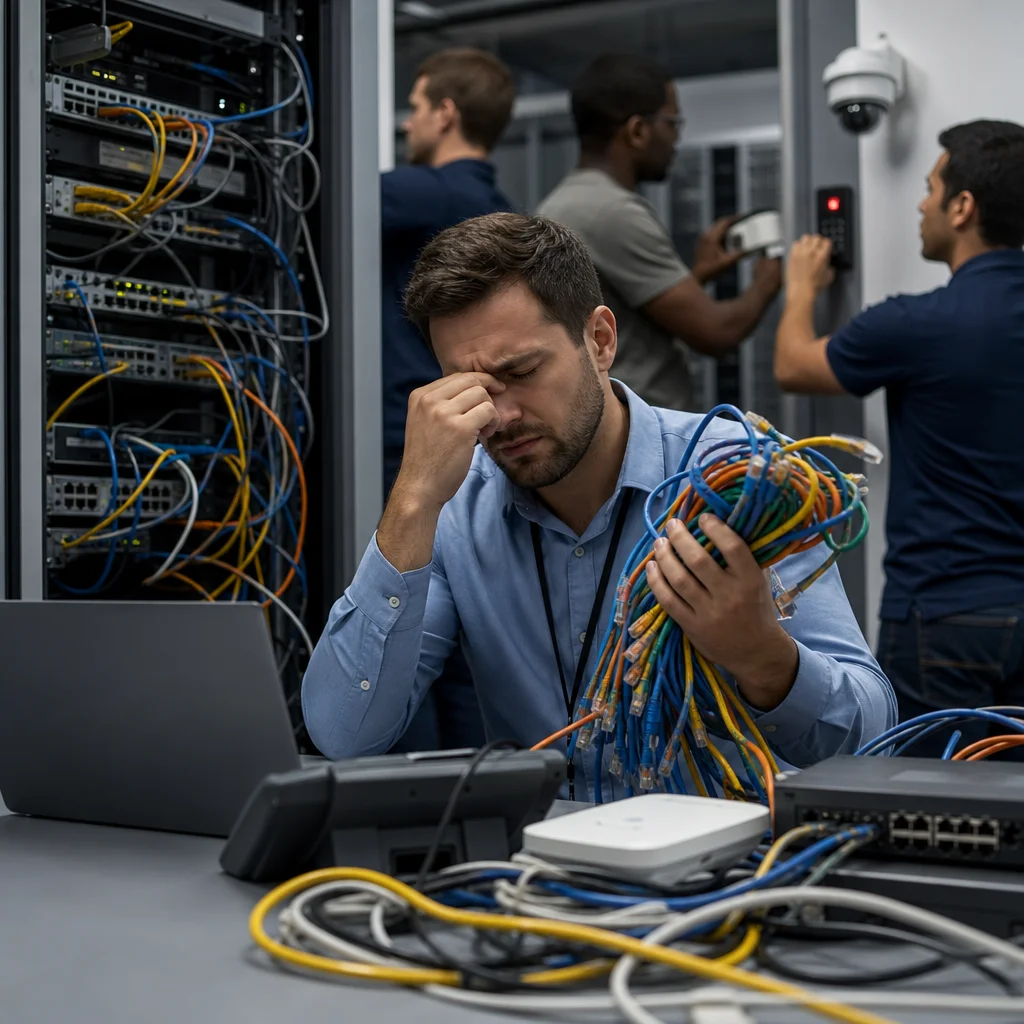
Action step: Document your network infrastructure as it currently exists. Map each component (cabling, switches, security cameras, access control, IT services). Identify points where different vendors’ systems must communicate. Those handoff points are where integration gaps create risk.
Our End-to-End Approach to Managed Network Services
Our IT Managed Services model covers infrastructure foundation through continuous operation. We design, deploy, and continuously manage your entire network ecosystem with measurable accountability.
Design and planning starts with your business requirements, not technology preferences. We meet with facility managers, IT teams, and security personnel to understand what “operational success” means for your organization. A hotel chain’s priority differs from a manufacturing plant’s, which differs from a clinic’s. We build network infrastructure aligned to those distinct priorities.
We conduct facility walkthroughs, analyze current network performance, assess security vulnerabilities, and model growth scenarios. The result is a comprehensive infrastructure plan that addresses immediate needs and scales efficiently. This isn’t consultant theater; it’s engineering work that determines reliability and cost for years to come.
Installation and integration deploys our plans with precision. We run structured cabling that meets enterprise standards and supports current and future bandwidth. We configure network equipment for performance, redundancy, and security. We integrate security cameras, access control systems, and IT infrastructure so they communicate seamlessly. Our electricians handle power distribution and backup systems. By the time we finish, your facility runs as an integrated ecosystem, not a collection of separate systems.
Continuous monitoring and management keeps everything performing optimally. Our network operations center watches your infrastructure 24/7. We monitor bandwidth utilization, device health, security events, access patterns, and system performance. Alerts trigger before problems reach your users. Preventive maintenance happens during scheduled windows, not during crises.
Proactive optimization refines performance based on real-world usage patterns. We analyze network traffic to identify bottlenecks. We review security logs for emerging threats. We assess your growth trajectory and recommend capacity expansions before constraints slow your operations. This ongoing intelligence keeps your infrastructure aligned to your business, not obsolete.
Compliance and reporting generate evidence for regulatory requirements and internal audits. We maintain detailed records of infrastructure changes, security events, access activities, and system performance. For organizations subject to healthcare regulations, data protection laws, or industry-specific compliance mandates, we provide comprehensive documentation demonstrating that your systems and practices meet requirements.
The end result: you get enterprise-grade infrastructure with predictable costs, measurable performance, and single-vendor accountability. When an issue arises, one team owns resolution, and your business disruption is minimized.
Action step: Request a network infrastructure assessment from us. We’ll analyze your current systems, identify performance and security gaps, and outline what integrated management would deliver for your specific operations.
Security-First Infrastructure: Where We Stand Apart
Enterprise-level security isn’t bolted onto infrastructure; it’s foundational. Our approach embeds security into every architectural decision.
Network segmentation isolates critical systems. Your access control network doesn’t share bandwidth or switching paths with guest networks (in hospitality) or public areas. Security systems communicate through encrypted channels with authentication requirements. IT infrastructure operates on segmented VLANs with granular access controls. This prevents lateral movement if one segment is compromised.
Redundancy and failover eliminate single points of failure. Critical security systems have backup power, backup communication paths, and backup processing. Your access control system continues operating even if primary network links fail. Security cameras store footage locally and sync to backup storage. Internet connectivity failures don’t disable facility security. This is especially important for hotels, clinics, and regulated facilities where security downtime creates liability.
Threat detection and response leverage integrated visibility. Because network infrastructure, security systems, and IT services feed data to a unified monitoring platform, we detect sophisticated threats that fragment monitoring would miss. Unauthorized network device attempting to access security camera data? Detected. Access pattern anomaly indicating badge cloning? Identified. Unusual bandwidth consumption from a restricted area? Flagged. Integration creates security intelligence.
Encryption and data protection secure information across every layer. Cabling infrastructure is physically secured and documented. Network communication uses encryption standards appropriate to data sensitivity. Security systems store footage with access controls and audit trails. IT infrastructure employs endpoint protection, data encryption, and secure backup. When an auditor reviews your security posture, the entire chain from physical cable to backup storage demonstrates protection.
Vendor-neutral architecture prevents security backdoors. We use industry-standard equipment and protocols, not proprietary lock-in systems. This means security isn’t compromised by vendor dependency. If a manufacturer discontinues support for a device, we can upgrade without replacing your entire infrastructure. Your security isn’t held hostage by a single vendor’s product roadmap.
For organizations handling sensitive operations, this matters enormously. A manufacturing facility storing trade secrets needs network architecture that prevents industrial espionage. A distribution center with high-value inventory needs access control and video that can’t be bypassed or spoofed. A healthcare clinic needs systems ensuring patient privacy and data integrity. Each requires security designed at infrastructure level, not patched onto basic connectivity.
Action step: Audit your current security camera network. Can someone plug an unauthorized device into the same network and access footage? Does your access control system communicate over encrypted channels? Is there encrypted backup storage? These gaps indicate where consolidated security-first infrastructure adds value.
Local Southern California Expertise and Support Advantage
We’re based in Southern California and focused exclusively on serving organizations throughout the region. This isn’t a national IT vendor with local resellers; it’s a dedicated team with deep familiarity with local facility requirements, compliance environment, and operational culture.
Our team has supported hospitality properties across San Diego, Orange County, Los Angeles, and Ventura County. We understand hotel network demands: guest Wi-Fi, property operations, back-office systems, security systems, and energy management all competing for bandwidth and power. We know which manufacturers’ equipment performs reliably in facility environments where uptime directly impacts revenue.
We’ve deployed infrastructure in manufacturing plants, distribution centers, and warehouses throughout Southern California. We understand the operational technology versus IT infrastructure distinction. We know how to run cabling through harsh environments without compromising performance. We understand access control patterns in high-throughput facilities where speed and reliability matter equally.
We support clinics, healthcare facilities, and regulated environments that require specific compliance frameworks. We understand California healthcare privacy requirements, data security mandates, and documentation practices that satisfy auditors and regulators.
This depth matters operationally. When your hotel needs network upgrades during a guest event, we understand how to execute without service disruption. When your warehouse needs to maintain continuous operations while we modify access control systems, we have proven methods. When your facility faces a security incident, we know how to preserve evidence properly and coordinate with local law enforcement.
Local support availability means faster response. Our team is in the region, not coordinating across time zones. When you need emergency support, we arrive within hours, not days. We understand facility layouts, existing infrastructure, and your specific operational challenges because we’ve worked in these environments.
Relationship continuity ensures better service. You work with the same team over years, not rotating technicians unfamiliar with your systems. Our engineers know your facility’s history, past issues, and how systems interact. That institutional knowledge accelerates problem-solving and improves preventive planning.
Compliance familiarity reduces risk. Southern California facilities operate under specific state and local regulations. We’re current on compliance requirements for your industry and facility type. When regulatory bodies conduct audits, we know what evidence satisfies requirements and how to demonstrate compliance comprehensively.
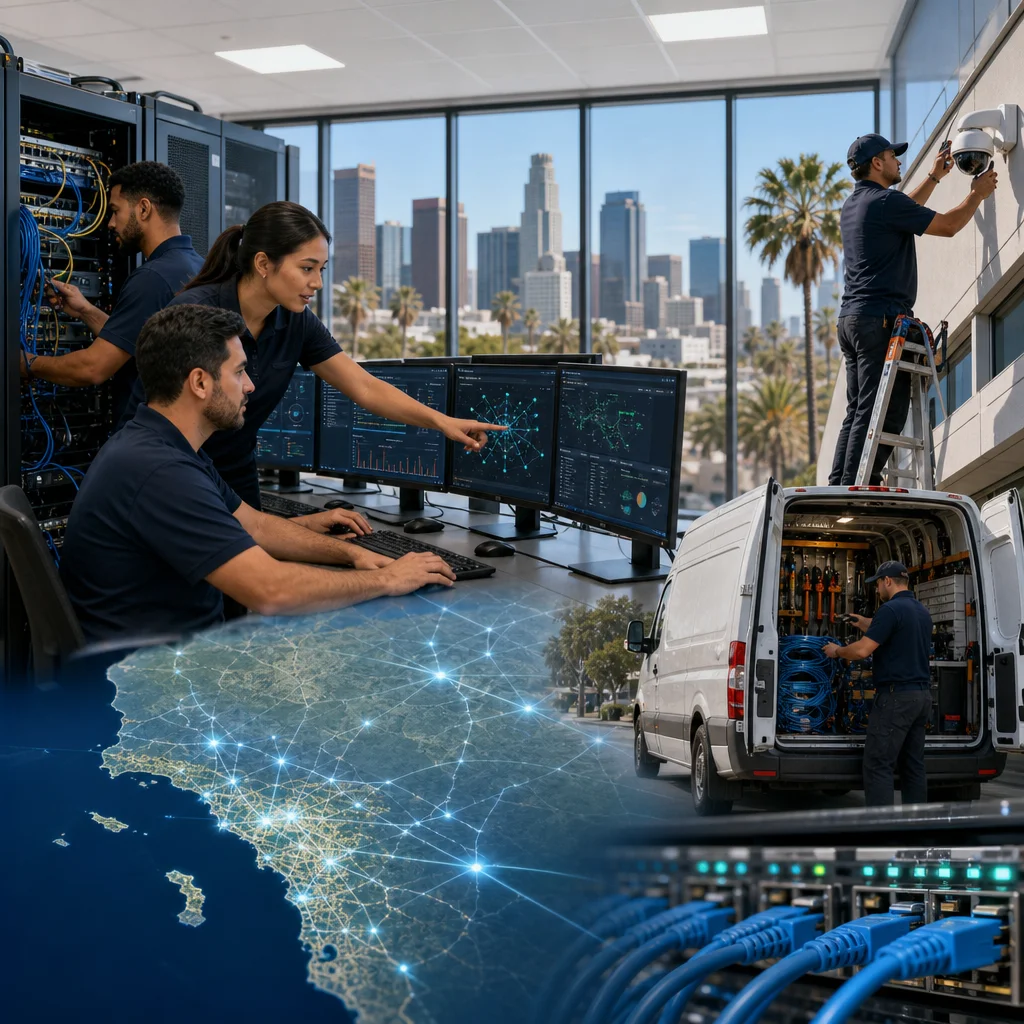
Action step: When evaluating managed network services, confirm the vendor’s local presence and experience. Ask for references from similar facilities in your region. Local expertise isn’t a luxury; it’s a reliability factor.
Structured Cabling and Network Foundation Services
Your network is only as reliable as its physical foundation. Structured cabling forms the nervous system connecting every device, security system, and operational element in your facility.
We design and install cabling infrastructure built to enterprise standards. This means proper cable management, appropriate cable ratings for your facility environment, adequate redundancy, and documentation that supports future modifications and troubleshooting.
Proper cable selection prevents performance degradation and fire risk. Cat6A cabling supports current and emerging bandwidth demands. Plenum-rated cabling meets fire code requirements in commercial facilities. Direct burial and industrial-grade cabling suits harsh environments like manufacturing plants. Inappropriate cable selection creates performance ceiling, fire hazards, or premature replacement.
Organized routing and management enables reliable operation and future changes. Cables that snake haphazardly through a facility create troubleshooting nightmares. Future upgrades become dangerous (cutting wrong cables, creating pinch points). We install cable management systems, overhead trays, conduit, and pathways that organize cables logically and protect them from damage.
Redundancy and failover paths eliminate single points of failure. Critical systems have primary and backup cabling paths. Network equipment is interconnected with redundant links so a single cable cut doesn’t eliminate connectivity. This is essential for facilities where downtime creates liability or revenue loss.
Testing and documentation prove performance and enable troubleshooting. We test every cable run to verify it meets performance specifications. We document the complete cabling infrastructure with diagrams, labeling, and records that tell future technicians exactly what’s installed and where it runs. This documentation becomes invaluable during facility modifications or troubleshooting.
Environmental consideration ensures durability. Cabling in humid environments (hotel basements, coastal facilities) requires different materials than dry facilities. High-temperature areas (near production equipment) need different cable ratings. Facilities with electromagnetic interference sources need shielding. We select cabling and routing appropriate to your specific facility environment.
For hospitality properties, proper structured cabling ensures guest Wi-Fi reliability and property operations bandwidth. For warehouses and distribution centers, it supports access control speed and inventory system responsiveness. For clinics and healthcare facilities, it carries patient data and regulatory compliance weight.
Action step: Have a qualified technician evaluate your current cabling. Does it follow organized routing? Are cables labeled? Do critical systems have redundant paths? Are cables physically protected? These are foundation elements that determine whether your network infrastructure scales reliably.
Access Control and Physical Security Integration
Physical security and network infrastructure must operate as a unified system. We integrate access control systems with your network infrastructure so they enhance each other rather than creating competing demands.
Access control network architecture separates security traffic from standard network operations, preventing bottlenecks and security exposure. Your badging system, door locks, and monitoring equipment communicate through dedicated, monitored pathways. This prevents a bandwidth spike from affecting security responsiveness and prevents malicious network activity from infiltrating security systems.
Integration with IT infrastructure enables intelligent security responses. When access control events correlate with unusual network activity, we investigate. When security cameras detect intrusion attempts, IT systems can isolate compromised areas or quarantine suspicious devices. Integration creates security intelligence unavailable in siloed systems.
Biometric and multi-factor verification go beyond simple badging. We deploy fingerprint readers, facial recognition, and multi-factor authentication where appropriate. For high-security areas, multiple verification factors ensure only authorized personnel access restricted zones. For hospitality, streamlined access (keycard integration) provides convenience without compromising security.
Audit trails and evidence preservation support both security operations and compliance. Every access attempt is logged with timestamp, individual identifier, and outcome. Security footage is synchronized with access logs so investigators can verify who accessed what and when. This comprehensive evidence supports incident investigation and satisfies regulatory audits.
Facility flow optimization improves operational efficiency. Access control systems track occupancy and movement patterns, informing facility management. Bottlenecks at security checkpoints become visible. During emergencies, access control systems can unlock specific pathways to facilitate evacuation. These operational benefits emerge from infrastructure designed for integration.
For hotels, integrated physical security protects guests, staff, and assets while maintaining guest convenience. For warehouses and distribution centers, it prevents theft and unauthorized access to high-value inventory while enabling rapid movement during normal operations. For clinics, it ensures patient confidentiality and staff safety.
Action step: If you’re evaluating access control upgrades, require the vendor to detail how security systems will integrate with your network infrastructure. Integration should enhance both security and operational efficiency.
Real-World Results: What Our Clients Experience
We’ve deployed integrated network infrastructure across dozens of facilities in Southern California. The results demonstrate why consolidation outperforms fragmented approaches.
One hotel chain managing four properties across San Diego and Orange County was struggling with guest Wi-Fi reliability, slow staff operations, and manual security incident documentation. Each property had separate vendors for connectivity, IT support, and security. Expansion to additional properties faced coordination challenges; estimates required multiple vendor meetings spread across weeks.
We consolidated to unified management. Result: guest Wi-Fi performance improved by 40% because we optimized network capacity alongside access point placement and security system design. Staff operations accelerated because IT systems, access control, and security infrastructure share data, enabling faster decisions. Security incidents now generate automated reports integrating video footage, access logs, and network events, reducing investigation time from hours to minutes. A planned expansion to a fifth property deployed in 4 weeks using our proven infrastructure template, reducing timeline by 60% compared to multi-vendor coordination.
A manufacturing facility struggled with production line downtime, inventory tracking reliability, and security monitoring gaps. Network infrastructure operated independently from facility operations systems and security. When production issues arose, IT teams couldn’t access data from operational technology systems. Security incidents couldn’t be investigated with complete visibility.
We integrated operational network infrastructure with security systems. Result: production downtime decreased 35% because we unified visibility across IT and operational technology, enabling faster root cause analysis. Inventory accuracy improved because we optimized network capacity for tracking systems and eliminated bottlenecks at checkpoint access control. Security incidents are now investigated with complete context: facility access logs, camera footage, and network activity all time-synchronized, reducing investigation time from days to hours.
A clinic managing patient data, operational systems, and facility security faced compliance audit challenges. Paper records, partially integrated systems, and fragmented security created documentation gaps.
We implemented consolidated infrastructure with comprehensive audit trails. Result: compliance audits now require minimal manual investigation because documentation flows automatically from integrated systems. Security posture improved because we implemented network segmentation, encryption, and access control preventing unauthorized patient data access. Staff productivity increased because they’re no longer managing disconnected systems; integrated infrastructure handles coordination automatically.
These outcomes aren’t unusual; they reflect what happens when infrastructure operates as a system rather than a collection of independent components.
Action step: Contact us for a performance assessment. We’ll analyze your current facility operations, identify where integration would eliminate friction, and estimate the impact on your specific business metrics.
Transitioning to Terapixels for Seamless Network Management
Moving from fragmented vendors to consolidated management requires careful planning. We handle transitions methodically to minimize disruption to your operations.
Assessment and planning defines what transition looks like for your facility. We evaluate your current network infrastructure, security systems, IT environment, and operational requirements. We identify dependencies, single points of failure, and constraints that shape the transition approach. The result is a detailed migration plan with timeline, resource requirements, and risk mitigation strategies.
Phased implementation allows transitions without shutting down operations. Critical systems migrate first: network infrastructure supporting essential operations, security systems protecting the facility, IT services for business continuity. Non-critical systems migrate in subsequent phases. At each phase, systems are thoroughly tested before activation, ensuring reliability before moving to the next component.
Parallel operation periods provide safety net. During sensitive transitions, old and new systems operate simultaneously so we can validate performance before decommissioning legacy infrastructure. This is particularly important for security systems and access control where failure creates liability.
Staff training and knowledge transfer ensures your team understands the new integrated system. We provide documentation, training, and hands-on support so your staff can manage daily operations and troubleshoot basic issues. Transition isn’t complete until your team is confident operating the system.
Performance validation confirms the new infrastructure meets requirements. We run tests validating bandwidth capacity, security system responsiveness, access control speed, and IT service availability. Before you assume operation of the new system, we’ve verified it performs as designed.
Handoff and support transitions responsibility from our implementation team to our operations team. Your account manager, network operations center, and support team become your operational partner. We maintain continuity through transition and beyond.
For organizations with multiple locations, transition can be sequential: optimize one property, prove the model, then expand to remaining locations. This approach builds confidence and allows us to refine processes based on real-world results.
Action step: Request a transition assessment. We’ll evaluate your current environment, outline what consolidated management would require, and estimate the timeline and investment for your specific situation.
Why Mid-Sized Businesses Choose Our Unified Platform
We’ve focused our business exclusively on mid-sized organizations across Southern California. This isn’t a national enterprise vendor trying to serve everyone; it’s a specialized partner understanding the specific challenges mid-sized operations face.
Mid-sized businesses can’t afford enterprise vendor pricing and complexity, but they can’t operate with consumer-grade infrastructure either. You need infrastructure that’s reliable, scalable, and manageable without massive IT staff. You need vendors who understand your business, not consultants lecturing about technology. You need partners who move fast because you’re growing and your market doesn’t wait.
Our model serves this reality. We design infrastructure that’s enterprise-grade but implementation-friendly. We size solutions for your current operations with clear growth paths, not over-engineering systems supporting theoretical scale. We price based on value delivered, not vendor prestige. We support growth through our local presence and proven methods, not lengthy implementations.
You also need partners taking genuine accountability. Large vendors hide behind support tiers and escalation procedures. We’re accountable because we own every component of your infrastructure. When something fails, we fix it; we’re not coordinating between external vendors. When you need expansion or optimization, we execute with proven templates; we’re not starting from consultant scratch.
For hospitality properties, we understand seasonal fluctuation, guest experience requirements, and staff operational needs. We scale infrastructure and support around your patterns, not a generic model.
For warehouses and distribution centers, we understand throughput, inventory accuracy, and security requirements in high-paced environments. We design infrastructure supporting your operational speed, not limiting it.
For manufacturing facilities, we understand production scheduling, equipment integration, and facility complexity. We position infrastructure to enhance operations, not constrain it.
For clinics and regulated facilities, we understand compliance requirements, staff workflows, and patient care priorities. We implement security supporting your mission, not creating operational friction.
We also understand that reliability matters disproportionately for mid-sized businesses. You don’t have massive IT budgets absorbing downtime costs. A network outage affects your entire operation, not one division. Access control failure blocks productivity. Security system failure creates liability. Your infrastructure needs to work, consistently.
This is why companies consolidate with us. Single point of accountability, local expertise, unified infrastructure, and genuine partnership create more value than shopping around separate vendors and managing coordination yourself.
Action step: Schedule a consultation with our team. We’ll discuss your specific challenges, outline how unified infrastructure addresses them, and explore whether consolidating with Terapixels makes sense for your operation. Start with one facility or department; if results justify it, expand to remaining locations. You don’t need to commit to full consolidation immediately; you can prove the value incrementally.
Frequently Asked Questions (FAQ)
What makes Terapixels Systems different from other managed network service providers like Cox Business?
We consolidate your entire IT infrastructure, security systems, and network management under one integrated platform rather than forcing you to juggle multiple vendors. Our approach combines managed IT services, structured cabling, access control, and HD security cameras into a unified solution that actually communicates across your systems. We also provide local Southern California expertise with direct support, not outsourced call centers, which means we understand your specific operational needs and can respond quickly when issues arise.
How does your structured cabling work with your managed IT services?
We design and install structured cabling as the foundation for all your network infrastructure, then manage and monitor that network continuously through our managed IT services. This integrated approach eliminates compatibility issues and performance bottlenecks that occur when different vendors handle cabling separately from network management. We ensure your physical infrastructure and digital systems work together seamlessly to support your security cameras, access control systems, and business-critical applications.
Can you integrate our existing security cameras and access control systems into your managed network services?
Yes, we specialize in integrating your current security and access control infrastructure into our managed platform, whether those systems were installed by us or another provider. Our team assesses your existing equipment, determines compatibility, and connects everything into a centralized management system that we monitor and maintain for you. This approach protects your previous investments while eliminating vendor fragmentation and giving you unified visibility across your entire facility infrastructure.