CONTACT US
Table of Contents
- Why Fragmented Security and IT Systems Cost Your Business More
- The Hidden Risks of Managing Multiple Technology Vendors
- How Integrated Monitoring Transforms Your Operations
- Our Comprehensive Approach to Unified Management
- Structured Cabling and Network Infrastructure as Your Foundation
- Access Control and HD Security Camera Integration
- Real-Time Monitoring and Alert Management
- Scalability as Your Business Grows
- Security Compliance and Data Protection Standards
- ROI and Operational Efficiency Gains
- Next Steps to Centralize Your Systems
- Frequently Asked Questions (FAQ)
Why Fragmented Security and IT Systems Cost Your Business More
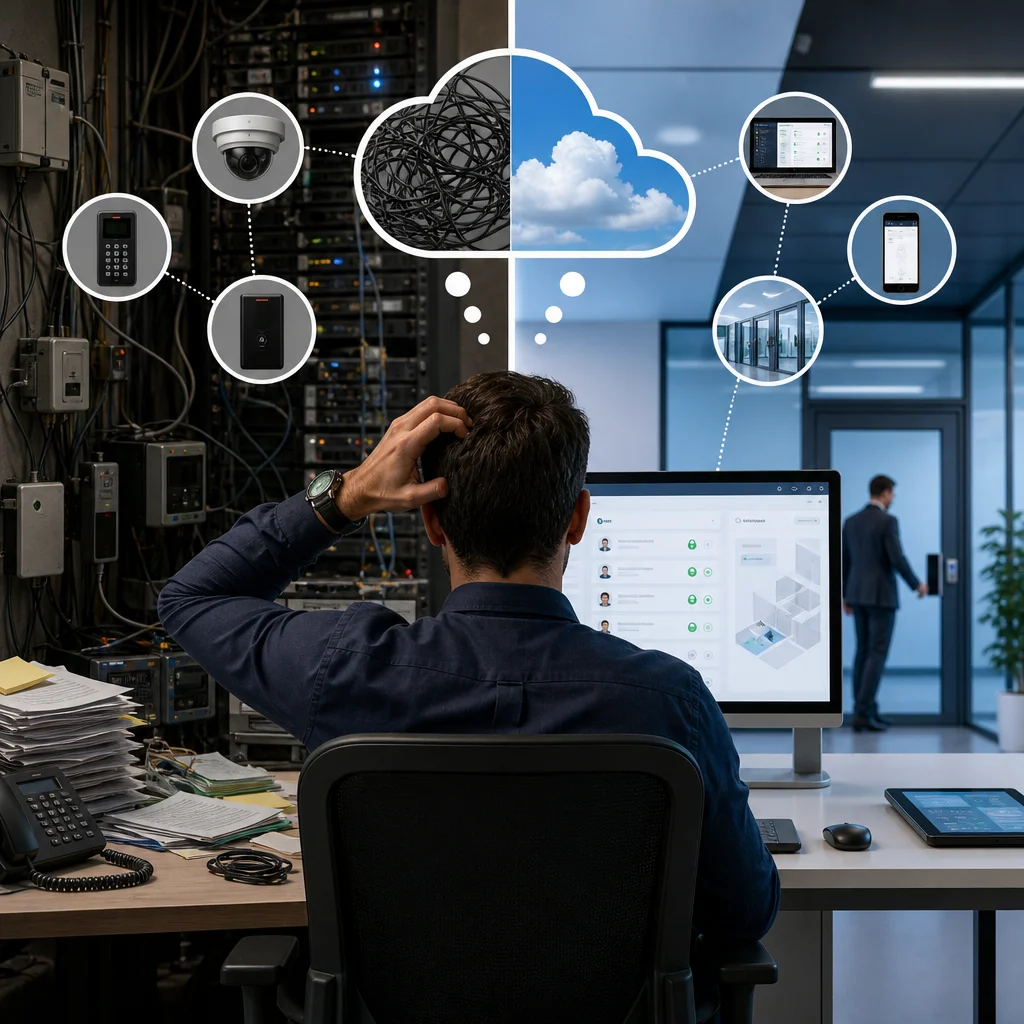
Managing multiple technology systems feels like running separate businesses within your business. Your IT team handles servers and networks in one corner, your security vendor manages cameras elsewhere, and your access control contractor works independently. The result: disconnected data, redundant alert systems, and operational inefficiency that compounds as you scale.
At Terapixels Systems, we’ve seen this fragmentation drain both budget and clarity for hundreds of mid-sized organizations across Southern California. The good news is that unified centralized IT and security monitoring eliminates these silos entirely. When your infrastructure, security, and IT operations run on an integrated platform, you gain real-time visibility, faster response times, and the operational control that competitive organizations demand.
This guide walks you through why consolidation matters, how it transforms day-to-day operations, and exactly what a modern unified monitoring strategy looks like for businesses like yours.
Fragmented systems create hidden expenses that accumulate silently. You’re paying separate contracts for surveillance monitoring, separate support lines for network issues, and separate on-site visits when problems arise. Each vendor manages their own hardware, their own software licenses, and their own support escalation process. The coordination gaps between these vendors slow response times and create accountability problems when something fails.
Consider a real scenario: a critical network outage occurs during peak operations at one of your facilities. Your IT vendor investigates the network infrastructure. Your security vendor checks camera feeds to see if there’s a physical issue at the server location. Your access control system goes offline because it depends on network connectivity. Three separate service calls, three separate diagnostic processes, three different timelines for resolution. Meanwhile, your business is partially or fully offline.
Beyond the operational drag, fragmentation creates data silos. Your security footage exists in one system, your network performance data in another, and your access logs in a third. Security teams can’t correlate physical events (someone entering a restricted area) with network activity (unauthorized data access from that same location). This gap becomes a serious compliance liability and obscures the true security posture of your organization.
The financial impact is measurable. Organizations typically overspend 15-25 percent on annual IT and security budgets when managing multiple vendors, according to industry analysis. You’re also absorbing opportunity costs: your IT team spends hours coordinating between vendors instead of strategic initiatives. Your facilities manager coordinates with multiple contacts instead of one trusted partner. Your security protocols become inconsistent because different systems use different standards and reporting structures.
Actionable takeaway: Audit your current technology contracts and count the distinct vendors managing your IT infrastructure, security systems, and network management. The number of vendors directly correlates with hidden coordination costs and response delays.
The Hidden Risks of Managing Multiple Technology Vendors
Every additional vendor introduces risk vectors that extend beyond simple operational inconvenience. When security cameras, access control systems, and IT infrastructure operate independently, security gaps emerge by design. A sophisticated breach might exploit the fact that your network monitoring system doesn’t communicate with your physical access logs, or your security cameras don’t integrate with your IT incident response protocols.
Data security becomes fragmented as well. Different vendors follow different encryption standards, backup procedures, and data retention policies. Your security camera footage might be encrypted at rest but transmitted over an unprotected connection to your monitoring center. Your access control data might sit on a local server with inconsistent backup schedules. Your network traffic analysis might not protect sensitive authentication data. When regulators or auditors examine your security posture, these inconsistencies create compliance exposure and documentation headaches.
Vendor dependency creates another layer of risk. When one vendor has critical infrastructure and that vendor experiences financial trouble, staffing issues, or contract changes, you’re suddenly scrambled to migrate systems or renegotiate terms. We’ve seen mid-sized businesses caught off-guard when a security monitoring company raised rates 40 percent or when an IT contractor reduced on-site support availability. You lose leverage when your security and IT are split among different providers because each one knows they’re not your sole technology partner.
Integration failures represent a fourth risk category. Your access control system might log someone entering a server room, but that event never appears in your IT incident logs. Your network monitoring detects unusual traffic patterns, but security doesn’t know to cross-reference corresponding physical access events. This disconnect makes forensic investigation slower and less accurate. When you need to understand “who accessed what and when,” fragmented systems force your team to manually correlate data across multiple platforms, introducing errors and consuming valuable time during security incidents.
Actionable takeaway: Schedule an internal audit where your IT, security, and facilities teams document exactly what information flows between your current systems and what data gaps exist. This audit reveals your true risk profile and becomes the baseline for evaluating a unified approach.
How Integrated Monitoring Transforms Your Operations
Unified monitoring changes how your organization responds to operational and security events. Instead of multiple alert channels generating noise and confusion, you receive contextualized alerts from a single platform that understands your entire operational environment. When your HD security cameras detect motion in a restricted area at 2 a.m., that alert reaches security immediately and includes network context about which workstations are currently online, which access cards have been used recently, and whether suspicious network traffic has been detected.
Real-time correlation becomes your operational advantage. A failed access attempt at your server room door appears in the same dashboard as your network monitoring data, allowing your team to detect coordinated breach attempts that would be invisible if these systems operated separately. Legitimate facility movements (maintenance contractors accessing equipment rooms) correlate with network activity, allowing your team to confirm that authorized physical access corresponds with expected system access patterns.
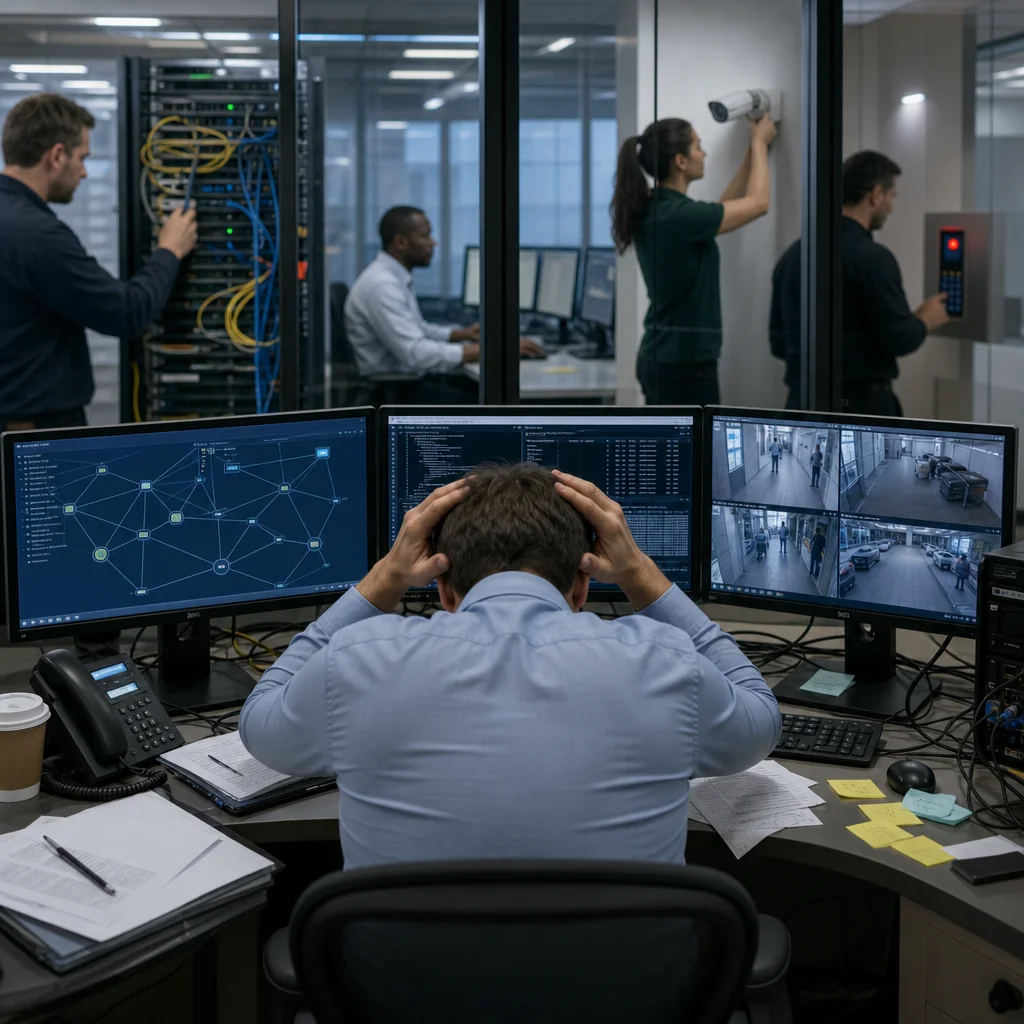
Response times compress dramatically. Your IT team no longer waits for the security team to investigate a physical incident before beginning network diagnostics. Your facilities manager doesn’t need to contact three separate vendors to understand the scope of an issue. All stakeholders see the same integrated view and can coordinate response in real time. This parallel response model reduces mean time to resolution by 40-60 percent based on implementations we’ve completed for similar organizations.
Operational visibility extends beyond incident response into routine management. Your facilities team can see network utilization trends correlated with physical occupancy patterns. Your IT team can understand how infrastructure demands change during different times of day or week based on actual access patterns. Security teams can identify emerging threats based on behavioral anomalies rather than waiting for incidents to occur. This shift from reactive to predictive operations transforms how proactively you manage your infrastructure.
Actionable takeaway: Define three operational scenarios that commonly cause coordination delays at your organization (such as a facility evacuation, a network outage, or a security incident). Map these scenarios against your current system capabilities and identify exactly what data integration would improve response time.
Our Comprehensive Approach to Unified Management
We design unified systems specifically for mid-sized organizations that need enterprise-grade capabilities without enterprise complexity. Our approach integrates your IT infrastructure, security systems, and network management into a cohesive operational backbone that operates as a single intelligent platform.
Our framework addresses four core areas: physical infrastructure, security integration, network management, and real-time intelligence. We begin by assessing your current environment, documenting existing systems and their capabilities, and identifying gaps where consolidation will deliver the most immediate value. Rather than forcing you into a complete rip-and-replace approach, we often integrate with your existing investments where they add value and modernize systems that have become operational liabilities.
The centerpiece of our solution is structured cabling and network infrastructure that supports integrated monitoring. Modern unified systems require network bandwidth and reliability that legacy cabling often can’t deliver. We design and deploy cabling infrastructure that accommodates HD security cameras, access control systems, network-based sensors, and IT infrastructure with redundancy and failover capabilities built in from the foundation.
Security integration follows a similar principle: we deploy systems designed to communicate with each other and share data securely. Your access control system understands your network topology. Your security cameras integrate with your network monitoring. Your incident response system automatically correlates physical and digital events. Your data protection standards apply consistently across all systems.
Our monitoring and management platform unifies alerts, logs, and dashboards into a single operational interface that your teams actually use. Rather than checking three different vendor portals, your team has one intuitive dashboard that shows security status, network health, infrastructure performance, and alerts ranked by severity and business impact.
Actionable takeaway: Identify which of your current systems you’re most dependent on or which vendor relationships are strongest. Build your unified approach around retaining those critical investments while consolidating less critical systems into an integrated framework.
Structured Cabling and Network Infrastructure as Your Foundation
Unified monitoring demands network infrastructure that can deliver the bandwidth, reliability, and scalability that modern security systems require. HD security cameras generate continuous data streams. Access control systems need real-time responsiveness. Network monitoring sensors require consistent connectivity. Your IT infrastructure depends on stable, redundant connections. Legacy cabling installed for basic networking simply can’t handle this integrated load effectively.
We deploy structured cabling systems that are fundamentally different from standard network installations. We design for current requirements and future growth, planning fiber optic runs for long-distance connections, category 6A or category 8 copper cabling for high-bandwidth applications, and redundant pathways so that a single cable cut doesn’t cascade into multiple system failures. Our installations include proper grounding, power distribution, and environmental controls that keep your systems operating reliably.
Network segmentation is built into the architecture from the start. Your security systems operate on dedicated network segments isolated from your general IT infrastructure, preventing a compromised workstation from accessing your camera feeds or access control systems. Yet these segments communicate securely through managed connections, allowing legitimate data correlation without creating security exposure. This design pattern is far more sophisticated than simply putting everything on one network.
Redundancy and failover capabilities are engineered throughout. Your primary network path carries traffic normally, but if that connection fails, your systems automatically route through a backup path with no service interruption. We implement uninterruptible power supplies at critical network nodes so that security systems remain operational during power incidents. We ensure your HD security camera system, access control infrastructure, and critical IT systems all maintain operation even when individual components fail.
The result is network infrastructure that can reliably support integrated monitoring. When we later add real-time monitoring capabilities or expand your system to additional facilities, that foundation is already in place to handle the additional load without degradation.
Actionable takeaway: Have us conduct a network infrastructure assessment at your primary facility to identify cabling upgrades needed to support integrated monitoring. This assessment becomes the technical foundation for your consolidation planning.
Access Control and HD Security Camera Integration
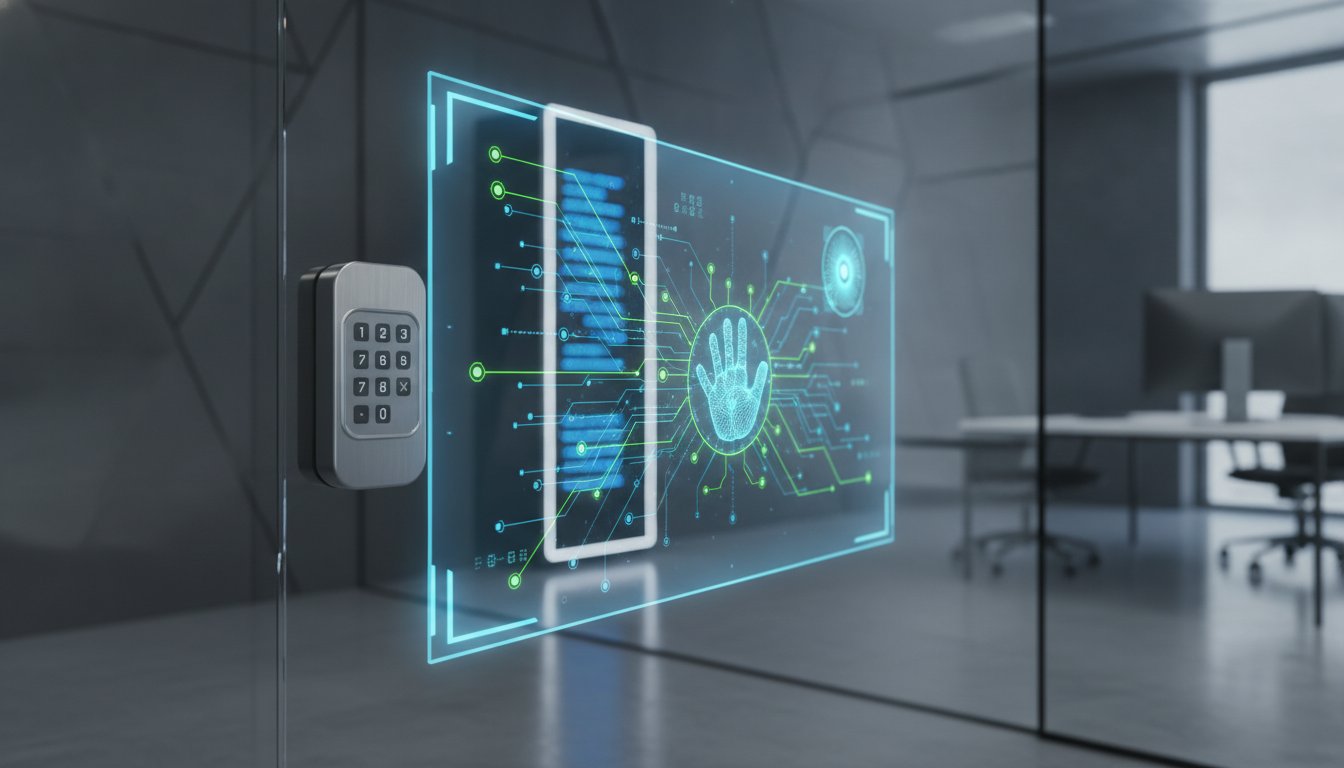
Access control systems and HD security cameras naturally integrate when they’re designed to operate together. We deploy systems where your access card readers, biometric readers, and door controllers share data with your camera system in real time. When someone uses an access card to enter a secure area, that event triggers the camera system to focus on that entry point and log the corresponding video timestamp to that access transaction.
This integration transforms security incident investigation. Traditionally, when you needed to investigate an access control event, you’d manually navigate to your video system, find the approximate timestamp, and scan through footage. With integrated systems, clicking on an access event immediately shows you the corresponding video, with the camera automatically positioned to capture that specific entry point. Your security team investigates incidents in minutes rather than hours.
Behavioral correlation becomes automatic. If someone uses an access card to enter your server room, that event appears in the same incident log as the corresponding camera footage. If camera analytics detect motion in restricted areas, you immediately see which access events correspond to that movement. If access patterns show unusual activity (someone entering areas they normally don’t access), that triggers alerts that can be correlated with other security events happening simultaneously.
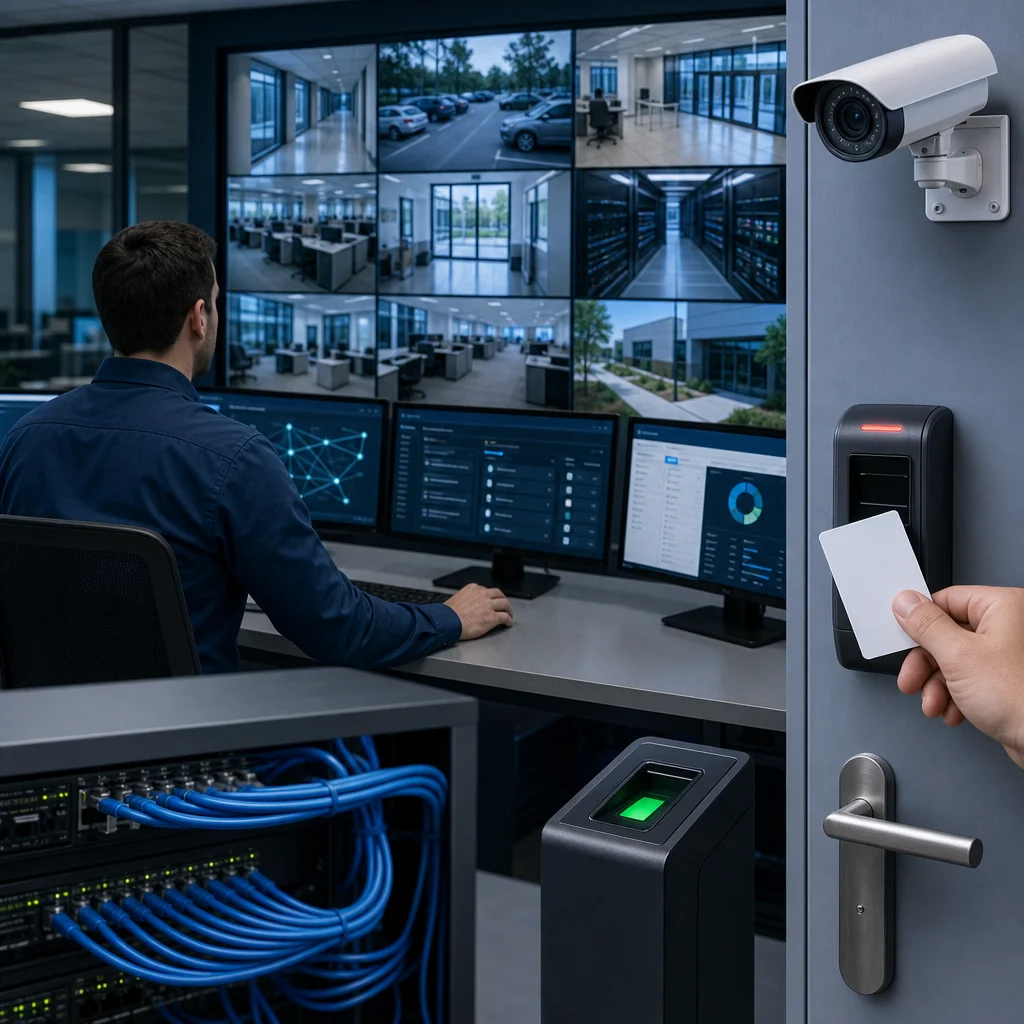
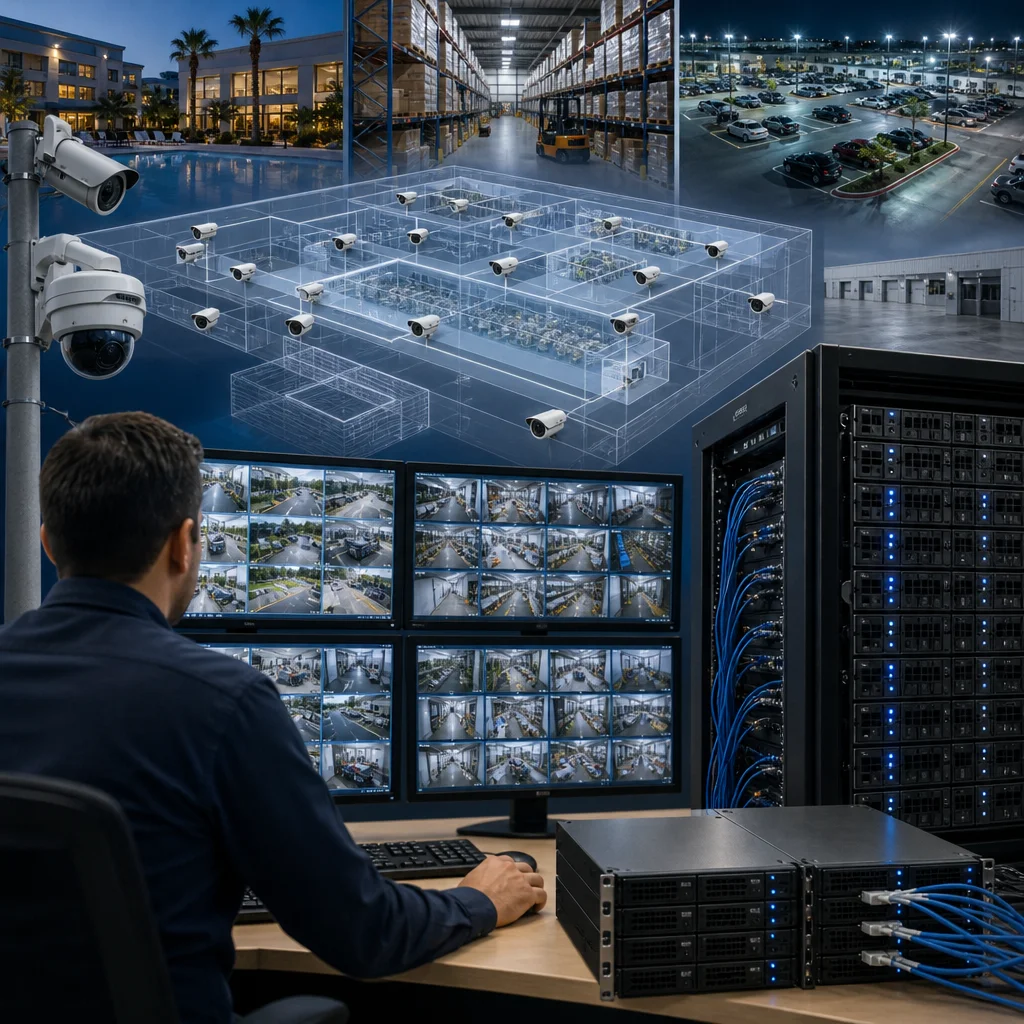
Our HD camera installations go beyond traditional surveillance. We deploy systems with analytics capabilities that understand facility layouts, detect intrusions, track movements across multiple cameras, and identify behavioral anomalies. When integrated with your access control data, these cameras become proactive security tools rather than passive recording devices. Your system alerts you to potential threats before they materialize, not after the fact.
Actionable takeaway: Document three high-value areas at your facility where integrated camera and access control monitoring would improve security or operational efficiency (such as your server room, restricted inventory areas, or executive offices). These become priority integration zones in your implementation plan.
Real-Time Monitoring and Alert Management
Unified monitoring generates alert intelligence that fragmented systems simply cannot provide. Instead of receiving alerts from your network monitoring system independently, your security system independently, and your access control system independently, you receive contextualized alerts that account for your entire operational environment.
Your facilities team receives an alert that a loading dock door has been propped open for longer than normal. The system correlates this with network data (has someone unauthorized accessed nearby servers?) and access control data (who was near that door in the last hour?). Your team can assess the situation with complete information rather than making decisions based on incomplete data.
An unusual spike in network traffic triggers an alert. Traditionally, your IT team investigates the source independently. With unified monitoring, your security team can simultaneously check camera feeds to see if anyone is physically accessing network equipment. Your access control logs show exactly who has accessed rooms containing network infrastructure in the relevant timeframe. This parallel investigation often reveals the root cause in minutes rather than hours.
Our remote monitoring management capabilities extend this intelligence beyond your facilities. Your team can monitor your entire operational environment from multiple locations, receive alerts on mobile devices with full context, and initiate response procedures from anywhere. This becomes particularly valuable for organizations operating multiple facilities or for security teams that need coverage outside standard business hours.
Alert fatigue is addressed through intelligent filtering and prioritization. Rather than overwhelming your team with hundreds of daily alerts, your unified system learns your normal operational patterns and alerts your team only to genuine anomalies or threats. Security cameras detect motion in restricted areas during business hours (likely normal) but alert you to motion at 3 a.m. (potentially concerning). Access control logs repeated failed card reads (potentially concerning) separately from successful authorized access (normal).
Actionable takeaway: Document which operational alerts currently generate false alarms or unnecessary notifications at your facility. These represent immediate opportunities for intelligent alert filtering that will improve your team’s ability to focus on genuine threats.
Scalability as Your Business Grows
Unified systems scale far more efficiently than fragmented approaches. When you add a new facility or expand an existing one, you simply extend your existing monitoring platform rather than negotiating new vendor contracts, deploying separate monitoring systems, and coordinating between multiple service providers.
If you operate facilities in different Southern California locations, a unified platform manages all of them from a single dashboard. Your security team can monitor all access control systems, all camera networks, and all network infrastructure as one integrated environment. Your IT team manages all network infrastructure centrally while maintaining local responsiveness. Your facilities teams coordinate across locations more effectively because they’re working with consistent systems and processes.
Scalability also applies to capability expansion. When you want to add network sensors to monitor environmental conditions, integrate biometric readers into your access control system, or deploy advanced video analytics, these additions integrate seamlessly into your existing platform rather than creating new silos. Your investment in unified infrastructure pays dividends every time you expand or enhance capabilities.
The financial model scales efficiently as well. Your cost per monitored facility decreases as you add locations because you’re extending a unified platform rather than duplicating separate systems at each location. Your IT team becomes more efficient as they manage consistent infrastructure across multiple sites. Your security operations center gains efficiency from standardized monitoring and response procedures across all facilities.
Actionable takeaway: If you operate or plan to operate multiple facilities, prioritize unified platform infrastructure that can scale across locations. This investment pays for itself through reduced coordination overhead and operational efficiency gains.
Security Compliance and Data Protection Standards
Modern compliance frameworks (HIPAA for healthcare, PCI-DSS for payment processing, SOC 2 for service providers) increasingly require integrated security and IT monitoring. Regulators understand that fragmented systems create security and audit gaps. When you can demonstrate unified monitoring, audit trails, and automated compliance controls, your compliance posture strengthens considerably.
Our integrated security systems are designed from the foundation with compliance requirements in mind. We implement role-based access controls so that different team members see only the data appropriate to their function. We maintain complete audit trails documenting who accessed what information and when. We encrypt data both in transit and at rest using standards that satisfy current and emerging regulatory requirements.
Data retention policies become consistent and auditable. Rather than different systems retaining data for different periods based on each vendor’s default settings, your unified system implements organization-wide retention policies that satisfy regulatory requirements and minimize data exposure. Security camera footage, access logs, and network activity logs are retained, destroyed, and backed up according to policies you define and that comply with applicable regulations.
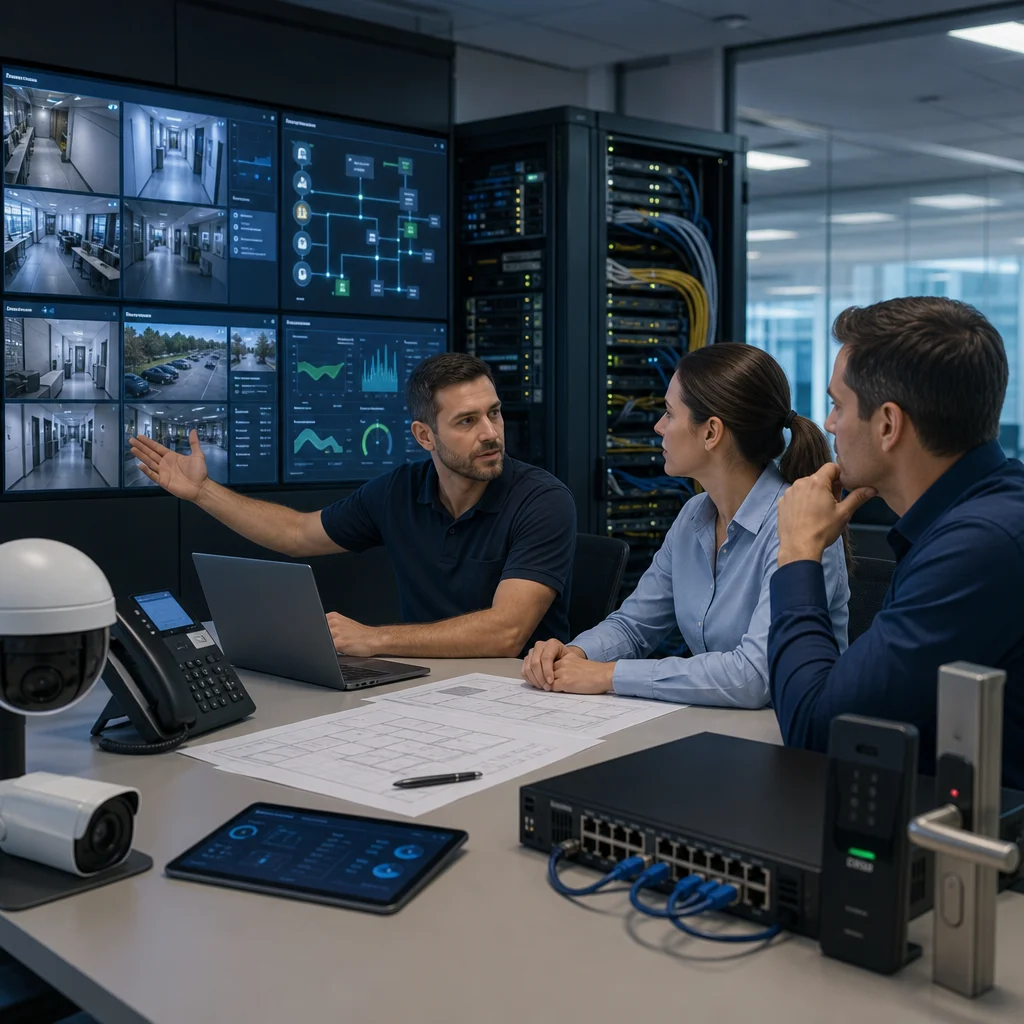
Incident response becomes more effective because you have complete visibility into what happened during a security incident. You can generate comprehensive reports documenting exactly what systems were accessed, which physical locations were entered, and what network activity occurred, all correlated into a single timeline. This documentation becomes invaluable if you need to notify regulators, provide evidence in legal proceedings, or demonstrate that you took appropriate security measures.
Actionable takeaway: Identify the specific compliance frameworks that apply to your organization (HIPAA, PCI-DSS, SOC 2, state privacy laws, etc.) and verify that your current systems meet documentation and monitoring requirements. Gaps in current compliance become drivers for your unified monitoring implementation.
ROI and Operational Efficiency Gains
The return on investment from unified monitoring comes from multiple sources, and the financial impact is measurable. Organizations consolidating to unified systems typically see 30-40 percent reduction in annual IT and security spending within the first 18 months as they eliminate redundant vendor contracts, reduce duplicate hardware and licensing, and compress support costs into a single vendor relationship.
Operational efficiency gains deliver ongoing value beyond cost reduction. Your IT team becomes more productive because they’re not spending hours coordinating between vendors. Your security team responds to incidents faster because they have complete information. Your facilities team manages infrastructure more effectively because they’re working with integrated systems rather than disconnected tools. These productivity gains compound over time as your team becomes more efficient with unified processes.
Reduced downtime translates directly to business impact. When network outages are resolved 40-60 percent faster because your entire team responds with complete visibility into the problem, that speed directly protects revenue and maintains customer service levels. When security incidents are detected and contained faster because you have integrated monitoring, you reduce breach exposure and minimize incident impact.
Risk reduction carries financial value even if you never experience a security incident. Insurance providers recognize that organizations with unified monitoring have lower breach risk, often offering premium discounts. Compliance audits proceed more smoothly when you can demonstrate comprehensive integrated monitoring, reducing audit costs and audit risk. Customer confidence increases when you can demonstrate enterprise-grade security practices.
Actionable takeaway: Calculate your current annual IT and security spending across all vendors. Assume a conservative 25 percent reduction from consolidation, plus an additional 10 percent from efficiency gains. Compare this annual savings against the cost of unified system implementation to calculate your payback period, which is typically 12-24 months.
Next Steps to Centralize Your Systems
Begin by scheduling a comprehensive infrastructure assessment with our team. We’ll evaluate your current IT infrastructure, security systems, network capabilities, and facility requirements to understand your specific environment. This assessment identifies consolidation opportunities, defines technical requirements for your unified platform, and establishes a realistic implementation roadmap.
The assessment typically includes interviews with your IT, security, and facilities teams to understand current pain points and priorities. We document your current system capabilities, identify gaps where integration would deliver immediate value, and develop a phased implementation approach that minimizes disruption to your operations.
Based on the assessment, we’ll develop a detailed proposal that outlines your unified monitoring architecture, implementation timeline, cost structure, and expected ROI. This proposal becomes your roadmap for consolidation, showing exactly what systems integrate first, which capabilities deploy in subsequent phases, and how the entire system evolves to meet your growing needs.
Our implementation approach prioritizes operational continuity. Rather than shutting down existing systems to deploy new ones, we integrate carefully, testing each new component thoroughly before placing it in production. Your teams transition to the new unified platform on a controlled schedule, with training and support ensuring smooth adoption.
The initial assessment is free and typically requires two to three hours of time from your key stakeholders. This investment generates a clear picture of your consolidation potential and a practical roadmap for achieving unified monitoring.
Contact Terapixels Systems today to schedule your infrastructure assessment. We serve mid-sized organizations throughout Southern California, from hospitality and healthcare to warehousing and manufacturing. Let us show you how unified monitoring transforms operational efficiency and security posture for organizations like yours.
Frequently Asked Questions (FAQ)
How does consolidating multiple technology vendors with us reduce our operational costs?
We eliminate the coordination overhead and redundant expenses that come from managing separate vendors for IT, cabling, security cameras, and access control. By providing integrated solutions through a single partner, we streamline your procurement, support, and maintenance processes, which directly reduces your technology spending and administrative burden.
What happens if our business grows and we need to expand our security and IT systems?
Our unified infrastructure is designed to scale with you. We build flexibility into our structured cabling, network architecture, and monitoring platforms so that adding new access points, camera locations, or IT resources happens seamlessly without replacing your existing foundation or disrupting your operations.
Why is real-time monitoring important for our business security and operations?
We provide immediate visibility into both your physical security and IT infrastructure, allowing our team and yours to detect threats and anomalies before they become costly incidents. Real-time alerts mean we can respond to unauthorized access attempts, network issues, or security breaches instantly rather than discovering problems after significant damage has occurred.