CONTACT US
Table of Contents
- 1. Security Vulnerabilities from Unknown Network Access Points
- 2. Compliance Failures and Audit Complications
- 3. Operational Downtime During Troubleshooting and Repairs
- 4. Costly Emergency Service Calls and Extended Outages
- 5. Scalability Limitations When Expanding IT Infrastructure
- 6. Data Loss and Network Performance Degradation
- 7. Our Comprehensive Cabling Audit and Documentation Solution
- 8. Implementation Strategy for Legacy System Remediation
- Frequently Asked Questions (FAQ)
1. Security Vulnerabilities from Unknown Network Access Points
Your facility’s network cabling is the backbone of every connected system you depend on. Yet many mid-sized organizations in Southern California operate with cabling infrastructure that nobody has properly documented, mapped, or tested in years. This hidden technical debt creates compounding risks that most business leaders don’t see coming until a crisis forces them to pay the price.
We’ve worked with hotel groups, healthcare facilities, warehouses, and manufacturing operations across the region. The pattern is consistent: undocumented cabling creates security blind spots, blocks compliance efforts, paralyzes your IT team during outages, and ultimately costs far more to fix than preventing it would have.
Undocumented cabling means you don’t know where your network connects or who might access it. A rogue access point, an abandoned line that still carries traffic, or a patch panel connection that no one can trace creates openings for unauthorized access. In a hospitality environment managing payment systems and guest data, or a healthcare facility handling protected information, this risk is unacceptable.
Without visibility into your physical network architecture, you can’t effectively implement network segmentation, monitor suspicious traffic patterns, or enforce consistent security policies across your infrastructure. An attacker who gains access through a forgotten cable run can potentially move laterally through your entire system before detection.
What to do next: Demand a full physical audit of where every cable terminates and what it connects. Map it in a searchable system. This foundation is non-negotiable before any security hardening work begins.
2. Compliance Failures and Audit Complications
Auditors don’t view undocumented infrastructure as a minor housekeeping issue. HIPAA compliance for healthcare facilities, PCI-DSS for payment processing, and industry-specific security standards all require documented network architecture. You can’t prove you’ve secured what you can’t identify.
When a compliance audit arrives, the absence of cabling documentation becomes a finding. Worse, when you can’t quickly produce evidence of your network topology, you signal operational immaturity to auditors and regulators. For hotel chains managing guest data across multiple properties or distribution centers processing sensitive shipping information, this translates into audit delays, repeat inspections, and potential penalties.
The remediation process itself becomes painful. Your IT team spends hours tracing cables by hand instead of reviewing certified documentation. This delays the audit closure and consumes resources you need for actual security improvements.
Actionable step: Begin documenting your current state immediately, even if imperfect. A documented baseline with a remediation timeline is substantially better than an undocumented infrastructure. Auditors want to see intentional management, not surprise discoveries.
3. Operational Downtime During Troubleshooting and Repairs
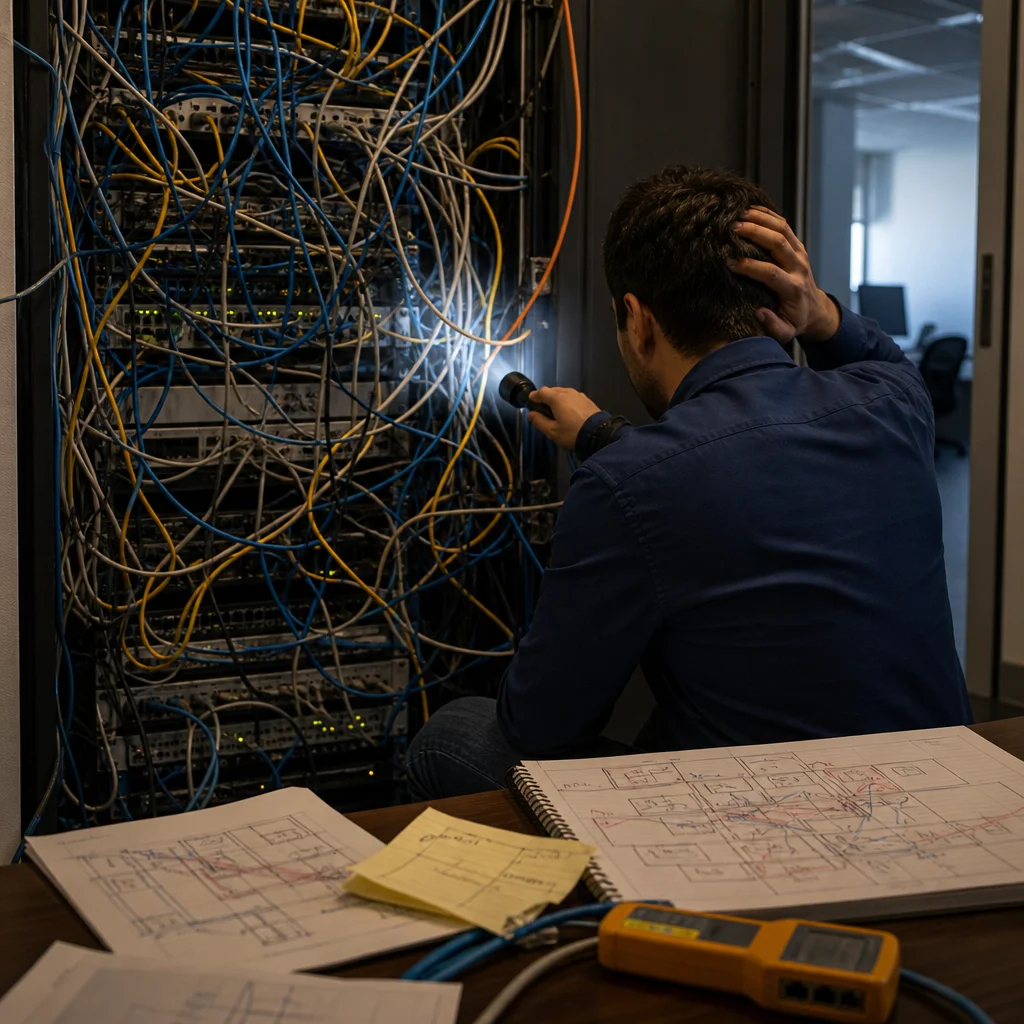
When a network issue occurs and your cabling is undocumented, your IT team enters guesswork mode. Which patch panel port actually connects to the server room switch? Does that wall jack in the conference room still carry traffic? Is that cable run above the ceiling active or abandoned?
Every minute spent tracing cables is downtime. For a hotel managing reservation systems, room access controls, and security cameras, this translates directly to guest-facing service interruptions. For a warehouse managing inventory and shipping logistics, it means halted operations and delayed orders. For a manufacturing facility coordinating production schedules, it equals lost output.
We’ve seen single troubleshooting calls stretch from minutes into hours because technicians were working blind. A properly documented system cuts resolution time dramatically. Your IT team knows exactly where to look, can isolate problems systematically, and restores service with precision instead of trial and error.
Immediate action: Create a quick reference guide for your most critical network paths, even if full documentation isn’t complete. Label every patch panel port and cable run with identifiers that match your documentation. This alone cuts troubleshooting time substantially.
4. Costly Emergency Service Calls and Extended Outages
Undocumented systems drive expensive emergency service calls. When your team can’t diagnose an issue quickly, you’re forced to call external contractors. They arrive to find the same mystery your internal staff did, then charge hourly rates to figure out what should have been documented months ago.
Contractors unfamiliar with your infrastructure take longer to diagnose problems. They can’t risk making changes without understanding the full impact, so they work cautiously. That caution, while protecting your systems, costs money. A two-hour diagnostic that could have taken fifteen minutes with proper documentation suddenly becomes a four-hour engagement at premium rates.
For a property management company overseeing multiple facilities, these emergency calls compound across your portfolio. One undocumented site becomes a revenue drain; a dozen of them become a budget crisis.
Next step: Establish a documented baseline so that future diagnostics start from a known position. Partner with an integrator who can provide certified documentation and train your team to maintain it going forward.
5. Scalability Limitations When Expanding IT Infrastructure
Adding new systems to an undocumented network is like building on a foundation you can’t see. You don’t know what bandwidth is available, whether existing cable runs can support new equipment, or how to safely integrate new infrastructure without disrupting what’s already in place. A hotel planning to upgrade security cameras, add access control systems, or expand wireless coverage can’t confidently plan the project without understanding the existing cabling capacity and routing.
Projects stall because you need to hire consultants just to assess feasibility. Then you discover mid-project that a wall run is full, or a pathway through the building isn’t viable, forcing expensive rerouting or redesigns. What should have been a three-month implementation becomes six months with budget overruns.

Documented infrastructure lets you scale intentionally. You know your capacity, you can plan cable runs efficiently, and you can integrate new systems with confidence. Expansion becomes predictable instead of chaotic.
Action item: If you’re planning infrastructure expansion, demand that any current cabling be documented first. This investment pays for itself in eliminated surprises and accelerated project timelines.
6. Data Loss and Network Performance Degradation
Undocumented cabling often includes abandoned runs, damaged cables, or improperly terminated connections that degrade network performance. Intermittent connectivity, packet loss, and bandwidth bottlenecks trace back to infrastructure issues that nobody can see because nobody documented the system.
For a manufacturing facility running real-time production monitoring, or a healthcare facility managing patient data streams, performance degradation isn’t just an inconvenience. It’s an operational failure. In critical scenarios, it can compromise data integrity or create safety risks.
Additionally, when cables aren’t properly documented, they’re often not properly maintained. Environmental factors like heat, moisture, or physical stress accumulate unnoticed. A cable run that looked fine five years ago may be quietly degrading your network today, with no one knowing it was the source of the problem.
Immediate opportunity: Run network performance diagnostics and map them against your physical cabling. You’ll often discover that documented, well-maintained runs show measurably better performance than undocumented legacy runs.
7. Our Comprehensive Cabling Audit and Documentation Solution
We’ve designed our cabling audit and documentation service specifically to address these risks for mid-sized facilities across Southern California. We start with a complete physical inventory of your infrastructure, testing every connection, tracing every run, and building comprehensive as-built documentation that becomes your operational truth.
Our process includes physical cable tracing, connection testing, performance baseline measurement, and delivery of certified documentation in digital and physical formats. We use industry-standard tools and methodologies, so your documentation is immediately useful to your IT team and auditors alike.
More importantly, we deliver actionable remediation recommendations. We identify obsolete runs to decommission, performance issues to address, and security gaps to close. You don’t just get a document; you get a strategic plan for bringing your infrastructure into compliance and operational excellence.
For organizations managing multiple properties, we can scale our approach across your portfolio, ensuring consistency and providing centralized documentation management. Whether you operate hotels, healthcare facilities, warehouses, or manufacturing operations, we tailor the audit scope to your specific systems and compliance requirements.
8. Implementation Strategy for Legacy System Remediation

Fixing undocumented infrastructure doesn’t require a complete rip-and-replace. We follow a phased remediation approach that prioritizes high-risk and high-impact areas first, minimizing disruption while building documented infrastructure systematically.
Phase one focuses on security-critical systems. We identify and document network access points, then implement segmentation and monitoring. Phase two addresses compliance requirements, ensuring your documentation meets regulatory standards for your industry. Phase three targets operational improvements, where we optimize routing, upgrade underperforming runs, and integrate new systems.
Throughout this process, your infrastructure remains operational. We work methodically, testing changes, updating documentation, and validating impact before moving to the next component. Your IT team stays informed and gradually gains visibility into systems they’ve been managing blind.
The investment in structured remediation typically pays for itself within the first year through avoided emergency service calls, reduced troubleshooting time, and elimination of downtime caused by infrastructure uncertainty.
Schedule a consultation with us to assess your current cabling documentation status. We’ll provide a no-cost evaluation of your infrastructure and a clear roadmap for bringing it into compliance and operational excellence. For organizations in Southern California managing complex facilities, this is the foundation everything else depends on.
For further reading: Structured cabling services.
Frequently Asked Questions (FAQ)
What happens when we don’t document our cabling infrastructure?
Undocumented cabling creates blind spots in your network that make it nearly impossible to troubleshoot issues quickly or identify unauthorized access points. We’ve seen organizations lose hours of productivity during outages simply because no one knew which cables connected to which systems. Without proper documentation, you’re also vulnerable to compliance violations since auditors need to verify your entire infrastructure is secure and accounted for.
How does legacy cabling infrastructure affect our ability to scale?
When we try to expand our IT systems without understanding our existing cabling setup, we risk creating conflicts, bottlenecks, and costly mistakes that compound over time. Undocumented networks force us to work around unknown constraints rather than building strategically for growth. We end up either over-purchasing capacity to avoid problems or under-investing because we can’t accurately assess what we already have in place.
Why do undocumented systems lead to expensive emergency service calls?
Without cabling documentation, every network issue becomes a detective mission that requires specialized technicians to trace connections and identify problems from scratch. We pay premium rates for emergency response and extended troubleshooting when what should be a quick fix turns into hours of investigation. Proper documentation prevents these costly surprises by giving us immediate visibility into our infrastructure so we can resolve issues efficiently.