CONTACT US
Table of Contents
- Why PCI and HIPAA Compliance Demands More Than Basic Security
- The Real Cost of Physical Security Failures in Regulated Industries
- Understanding PCI DSS Physical Security Requirements for Your Business
- HIPAA Physical Safeguards: What Your Healthcare or Life Sciences Facility Must Implement
- How Integrated Cabling Infrastructure Supports Compliance Across Systems
- Access Control Systems as Your First Line of Compliance Defense
- HD Security Camera Placement and Recording Standards for Audit Success
- The Importance of System Integration for Seamless Compliance Management
- Our Comprehensive Approach to Compliance-Ready Security Infrastructure
- Why Southern California Businesses Choose Our Integrated Solution
- Implementation Timeline and Minimizing Disruption to Operations
- Maintaining Compliance: Ongoing Monitoring and System Management
- Frequently Asked Questions (FAQ)
Why PCI and HIPAA Compliance Demands More Than Basic Security
Compliance isn’t something you can bolt onto your existing security setup. PCI DSS (Payment Card Industry Data Security Standard) and HIPAA (Health Insurance Portability and Accountability Act) impose specific physical security mandates that go far beyond installing a few cameras and locking doors.
The distinction matters because regulators don’t evaluate your security posture in isolation. They examine whether your physical infrastructure prevents unauthorized access to sensitive data and whether your systems create an auditable record of who accessed what and when. A standard commercial security system won’t document these requirements at the level auditors expect.
Many mid-sized business leaders in Southern California underestimate how thoroughly regulators scrutinize physical security during compliance reviews. An audit doesn’t just check whether you have access control. Auditors verify that your cabling is segregated appropriately, your camera footage captures actionable detail, your access logs integrate with your IT systems, and your entire infrastructure aligns with documented policies. When these elements operate independently, compliance becomes fragmented and audit readiness suffers.
This is precisely where we focus our expertise. We design integrated security infrastructure specifically for regulated environments, ensuring every component reinforces your compliance posture rather than creating gaps between systems.
The Real Cost of Physical Security Failures in Regulated Industries
A compliance violation carries consequences that extend well beyond a single fine. Consider a healthcare facility that experiences a data breach involving patient records: the direct regulatory penalty might reach $1.5 million, but the total damage includes notification costs, legal fees, credit monitoring services, reputation harm, and lost patient trust. A PCI violation at a hospitality property can result in fines, forced system upgrades at the acquiring bank’s expense, and restrictions on processing payments.
We’ve worked with facilities where physical security gaps led to audit findings that triggered mandatory corrective action plans and increased oversight costs for months. One warehouse operation discovered unauthorized access to a secure storage area because their access control system wasn’t integrated with their IT security monitoring. The resulting audit remediation consumed significant management time and resources that could have been invested in growth.
The operational friction adds up quickly. When physical security systems don’t communicate with IT infrastructure, your team spends time manually reconciling logs, investigating incidents without complete information, and struggling to demonstrate compliance during audits. This creates compliance debt that compounds over time.
Prevention through proper infrastructure design is substantially less expensive than remediation. We help you avoid these costly scenarios by implementing systems built specifically for audit transparency and regulatory scrutiny from the start.
Understanding PCI DSS Physical Security Requirements for Your Business
PCI DSS defines strict physical security controls organized around restricted access, surveillance, and accountability. Requirement 9 specifically addresses physical access to cardholder data environments, and the standards are explicit about what qualifies as adequate protection.
Your business must restrict physical access to systems that store, process, or transmit payment card data. This means controlled entry points with documented access logs, visitor management procedures, and physical barriers that prevent unauthorized movement through sensitive areas. If your facility processes credit card payments, auditors will expect to see that only authorized personnel can reach payment terminals, servers, and network infrastructure.
Surveillance forms the compliance backbone. PCI DSS requires monitoring of all physical access points and sensitive areas with recording systems capable of capturing actionable video. “Actionable” means resolution sufficient to identify individuals and reconstruct incidents. Low-resolution systems often fail audit requirements because they cannot provide adequate forensic detail.
Retention periods matter equally. PCI mandates maintaining surveillance recordings for at least 90 days, with many organizations maintaining longer retention to satisfy state regulations or internal policy. Your infrastructure must support this retention timeline without degrading video quality or creating compliance complexity.
Access logs must be retained and regularly reviewed. This requirement forces you to implement systems that automatically capture access attempts, failed authentication events, and privilege escalation activities. Manual logs or systems that don’t integrate with your broader IT environment typically don’t satisfy auditor expectations.
Your next step should be a physical security assessment identifying every location where cardholder data might be processed or stored, then mapping access control and surveillance requirements to those locations.
HIPAA Physical Safeguards: What Your Healthcare or Life Sciences Facility Must Implement
HIPAA’s physical safeguards are equally comprehensive but emphasize healthcare-specific concerns around patient privacy, facility access, and workstation security. The standards require healthcare and life sciences facilities to implement facility access controls, workstation use policies, workstation security procedures, and device and media controls.
Facility access controls demand that your healthcare facility restricts entry to areas where patient health information is created, stored, or processed. This extends beyond isolated server rooms to include medical records storage, billing departments, clinics, and any space where patient data transits through your network. HIPAA auditors evaluate whether your access control system can demonstrate that only credentialed staff accessed patient areas during specific time windows.
The challenge in healthcare settings is complexity. A mid-sized clinic or hospital serves multiple departments with different access requirements. Doctors, nurses, administrative staff, housekeeping, and maintenance personnel require different access levels to different areas. Your access control system must enforce these distinctions automatically and audit them thoroughly.
Surveillance in healthcare carries privacy considerations that differ from other regulated industries. While PCI emphasizes comprehensive monitoring, HIPAA requires facilities to balance surveillance with patient privacy rights. You cannot record areas where patients receive care in ways that capture sensitive medical information. However, you must monitor entry and exit points, corridors, and administrative areas where data transits.
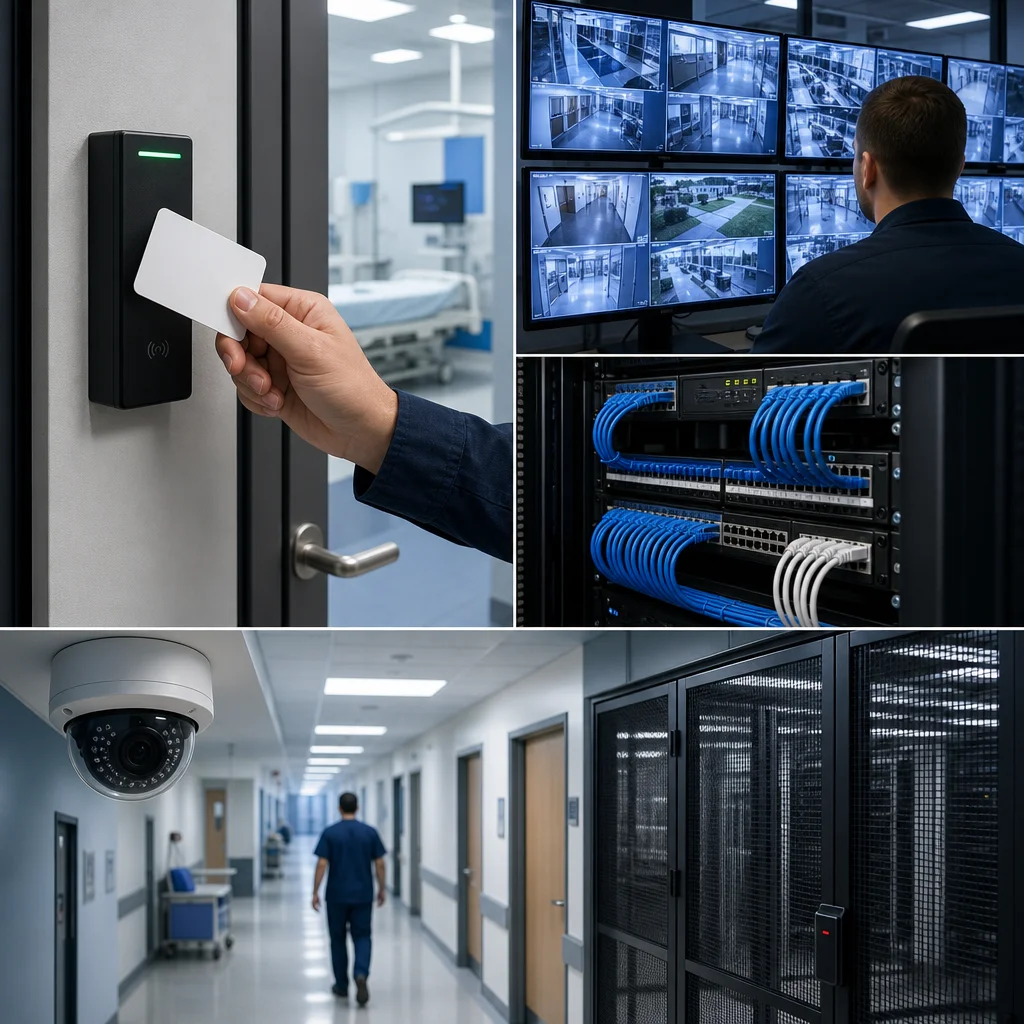
Visitor management in healthcare facilities presents another HIPAA requirement. Every visitor entering a patient care area or administrative zone must be logged, badged appropriately, and monitored. When a breach investigation occurs, auditors expect to review visitor logs and surveillance footage to determine whether an unauthorized individual accessed protected health information.
Device and media controls extend your physical security requirements to include how you manage removable media, portable devices, and data leaving your facility. This demands access control at your facility exit points and coordination with your IT security policies.
Healthcare facility security standards require that your access control and surveillance systems integrate seamlessly with your IT infrastructure so that compliance officers and auditors can cross-reference access logs with network activity, creating a complete audit trail.
How Integrated Cabling Infrastructure Supports Compliance Across Systems
Many facility managers overlook cabling as a compliance component, but structured cabling infrastructure directly influences your ability to segregate systems, secure networks, and document data flow for audit purposes.
Properly designed cabling architecture segregates cardholder data networks from general facility networks, preventing cross-contamination and limiting the scope of PCI compliance obligations. When cabling is poorly planned, credit card processing systems might share network pathways with general employee workstations, forcing you to extend compliance controls across your entire facility rather than isolating them to specific network segments.
In healthcare environments, structured cabling allows you to segregate patient data networks from administrative systems, supporting HIPAA’s principle of minimum necessary access. When a nurse accesses patient records in a clinical area, that traffic should traverse a network segment specifically designed for patient care, distinct from guest WiFi or general business systems.
We design cabling infrastructure that supports secure, auditable data flow from the physical point of data collection through storage and transmission. This means properly labeled, segregated cable runs; environmental protections preventing unauthorized tapping; and documentation that auditors expect during compliance reviews.
Your cabling system must also support the surveillance and access control cameras themselves. These systems generate significant data that requires dedicated network capacity and power delivery. Inadequate cabling infrastructure leads to bandwidth congestion, dropped recordings, and system failures that can trigger audit findings.
The integration point matters considerably. Your access control system needs network connectivity to your IT management infrastructure. Your surveillance system must transmit footage to secure storage. Your card processing terminals require segregated network access. Each of these systems requires dedicated, documented cabling pathways that your team can explain to auditors.
We implement structured cabling designed specifically for regulated environments, ensuring that every network segment serves a documented business purpose and supports your compliance requirements.
Access Control Systems as Your First Line of Compliance Defense
Access control represents the critical barrier preventing unauthorized individuals from reaching sensitive areas and systems. For PCI and HIPAA compliance, access control isn’t optional or secondary; it’s fundamental to demonstrating that your facility enforces the access restrictions regulators require.
We implement Integrated Access Control Security Systems in Southern California that provide credential management, real-time access monitoring, and comprehensive audit logging. Modern systems move beyond simple magnetic card readers to multi-factor authentication, biometric identification, and mobile credentials that integrate with your broader IT security infrastructure.
The audit trail function is what separates compliant access control from systems that merely control doors. When an auditor investigates whether unauthorized personnel accessed a restricted area during a specific timeframe, they expect to review detailed logs showing every access attempt, successful authentication, denied attempts, and credential usage. Your access control system must generate this documentation automatically without requiring manual compilation.
Credential management deserves particular attention. When employees change roles, leave the organization, or transfer between departments, their access levels must update immediately. Delayed deactivation of credentials creates compliance vulnerabilities that auditors flag aggressively. Your access control system should integrate with your HR systems so that access adjustments occur as part of standard personnel processes.
In healthcare facilities, role-based access control is essential. A physician should access patient care areas and clinical systems, but not billing records. Administrative staff should access billing systems, but not clinical areas. Your access control system must enforce these distinctions automatically across multiple entry points and system integrations.
The physical placement of access control readers matters for compliance documentation. Every entry point to a restricted area needs reader coverage. Exit doors require verification capabilities. Stairwells and corridor junctions in sensitive areas require monitoring. We assess your facility layout and access patterns to position readers and integrations that capture the complete access picture.
We also implement visitor management systems that extend access control principles to temporary personnel, consultants, and vendors. These systems issue temporary credentials, restrict visitor access to specific areas, log their movement through your facility, and provide auditors with complete visibility into who accessed what during their tenure.
HD Security Camera Placement and Recording Standards for Audit Success
Surveillance documentation represents your second line of compliance evidence. When access control logs show that someone entered a restricted area, video footage confirms their identity and documents what they actually did. For regulatory auditors, this combination of access logs and video evidence constitutes proof of physical security effectiveness.
PCI DSS specifies that surveillance must cover all physical access points to systems that process, store, or transmit cardholder data. This includes entry and exit doors, server room access, network closet entries, and workstation areas where payment terminals operate. The standard also requires monitoring of areas surrounding these systems to detect unauthorized approaches.
“Actionable video” means resolution sufficient to identify individuals, read signage, and capture details of activities. Auditors generally expect minimum resolution of 720p HD for facial identification at 15 feet or closer, with higher resolution for critical access points. This isn’t about general surveillance; it’s about creating evidence that would be admissible if you needed to investigate a breach or defend against a compliance violation.
Camera placement strategy differs between PCI and HIPAA environments. In payment processing areas, you need comprehensive coverage of card handling activities without capturing patient medical information. In healthcare facilities, you balance surveillance of administrative and clinical support areas with privacy protections in patient care zones. We design camera positioning that captures the compliance-critical activities while respecting privacy boundaries.
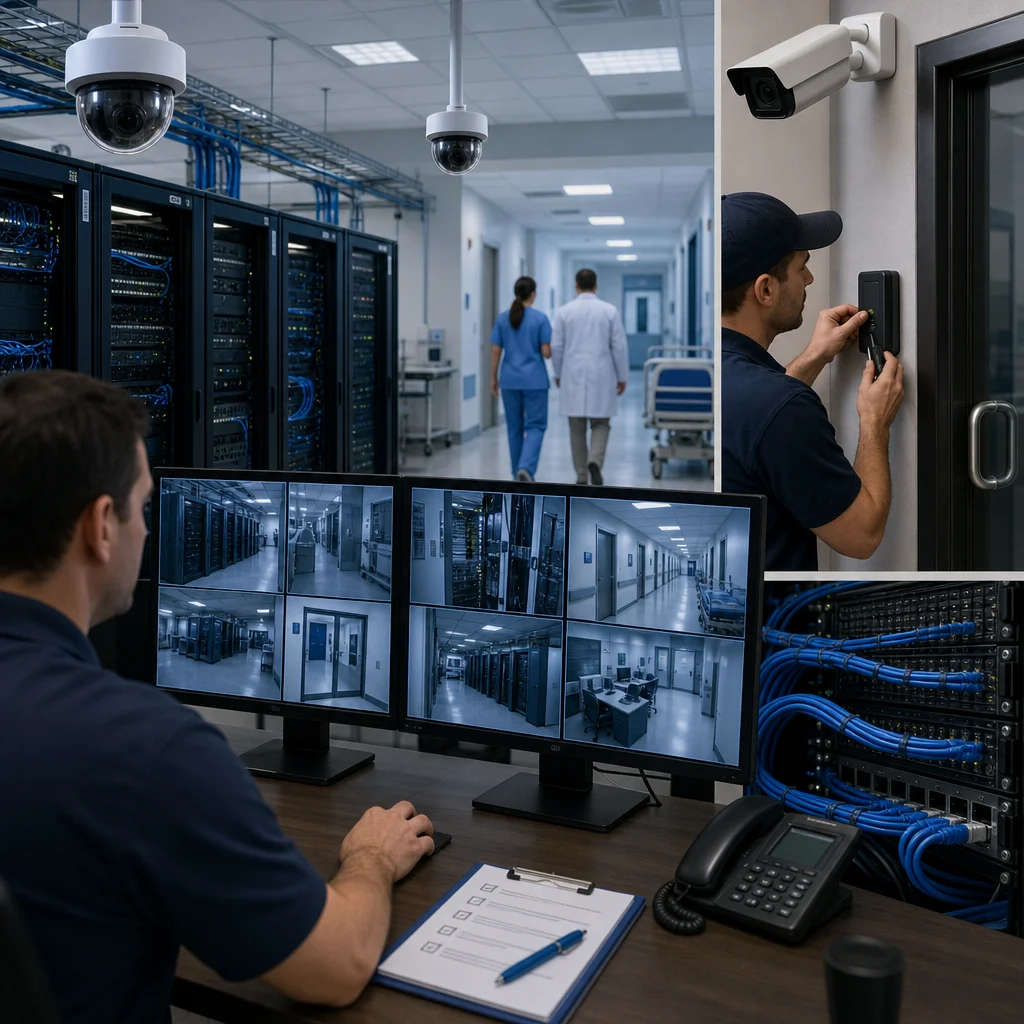
Recording retention requirements typically mandate 90 days minimum for PCI and 6 years for HIPAA, though many facilities maintain longer retention based on state regulations or internal policy. Your infrastructure must support this retention timeline with reliable storage, managed backup, and organized retrieval systems that allow auditors to locate specific footage quickly.
Storage management is often overlooked. Many facilities implement surveillance systems without considering how they’ll manage years of recordings. Cloud-based and hybrid storage solutions provide both compliance assurance and operational efficiency. We implement systems with automatic retention management, ensuring that older footage is systematically archived while recent recordings remain readily accessible for investigation and audit.
Integration between access control and surveillance creates the complete compliance picture. When an access control log shows entry at 2:47 PM, your surveillance system should timestamp footage to the same moment, allowing auditors to verify that the logged access corresponds to actual physical movement through your facility.
The Importance of System Integration for Seamless Compliance Management
Standalone security systems create compliance gaps. Your access control system operates independently, your surveillance generates separate recordings, your IT infrastructure tracks network activity in yet another system, and your physical audit trail becomes fragmented across multiple platforms.
Integrated systems eliminate these gaps. We design security infrastructure where access control, surveillance, IT monitoring, and environmental systems communicate and share data in real time. When someone accesses a restricted area, your access control system logs the event, triggers surveillance footage capture, and notifies your IT monitoring system to examine network activity during that window. Your compliance officers and auditors see the complete picture without manual investigation.
This integration extends to incident response. When an access control system detects an unauthorized entry attempt, an integrated system can immediately retrieve associated video footage, check IT logs for suspicious network activity, and alert facility management through a unified dashboard. Without integration, investigating the same incident requires checking multiple systems, waiting for data exports, and manually correlating activities across platforms.
Audit preparation becomes substantially simpler with integrated systems. Rather than gathering access logs from one system, surveillance footage from another platform, and network logs from a third, you can generate unified compliance reports that auditors expect to see. Many facilities implement auditor portals where authorized regulators can review integrated logs and footage for specific time periods without requiring IT staff to manually assemble evidence.
We prioritize system integration at the infrastructure level, ensuring that your access control readers, surveillance cameras, IT network infrastructure, and management systems all communicate through a unified platform. This approach reduces the complexity your team manages daily while providing auditors with the comprehensive compliance documentation they require.
Our Comprehensive Approach to Compliance-Ready Security Infrastructure
We take a holistic approach to compliance-ready infrastructure that begins with understanding your specific regulatory requirements, facility layout, and operational constraints.
Our process starts with a detailed facility assessment identifying every location where sensitive data is processed, stored, or transmitted. For payment processing facilities, we map card handling workflows and identify all systems requiring PCI protection. For healthcare facilities, we assess patient data access points, clinical support areas, and administrative zones subject to HIPAA safeguards. This assessment becomes the foundation for your security design.
We then design integrated infrastructure combining structured cabling, access control systems, HD surveillance, and IT network components into a unified compliance solution. Rather than selecting individual security products and forcing them to work together, we architect systems designed from the ground up for regulatory environments.
Structured cabling forms the foundation, with dedicated network segments for access control, surveillance, IT systems, and patient or cardholder data networks. We ensure that cabling runs are documented, labeled, secured against unauthorized access, and positioned to support your facility layout without creating security vulnerabilities.
Access control implementation includes credential management systems, multi-factor authentication where required, role-based access provisioning, and audit logging integrated with your IT infrastructure. We position readers, keypads, and biometric systems to enforce access restrictions while maintaining the complete audit trail compliance requires.
Surveillance design emphasizes resolution, coverage, and integration. We position HD cameras to capture all critical access points and monitoring areas, configure recording systems with appropriate retention and storage management, and integrate footage timestamps and access logs for seamless auditing.
IT infrastructure integration connects all physical security systems to your network monitoring and management platforms, creating unified compliance dashboards where your team can manage access, review incidents, and prepare audit documentation.
Why Southern California Businesses Choose Our Integrated Solution
Southern California businesses operating in hospitality, healthcare, logistics, and manufacturing recognize that compliance requires specialized expertise. Many organizations initially tried piecing together security systems from multiple vendors, only to discover that integration gaps created audit vulnerabilities and operational inefficiency.
Hotels and hospitality operations appreciate that our approach segregates guest areas from payment processing and administrative zones, protecting both guest privacy and payment security simultaneously. We’ve implemented systems for major hospitality chains managing multiple properties where centralized compliance monitoring across locations simplifies audit preparation and reduces regulatory risk.
Healthcare and life sciences facilities value our understanding of HIPAA requirements extending beyond access control to encompass the clinical workflow, patient privacy considerations, and integration with electronic health record systems. We’ve worked with clinics, outpatient surgery centers, and diagnostic facilities where our infrastructure supports rapid, auditable access to patient information while maintaining strict privacy boundaries.
Logistics, distribution, and manufacturing operations benefit from our experience segregating controlled access zones from operational areas, managing vendor and temporary staff access, and creating audit trails for high-value inventory and sensitive processes.
Our clients recognize that compliance infrastructure requires ongoing partnership rather than one-time installation. We provide regular compliance assessments, system updates as regulations evolve, and proactive maintenance that keeps your systems audit-ready year-round.
Implementation Timeline and Minimizing Disruption to Operations
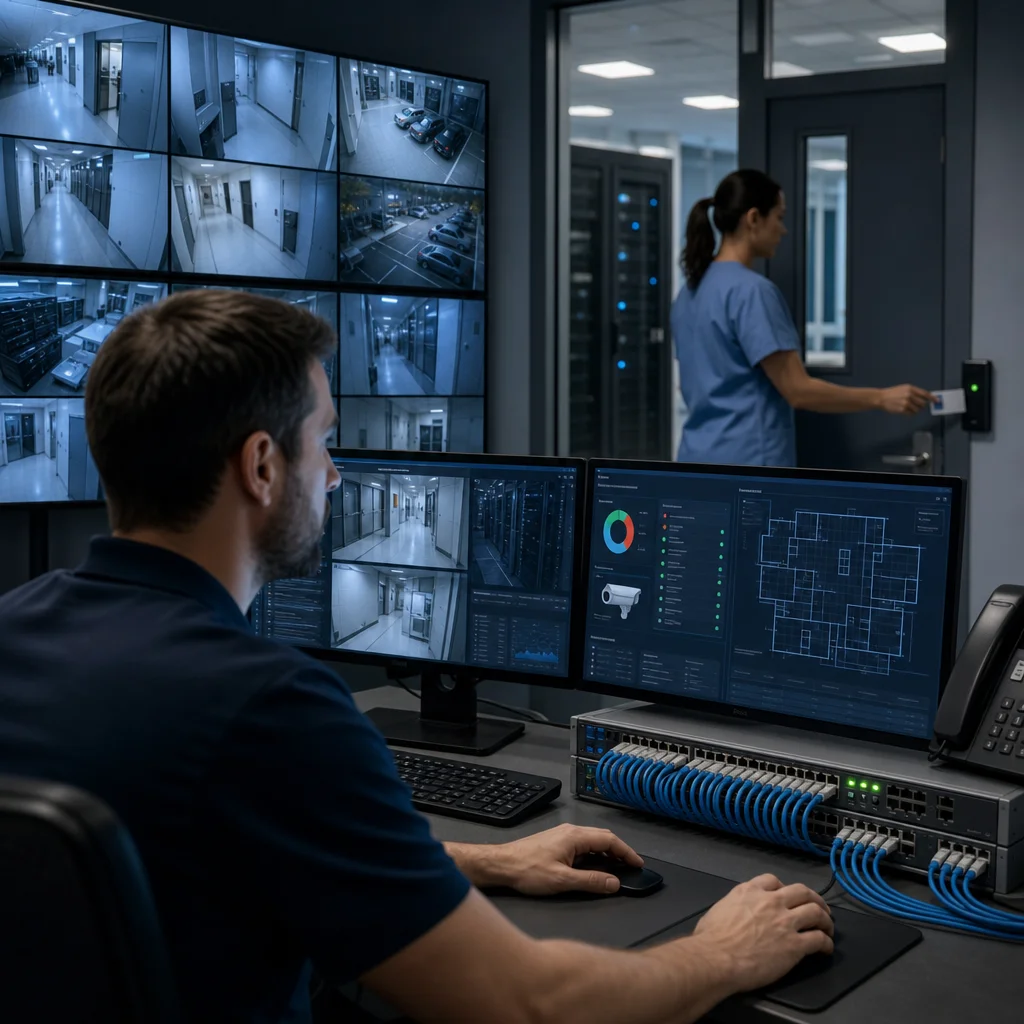
Compliance-ready infrastructure requires careful planning to minimize operational disruption. We work with your team to stage implementation in phases that allow your facility to continue normal operations throughout the process.
Typical implementation begins with detailed planning and site assessment during week one through two. This phase involves mapping your facility, understanding access patterns, identifying cabling pathways, and documenting your current security systems. We create detailed implementation plans that your team can review and adjust based on operational priorities.
Structured cabling installation usually occurs during weeks three through six, depending on facility size and complexity. We identify low-traffic periods and coordinate with your facilities team to install cable runs with minimal disruption to daily operations. Most facilities can continue normal operations during cabling installation with minor scheduling adjustments in specific areas.
Access control deployment typically follows cabling installation during weeks six through eight. We install readers, keypads, and credential management systems while maintaining manual security procedures during the transition. We phase reader activation area by area, allowing your staff time to adjust to new authentication procedures and for management to verify system functionality before full deployment.
Surveillance installation occurs concurrently with access control deployment. Camera positioning, cabling termination, and recording system configuration happen during weeks six through nine. We activate surveillance progressively, ensuring complete coverage while allowing your team to become comfortable with new systems.
Integration and testing occur during weeks eight through ten. We connect access control and surveillance systems to your IT infrastructure, verify that data flows correctly between platforms, and train your team on unified compliance management dashboards.
Final training and handoff occurs during week ten. Your staff completes training on system management, incident response procedures, and audit documentation. We provide documentation and support resources for ongoing operation and compliance maintenance.
The entire process typically completes within 10-12 weeks for mid-sized facilities, though larger or more complex environments may require extended timelines. We schedule implementation to avoid critical business periods and coordinate closely with your operations team to ensure minimal disruption.
Maintaining Compliance: Ongoing Monitoring and System Management
Implementation represents the beginning of your compliance journey, not the conclusion. Regulators expect that your security infrastructure remains current, functional, and continuously monitored. We provide ongoing management services that keep your systems audit-ready indefinitely.
Monthly compliance assessments review your access control logs for anomalies, verify that surveillance systems captured footage as configured, and ensure that integration between physical security and IT systems continues functioning properly. We identify inactive credentials that require deactivation, camera failures requiring service, and any access patterns that might indicate security vulnerabilities.
Quarterly compliance audits examine your access control procedures against your documented policies, verify that role-based access rules remain current as your organization changes, and review your surveillance retention management to ensure you maintain required recording archives. These internal audits often identify issues before external auditors discover them, allowing proactive remediation.
Annual regulatory updates address changes in PCI DSS, HIPAA regulations, or state-specific requirements that might impact your security infrastructure. As standards evolve, we update your system configurations, policies, and staff training to maintain compliance with current requirements.
Quarterly staff training reinforces compliance procedures, reviews access control best practices, and ensures that your team understands their role in maintaining regulatory posture. New employees receive focused training on compliance requirements relevant to their positions.
We also manage system maintenance, including firmware updates for access control and surveillance systems, security patches for IT infrastructure, storage management for surveillance recordings, and credential management for your access control system. Proactive maintenance prevents system failures that could interrupt operations or create audit gaps.
System health monitoring provides continuous visibility into whether your infrastructure operates as designed. We monitor access control reader functionality, verify surveillance recording status, confirm data flow between systems, and alert your team immediately if issues require attention.
Working with us for ongoing compliance management means that when regulators arrive for audit, your infrastructure is audit-ready without last-minute preparation or system remediation. You’ll have organized documentation, functioning systems, and complete audit trails demonstrating your compliance commitment.
Contact us to discuss how we can design and implement compliance-ready infrastructure for your Southern California facility. Whether you’re in hospitality, healthcare, logistics, or manufacturing, we’ll ensure your physical security and IT systems work together to satisfy regulators and protect your operations.
Frequently Asked Questions (FAQ)
How do we ensure our security infrastructure meets both PCI and HIPAA standards?
We design integrated systems that address the specific physical security requirements of each compliance framework. Our approach combines structured cabling infrastructure, access control systems, and HD security cameras configured to meet PCI DSS and HIPAA audit standards. We ensure proper placement, recording retention, and system documentation so your facility passes compliance audits without gaps between security components.
What’s the difference between our approach and piecing together security from multiple vendors?
We consolidate your technology stack into one unified system managed by our team, which eliminates the compatibility issues and documentation gaps that create compliance vulnerabilities. When your access control, cabling, cameras, and IT infrastructure work together seamlessly, we can demonstrate comprehensive compliance to auditors. Managing one integrated partner also reduces complexity and gives you a single point of accountability for your security posture.
Why does physical security infrastructure matter as much as cybersecurity for compliance?
Auditors evaluate both digital and physical controls, and physical security failures can create compliance violations even with strong IT security. We implement camera coverage at critical access points, proper cabling organization for audit trails, and access control systems that document who enters restricted areas and when. Our integrated approach ensures your physical security infrastructure actually supports your compliance requirements rather than creating additional risk exposure.