CONTACT US
Table of Contents
- Why Your Current Network Cannot Handle 4K Security Demands
- Understanding Bandwidth Requirements for 4K Camera Systems
- [++Structured Cabling++ as the Foundation of High-Performance Networks](#structured-cabling-as-the-foundation-of-high-performance-networks)
- Preferred Brands & Network Capabilities
- Our Integrated Approach to Network Infrastructure Planning
- Optimizing Network Architecture for Multiple 4K Streams
- Access Control and Security Integration Without Performance Compromise
- Implementation Timeline and Minimal Disruption Strategy
- Long-Term Network Scalability and Future-Proofing
- The Business Case for Consolidating Your Technology Partners
- Getting Started with Your San Diego Network Assessment
Why Your Current Network Cannot Handle 4K Security Demands
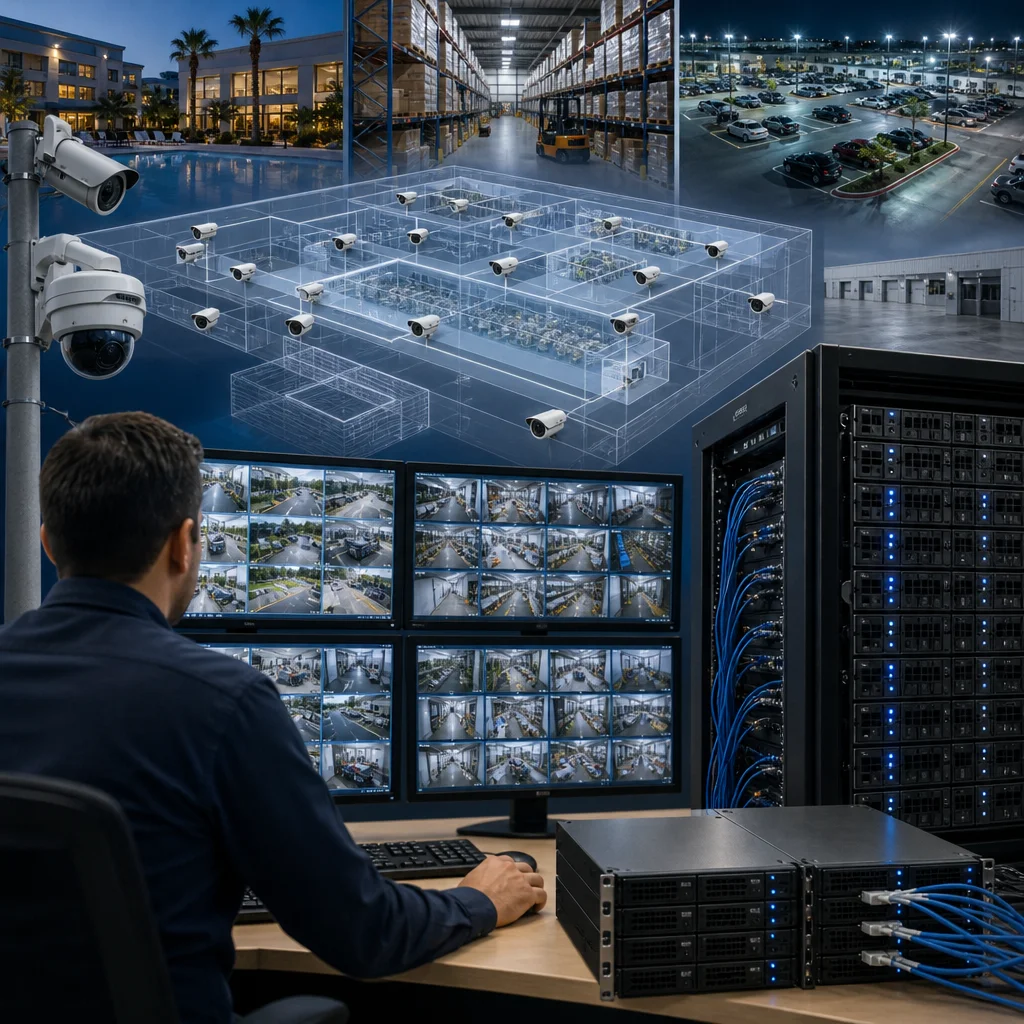
4K security camera systems deliver exceptional clarity, but they demand far more from your network infrastructure than traditional surveillance setups. We see this challenge across San Diego and Southern California’s premier sectors—including Hospitality, Commercial Real Estate, Warehousing & Logistics, Manufacturing, Healthcare, Education, and Retail—constantly. Organizations installing 4K cameras without upgrading their underlying network backbone face video buffering, dropped frames, and system failures that compromise both physical security and operational efficiency.
This guide walks you through the technical and strategic requirements for a 4K-ready network upgrade. We will cover bandwidth calculations, low-voltage cabling planning, and the integrated approach that ensures your security investment performs reliably from day one.
Most existing network infrastructure was designed for standard business computing, email, and basic connectivity. When you add multiple 4K IP security cameras to that same network, you introduce bandwidth demands the original architecture never anticipated.
A single 4K camera recording at 30 frames per second with appropriate compression consumes between 4 to 12 Mbps of bandwidth, depending on codec and quality settings. Multiply that by a 16-camera installation across a facility in Downtown San Diego or an industrial park in Otay Mesa. That is 64 to 192 Mbps dedicated to video alone—before accounting for access control systems, visitor management, or day-to-day business operations.
Your current network backbone likely lacks adequate capacity. Legacy switches, older cabling, and unsegmented traffic create bottlenecks that cascade through the entire system. When the network becomes congested, security camera feeds stall, access control card reader authentication slows down, and your team experiences frustrating delays at entry points.
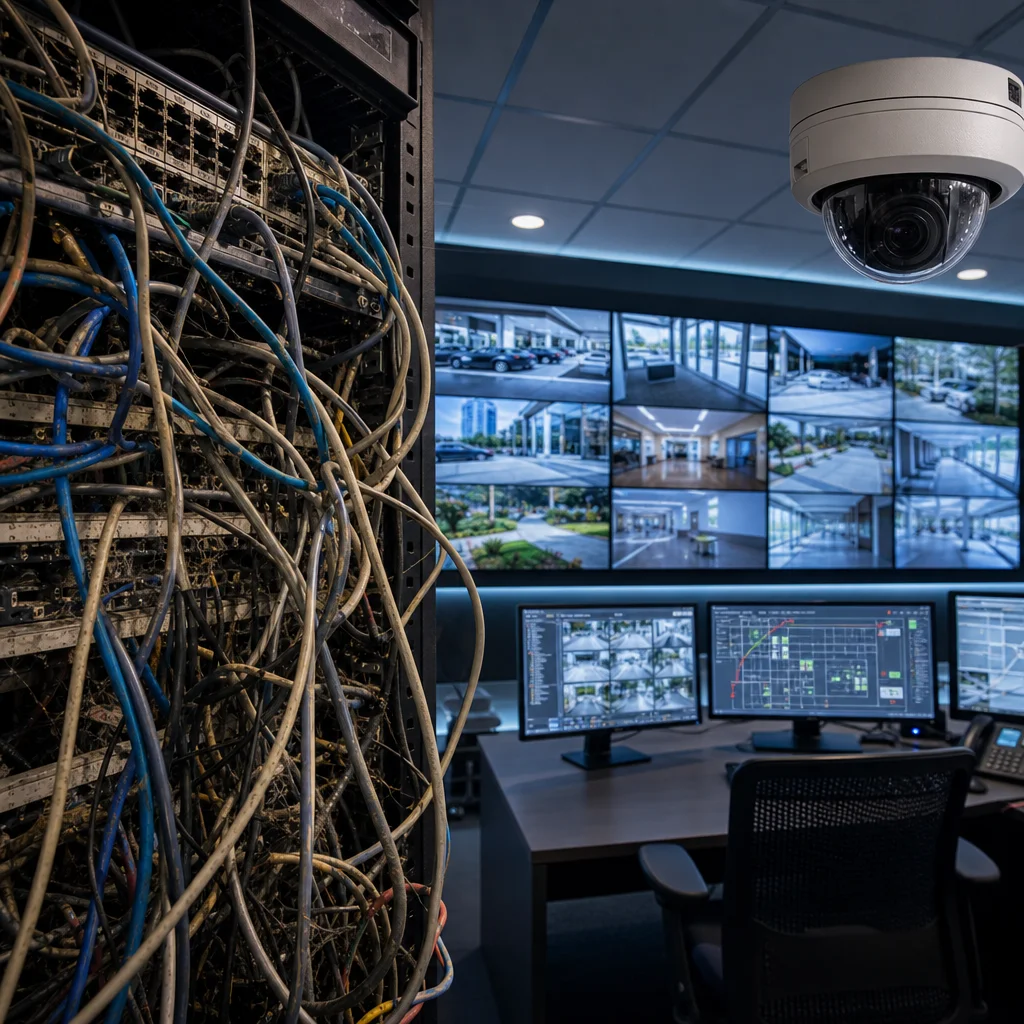
Beyond bandwidth limitations, older cabling infrastructure introduces latency and packet loss. Copper runs installed 10 or 15 years ago may have degraded connectors, improper terminations, or insufficient shielding. These physical layer problems appear as intermittent video drops, authentication delays in door access systems, and inexplicable system timeouts that are expensive to troubleshoot.
The solution requires more than simply adding faster internet service. You need to rebuild the physical foundation that supports high-performance security systems. That foundation starts with proper low-voltage cabling and extends through enterprise network architecture planning.
Understanding Bandwidth Requirements for 4K Camera Systems
Calculating bandwidth for 4K security cameras requires understanding how compression, frame rates, and resolution interact.
A 4K camera (3840 x 2160 resolution) generates roughly four times the raw data volume of a 1080p camera. However, modern codecs like H.265 compress that data significantly. Here is what you should plan for:
- 4K at 30 fps with H.265 compression: 4–8 Mbps
- 4K at 30 fps with H.264 compression: 6–12 Mbps
- 4K at 60 fps with H.265 compression: 8–16 Mbps
- Analytics-enabled 4K streams (with motion detection processing): Add 2–4 Mbps per camera
Higher bitrate settings for mission-critical areas—such as server rooms, cash wraps, or hospital entry points—push these numbers upward.
Beyond individual camera requirements, you must account for redundancy and network overhead. A properly designed system does not operate at 100% capacity constantly. If your peak load is 150 Mbps across all 4K feeds, your network backbone should support at least 300 Mbps to maintain headroom and accommodate packet retransmissions. The standard rule of thumb is oversizing bandwidth capacity by 50% to 100% beyond peak demand.
Storage considerations also affect bandwidth planning. 4K footage at 8 Mbps generates approximately 3.5 GB of data per camera per hour. A 30-day retention policy for 16 cameras requires robust local storage or cloud infrastructure. The bandwidth required to write this data to Network Video Recorders (NVRs) or Video Management Systems (VMS) must not compete with live feed transmission.
For San Diego hotel properties, medical clinics, distribution centers, and manufacturing environments, we recommend segmenting camera systems into separate Virtual Local Area Networks (VLANs). This ensures physical security feeds never compete with Point-of-Sale (POS) networks, internal databases, or guest Wi-Fi connectivity.
++Structured Cabling++ as the Foundation of High-Performance Networks
You cannot achieve reliable 4K video transmission over aging, uncertified cabling infrastructure. The physical layer determines your network’s performance ceiling, and upgrading it is the most critical investment in your security transformation.
We deploy certified ++structured cabling++ systems that exceed current requirements while accommodating future growth. Category 6A (Cat6A) cabling is our standard for new installations supporting 4K camera systems and enterprise networks. Cat6A supports 10 Gbps speeds over 100 meters, providing the headroom necessary for high-definition video, access control controllers, and high-density Wi-Fi access points.
A properly designed low-voltage cabling plant includes:
- Organized Pathway Routing: Routing through conduit, J-hooks, or wire trays that prevent sagging, physical damage, and electromagnetic interference (EMI).
- Centralized Patch Panels: Allowing flexibility in system reconfiguration without disturbing main cable runs.
- Properly Shielded Connections: Eliminating alien crosstalk between copper runs in tight riser conduits.
- Meticulous Labeling & Documentation: Mapping every drop to physical rack locations and floor plans.
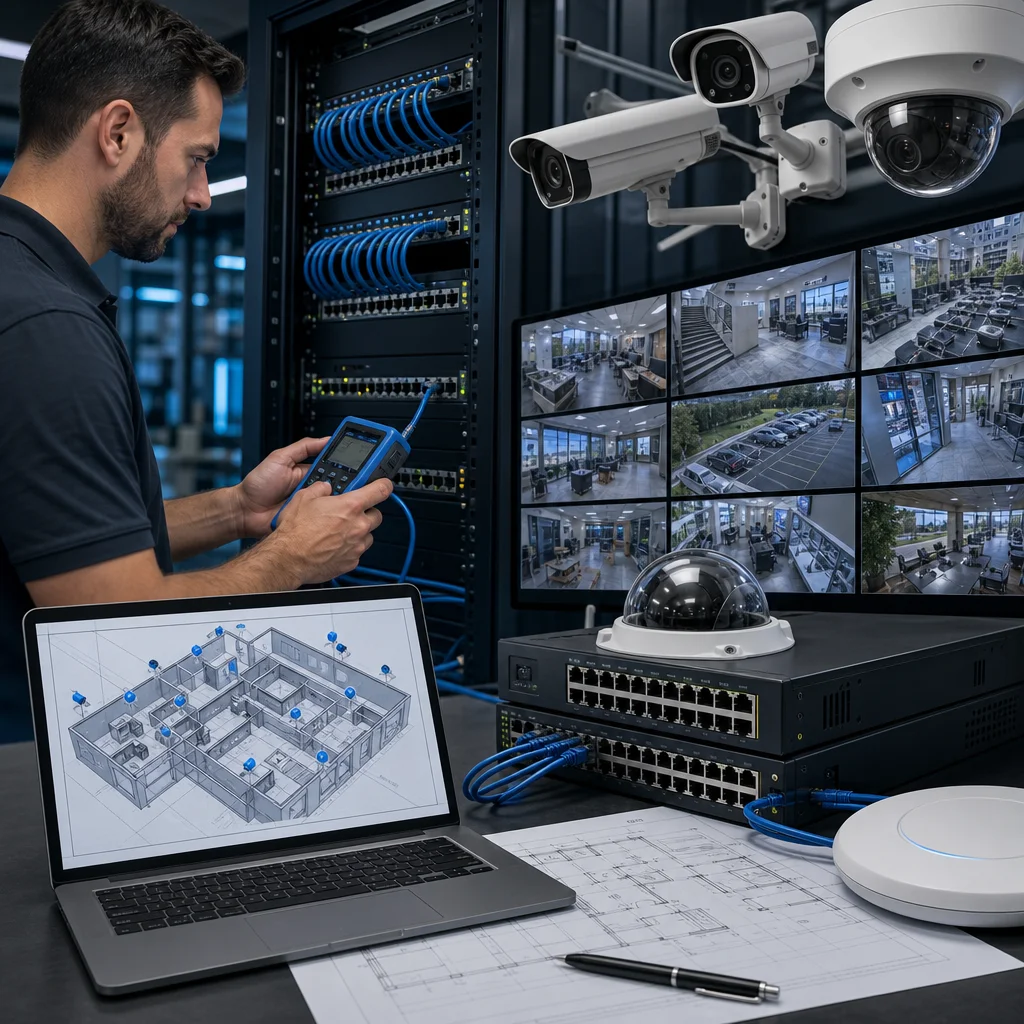
- 100% Certified Testing: Verifying signal integrity and throughput across every connection drop using industry-standard cable analyzers.
In San Diego hospitality environments, structured cabling simplifies expansion when renovating guest wings or adding new outdoor surveillance zones. Manufacturing facilities benefit from organized routing that survives equipment movement and vibration. Commercial real estate property managers operating multiple sites appreciate standardized infrastructure that reduces troubleshooting complexity.
Unlike temporary patch cords or surface-mounted wiring, certified structured cabling systems deliver rock-solid stability for 10 to 15 years without signal degradation.
Preferred Brands & Network Capabilities
To ensure 4K camera streams and real-time door credentials transmit flawlessly across your San Diego facility, we standardize on enterprise-grade hardware platforms:
- Camera Systems & VMS: Avigilon, Axis Communications, Hanwha Vision, Eagle Eye Networks, ACTi, Milestone Systems, Exacqvision, and Salient Systems.
- Access Control Systems: Brivo, Openpath (Motorola Solutions), Kantech, and AMAG Technology.
- Networking & Structured Cabling: Cisco, Cisco Meraki (including high-capacity security appliances like the Meraki MX250 and Meraki MX450 firewalls), Aruba Networks, and Ruckus Wireless (managed via Ruckus SmartZone).
Capabilities Overview
- Structured Cabling: Certified Cat6A & Fiber Optic infrastructure engineered for 10Gbps throughput and high PoE power delivery.
- Camera Systems & VMS: High-definition platforms (Axis, Avigilon, Hanwha) optimized for low latency and analytics processing.
- Access Control: Cloud/Enterprise platforms (Brivo, Openpath, AMAG) unified directly with live VMS video streams.
- Network Hardware: Core enterprise firewalls and switches (Cisco Meraki MX250/MX450, Aruba, Ruckus) configured with isolated security VLANs and QoS traffic prioritization.
Our Integrated Approach to Network Infrastructure Planning
We design network upgrades that treat 4K security cameras, door access control, core IT infrastructure, and facility management as a unified ecosystem, not isolated components.
This integration begins with a comprehensive infrastructure assessment across your San Diego property. We evaluate your current low-voltage cabling, switch backplane capacity, Power-over-Ethernet (PoE) delivery, and topology. We identify bottlenecks, capacity limitations, and single points of failure that could compromise your security posture.
From that assessment, we engineer a network architecture that supports:
- Dedicated Bandwidth Allocation: Guaranteed throughput for 4K video streams without starving business-critical applications.
- Redundant Network Pathways: Ensuring that a single cable cut or switch failure does not disable physical security.
- High-Power PoE Infrastructure: Deploying PoE+ and PoE++ (802.3at/bt) switches to supply high-draw 4K pan-tilt-zoom (PTZ) cameras and door controllers.
- Intelligent Switch Configuration: Minimizing hop latency from cameras to storage servers and central monitoring stations.
For large San Diego facilities, this means implementing a star topology with core switches (Cisco Meraki MX450, Aruba) in a central equipment room, distribution switches on each floor or wing, and edge switches at device termination points. This tiered approach isolates video traffic, prevents congestion, and simplifies maintenance.
We also account for environmental factors: server rooms require climate control and physical security, hotels need discrete cable pathways that preserve aesthetic standards, logistics warehouses in Otay Mesa require cable routing protected from forklift traffic, and industrial plants require shielded cabling against heavy machinery interference.
Optimizing Network Architecture for Multiple 4K Streams
Transmitting multiple 4K streams simultaneously requires deliberate network design that prevents the congestion and latency that degrade system performance.
Network segmentation through VLANs is essential. By separating video traffic from business data, you ensure that a large file backup or guest downloading media does not cause security camera streams to buffer. You also simplify bandwidth management and enable Quality of Service (QoS) prioritization.
We typically configure three core VLANs:
- Video VLAN: Carries all 4K camera feeds, VMS recording data, and video analytics traffic.
- Access Control VLAN: Isolates authentication and credential traffic, guaranteeing immediate door unlocking response.
- Business & Guest VLAN: Handles standard IT operations, internal servers, and guest Wi-Fi without interfering with physical security.
Within the Video VLAN, QoS policies prioritize live streaming and door-event triggers over background recording archives. Switch selection is equally vital: enterprise-grade switches with high backplane switching capacity and large packet buffers easily process the continuous data streams generated by high-resolution cameras.
For multi-building San Diego campuses, dedicated fiber optic backbones eliminate the bandwidth bottlenecks inherent in wireless bridges, ensuring seamless multi-gigabit throughput across geographic distances.
Access Control and Security Integration Without Performance Compromise
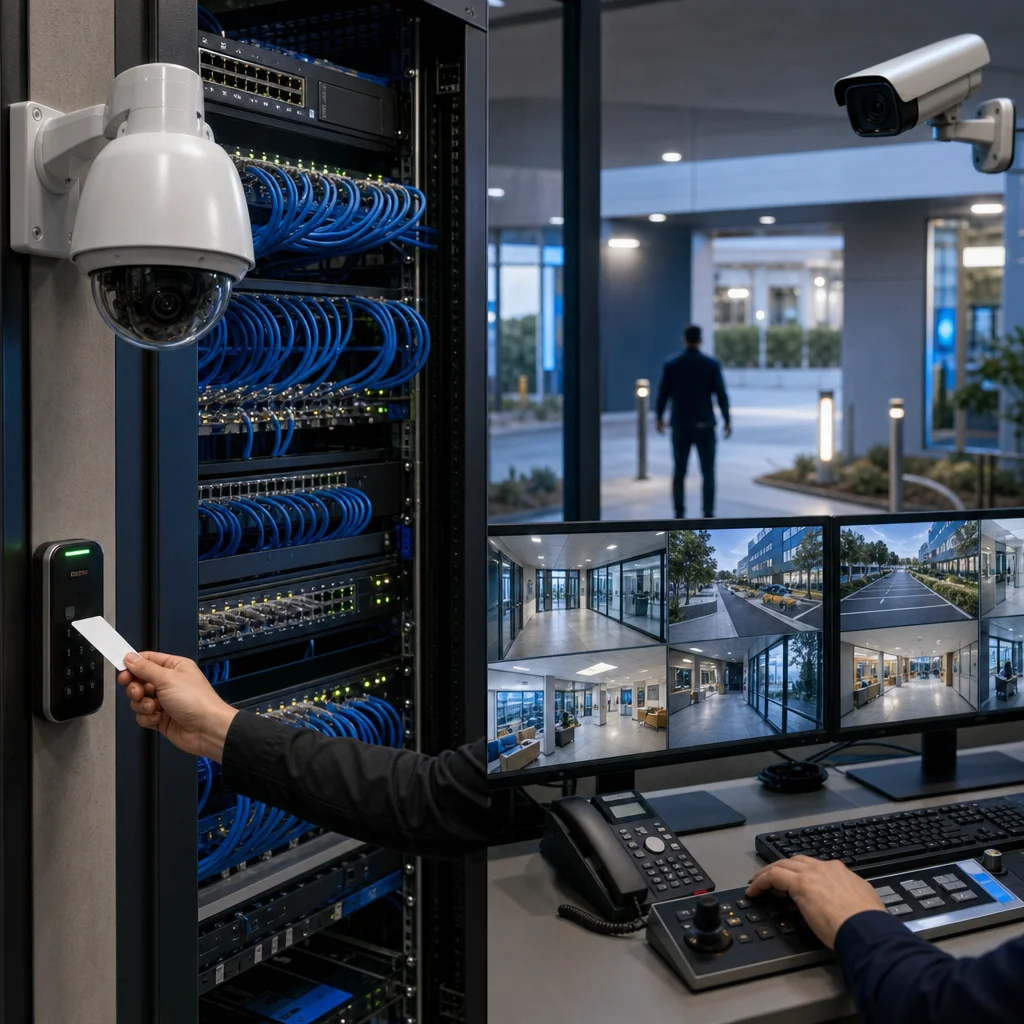
Your security ecosystem includes not only 4K cameras but also ++integrated access control systems++ that authenticate credentials, log entry/exit events, and trigger automated lockdowns. When you consolidate these systems on a shared, enterprise network, powerful integration opportunities emerge.
Access control systems require split-second responsiveness. A reader at a secure entry door must authenticate a credential and unlock within 300 milliseconds. Network latency exceeding 200–300 ms becomes noticeable to users and creates security risks.
Our integrated approach ensures access control never competes for bandwidth with 4K video streams:
- We deploy dedicated PoE power infrastructure that supplies access control door hardware without drawing from camera power budgets.
- We segment access control traffic on its own VLAN with QoS policies prioritizing card swiping above video archiving.
When someone presents a card or mobile credential at an access-controlled door:
- The reader authenticates the credential in milliseconds over the network.
- The door unlocks and logs the entry event.
- The system automatically triggers the nearest Axis, Hanwha, or Avigilon 4K camera to bookmark the video feed at a higher bitrate for 30 seconds.
- The event is linked with video proof in the central VMS (Milestone Systems, Exacqvision, Eagle Eye Networks, or Salient Systems) for audit reviews.
Implementation Timeline and Minimal Disruption Strategy
Upgrading network infrastructure sounds disruptive, but we utilize phased methodologies that complete deployments with minimal impact on your daily operations:
- Phase 1: Planning & Assessment (Weeks 1–3): Conducting detailed low-voltage surveys, mapping cable pathways, and developing the installation roadmap. For hospitality properties, this includes scheduling work during off-peak hours or floor-by-floor phases to preserve guest experiences.
- Phase 2: Infrastructure & Cabling Deployment (Weeks 4–8): Installing Cat6A structured cabling, core switches (Cisco Meraki, Aruba), and PoE infrastructure. Existing legacy security systems remain fully operational in parallel until new cabling is verified.
- Phase 3: Camera & Access Control Rollout (Weeks 9–12): Mounting 4K cameras and deploying smart door access controllers (Brivo, Openpath, AMAG, Kantech). Each drop is tested for bitrate optimization and network integration prior to going live.
- Phase 4: Optimization & Training (Weeks 13–14): Fine-tuning QoS traffic policies, validating automatic failover mechanisms, and delivering hands-on training to your local San Diego staff.
Long-Term Network Scalability and Future-Proofing
A network upgrade should support today’s 4K requirements while anticipating emerging technologies over the next decade.
The certified Cat6A structured cabling infrastructure we deploy supports 10 Gbps speeds, ensuring you won’t need to replace cable runs as network standards advance. At the hardware level, core switches and high-draw PoE++ power budgets support emerging capabilities:
- 8K Security Surveillance: Delivering extreme detail across massive open areas.
- Edge AI & Video Analytics: License plate recognition (LPR), facial analytics, and object tracking processed directly at the camera level.
- Unified Sensor Integration: Correlating door access, video surveillance, environmental sensors, and building management into a single administrative interface.
Complete documentation—including CAD floor plans, rack elevation maps, cable drop labeling, and switch port mapping—is delivered upon project completion so your team maintains full visibility over your technology assets.
The Business Case for Consolidating Your Technology Partners
Managing security cameras from one contractor, access control from another, and low-voltage cabling from a third creates friction and hidden costs.
Consolidating your infrastructure under Terapixels Systems eliminates these inefficiencies:
- Single-Point Accountability: One partner owns your cabling, core switches, camera feeds, and access control hardware. Finger-pointing between vendors is eliminated.
- Reduced Overhead: Streamlined procurement, unified service level agreements (SLAs), and predictable maintenance schedules lower total cost of ownership by 25% to 35%.
- Standardized Deployments: Multi-site organizations across San Diego County benefit from uniform hardware standards, simplified spare parts management, and streamlined staff training.
Getting Started with Your San Diego Network Assessment
The first step is evaluating whether your current network can support 4K security camera demands or if underlying bottlenecks exist.
Terapixels Systems provides comprehensive on-site network assessments evaluating cable infrastructure condition, switch backplane capacity, PoE power budgets, single points of failure, and growth capacity for the next 3 to 5 years. You receive a detailed technical report outlining current utilization, upgrade recommendations, cost estimates, and risk analyses.
Ready to prepare your network for high-definition 4K surveillance and unified physical security? Contact Terapixels Systems today to schedule your San Diego network infrastructure assessment.