CONTACT US
Table of Contents
- The Hidden Costs of Managing Multiple IT and Security Vendors
- Why Mid-Sized San Diego Firms Struggle with Fragmented Technology
- How Unified Infrastructure Simplifies Operations and Reduces Risk
- Our End-to-End Security and IT Integration Approach
- Structured Cabling and Network Infrastructure as Your Foundation
- Access Control and Security Camera Systems Working Together
- Managed IT Services That Protect Your Operations
- Capabilities & System Integration Snapshot
- The Business Case for Consolidating to One Trusted Partner
- Implementation Timeline and Minimal Disruption to Your Team
- Measuring ROI from Integrated Technology Solutions
- Getting Started with Your Technology Consolidation
The Hidden Costs of Managing Multiple IT and Security Vendors
Running a mid-sized business means juggling dozens of technology decisions. Your low-voltage network infrastructure needs attention. Security cameras require monitoring and maintenance. Access control systems demand updates. Your servers need managed oversight. Most leaders cobble together solutions from different vendors, each with their own support line, billing cycle, and compatibility quirks. But what if there’s a better path?
We work with Hospitality, Commercial Real Estate, Warehousing & Logistics, Manufacturing, Healthcare, Education, and Retail firms across San Diego and Southern California who have felt the friction of fragmented systems. When you operate facilities with multiple locations—from downtown hotel properties to industrial hubs in Otay Mesa—having one unified partner transforms not just your operations, but your bottom line.
When you spread your technology needs across four or five different contractors, the actual expense goes far beyond the monthly contract fees you see on paper.
The Hidden Financial Drain
- Administrative Overhead: Your internal team spends hours coordinating between vendors when problems arise. A camera drop could involve the camera contractor, the IT provider managing your switches, and the access control vendor who integrates with the door locks. Each points fingers at the others while days pass waiting for a resolution.
- Support Ticket Fragmentation: Vendor A blames Vendor B’s system. Vendor B claims it’s a network configuration issue. You are forced to manage multiple help desk queues, separate ticketing portals, and conflicting SLAs. When a door reader fails or a camera stream drops late at night, you are calling three emergency numbers instead of one.
- Incompatibility & Rework Costs: Thousands of dollars get wasted retrofitting legacy hardware because IP cameras from one vendor don’t communicate cleanly with door access controllers from another. Your low-voltage cabling might not be certified or optimized for the specific bandwidth requirements of 4K security video feeds.
- Compromised Physical Security: When systems don’t integrate cleanly, critical blind spots open up. An unauthorized person can tailgate through a door that your security cameras can’t properly monitor, or network gaps emerge because your cabling contractor and IT provider weren’t aligned.
What to do next: Audit your current vendor list and calculate the total cost of ownership including internal staff time spent on vendor coordination, not just contract amounts.
Why Mid-Sized San Diego Firms Struggle with Fragmented Technology
A mid-sized firm in San Diego often operates in an uncomfortable middle ground: you are too large to run everything informally, but you might not have a dedicated Chief Information Security Officer (CISO) or a sprawling internal IT department. You likely inherited legacy low-voltage cabling and added new cameras or badge readers as your business expanded.
This situation creates decision-making fatigue. When you need to fix a network issue, you can’t just call one person who owns the whole picture. You have to mentally context-switch between multiple vendor relationships, technical environments, and communication styles. Your IT lead spends more time managing contractors than driving your actual technology strategy.
Budgeting becomes unnecessarily complicated. Some contractors bill annually, others monthly. Equipment refresh cycles don’t align. One camera system might need replacement in 18 months while your access control software has a 5-year lifecycle. You can’t plan capital expenditures coherently because you are reactively managing piecemeal upgrades.
Staff training also suffers when systems don’t share common interfaces. Your facilities team learns one platform’s approach to badge management, then has to learn an entirely different philosophy for your camera system. When a new employee joins, onboarding takes longer because nothing feels connected.
What to do next: List out every vendor your organization currently uses for low-voltage cabling, security cameras, access control, network hardware, or IT infrastructure in San Diego. Count the touchpoints and identify which ones cause the most friction.
How Unified Infrastructure Simplifies Operations and Reduces Risk
A unified IT and physical security infrastructure functions like an integrated nervous system for your facility. Instead of isolated components sending signals in different directions, everything feeds into a single coordinated whole.
Core Benefits of Operational Unity
- Single Point of Contact: When an access control reader flags an anomaly at a warehouse loading dock, that alert goes directly to your trusted local San Diego partner. They can pull network logs, live Axis or Hanwha camera feeds, and card reader data instantly.
- Reduced Physical Vulnerabilities: Complete visibility across how your low-voltage cabling supports your security hardware ensures that bandwidth allocation, Power-over-Ethernet (PoE) delivery, and data redundancy meet strict operational requirements.
- Predictable Scalability: As you open new sites in Mission Valley, Sorrento Valley, or Carlsbad, a single partner handles the expansion seamlessly. Certified Cat6A cabling integrates with existing switches, new Brivo or Openpath access zones sync with central software, and new cameras connect without bandwidth bottlenecks.
- Resilient Business Continuity: Backup power systems, redundant network paths, and automatic failover procedures ensure that if a main power line drops, door locks remain functional and camera recording continues locally.
What to do next: Identify three specific operational or security problems your facility faced in the last year that arose from vendor coordination or system integration issues.

Our End-to-End Security and IT Integration Approach
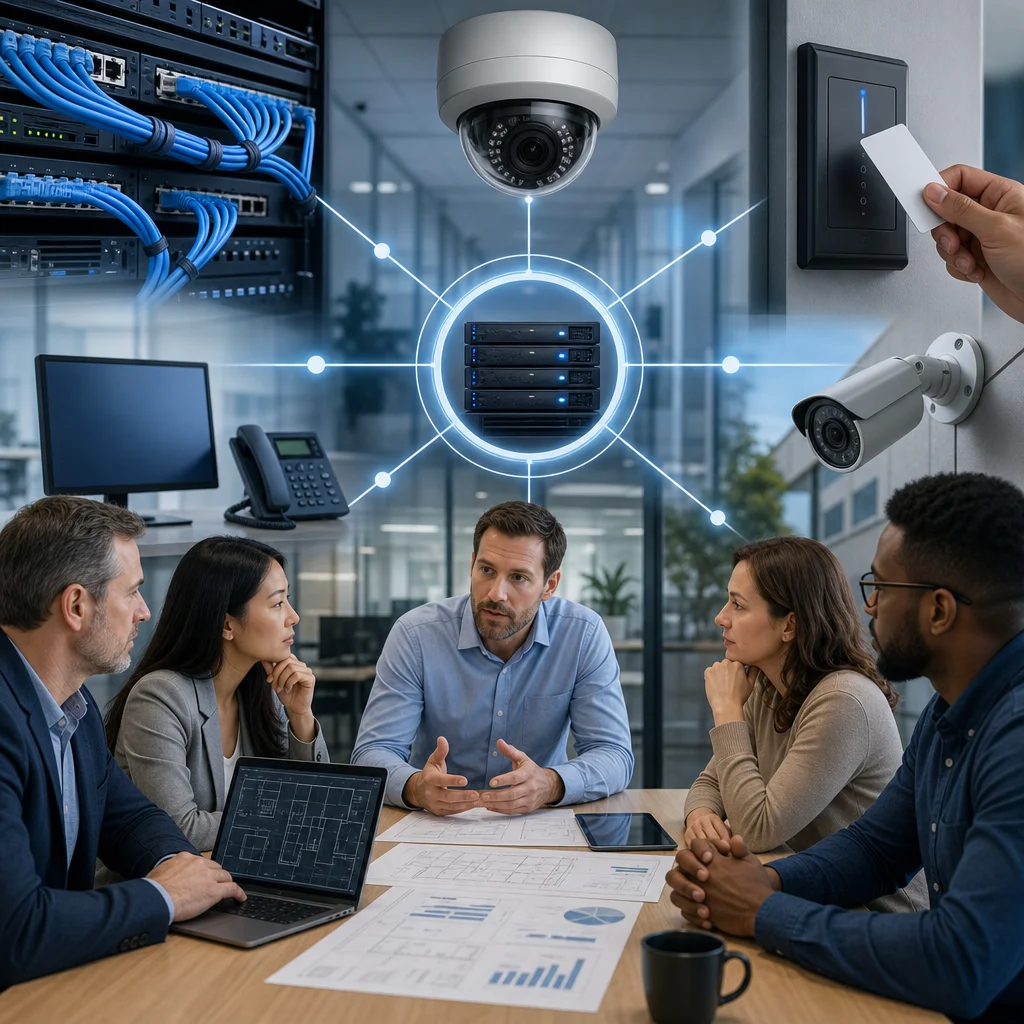
At Terapixels Systems, we build our practice around the specific needs of mid-sized and enterprise organizations operating physical facilities in San Diego and across Southern California. We don’t view low-voltage cabling, core networks, and physical security as separate domains that happen to exist in the same building—we design them as one integrated ecosystem.
Our approach starts with a thorough assessment of your current physical setup, your growth trajectory, and your specific industry requirements. Whether you operate a hotel in Downtown San Diego, a biotech facility in Torrey Pines, a logistics warehouse in Otay Mesa, or a commercial real estate portfolio, we tailor solutions to your specific operational realities.
Core Preferred Technology Brands
We partner with top-tier brands across all three foundational disciplines:
- Camera Systems & VMS: Avigilon, Axis Communications, Hanwha Vision, Eagle Eye Networks, ACTi, Milestone Systems, Exacqvision, and Salient Systems.
- Access Control Systems: Brivo, Openpath (Motorola Solutions), Kantech, and AMAG Technology.
- Networking & Structured Cabling: Cisco, Cisco Meraki (including core enterprise appliances like the Meraki MX250 and Meraki MX450 firewalls), Aruba Networks, and Ruckus Wireless (managed via Ruckus SmartZone).
We handle everything from initial structured cabling through security camera installation, ++integrated access control systems++, and ongoing managed IT support. This comprehensive scope means we are fully accountable for your entire ecosystem’s performance.
Our ++integrated security products and services++ are selected and configured to work together from day one, rather than being retrofitted to talk to legacy systems.
What to do next: Schedule a consultation to discuss your current San Diego environment and explore which integrated solutions will eliminate your biggest operational friction points.
Structured Cabling and Network Infrastructure as Your Foundation
Everything else depends on a strong physical cabling foundation. Many mid-sized firms don’t realize how many of their camera latency issues or access control drops trace directly back to suboptimal low-voltage cabling and network design.
Structured cabling isn’t just about running copper wires neatly through ceiling trays—it’s about building a physical layer that handles current bandwidth demands while anticipating future expansion. We deploy certified Cat6A and Fiber Opticcable plants engineered with capacity and redundancy built in. When you add a new 4K IP camera, a mobile badge reader, or a high-density Wi-Fi access point, it connects to an infrastructure already built to support it.
Strategic Cabling Design Ensures:
- Uncompromised Video Streams: High-definition cameras from Avigilon, Axis, or Hanwha stream feeds without causing network bottlenecks or buffering.
- Low-Latency Access Validation: Door controllers respond with millisecond accuracy during peak shift changes.
- Physical & Logical Separation: Data traffic is isolated via secure VLANs on enterprise switches (Cisco, Aruba, Ruckus), keeping physical security data separate from staff or guest Wi-Fi.
What to do next: Request a professional assessment of your current low-voltage cabling plant to identify capacity bottlenecks or uncertified drops that could compromise your security hardware.
Access Control and Security Camera Systems Working Together
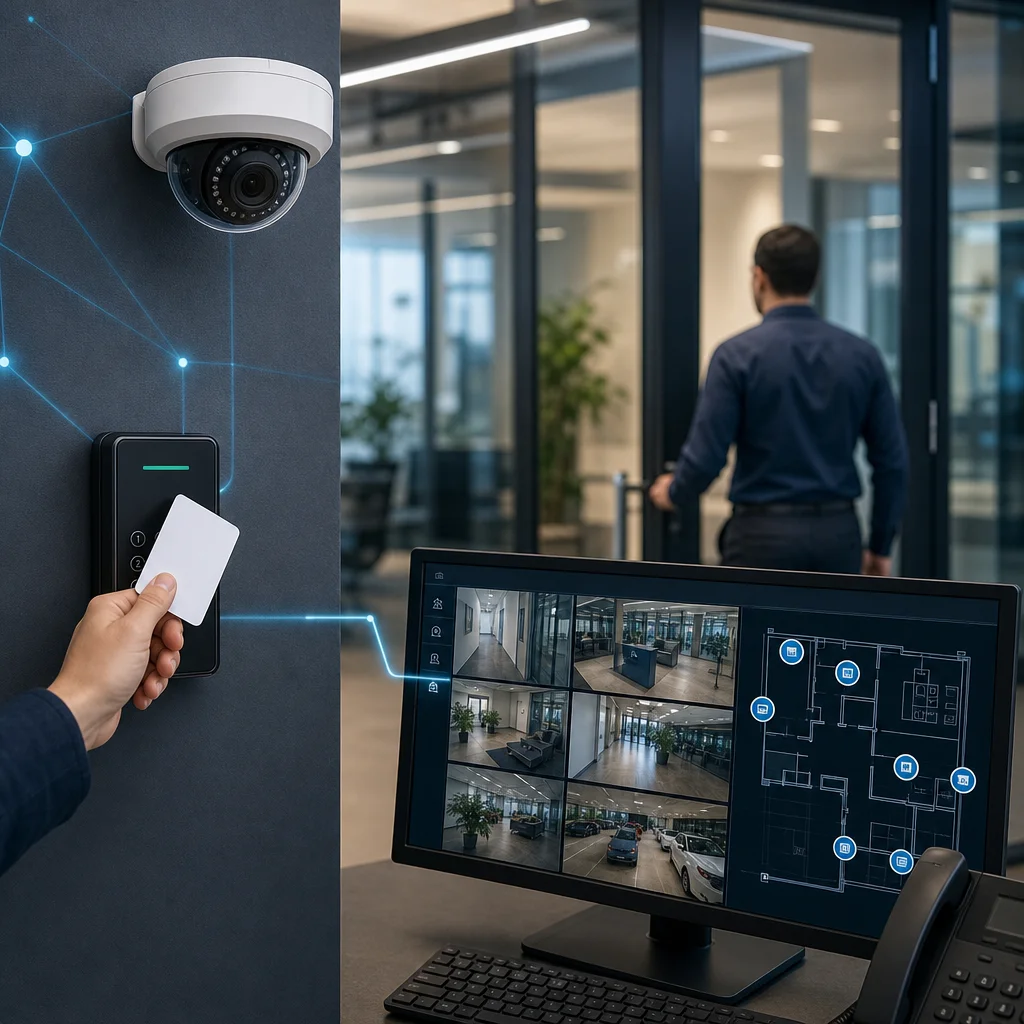
Separate access control and camera systems create documentation gaps. An employee swipes a badge to enter a restricted warehouse or server room, but the camera covering that entrance operates on a separate network with independent timestamps and retention schedules. If an incident occurs, reconstructing the event requires manual detective work across separate apps.
When access control and camera systems are truly integrated using unified platforms like Milestone Systems, Exacqvision, Eagle Eye Networks, Brivo, or Openpath, they create a seamless security workflow:
+———————————————————————————–+
| UNIFIED SECURITY WORKFLOW |
| |
| 1. Unauthorized Door Access Attempt —> (Brivo / Openpath / AMAG Reader) |
| 2. Real-Time VMS Exception Alert —> (Milestone / Avigilon / Eagle Eye) |
| 3. Live Video Pop-Up & Record —> (Axis / Hanwha HD Camera) |
| 4. Bookmarked Audit Trail Created —> (Unified Security Dashboard) |
+———————————————————————————–+
Real-time integration gives your security or facility team instant context. If an unauthorized badge attempt or forced-door event is detected in an Otay Mesa logistics bay, the nearest pan-tilt-zoom camera automatically swings to focus on that door, popping up a live video feed on your central dashboard.
What to do next: Document any recent security incidents or policy violations that would have been resolved faster with integrated access control and live camera visibility.
Managed IT Services That Protect Your Operations
Managed IT services are often treated as a separate administrative expense, but they are actually inseparable from your physical security infrastructure. Your network security, physical access logs, and video recording retention all rely on robust managed network management.
We provide 24/7 proactive monitoring across your entire San Diego infrastructure. We monitor the enterprise switches (Cisco Meraki MX250/MX450, Aruba) that power your cameras, apply security patches to video servers, and track storage health on your Network Video Recorders (NVRs). If a PoE switch port loses power or a drive fails in a camera storage array, our team catches it and initiates diagnosis before you even notice a gap in coverage.
For mid-sized firms in San Diego, this delivers enterprise-grade infrastructure management without the massive cost of hiring a full internal engineering department.
What to do next: Review your current IT support arrangements and identify any gaps where you lack 24/7 monitoring, automated backup verification, or rapid hardware replacement SLAs.
Capabilities & System Integration Snapshot
- Structured Cabling: Certified Cat6A & Fiber Optic infrastructure designed for multi-gigabit throughput and high PoE power delivery.
- Camera Systems & VMS: Enterprise platforms (Axis, Avigilon, Hanwha, Milestone, Eagle Eye, Exacqvision) configured with automated failover and 24-hour hardware swap SLAs.
- Access Control Hardware: Cloud and enterprise door access (Brivo, Openpath, Kantech, AMAG) unified directly with live video pop-ups.
- Core Network Appliances: Enterprise firewalls and switches (Cisco Meraki MX250/MX450, Aruba, Ruckus SmartZone) built with isolated security VLANs and QoS priority.
The Business Case for Consolidating to One Trusted Partner
From a purely financial perspective, consolidating your low-voltage cabling, IT network, security cameras, and access control under Terapixels Systems typically reduces total operational overhead by 25% to 40%.
Concrete ROI Drivers
- Recovered Staff Productivity: Your internal team stops playing phone tag between uncoordinated contractors. For a mid-sized business, this frees up hundreds of hours of productive management time annually.
- Simplified Compliance Audits: Whether meeting healthcare standards, corporate security policies, or insurance mandates, having a single, unified audit trail across physical access logs and video archives streamlines compliance verification.
- Coordinated Capital Upgrades: Instead of managing piecemeal, overlapping replacement schedules, we help you plan structured equipment refreshes where cabling, network appliances, and camera hardware upgrade logically together.
- Reduced Downtime Costs: When a hardware fault occurs, downtime is measured in minutes or hours rather than days, protecting your operational throughput and revenue.
What to do next: Calculate your organization’s hourly cost of downtime—including lost production, delayed shipments, or missed revenue—to understand the real value of consolidated, reliable infrastructure.
Implementation Timeline and Minimal Disruption to Your Team
Consolidating your infrastructure does not require a disruptive “rip-and-replace” process that shuts down your business. We phase deployments over structured timelines to ensure continuous operational uptime.
- Assessment & Discovery (Weeks 1–4): Auditing existing cable drops, evaluating camera coverage gaps, inspecting access control hardware, and identifying legacy equipment that can be integrated or repurposed.
- Pathway & Network Preparation (Weeks 5–12): Pulling certified Cat6A cabling, mounting enterprise switches (Cisco Meraki, Aruba), and setting up dedicated security VLANs behind the scenes.
- Phased Hardware Rollout (Weeks 13–24): Installing Axis or Hanwha cameras, mounting Brivo or Openpathdoor controllers, and migrating doors section-by-section so entryways remain secure throughout.
- Integration, Testing & Training (Weeks 25–28): Testing cable performance, verifying camera triggers in the VMS dashboard, calibrating access control rules, and delivering hands-on staff training.
Throughout the deployment, your business operations in San Diego continue uninterrupted. Your doors stay secure, your network stays online, and your staff transitions smoothly into a unified platform.
Measuring ROI from Integrated Technology Solutions
The ROI from consolidating to a unified IT and security vendor manifests in several ways, some obvious and others subtle but measurable.
Direct cost savings are easiest to quantify. You reduce redundant support contracts, eliminate overlapping services, and gain better pricing by consolidating volume. Most mid-sized firms see annual savings of 15-30% on their total IT and security spending after consolidation. For a firm spending $150,000 annually across multiple vendors, that’s $22,500-45,000 in direct savings.
Operational efficiency gains are substantial. Your IT team’s time becomes more productive. Security incidents resolve faster. System deployments and upgrades happen more smoothly. If consolidation frees up one full-time employee’s worth of IT management time, and that person’s fully-loaded cost is $100,000 annually, that’s another $100,000 in recovered productivity.
Reduced downtime and improved reliability translate directly to business continuity value. For a manufacturing facility, one hour of downtime might cost $10,000 in lost production. For a hotel, it might mean customer complaints and lost revenue. If integrated infrastructure reduces your annual downtime by just 20 hours, that’s easily $200,000 in avoided losses.
Security improvement is harder to quantify but critically important. Better integrated security systems catch incidents faster, reducing the severity of security breaches. Improved compliance posture might mean avoiding regulatory fines. Audit efficiency improvements might save 100 hours of administrative work annually. These add up to substantial value.
Risk reduction is the final ROI component. By eliminating single points of failure, you reduce the probability of catastrophic incidents. By improving visibility and audit trails, you reduce investigation time when issues do occur. By having a unified partner accountable for your entire infrastructure, you shift vendor risk management from your shoulders to your partner’s.
What to do next: Build a detailed ROI model for your organization that includes direct savings, productivity recovery, downtime reduction, and risk mitigation.
Getting Started with Your Technology Consolidation
If the business case for a unified low-voltage cabling, physical security, and IT infrastructure aligns with your goals, taking the next step is straightforward.
Contact Terapixels Systems to schedule a comprehensive assessment of your San Diego facility. We will evaluate your current infrastructure, pinpoint integration friction points, identify cost-saving opportunities, and deliver a clear, phased roadmap designed specifically for your organization.
Ready to eliminate vendor friction and protect your facility with a single accountable partner? Contact Terapixels Systems today to get started.