CONTACT US
Table of Contents
- The Critical Challenge of Healthcare Video Evidence Management
- Why Healthcare Facilities Struggle With Video Retention Compliance
- How Cloud-Based NVR Systems Impact Hospital Operations
- The Case for On-Premises NVR Infrastructure in Medical Environments
- Integration With Your Existing Security and Access Control Systems
- Designing a Retention Strategy That Meets Regulatory Requirements
- Our Integrated Approach to Hospital Video Evidence Solutions
- Implementation Timeline and Operational Benefits
- Security Considerations Across Both Deployment Models
- Cost Analysis: Long-Term Value of Strategic NVR Placement
- Compliance Documentation and Evidence Chain of Custody
- Selecting the Right NVR Strategy for Your Healthcare Facility
- Frequently Asked Questions (FAQ)
The Critical Challenge of Healthcare Video Evidence Management
Hospital administrators face a unique intersection of operational demands and regulatory scrutiny when managing video evidence systems. Patient privacy, incident investigation, staff safety, and liability protection all depend on how you retain and access surveillance footage. Unlike retail or hospitality environments, healthcare facilities must balance 24/7 operational visibility with strict HIPAA requirements and state-mandated retention periods.
We work with mid-sized hospital systems across Southern California that routinely confront questions their existing vendors can’t answer clearly. How long must you retain footage of emergency departments? What happens when a medication error or patient fall requires investigation weeks later? Can your current system guarantee evidence integrity for legal proceedings? These questions demand more than off-the-shelf solutions.
The stakes are measurably higher in healthcare. A single unsecured footage file or incomplete retention chain can undermine incident investigation, complicate malpractice defense, or trigger regulatory penalties. Your NVR strategy isn’t just a technical choice; it’s a critical operational safeguard.
Action step: Audit your current retention timeline against your facility’s actual investigation windows. Most hospitals discover they’re deleting evidence before incidents surface.
Why Healthcare Facilities Struggle With Video Retention Compliance
Healthcare organizations typically face three competing pressures that create retention challenges. First, regulatory bodies (including CMS, state health departments, and accreditation agencies) don’t specify uniform retention periods, leaving facilities to interpret requirements across multiple jurisdictions. Second, storage capacity constraints force difficult trade-offs between longer retention windows and system responsiveness. Third, staff transitions and documentation gaps mean nobody clearly owns the retention policy or can defend it during audits.
We’ve observed that most facility compliance gaps stem from policy ambiguity rather than technical failure. A hospital might retain 30 days of footage by default because that’s what their legacy system recommended ten years ago, not because it matches their actual operational needs. When an incident occurs outside that window, footage is gone.
Common compliance missteps include:
- Inconsistent retention across different camera zones (ED footage vs. administrative areas)
- Missing documentation of retention rationale or deletion procedures
- Lack of evidence chain-of-custody protocols when footage is exported
- No periodic review of retention rules as regulations evolve
The cost of non-compliance extends beyond fines. Unrecoverable footage weakens incident response, invites litigation exposure, and damages institutional trust with both patients and regulators.
Action step: Document your current retention policy in writing, including the specific regulation it satisfies. If you can’t cite the source, it’s time to revise.
How Cloud-Based NVR Systems Impact Hospital Operations
Cloud-based NVR platforms offer compelling advantages for distributed hospital networks and mixed-use campuses. Footage streams to secure data centers, eliminating on-site storage constraints and providing automatic redundancy across geographic regions. Staff access footage remotely via authenticated portals, which accelerates investigation workflows and supports multi-facility healthcare systems.
However, cloud systems introduce operational dependencies that healthcare facilities must manage carefully. Internet connectivity becomes critical infrastructure. If your facility loses WAN connectivity, local recording capability matters immensely. We’ve supported hospitals where a circuit failure would have meant losing real-time investigative access for hours, creating operational blind spots during high-acuity events.
Cloud NVR benefits for hospitals:
- Scalable storage without physical infrastructure expansion
- Automatic backup and disaster recovery across data centers
- Role-based access controls aligned with HIPAA staff segregation
- Simplified multi-facility management through unified dashboards
The trade-offs require realistic planning:
- Ongoing subscription costs grow with recording volume and retention duration
- Internet bandwidth must accommodate peak recording loads
- Regulatory approval processes may add implementation timelines
- Data residency requirements may limit cloud provider options
Most healthcare organizations we partner with use hybrid approaches, maintaining local NVR infrastructure as primary recording while cloud systems provide redundancy and long-term archival. This strategy eliminates hard choices about storage limits while protecting against single points of failure.
Action step: Map your facility’s internet capacity to peak simultaneous HD camera streams. If you’re above 60% utilization, hybrid or on-premises architectures become more practical.
The Case for On-Premises NVR Infrastructure in Medical Environments
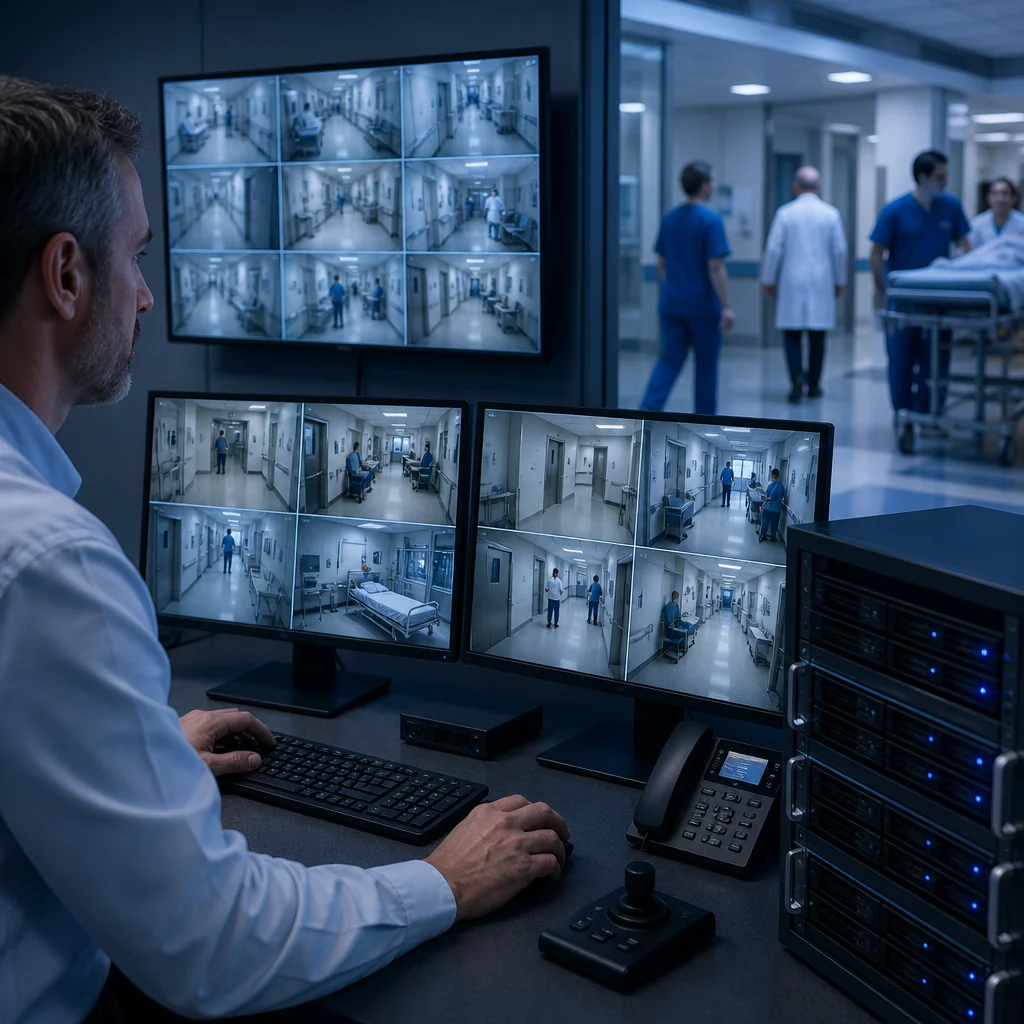
On-premises NVR systems provide the operational control that healthcare administrators increasingly prioritize. Local storage means footage remains immediately accessible regardless of internet conditions, critical during incidents when investigative urgency is highest. You maintain direct custody of evidence, simplifying chain-of-custody documentation and regulatory compliance.
For hospital facilities in Southern California managing mixed clinical, administrative, and visitor areas, on-premises infrastructure integrates seamlessly with access control and alarm systems. When a security event occurs, your staff can instantly correlate video with badge swipes, door activity logs, and emergency alerts from a single facility server. That integration speed matters when seconds determine investigative clarity.
Hospital-specific advantages of on-premises NVR:
- Autonomous operation during network outages or provider disruptions
- Direct control over retention deletion procedures and forensic preservation
- Streamlined integration with existing badge readers, intercoms, and fire systems
- Simplified compliance audits through locally maintained evidence logs
On-premises requirements hospitals must address:
- Physical infrastructure investment and ongoing hardware maintenance
- In-house IT expertise or vendor support contracts for troubleshooting
- Facility space, power, and cooling for server equipment
- Manual failover processes if primary systems fail
Modern on-premises systems address many legacy pain points. Redundant storage, automated backup to external drives, and cloud sync capabilities provide protection without compromising operational independence.
Action step: Evaluate whether your current IT team can support NVR hardware maintenance, or whether managed service agreements better suit your staffing model.
Integration With Your Existing Security and Access Control Systems
Your NVR strategy only delivers full value when video systems speak to access control, alarm systems, and emergency management platforms. When a patient safety event occurs, correlating video footage with badge access logs and door sensor data dramatically accelerates investigation and identifies contributing factors.
We design video surveillance integration that treats NVR systems as central nodes in your security architecture rather than isolated recording solutions. This means when your access control system logs a credential used after-hours in a restricted medication area, your NVR system can instantly tag and flag that time window for investigative review.
Integration touchpoints for hospital facilities:
- Badge reader data synchronized with video timestamps for staff accountability
- Door sensor integration triggering immediate video recording during unauthorized entries
- Panic button activation automatically saving preceding and following video segments
- Intercom systems correlating audio and video for complete incident documentation
Integration benefits transcend security. During patient falls or medication incidents, correlated video and access logs provide institutional documentation that protects staff and facility from unfounded liability claims.
Action step: Map your current access control and alarm systems, then identify the top three incident scenarios where video and access data correlation would matter most for investigation.
Designing a Retention Strategy That Meets Regulatory Requirements
Effective retention strategy starts with clarity about your actual investigation timelines, not regulatory minimums. State health departments typically require 30-90 days of retention, but real-world investigations often need footage from weeks prior to incident discovery. A medication error discovered during peer review might require footage from 45 days earlier to understand workflow breakdowns.
We recommend structuring retention in tiers. Critical areas like emergency departments, medication dispensaries, and operating rooms warrant extended retention (90-180 days). Administrative areas and hallways can operate on shorter cycles (30-45 days). Specialty footage like emergency response situations should be manually preserved outside automated deletion schedules.
Retention design framework:
- Map camera locations by risk category (high-acuity clinical vs. administrative access)
- Define retention windows for each category based on historical investigation patterns
- Establish manual preservation procedures for incidents or litigation holds
- Document the rationale for each retention tier with regulatory citations
Implementation details matter for compliance defensibility. Your retention policy document should specify deletion procedures, preservation exceptions, and how staff requests extend footage hold periods. When regulators audit compliance, written policy with documented adherence provides institutional protection.
Action step: Calculate your facility’s average investigation timeline by reviewing the last 12 incident reports. That number should drive your minimum retention window.
Our Integrated Approach to Hospital Video Evidence Solutions
We provide end-to-end healthcare video management solutions combining structured cabling infrastructure, HD security camera installation, and managed IT services to ensure your evidence systems remain operationally reliable. Rather than positioning you to choose between cloud and on-premises options, we architect hybrid strategies that leverage both for maximum resilience.
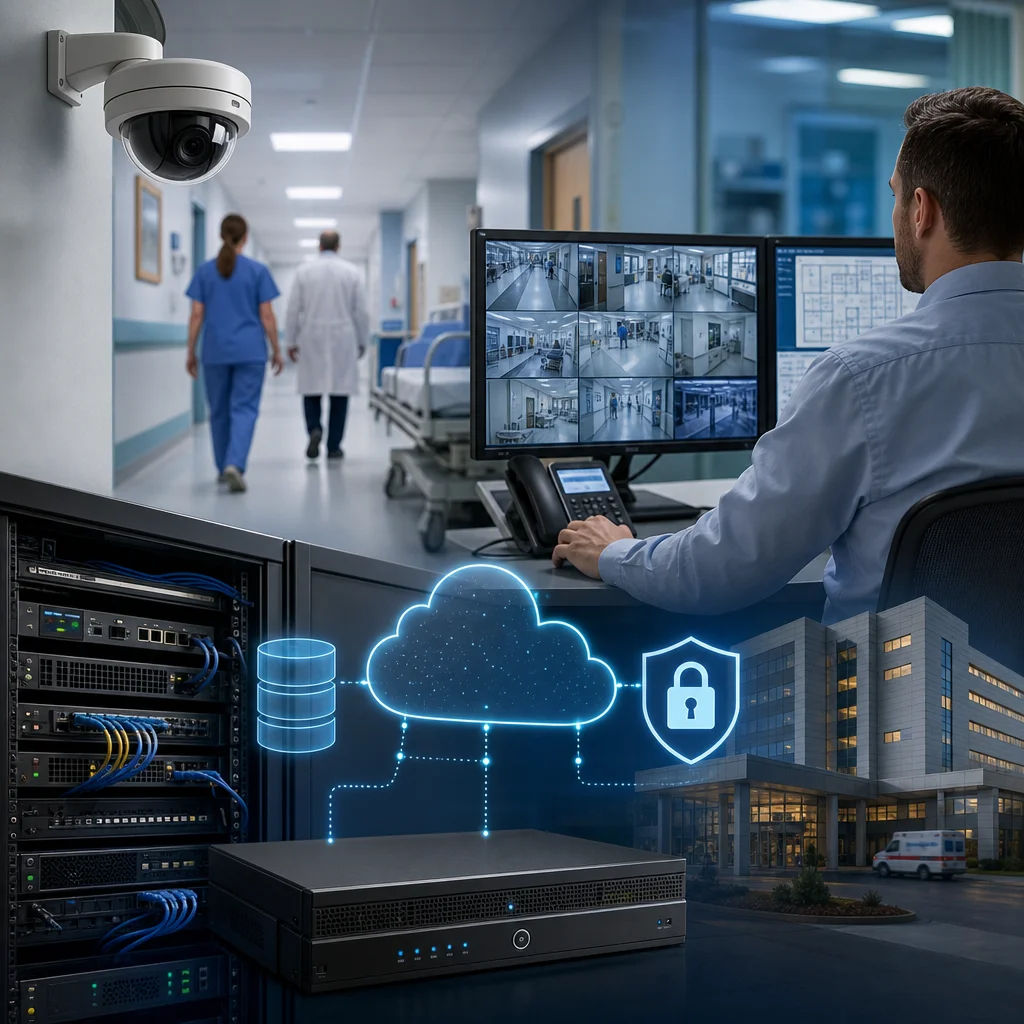
Our approach begins with facility assessment. We analyze your current camera coverage, bandwidth capacity, and access control integration points. From that baseline, we design systems that prioritize evidence integrity, compliance documentation, and investigative workflow efficiency. We handle structured cabling installation to ensure your surveillance infrastructure operates independently from clinical IT systems, protecting both from unnecessary interdependencies.
For hospitals managing multiple campuses or distributed facilities, we implement redundant systems where local NVR maintains immediate investigative access while cloud archives provide geographic backup and long-term retention. This architecture eliminates forced trade-offs between operational control and disaster recovery capabilities.
Our clients work with us as extensions of their security leadership, not just equipment vendors. We provide quarterly compliance reviews, retention policy updates as regulations evolve, and staff training on proper evidence handling and documentation procedures.
Action step: Schedule a facility assessment with our team to identify integration gaps between your current video, access control, and alarm systems.
Implementation Timeline and Operational Benefits
Healthcare infrastructure projects require careful scheduling to avoid operational disruption. We typically design hospital implementations across 8-12 weeks, coordinating camera installation with facility scheduling to minimize patient impact and staff workflow interruption.
Early phases focus on assessment and design validation. We work with your security team, IT department, and clinical leadership to ensure the system aligns with operational realities. Installation follows in phases by facility zone, allowing departments to maintain normal operations while upgrades proceed.
Implementation sequence for typical hospital facilities:
- Weeks 1-3: Site survey, capacity planning, compliance policy review
- Weeks 4-6: Structured cabling infrastructure and equipment procurement
- Weeks 7-10: Camera installation and system configuration by facility zones
- Weeks 11-12: Access control integration, staff training, compliance documentation
Operational benefits materialize immediately. Investigation response times typically improve 40-60% when investigators can access correlated video and access logs from unified dashboards. Staff accountability improves when footage availability creates documented evidence trails for incidents. Risk management gains measurably when video evidence supports institutional compliance defense during regulatory reviews.
Action step: Identify your facility’s lowest-impact installation window. Even phased implementations work better when scheduled strategically.
Security Considerations Across Both Deployment Models
Whether you choose cloud, on-premises, or hybrid architectures, security fundamentals remain identical. Footage must remain confidential, its integrity verified, and its availability guaranteed despite equipment failures or attack scenarios.
On-premises systems require vigilant access controls. Your NVR servers must live on segregated networks separate from clinical systems, preventing malware or system failures from cascading across infrastructure. Redundant storage and encrypted backups protect against ransomware attacks that increasingly target healthcare facilities.
Cloud systems introduce different risk profiles. Your data becomes dependent on provider security practices, contractual safeguards, and data residency controls. We ensure cloud-based surveillance systems you select offer HIPAA Business Associate Agreements, encryption in transit and at rest, and audit trails documenting access to protected health information.
Security requirements regardless of deployment:
- Multi-factor authentication for all investigator and administrator access
- Role-based access controls limiting footage visibility to authorized staff
- Encrypted evidence export with digital signatures for chain-of-custody verification
- Regular security audits documenting access patterns and retention compliance
Healthcare-specific threats demand continuous vigilance. Insider threats pose particular risks in hospitals where employee badge access might enable inappropriate footage review. Our systems implement detailed access logging that tracks who viewed footage of specific patients, when, and for what duration. That audit trail provides institutional accountability and deters unauthorized access.
Action step: Review your current footage access logs from the past 90 days. If you can’t produce those logs within minutes, your access controls need strengthening.
Cost Analysis: Long-Term Value of Strategic NVR Placement
Healthcare facility leaders evaluate video infrastructure through total cost of ownership rather than capital expense alone. Cloud systems typically offer lower upfront costs but generate ongoing subscription expenses that accumulate substantially over five-year horizons. On-premises systems require higher initial investment but stabilize costs predictably, making budgeting more straightforward.
For a mid-sized hospital managing 100-150 cameras with 90-day retention requirements, on-premises systems typically cost $80,000-$120,000 in capital equipment but $8,000-$12,000 annually in maintenance and support. Cloud systems might require $25,000-$40,000 initially but $20,000-$35,000 annually in subscription and bandwidth costs. Over ten years, on-premises solutions generally prove more economical despite higher front-end investment.
Cost considerations beyond storage:
- IT support requirements (in-house expertise vs. managed service contracts)
- Network infrastructure upgrades needed for bandwidth capacity
- Redundancy and disaster recovery features
- Compliance documentation and audit support
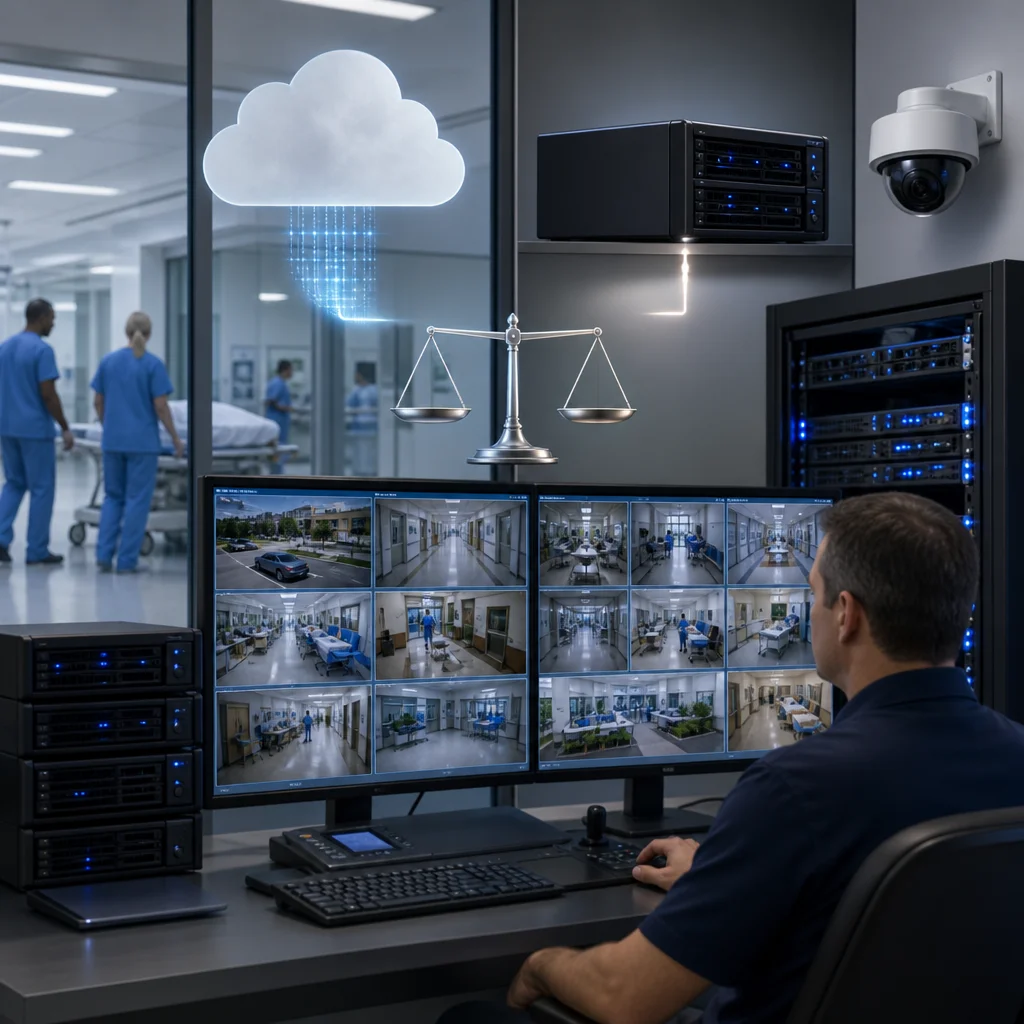
Hybrid approaches often optimize value. Local NVR systems handle primary recording and investigation workflows, while cloud systems provide long-term archival and geographic redundancy. This architecture typically costs 15-20% more than pure on-premises but delivers resilience benefits that justify the premium through avoided downtime risks.
We help facility administrators model actual costs against retention requirements and investigation patterns. Most discoveries reveal that longer retention windows actually reduce overall operational costs by improving investigation quality and reducing repeat incidents.
Action step: Calculate your current annual spending across all security vendors. We typically identify 15-25% savings through system consolidation and elimination of redundant subscriptions.
Compliance Documentation and Evidence Chain of Custody
Regulatory defensibility hinges on consistent, documented procedures for evidence handling. Your NVR system must generate audit trails proving when footage was accessed, by whom, and for what purpose. Export procedures must create digitally signed files that prevent tampering and establish integrity for legal proceedings.
We implement systems that document the complete evidence lifecycle. When an investigator exports footage for incident review, the system records the export timestamp, requesting staff member, export duration, and destination. If that footage later appears in litigation, chain-of-custody documentation proves the evidence remained unaltered from capture through legal proceedings.
Hospital compliance documentation requirements:
- Retention policy documentation with regulatory justification
- Access logs showing all footage viewing and export activity
- Deletion procedures and preservation exception processes
- Digital signatures and integrity verification for exported evidence
- Training records proving staff understand evidence handling protocols
We provide quarterly compliance reports summarizing retention statistics, access patterns, and any deviations from documented procedures. When regulators audit your facility, these reports demonstrate systematic compliance rather than ad-hoc practices.
Action step: Request access logs from your current system covering the past 30 days. If your vendor can’t provide them within two business days, your evidence documentation is inadequate.
Selecting the Right NVR Strategy for Your Healthcare Facility
Your optimal NVR strategy depends on facility-specific factors: campus distribution, IT infrastructure maturity, regulatory environment, and investigation patterns. We guide that decision through systematic assessment rather than vendor bias.
Single-campus hospitals typically benefit from on-premises NVR systems providing immediate investigative access and simplified compliance documentation. Multi-campus health systems often prefer hybrid architectures where local systems maintain operational independence while cloud components provide unified policy enforcement across facilities.
Selection framework questions:
- Can your facility accept brief investigative delays if internet connectivity fails?
- Do you have IT staff capable of supporting hardware maintenance and troubleshooting?
- Are your investigation timelines consistent or does incident discovery timing vary widely?
- Do regulators or accreditation bodies impose specific data residency requirements?
- Does your existing security infrastructure already include cloud-based components?
Your answers to these questions determine the architecture that delivers maximum value. We’ve designed systems where cloud-first technology companies implement on-premises NVR for operational benefits, and traditional hospital networks adopt cloud components for disaster recovery despite IT staffing constraints.
The right strategy aligns with your operational priorities, not generic best practices. We help you define those priorities, then design systems that deliver them reliably.
Action step: Schedule a compliance and technology assessment call with our team. We’ll evaluate your current systems, map your investigation patterns, and recommend the optimal architecture for your facility’s specific requirements.
Frequently Asked Questions (FAQ)
What’s the difference between cloud and on-premises NVR systems for hospital video retention?
We recommend cloud-based systems when you need remote access, automatic redundancy, and reduced on-site hardware maintenance, though they require consistent bandwidth and involve ongoing subscription costs. On-premises NVR infrastructure gives you direct control over your data, better compliance with strict HIPAA requirements, and eliminates dependency on external connectivity. We typically help healthcare facilities choose based on their existing infrastructure, IT resources, and how quickly they need to access stored evidence for investigations.
How do we ensure our NVR system meets HIPAA and other healthcare compliance requirements?
We design retention strategies that address your specific regulatory obligations, including proper encryption, access controls, and audit trails for all video evidence handling. Our systems integrate with your existing access control infrastructure so we can track who views footage and when, creating the documentation regulators require. We also structure data retention schedules that align with your state’s medical record laws and your facility’s incident investigation protocols.
Can we integrate a new NVR system with our current security cameras and access control systems?
We absolutely can integrate new infrastructure with your existing equipment rather than requiring a complete replacement. Our team conducts a detailed assessment of your current structured cabling, cameras, and control systems to design a unified platform that communicates across all your security components. This approach reduces disruption to your operations while giving you the consolidated management capability you need to respond to evidence requests efficiently.