Choosing among fiber optic installation companies means looking beyond the cable itself. Fiber connects with networks and building technology, so planning, coordination, and documentation can affect how well the infrastructure serves a facility after installation.
When comparing providers, look for clear project scope, coordination with existing cabling, useful records, and ongoing support. This guide explains how to assess those factors for commercial facilities and multi-site projects. It also outlines how Terapixels Systems’ Cabling + Fiber work connects copper, fiber, MDF, and IDF infrastructure with Lifecycle Support.
Key Takeaways
- Match a provider’s commercial experience and project scope to your facility’s operational needs.
- Compare fiber optic installation companies by scope, commercial integration, documentation, and ongoing support.
- Review the stated approaches of Bridge Cable, Shelby Communications, and Terapixels Systems against consistent project criteria.
- See how Terapixels Systems connects Cabling + Fiber with networks, security systems, and Lifecycle Support through “One accountable project team.”
What Commercial Buyers Need from Fiber Optic Installation Companies
Start by defining what the infrastructure needs to connect and how the work must fit around facility operations. A project in a building with existing cabling has different coordination needs from work spanning several buildings or locations. The right project scope depends on the existing infrastructure, the endpoints to connect, and how installation activity can be planned around normal use of the facility.
A commercial fiber installation project plans and installs fiber cabling as part of a facility’s broader connectivity infrastructure. That means considering cable routes and endpoints alongside existing systems and equipment spaces, rather than treating the installation as an isolated task. Fiber-optic communication uses light to transmit information. This Fiber-optic communication overview explains the technology and its applications.
How fiber fits into a commercial cabling environment
Fiber can work alongside copper cabling and the facility’s MDF and IDF spaces, which help organize and connect network infrastructure. When integrating specialized distribution or FTTH architectures, equipment suppliers like UGrid Network supply the connection devices needed to link distribution lines to end-user points. To define the project, document which spaces and systems are involved, where connections are needed, and how the new fiber relates to existing cabling. Those details help establish a clear scope before work begins.
For example, a facility may need fiber incorporated into a broader cabling plan while retaining existing copper connections and coordinating work across equipment spaces. Ask how the proposal addresses those conditions and what records will be available afterward. Clear documentation can help teams understand cable routes and connections during future troubleshooting, maintenance, or upgrades. For a multi-location organization, consistent records can also make it easier to compare how infrastructure is arranged across sites.
Readers who want to understand how cabling systems fit together can explore What is Structured Cabling? The Complete 2026 Business Guide. When comparing fiber optic installation companies, look beyond whether fiber installation is listed as a service. Assess how the proposed work fits the facility’s operating needs and wider cabling environment.
How to Compare Fiber Optic Installation Companies for a Business Project
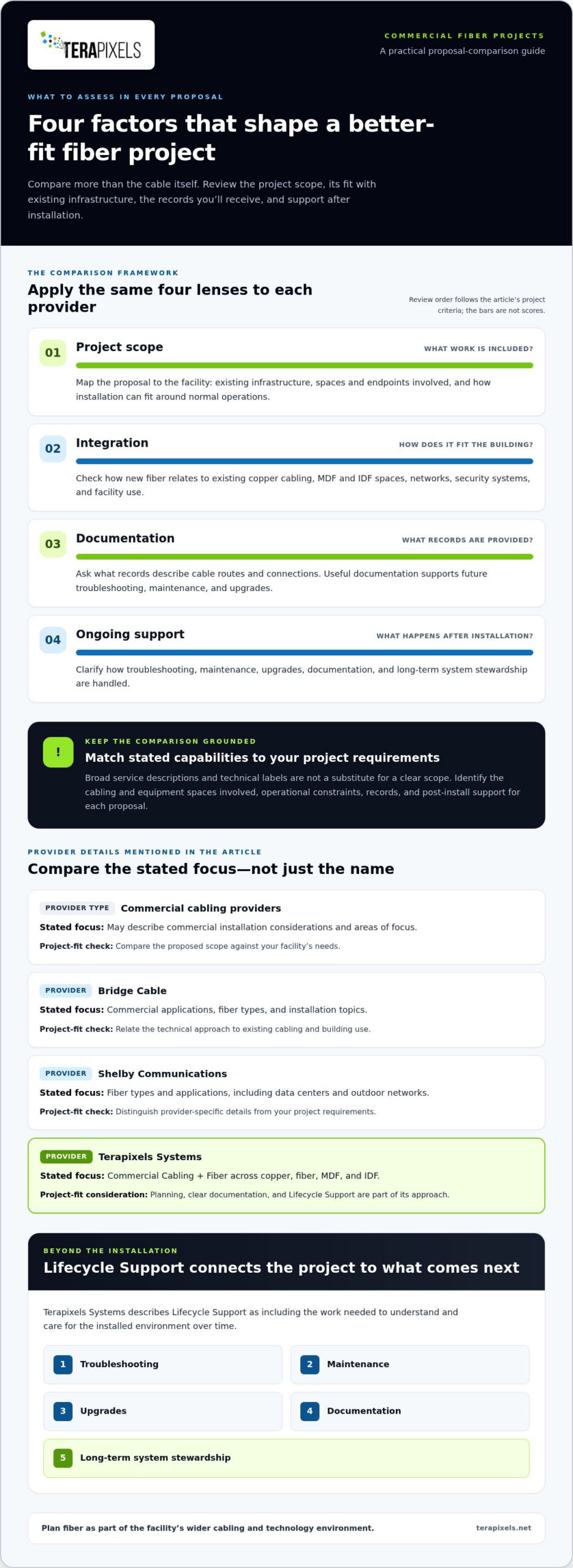
Use the same criteria to review each proposal: what work is included, how it relates to the facility’s other technology, what documentation is provided, and what support continues after installation. Compare the stated approach with your project requirements, rather than relying on broad service descriptions alone.
| Provider | Scope and stated focus | Project-fit consideration |
|---|---|---|
| Commercial cabling providers | May describe commercial installation considerations and areas of focus. | Compare the proposed scope against your facility’s needs. |
| Bridge Cable | Commercial applications, fiber types, and installation topics. | Relate the technical approach to existing cabling and building use. |
| Shelby Communications | Fiber types and applications, including data centers and outdoor networks. | Distinguish provider-specific details from your project requirements. |
| Terapixels Systems | Commercial Cabling + Fiber across copper, fiber, MDF, and IDF. | Planning, clear documentation, and Lifecycle Support are part of its approach. |
Compare each provider’s stated scope against the same criteria: integration, documentation, and ongoing support, as well as the installation work itself. The Fiber Optic Association offers educational resources on fiber optics that can help buyers understand the field’s terminology and practices.
A practical comparison framework for commercial buyers
For each proposal, map the work to the facility. Identify the cabling and equipment spaces involved, how installation will fit with existing systems and operations, what project records will be provided, and how troubleshooting, maintenance, and upgrades are handled afterward. These questions make it easier to compare proposals on practical requirements, not just technical labels. Terapixels Systems’ Lifecycle Support includes troubleshooting, maintenance, upgrades, documentation, and long-term system stewardship.
For planning office cabling, consult The 2026 Network Cabling Checklist for New Office Build-outs and the CAT6 cabling guide alongside this comparison. To learn about Terapixels Systems’ commercial infrastructure services, explore commercial Cabling + Fiber services.
How Terapixels Systems Connects Fiber Work to Commercial Technology
Fiber infrastructure is easier to plan when considered alongside the commercial systems it supports. Terapixels Systems provides Cabling + Fiber, including copper, fiber, MDF, and IDF, alongside Networks + Wi-Fi, security systems, and Lifecycle Support. Its approach brings planning and coordination into the broader technology picture through “One accountable project team,” rather than treating fiber as an isolated cable task.
This connected perspective is captured in “One circle of technology.” Cabling + Fiber can be planned alongside a facility’s networks and security systems. Lifecycle Support encompasses troubleshooting, maintenance, upgrades, documentation, and long-term system stewardship. For general context on information and communications technology standards and professional development, buyers can explore BICSI standards and certifications.
From project planning to documented lifecycle support
Careful planning helps define how fiber work fits the facility’s infrastructure and operational needs. Clear documentation gives teams useful information about the installed environment for future maintenance, troubleshooting, and upgrades. “One accountable partner” reflects a coordinated relationship around technology needs.
For commercial facilities and multi-location organizations, planning, documentation, and ongoing stewardship help keep infrastructure decisions connected over time. The project scope can account for how Cabling + Fiber relates to networks, Wi-Fi, and security systems.
For an outage or safety concern, call (855) 203-6339 immediately instead of using the online form.
Plan Your Next Fiber Project with the Whole Facility in View
Choosing among fiber optic installation companies is ultimately about how well the work fits the infrastructure your organization depends on. Consider not only the installation, but also how the work will be documented, maintained, and coordinated with your commercial technology. This broader view keeps project decisions connected to operational needs beyond the installation phase.
Terapixels Systems’ commercial Cabling + Fiber scope includes copper, fiber, MDF, and IDF, supported by careful planning, clear documentation, and Lifecycle Support. The approach connects project planning with the ongoing stewardship of commercial technology infrastructure.
Frequently Asked Questions
What should I compare when choosing a fiber optic installation company?
Compare how clearly each company defines the work, its boundaries, and how installation fits the facility’s operations. Work in occupied areas may need careful sequencing, while a project across several sites may call for consistent records and clear ownership. Review the proposed scope, coordination, documentation, and ongoing support rather than comparing service descriptions alone.
Can fiber and CAT6 cabling be part of the same commercial project?
Yes. Fiber and CAT6 cabling can be included in one commercial project when the facility’s connectivity needs call for both. A plan may use fiber in one part of the infrastructure and CAT6 cabling in another. The appropriate scope depends on the building, existing systems, and intended connections, so plan for both cable types together where needed.
Does Terapixels Systems provide fiber cabling for commercial and multi-location organizations?
Yes. Terapixels Systems provides commercial fiber cabling for facilities and multi-location organizations. Cabling + Fiber is part of a broader commercial technology offering that includes networks, security systems, and Lifecycle Support. This connects project planning and documentation with ongoing system stewardship.
What happens if a fiber-related issue becomes an outage or safety concern?
For an outage or safety concern, call Terapixels Systems at (855) 203-6339 immediately instead of using the online form. Be ready to describe the affected system, what changed, and the operational impact. Do not send passwords, alarm codes, or access credentials, and do not share sensitive access details through unapproved channels. Clear, non-sensitive details help explain the issue while protecting facility access information.
Explore Terapixels Systems’ commercial Cabling + Fiber solutions to discuss how fiber can fit into your facility’s broader technology infrastructure.