
Table of Contents
- Why Facial Recognition Accuracy Matters for Your Hotel Operations
- Common Challenges in Measuring Recognition Performance
- Our Comprehensive Testing Framework for Facial Recognition Systems
- Environmental Factors That Impact Recognition Reliability
- Calibrating Your System for Southern California Conditions
- How We Validate Accuracy Across Different Guest Demographics
- Integration with Your Existing Access Control Infrastructure
- Real-World Performance Metrics You Should Track
- Implementing Continuous Monitoring and Adjustment Protocols
- Case Studies: Hotels Achieving Superior Recognition Performance
- Optimizing Your ROI Through Accurate Biometric Systems
- Getting Started with Professional Accuracy Testing Today
- Frequently Asked Questions (FAQ)
Why Facial Recognition Accuracy Matters for Your Hotel Operations
Facial recognition systems have moved from theoretical security upgrades to operational necessities for enterprise hotel properties. When your team deploys biometric access control, guest safety protocols, and threat detection, the accuracy of those systems directly impacts both security outcomes and guest experience.
We see this play out constantly across Southern California properties. A system that misidentifies guests creates friction at entry points, generates false security alerts, and can expose your team to liability if access decisions fail at critical moments. Conversely, a properly calibrated system streamlines guest flow, reduces staffing time spent on manual verification, and provides auditable security records that satisfy compliance requirements.
The stakes are higher in hospitality than in many other verticals. Your guests move through multiple zones during their stay, staff members rotate through shifts, and you’re operating in controlled interior environments that don’t always match the lighting conditions where facial recognition algorithms were initially trained. Getting this right requires systematic testing before deployment and ongoing validation after.
Actionable takeaway: Document your current access control pain points before evaluating facial recognition. Are staff spending excessive time on manual verification? Are there security gaps during high-occupancy periods? These baseline metrics become your success criteria for testing.
Common Challenges in Measuring Recognition Performance
Most hotel operators approach facial recognition testing reactively: they install a system, observe whether it works, and adjust only when problems surface. This approach leaves accuracy gaps undiscovered until they matter.
The core challenge is that “accuracy” isn’t a single number. A system might show 99% accuracy in controlled lab conditions but 85% accuracy in your actual lobby with mixed lighting, seasonal glare from windows, and guests wearing sunglasses. Standard industry metrics like false acceptance rate (FAR) and false rejection rate (FRR) tell part of the story, but they don’t account for real-world environmental variables unique to your property.
We also encounter confusion around testing scope. Hotels often test facial recognition against a small, homogeneous dataset, then deploy against guests representing dozens of ethnicities, age groups, and facial feature variations. The algorithm performs differently across demographics, and most operators don’t discover this until after launch.
Testing infrastructure itself presents obstacles. You need baseline images, controlled test scenarios, documented environmental conditions, and multiple test runs across different times of day and seasons. Most properties lack the technical expertise or tooling to conduct this systematically.
Actionable takeaway: Schedule a pre-deployment accuracy audit with a partner experienced in biometric system validation. Insist on testing in your actual physical spaces, not in controlled labs or test environments.
Our Comprehensive Testing Framework for Facial Recognition Systems
We’ve developed a structured approach that moves beyond basic pass-fail testing. Our framework measures accuracy across multiple dimensions that matter for hotel operations.
First, we establish baseline performance using your specific hardware, camera placement, and environmental conditions. This involves capturing reference images of staff and authorized personnel under various lighting scenarios, then running multiple test cycles where the system attempts to recognize these individuals. We document true positive rate, false positive rate, and false negative rate separately for each zone and time of day.
Next, we conduct cross-demographic testing. We work with representative datasets spanning different age groups, skin tones, facial structures, and accessories. This reveals whether your system’s accuracy degradation is uniform or concentrated in specific populations, which is critical for ensuring equitable security policies.
We also stress-test under worst-case conditions: direct sunlight, indoor shadow patterns, reflections from glass and metal surfaces, and the full range of seasonal lighting changes your property experiences. A system that works in June might struggle in December when the sun angle shifts dramatically.
Finally, we document threshold calibration. Every facial recognition system has an adjustable confidence threshold. Set it too low and you get false positives; set it too high and legitimate users get rejected. We find the optimal threshold for your specific use case, then validate it doesn’t degrade performance across demographic groups.
Actionable takeaway: Require your technology partner to provide written documentation of accuracy metrics broken down by zone, time of day, and demographic representation. Don’t accept summary statistics alone.
Environmental Factors That Impact Recognition Reliability
Southern California’s geography creates specific challenges that operators in other regions don’t face. Large windows, high-glare environments, and consistent year-round sunlight mean your facial recognition system never operates in truly “stable” conditions.
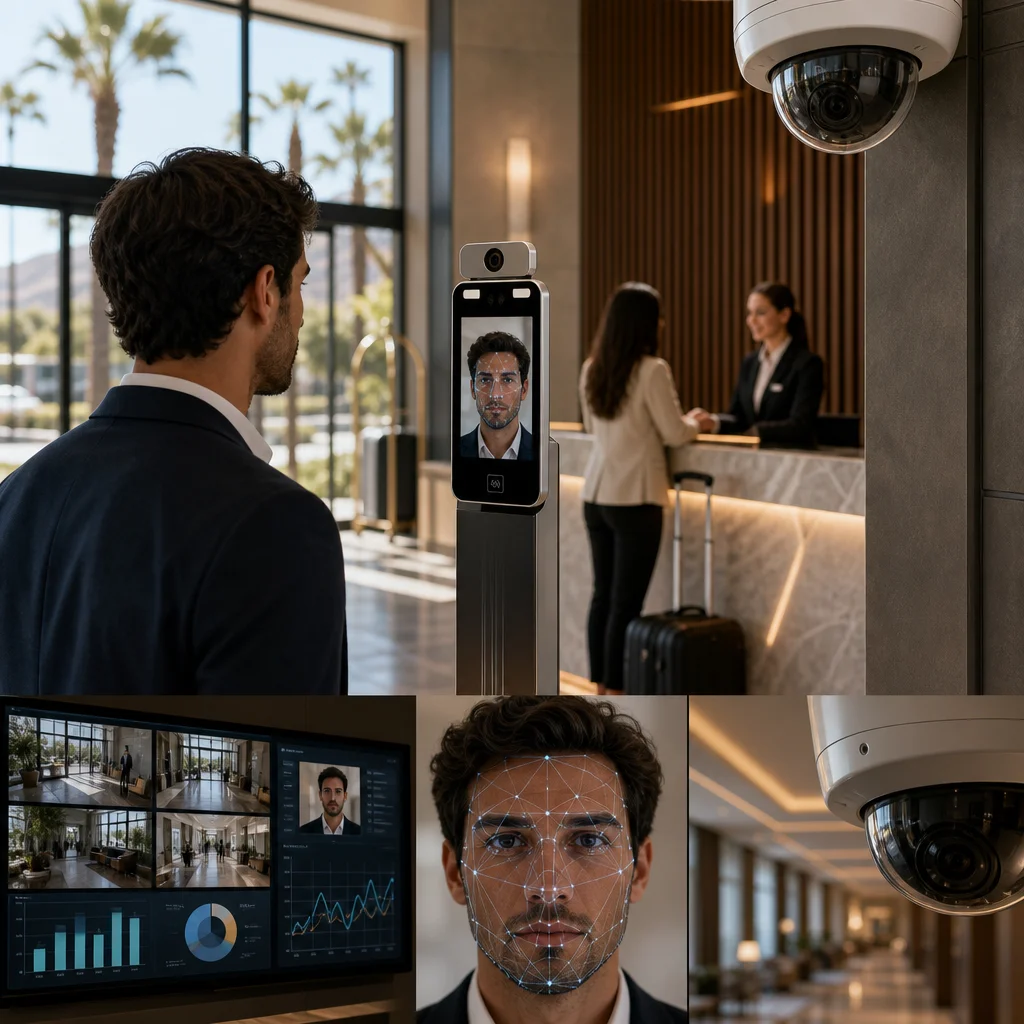
We measure several environmental variables during testing. Illumination level is the most obvious: direct sunlight creates harsh shadows and reflection off facial features that confuse algorithms. We test using lux meters to document exactly which light intensity ranges trigger degraded accuracy. Most systems perform poorly above 1,500 lux or below 500 lux.
Camera angle and distance also matter significantly. If a camera is mounted too high, it captures mostly forehead and eyebrows. Too low, and you capture mostly chin and neck. We test multiple camera positions during the planning phase to identify the angle that provides consistent full-face capture as guests move through spaces.
Background complexity influences results too. A lobby with varied colors, patterns, and movement in the background creates noise that degrades recognition. We test whether your system’s background filtering algorithms adjust to your specific environment.
Seasonal factors extend beyond simple sun angle changes. We’ve seen humidity and heat cause condensation on camera lenses during summer months in Southern California, and temperature fluctuations can affect both hardware performance and guest appearance (heavy sweating, different grooming). We document these patterns and recommend maintenance schedules that account for seasonal degradation.
Actionable takeaway: Work with your partner to identify the 2-3 highest-risk time periods in your property’s daily operation (lunch rush, evening turnover, etc.) and run extended accuracy tests during those exact times and seasons.
Calibrating Your System for Southern California Conditions
Generic facial recognition algorithms don’t account for your specific property’s environmental signature. Calibration bridges that gap.
We start by collecting a large, representative dataset of images captured in your actual spaces. These become training references that help the system learn your specific lighting patterns, camera angles, and typical guest appearances. This isn’t retraining the algorithm from scratch; it’s fine-tuning the confidence thresholds and feature weighting to match your environment.
For access control applications, we typically create separate profiles for different zones. Your main entrance might need different calibration than a back-of-house access point because the lighting, camera placement, and expected user population differ. We test and document optimal thresholds for each zone independently.
We also build seasonal adjustment protocols. You’ll need different threshold settings in December than in July. Rather than requiring manual recalibration four times annually, we work with your team to establish trigger points. When outdoor light conditions shift beyond specified ranges, the system adjusts thresholds automatically within approved parameters.
Guest appearance variation requires attention too. Travelers wear different accessories and grooming styles at different times of day. We test whether your system maintains consistent accuracy for the same person photographed with glasses, without glasses, hats, and in various grooming states. Most systems need recalibration if they’re going to handle this variation reliably.
Actionable takeaway: Schedule calibration testing across all four seasons, not just during your property’s busy period. A system that works perfectly in summer might fail during winter’s different lighting conditions.
How We Validate Accuracy Across Different Guest Demographics
Algorithmic bias in facial recognition is well-documented. Systems historically showed significantly higher error rates for women, people with darker skin tones, and younger individuals. For hotels serving diverse clientele, this isn’t an abstract concern; it’s an operational and ethical issue that affects real guests.
We conduct formal demographic parity testing. Using our representative dataset, we segment results by age group, gender identity, and skin tone, then calculate error rates for each segment. We document whether the system shows statistically significant accuracy differences between groups.
Testing methodology matters here. We use datasets representative of your expected guest population. A property in Southern California needs testing data that reflects the region’s demographic diversity. We work with vendors who provide validated datasets rather than relying solely on whatever training data their algorithm was originally built on.
When we identify accuracy disparities, we document them clearly and adjust either the system thresholds, camera placement, or lighting to address the gap. The goal isn’t just compliance; it’s ensuring your security system performs reliably for every guest.
We also test with realistic accessories. Guests wear sunglasses, hats, and facial hair in countless combinations. Our testing protocol includes these variations, and we measure whether the system’s accuracy degrades differently depending on accessory type or demographic group. If the system struggles specifically with, for example, women wearing sunglasses, that’s a calibration issue we address before deployment.
Actionable takeaway: Request a formal demographic accuracy report from your technology partner before signing off on any facial recognition deployment. If they can’t provide one, they haven’t tested thoroughly enough.
Integration with Your Existing Access Control Infrastructure
Facial recognition doesn’t operate in isolation. It needs to integrate seamlessly with your existing access control systems, badge readers, mobile credential infrastructure, and security operations workflows.
We handle this through our comprehensive access control integration approach. During accuracy testing, we simulate the full access decision workflow: facial recognition identifies a guest, the system checks credential status in your access database, and the result triggers the actual lock/door mechanism.
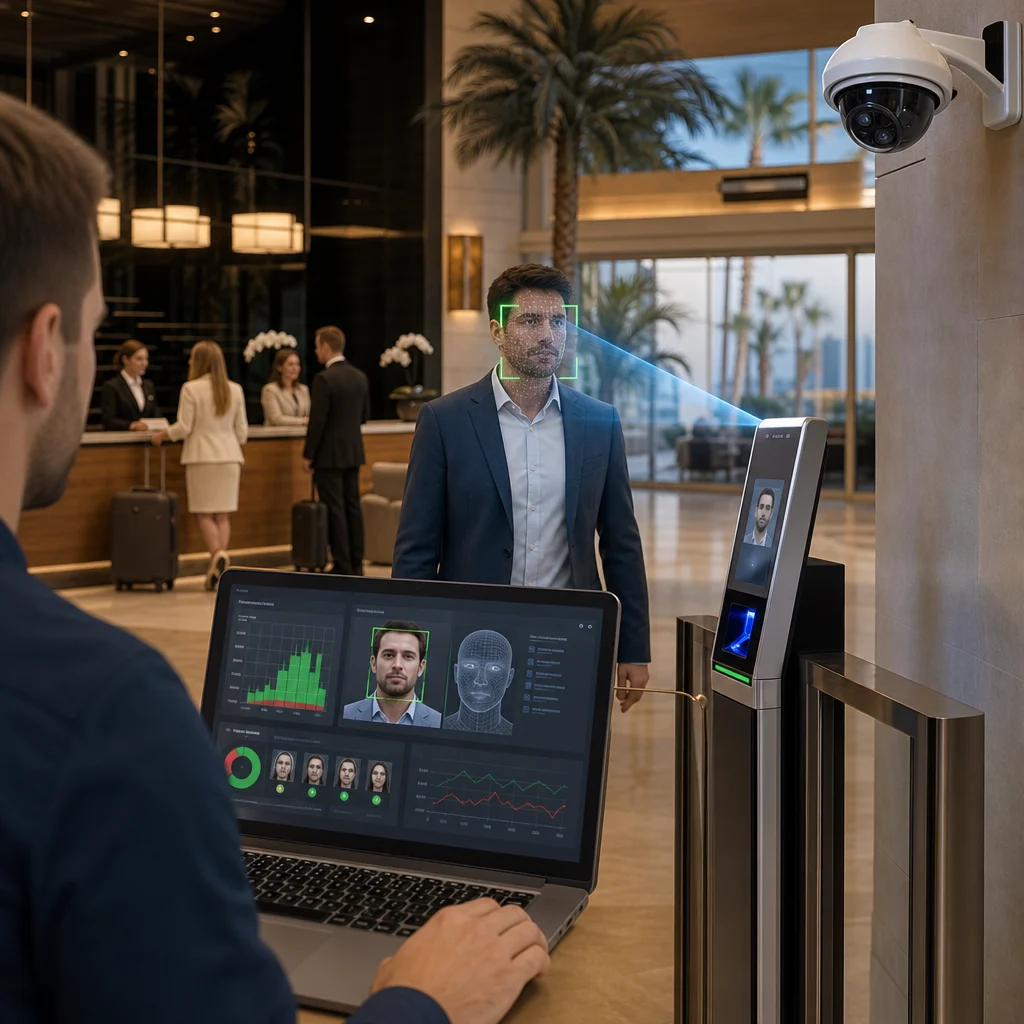
Testing this integration reveals coordination issues that single-system testing misses. Does the recognition decision happen fast enough before guests walk past the camera? Does the system fall back gracefully to badge reading if facial recognition fails? What happens when the biometric system is slightly uncertain about an identity?
We establish integration test scenarios that mirror your actual operational flow. For example, we test during shift change when multiple guests and staff are moving through entry points simultaneously. Single-person testing doesn’t reveal whether the system handles queue situations effectively.
Documentation during this phase is critical. We create decision trees showing exactly what happens in each scenario: successful recognition, failed recognition, borderline confidence scores, and fallback pathways. Your security operations team needs to understand these flows before going live.
Actionable takeaway: Don’t deploy facial recognition until you’ve tested the complete integrated system with your actual badge readers, access control software, and door hardware operating together.
Real-World Performance Metrics You Should Track
Once deployed, you need specific metrics that reveal whether your system is performing as tested. Vague statements like “the system is working well” mask problems until they escalate.
We recommend tracking false non-match rate (FNR) and false accept rate (FAR) continuously. FNR measures how often authorized users are rejected; high FNR creates guest frustration and increases manual verification workload. FAR measures how often unauthorized individuals are mistakenly accepted; high FAR is a direct security breach.
Zone-specific metrics matter too. Your main lobby might show 98% accuracy while your service entry shows 92% accuracy because of different lighting or camera angles. Tracking these separately helps you identify specific locations needing recalibration.
Temporal metrics reveal patterns you can’t see in aggregate numbers. Does accuracy degrade during specific hours? We’ve found that many systems perform worse during peak occupancy periods when multiple guests are near recognition cameras simultaneously. Tracking hourly accuracy trends surfaces these patterns.
Demographic breakdowns of performance should continue post-deployment. Set up monitoring to flag if your system’s accuracy diverges between demographic groups over time. Algorithm drift and environmental changes can create new biases that weren’t present at launch.
We also recommend tracking operational metrics: how often does manual verification override occur? How much staff time is spent dealing with recognition failures? These metrics quantify the business impact and inform decisions about recalibration or system adjustments.
Actionable takeaway: Establish a monthly reporting cadence where you review facial recognition performance metrics. If you’re seeing FNR above 5% or FAR above 1%, schedule a recalibration session immediately.
Implementing Continuous Monitoring and Adjustment Protocols
Facial recognition accuracy doesn’t remain static. Environmental changes, hardware aging, lighting modifications to your property, and seasonal shifts all affect system performance over time. Your accuracy testing framework needs to extend into ongoing operations.
We establish monitoring protocols that flag when performance degrades beyond acceptable thresholds. Most systems should maintain their validated accuracy levels within a 2-3% margin. When we detect drift beyond that, we investigate whether the cause is environmental (lighting changes, camera obstruction) or systemic (hardware degradation, algorithm drift).
Seasonal recalibration becomes routine maintenance. We schedule testing sessions for each season transition and adjust thresholds based on results. This prevents the February accuracy crisis many operators face when winter lighting conditions differ dramatically from summer calibration.
We also implement guest feedback loops. When guests report access issues or unusual rejections, we capture that data and analyze whether it reflects individual incidents or systemic problems. Patterns in guest feedback often reveal problems that raw metrics miss.
Hardware maintenance ties directly to accuracy. Dirty camera lenses, misaligned cameras from building settling, or lens degradation all reduce accuracy. We establish maintenance schedules that account for your property’s specific environmental conditions. Coastal properties need more frequent cleaning than inland properties, for example.
Your security operations team needs clear escalation protocols. If accuracy drops below operational thresholds, who handles investigation? What’s the timeline for recalibration? We document these workflows so issues don’t languish unaddressed.
Actionable takeaway: Contract for quarterly accuracy audits during your first year of operation, then semi-annual audits afterward. Include automatic threshold recalibration in your maintenance agreement.
Case Studies: Hotels Achieving Superior Recognition Performance
One large hospitality operator in the San Diego area deployed facial recognition across eight properties with highly variable results initially. Their downtown property with extensive glass facades struggled with glare-related accuracy issues while their inland property maintained consistent performance. Rather than accepting these variations, they invested in targeted environmental adjustments: anti-glare films on selected windows, additional lighting control, and recalibrated thresholds for each location. Post-adjustment accuracy improved from 87% to 96% across all properties.
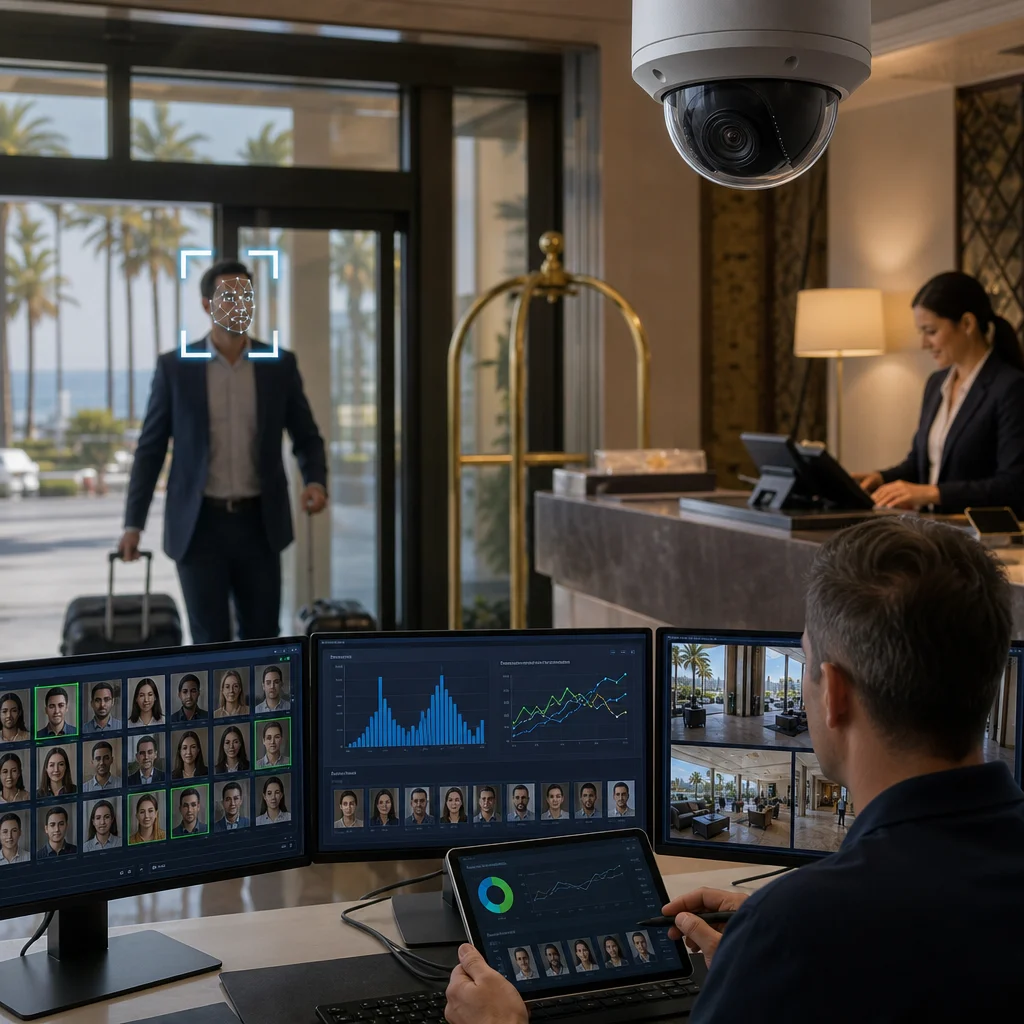
Another Southern California hotel chain initially experienced demographic accuracy gaps. Their system performed well for guests in their 30s-50s but showed elevated false rejection rates for younger guests and guests with darker skin tones. Through systematic testing and rebalanced confidence thresholds, they achieved demographic parity within 2 percentage points across all tested groups. The key was refusing to accept the default algorithm performance and investing in calibration work specific to their guest population.
A third property group discovered that their facial recognition system worked excellently during normal operations but failed dramatically during high-occupancy events when multiple guests approached the recognition point simultaneously. Their testing had used single-person scenarios. After identifying this, they adjusted camera placement, added secondary recognition points to distribute traffic, and refined the system’s queue-handling logic. Performance metrics for peak periods improved from 78% to 94% accuracy.
These examples share a common pattern: initial deployment rarely delivers optimal accuracy without targeted post-deployment testing and adjustment. Hotels that treat accuracy testing as a one-time event consistently underperform compared to those who make it ongoing operational practice.
Actionable takeaway: Ask your technology partner for references from similar-sized properties in similar climates. Request their accuracy metrics, not just testimonials about satisfaction.
Optimizing Your ROI Through Accurate Biometric Systems
The financial case for facial recognition depends on accuracy. A system that works 90% of the time costs you staff time on manual verifications, creates guest friction that damages satisfaction scores, and can fail during critical security moments.
Calculate your baseline costs first. How many staff hours do you currently spend on access control verification and troubleshooting? At typical hospitality labor rates, even 8-10 hours weekly adds up quickly. An accurate facial recognition system that eliminates most manual verification creates obvious cost savings.
Guest experience improvement has financial weight too. Seamless access contributes to perceived quality and review scores. Conversely, repeated rejection at entry points frustrates guests and creates negative social media sentiment. These effects don’t always show up in standard accounting.
Security incident prevention also has financial impact. A security breach that might have been prevented by more reliable access control carries significant liability and reputation costs. Enterprise properties carry insurance, but prevention remains cheaper than remediation.
The investment required for proper accuracy testing and calibration ranges from $15,000 to $40,000 depending on property size and complexity. Properties often resist this cost, but it’s the difference between a system that works and one that creates more problems than it solves. Amortize this over three years and it’s negligible compared to annual payroll and potential security costs.
Actionable takeaway: Calculate your ROI assuming 85% accuracy initially, then 95% after proper calibration. The difference in staffing cost savings alone typically justifies the testing investment.
Getting Started with Professional Accuracy Testing Today
If you’re evaluating facial recognition for your Southern California hotel property, start with a clear understanding of your operational requirements. Which access points need facial recognition? What’s your tolerance for false rejection? Do you need integration with existing systems?
We conduct comprehensive pre-deployment accuracy assessments that test your specific facility, environmental conditions, and operational scenarios. Our approach uses your actual hardware and spaces rather than simulated conditions, so results reflect real-world performance.
Our team documents baseline accuracy metrics, identifies calibration requirements, and establishes the monitoring protocols that keep your system performing reliably long-term. We specialize in deploying AI security camera systems and biometric access control for enterprise hospitality properties across Southern California.
Contact our team to schedule an initial assessment. We’ll evaluate your property’s specific characteristics, discuss your operational goals, and outline how proper accuracy testing protects your security investment. Whether you’re managing a single property or a portfolio, getting this right from the start eliminates costly post-deployment problems and ensures your guests experience seamless security that works reliably every time.
Frequently Asked Questions (FAQ)
Why should we invest in facial recognition accuracy testing before deploying the system at our hotel?
We recommend accuracy testing because facial recognition systems can experience significant performance variations depending on lighting conditions, guest demographics, and environmental factors specific to Southern California. By validating your system’s performance before full deployment, we help you identify potential blind spots and calibration needs, ensuring your investment delivers reliable security operations from day one rather than discovering issues after implementation.
How do we ensure facial recognition systems work reliably with your existing access control infrastructure?
We integrate facial recognition as part of your broader access control ecosystem, testing how the biometric data flows seamlessly with your current systems and protocols. Our team validates that recognition events trigger appropriate access permissions, alarm notifications, and audit logs in real-time, so your security operations remain unified across all entry points and monitoring stations.
What performance metrics should we be tracking once our facial recognition system is operational?
We recommend monitoring false acceptance rates (guests incorrectly matched to unauthorized profiles), false rejection rates (authorized guests denied access), and processing speed during peak occupancy periods. We also track system performance across different times of day and seasonal lighting changes to ensure your accuracy levels remain consistent and meet your operational requirements throughout the year.