CONTACT US
Table of Contents
- Why Your Infrastructure Needs Defined Service Level Agreements
- The Cost of Undefined IT and Security Commitments
- The Cost of Undefined IT and Security Commitments
- Critical SLA Metrics for Network Infrastructure Performance
- Our Integrated Approach to Infrastructure and Security SLAs
- Capabilities & SLA Focus Area
- Structured Cabling and Access Control SLA Expectations
- Security Camera System Reliability and Maintenance SLAs
- Consolidating Multiple Vendors Into One Accountable Partner
- Implementation Timeline and SLA Achievement Roadmap
- Measuring Success: Monitoring and Reporting on Your SLAs
Why Your Infrastructure Needs Defined Service Level Agreements
Your physical security and IT infrastructure are not optional luxuries. They are business-critical systems that directly impact guest safety, operational efficiency, and regulatory compliance. Without clear service level agreements (SLAs), you are operating blind when it comes to the actual performance expectations and accountability of your technology partners.
A defined SLA transforms a vague promise (“we’ll keep your systems running”) into a measurable, contractual commitment. It specifies exactly what uptime you can expect, how quickly low-voltage cabling, camera, or access control problems get resolved, and what happens when those standards aren’t met. For mid-sized organizations managing multiple facilities across San Diego and Southern California, this clarity is essential.
Consider a San Diego hospitality operation running 24/7 in Mission Valley or Downtown. Your access control system, security cameras, and network infrastructure all enable guest experience and staff safety. When these fail without defined response times, you are exposed to liability, operational disruption, and loss of revenue. An SLA gives you concrete recourse and ensures your technology partner prioritizes your needs appropriately.
We have seen organizations that thought they had support agreements, only to discover their provider had no obligation to respond within any specific timeframe. That gap between expectation and reality can be costly.
Action: Audit your current technology contracts and identify which systems lack defined uptime guarantees and response times.
The Cost of Undefined IT and Security Commitments
Many mid-sized facilities operate with informal arrangements where their IT support and security provider answers “when they can.” This creates hidden costs that compound over time.
Undefined commitments lead to several critical problems:
- Extended Network Outages: Outages that last hours instead of minutes because there is no contractual urgency to respond quickly.
- Undetected Security System Failures: Blind spots discovered only when a tenant or staff member reports a non-functioning camera or access badge issue.
- Deprioritized Support: Competing priorities where your San Diego facility gets deprioritized in favor of clients with formal SLAs.
- Unplanned Operational Downtime: Disruptions that impact guest services, staff productivity, and compliance audits.
- Premium Emergency Costs: Emergency service calls at inflated rates because proactive maintenance wasn’t guaranteed.
We have worked with logistics and distribution centers in Otay Mesa that experienced critical network outages lasting six hours. An undefined SLA meant their provider had no financial penalty and no contractual obligation to prioritize the issue. The facility lost productivity worth five times the annual IT contract value during a single outage.
In hospitality, biotech, or healthcare settings across San Diego, security system downtime creates immediate liability exposure. A non-functional access control system or security camera outage during an incident creates documentation gaps that regulators and legal teams scrutinize. An undefined SLA won’t protect you in that scenario.
Action: Calculate the hourly operational cost of your facilities, then multiply by 6–8 hours (a typical undefined outage window). That’s your annual risk exposure before implementing formal SLAs.
The Cost of Undefined IT and Security Commitments
Many mid-sized facilities operate with informal arrangements where their IT support and security provider answers “when they can.” This creates hidden costs that compound over time.
Undefined commitments lead to several problems:
- Network outages that last hours instead of minutes because there’s no contractual urgency to respond quickly
- Security system failures discovered only when a tenant reports a non-functioning camera or access badge issue
- Competing priorities where your facility gets deprioritized in favor of clients with formal SLAs
- Unplanned downtime that impacts guest services, staff productivity, and compliance audits
- Emergency service calls at premium rates because preventive maintenance wasn’t guaranteed
We’ve worked with distribution centers that experienced a critical network outage lasting six hours. The undefined SLA meant their provider had no financial penalty and no contractual obligation to prioritize the issue. The facility lost productivity worth five times the annual IT contract value during that single outage.
In hospitality settings, security system downtime creates immediate liability exposure. A non-functional access control system or security camera outage during an incident creates documentation gaps that regulators and legal teams scrutinize. An undefined SLA won’t protect you in that scenario.
The financial impact extends beyond direct downtime costs. Undefined agreements also mean you’re paying for reactive emergency repairs instead of proactive maintenance. You’ll replace components that could have been serviced before failure. You’ll troubleshoot problems without an assigned technician and timeline.
Action: Calculate the hourly operational cost of your facilities, then multiply by 6-8 hours (a typical undefined outage window). That’s your annual risk exposure before addressing SLAs.
Critical SLA Metrics for Network Infrastructure Performance
Network infrastructure forms the digital backbone for everything else. Without clear performance standards, you cannot evaluate whether your infrastructure meets your operational needs.
Core SLA metrics for network infrastructure include:
- Uptime Percentage: Industry standard for critical systems is 99.9% (approx. 45 minutes of unplanned downtime per month) or 99.99%. For multi-site operations across San Diego, 99.9% is realistic and appropriate.
- Mean Time to Repair (MTTR): How long between reporting an issue and its full resolution. For critical infrastructure, this should be 4 hours maximum, with a 2-hour target for high-priority issues affecting access control or video surveillance.
- Mean Time Between Failures (MTBF): Measures equipment reliability. Higher numbers indicate better infrastructure design. Your SLA should specify minimum MTBF targets for enterprise switches, routers, and cabling plants.
- Planned Maintenance Windows: Defining when maintenance can occur (typically 2–4 AM on specified nights) with 5 to 7 days advance notice.
- Network Latency & Throughput Guarantees: For IP cameras and access control readers, network latency matters significantly. Your SLA should specify maximum millisecond delays and guaranteed bandwidth allocation for physical security traffic.
These metrics prevent finger-pointing. When a network issue occurs, everyone knows the defined response time and resolution target.
Action: Request your current provider’s network infrastructure SLA or ask what metrics they are willing to guarantee in writing.

Our Integrated Approach to Infrastructure and Security SLAs
Compartmentalized SLAs create accountability gaps. When your network infrastructure provider is separate from your security contractor, who is responsible when an IP camera drops offline due to a switch port issue?
Our approach consolidates low-voltage cabling, networking, camera systems, and access control under one comprehensive SLA framework.
+———————————–+
| Single SLA & Service Agreement |
+—————–+—————–+
|
+—————————+—————————+
| | |
v v v
+—————+ +—————+ +—————+
| STRUCTURED | | CAMERA | | ACCESS CONTROL|
| CABLING | | SYSTEMS | | SYSTEMS |
| Certified | | Axis, Avigilon| | Brivo, AMAG, |
| Cat6A / Fiber | | Hanwha, VMS | | Openpath |
+—————+ +—————+ +—————+
Preferred Technology Partners & Brands
To guarantee SLA targets, we standardize on proven industry-leading hardware:
- Camera Systems & VMS: Avigilon, Axis Communications, Hanwha Vision, Eagle Eye Networks, ACTi, Milestone Systems, Exacqvision, and Salient Systems.
- Access Control Systems: Brivo, Openpath (Motorola Solutions), Kantech, and AMAG Technology.
- Network Infrastructure & Cabling: Cisco, Cisco Meraki (including core enterprise platforms like Meraki MX250 and MX450 firewalls), Aruba Networks, and Ruckus Wireless (managed via Ruckus SmartZone).
When an issue occurs, we diagnose the root cause across the entire stack—cabling, switch configuration, or hardware—and resolve it without inter-vendor delay.
Capabilities & SLA Focus Area
Capability Area
Multi-Vendor Setup (Uncoordinated)
Terapixels Consolidated SLA
Structured Cabling
Uncertified drops; no guarantees on signal degradation or physical warranty.
Certified Cat6A/Fiber tested to TIA standards with guaranteed remediation response times.
Camera Systems
Disconnected NVRs; slow replacement times for failed cameras (3–5 days).
High-definition platforms (Axis, Avigilon, Hanwha) with 24-hour hardware swap SLAs.
Access Control
Standalone door hardware with no failover or latency guarantees.
Cloud/Enterprise platforms (Brivo, Openpath, AMAG) with 99.95% guaranteed uptime.
Network Infrastructure
Unmanaged switches leading to latency spikes and video buffering.
Enterprise routing (Cisco MX series, Aruba, Ruckus) with prioritized security VLANs.
Structured Cabling and Access Control SLA Expectations
Structured cabling is the physical foundation of your technology stack. Poor cabling design causes intermittent connection drops that are difficult to diagnose and expensive to fix.
Structured Cabling SLA Standards:
- Installation Quality & Certification: All copper (Cat6A) and fiber runs are certified to TIA-568 standards with full documentation provided upon completion.
- Bandwidth & Crosstalk Testing: Cables must pass certification testing matching the high-bandwidth requirements of 4K security cameras and enterprise Wi-Fi.
- Remediation Response: Physical cabling faults in security-critical runs are addressed within 24 hours.
Structured cabling directly supports physical access control performance. Our ++access control systems++ SLA guarantees:
- Reader & Lock Reliability: Door readers achieve 99.9% uptime, backed by an on-site replacement inventory for rapid hardware swaps within 24 hours.
- Database Synchronization: Multi-facility badge databases across San Diego synchronize continuously, with failover procedures when central links are offline.
- Battery Backup Assurance: Regular quarterly testing and scheduled replacement cycles for power supply battery backups.
Action: Request cabling performance documentation from your current access control provider. If they cannot produce certified test reports, your security hardware is running on unverified infrastructure.
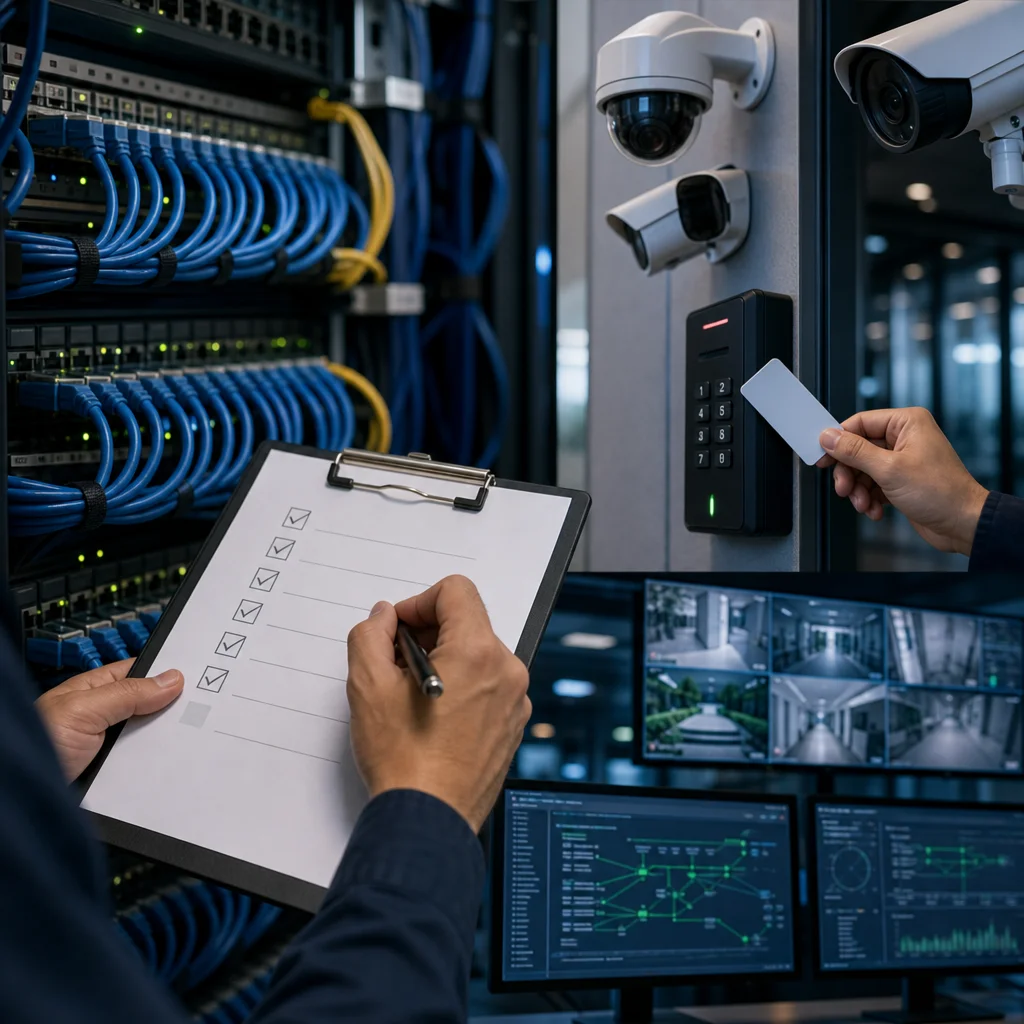
Security Camera System Reliability and Maintenance SLAs
High-definition camera systems represent a major investment. Your SLA protects that investment and ensures uninterrupted visual auditing.
We structure camera system SLAs around key metrics:
- Camera Hardware Uptime: 99.9% uptime per camera (excluding scheduled maintenance). Outdoor cameras include proper weatherproofing and thermal management.
- VMS & NVR Redundancy: Redundant NVR configurations with automatic failover so recording continues without missing a frame.
- Storage Reliability: Guaranteed footage retention utilizing RAID 6 or better storage arrays, supplemented by offsite cloud backups for critical San Diego sites.
- Proactive Health Monitoring: 24/7 automated monitoring of camera status, bandwidth usage, and storage health. If a feed drops, our team receives an alert instantly.
Consolidating Multiple Vendors Into One Accountable Partner
Most San Diego facilities juggle multiple contractors: a network provider, a cabling team, and separate security integrators. This fragmentation creates accountability gaps during outages.
When you ++consolidate into one SLA partner++:
- Single-Point Accountability: One partner takes full responsibility for end-to-end physical and network performance.
- Coordinated Maintenance: Instead of multiple vendors scheduling separate service windows, maintenance is performed during a single, pre-planned window.
- Cost Optimization: Eliminates redundant SLAs, reduces administrative overhead, and lowers overall service costs.
- Portfolio Consistency: Multi-site organizations across San Diego receive uniform service standards, reporting, and response times.
Implementation Timeline and SLA Achievement Roadmap
Transitioning to a unified managed SLA framework requires structured execution:
- Assessment Phase (Weeks 1–4): Comprehensive audit of your San Diego facility’s cabling, switch architecture, access control hardware, and camera coverage to establish performance baselines.
- Remediation Phase (Weeks 5–12): Upgrading aging cable drops, replacing unmanaged switches with enterprise hardware (Cisco Meraki, Aruba, Ruckus), and configuring VMS redundancy.
- SLA Finalization (Week 6): Drafting formal SLA documents outlining exact uptime targets, MTTR metrics, and escalation paths.
- Transition & Active Monitoring (Weeks 8–16): Full transition to proactive 24/7 monitoring and reporting.
- Continuous Optimization (Ongoing): Regular quarterly reviews to analyze uptime trends and adjust capacity as your facility grows.
Measuring Success: Monitoring and Reporting on Your SLAs
An SLA is only as good as its measurable data. We provide complete transparency through:
- Real-Time Dashboards: Live visibility into system uptime, active alerts, and network performance across all your San Diego locations.
- Weekly & Monthly Reports: Detailed summaries outlining uptime percentages, ticket resolution times, and root-cause analyses for any service incidents.
- Automated Escalation & Service Credits: Clear, contractual recourse and automatic service credits if defined uptime targets are missed.
Your physical infrastructure and security systems require defined service level agreements that create true accountability. Contact Terapixels Systems today to evaluate your current setup and explore how a consolidated SLA framework can bring peace of mind and bulletproof reliability to your San Diego facility.