CONTACT US
Table of Contents
- Why Network Cable Failures Demand Local Expertise
- Response Time: Local Advantage Over National Call Centers
- Technical Expertise in Structured Cabling Systems
- Continuity of Service and Relationship Management
- Cost Efficiency of Regional IT Partners
- Our Comprehensive Network Infrastructure Support
- Why Terapixels is Your San Diego Solution
- Frequently Asked Questions (FAQ)
Why Network Cable Failures Demand Local Expertise
When your network cable fails at 2 PM on a Thursday, your business doesn’t pause. Neither can your infrastructure. The difference between a quick local response and a three-hour wait for a national provider’s field technician directly impacts your operational downtime, customer service delivery, and bottom line.
We’ve worked with hospitality groups, warehousing operations, and healthcare facilities across Southern California long enough to understand that emergency network cable repair isn’t just about fixing a broken line. It’s about minimizing disruption, maintaining security integrity, and having someone who understands your specific infrastructure setup arrive with the right tools and knowledge.
Network cable failures don’t announce themselves politely. A severed line, connector failure, or environmental damage can take down your entire site’s connectivity. When this happens, national call centers route your ticket into a queue managed by someone 500 miles away who has never seen your facility.
Local expertise means understanding the physical realities of your infrastructure. We know San Diego’s climate challenges: coastal salt spray affecting outdoor installations, temperature fluctuations in warehouse environments, and moisture concerns in hospitality settings. We’ve installed and maintained systems in hotels like Marriott and Hilton properties throughout the region, giving us real knowledge about how environmental factors degrade cabling over time.
Beyond environmental awareness, local partners understand your building’s unique layout and cable management approach. A manufacturer with distributed production floors has different cabling needs than a clinical facility with strict compliance requirements. We’ve worked in both environments and know the critical difference between a quick patch and a solution that maintains your system’s long-term integrity.
Actionable step: Document your cable routes and environmental conditions today, so when an emergency occurs, you can reference this information immediately with your repair provider.
Response Time: Local Advantage Over National Call Centers
A national IT services provider operates on a call-center model designed for scale, not speed. Your ticket enters a system with hundreds of others. A technician is dispatched based on geographic zones, and even if they’re “in your area,” they might be finishing another job three neighborhoods over.
We’re based in San Diego and maintain a fleet of technicians who know this region’s streets, traffic patterns, and facility types. Our emergency network cable repair response means a qualified technician can reach most Southern California locations within 45 minutes to two hours, not the national standard of 4-8 hours. That difference is the gap between a minor incident and a major business interruption.
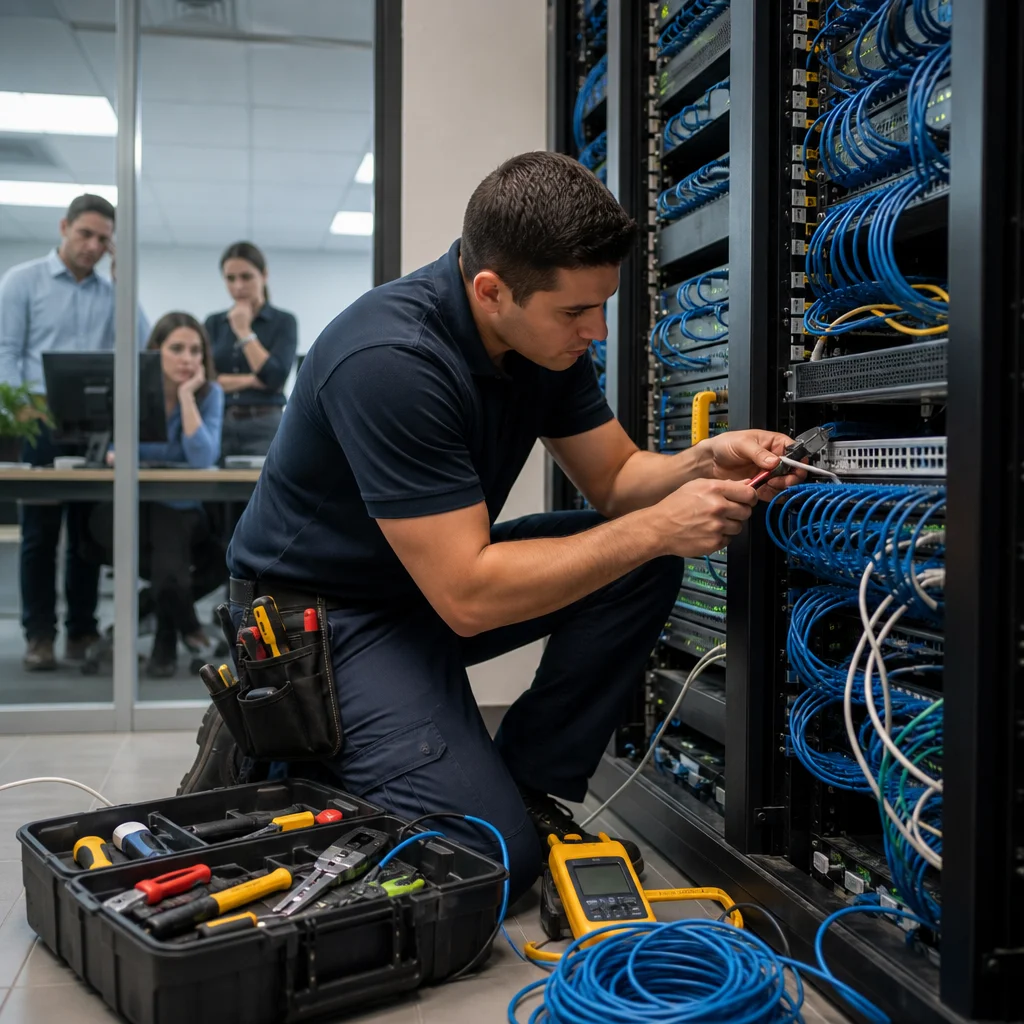
For a hospitality property managing guest satisfaction and revenue per room, even two hours without network access cascades into reservation system outages, payment processing failures, and compromised security camera feeds. For a distribution center running time-sensitive logistics, downtime translates to missed shipments and supply chain ripples.
National providers acknowledge this trade-off openly: their scale means higher ticket volumes and longer wait times in most non-metropolitan areas. They make up for it through standardized pricing, but you pay that cost in operational damage before a technician even arrives.
Your next move: Contact us for our 24/7 emergency response program details, which includes guaranteed response timeframes for your facility type.
Technical Expertise in Structured Cabling Systems
Emergency repairs require more than a technician with a toolkit. They require someone who understands structured cabling standards, termination protocols, and the relationship between your cabling infrastructure and the systems it supports.
When we respond to an emergency cable failure, our technicians carry knowledge of Category 6A specifications, fiber optic termination techniques, and how your access control systems, security cameras, and network management integrate through the same infrastructure. National providers often dispatch general field technicians trained on basic line replacement but without deep expertise in enterprise-grade structured cabling.
The difference matters when a repair requires more than a straightforward cable swap. Your access control system might rely on power-over-ethernet through the same line supporting your security cameras. A technician unfamiliar with PoE requirements could reinstall a cable that technically restores network connection but degrades power delivery to critical devices. We understand these interdependencies because we’ve designed and maintained these systems across high-stakes environments like healthcare facilities and secure warehousing operations.
Our structured cabling services include documentation of your full infrastructure, which means emergency repairs include context about redundancy, failover paths, and compliance requirements specific to your industry.
What to do now: Request a cable infrastructure audit from your current provider. If they can’t explain PoE specifications or your system’s redundancy paths, you’re at risk during emergencies.
Continuity of Service and Relationship Management
National providers handle tickets. We manage relationships with our clients, which translates to continuity during crises. When you call a national call center during an emergency, you’re assigned a ticket number. When you call us, you’re talking to someone who likely knows your facility manager, understands your previous infrastructure challenges, and can prioritize your emergency based on business context.
This matters operationally. We’ve worked with Marriott and Hyatt properties long enough to know which systems are revenue-generating (guest-facing networks) and which are operational (back-of-house systems). During an emergency, that knowledge helps us triage which lines to restore first and which redundancies we can leverage while repairs complete.
Continuity also means you receive the same technician or a team familiar with your site’s history. They’ve seen your previous cable installations, understand any quirks in your building’s infrastructure, and can reference prior repairs when diagnosing new issues. National dispatching assigns whoever is geographically closest, meaning you repeat your story every time and lose the benefit of accumulated knowledge.
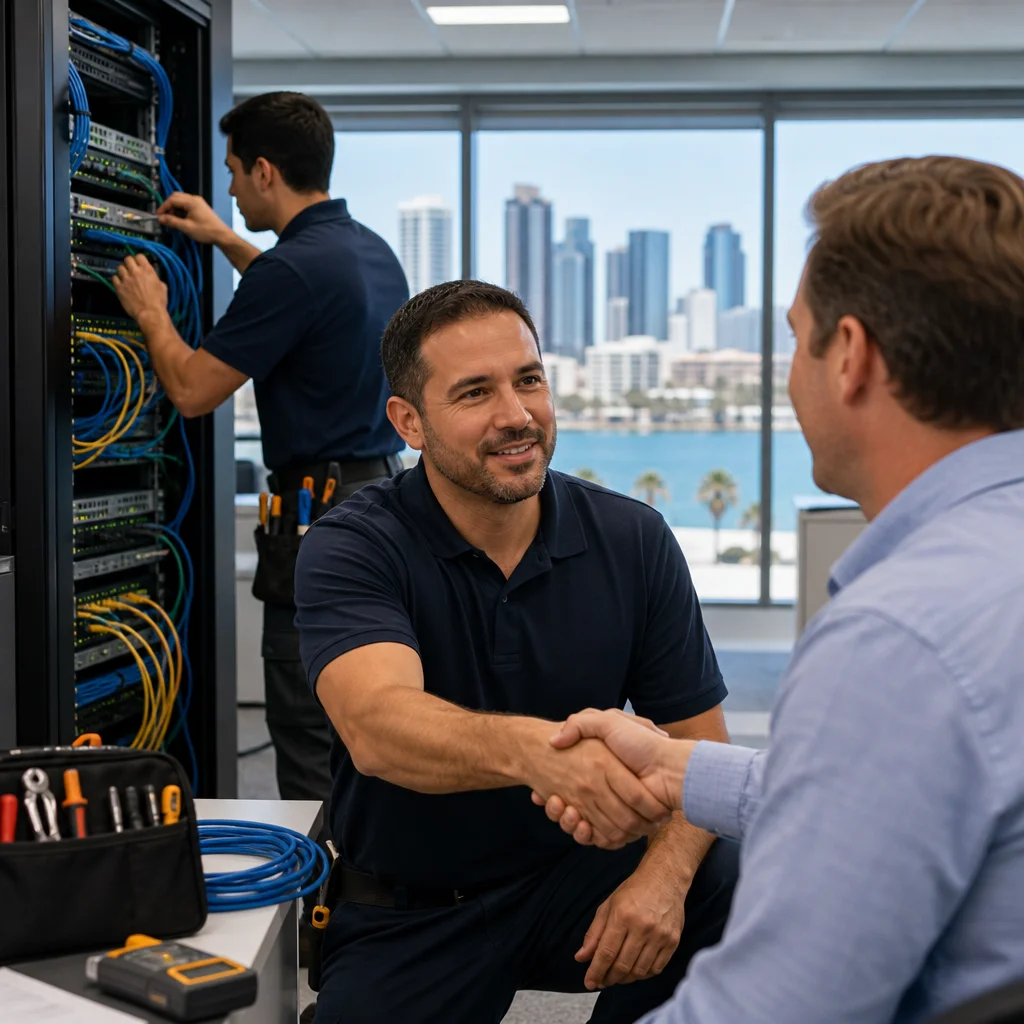
Immediate action: Establish a primary and secondary contact relationship with a local provider now, before emergencies force rushed decisions.
Cost Efficiency of Regional IT Partners
Regional providers operate with lower overhead than national chains. We don’t support massive call centers, 50-state licensing infrastructure, or corporate layers. That efficiency translates to cost savings for our clients, especially during emergency repairs when you’re already facing operational pressure.
National providers charge premium rates for emergency services, often with minimum service fees or expedited dispatch charges layered on top of technical work. Regional partners like us price emergency response competitively because our geographic concentration means lower travel time and faster completion.
Beyond the immediate repair cost, working with a regional provider creates opportunities for predictive maintenance and system optimization that prevent future emergencies. We already know your infrastructure, so we can recommend upgrades, redundancy additions, or environmentally protected routing that saves you thousands in future emergency repairs and downtime.
For a multi-property hotel group, this compounds. One emergency cable failure at a single property might cost $3,000-$5,000 with national providers. Across 10 properties, emergencies become catastrophically expensive. Regional providers offer service packages and maintenance contracts that keep costs predictable while reducing emergency frequency.
Next step: Compare your last three years of emergency service invoices and calculate what preventive maintenance investments would have prevented them.
Our Comprehensive Network Infrastructure Support
We don’t just repair cables when they fail. We provide end-to-end network infrastructure management that prevents emergencies from happening in the first place.
Our approach includes proactive monitoring of your cabling systems, environmental controls to protect infrastructure, and redundancy design that isolates failures to individual segments instead of taking your entire network down. For hospitality properties, this means guest-facing networks remain operational even if back-of-house systems experience failures. For healthcare facilities, it means compliance-critical systems stay online while we address non-critical cable issues.
We also provide infrastructure documentation and asset tracking, so when an emergency does occur, we have complete knowledge of your system configuration. This eliminates diagnosis time and gets repairs completed faster. We’ve implemented this for distribution centers and manufacturing facilities where downtime costs accumulate in minutes.
Our managed IT services complement cable infrastructure management. We monitor your network from our operations center, which means we often detect cable problems before they cascade into full outages. Abnormal traffic patterns, intermittent connectivity, or signal degradation gets flagged by our systems before your users experience service interruption.
Why Terapixels is Your San Diego Solution
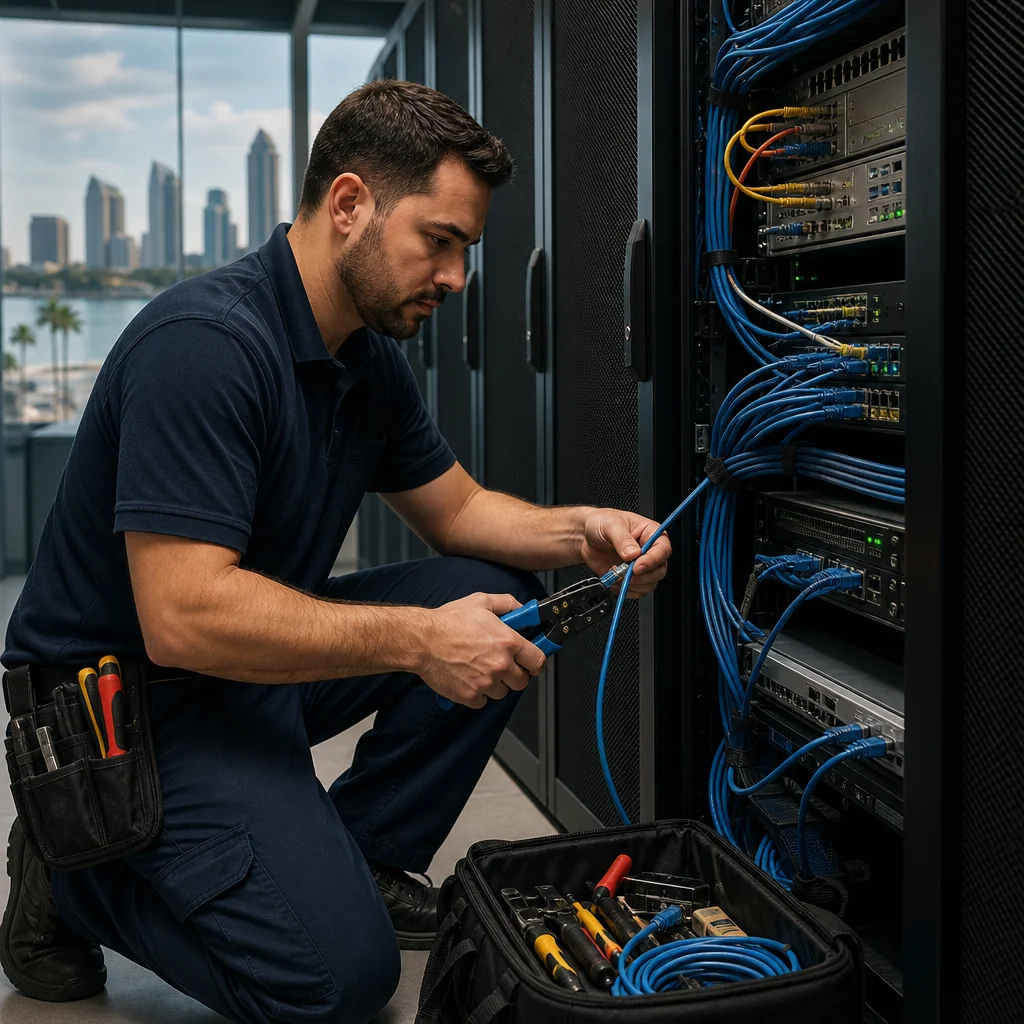
You need an infrastructure partner who understands the urgency of network cable failures and has the local presence to respond immediately. National providers prioritize ticket volume over client outcomes. Regional specialists like us prioritize your operational continuity because our reputation depends on it.
We’re based in Southern California, serving hospitality groups, healthcare facilities, warehousing operations, and manufacturing centers throughout the region. Our technicians know San Diego’s infrastructure challenges, your building types, and the specific compliance requirements your industry demands. When you call us with an emergency network cable repair, you’re connecting with someone who can be at your site quickly and who understands how your network failure impacts your business.
We provide 24/7 emergency response, expert-level structured cabling repair, and preventive maintenance programs designed to eliminate future emergencies. We integrate your access control systems, security cameras, and network infrastructure through a single coherent plan, which means emergency repairs maintain system integrity across all your critical infrastructure.
Don’t wait for an emergency to choose your infrastructure partner. Contact Terapixels Systems today to discuss emergency response programs tailored to your facility type, schedule a cable infrastructure audit, or set up preventive monitoring that keeps your network running reliably. Your operational continuity depends on local expertise backed by enterprise-level knowledge.
For further reading: Structured cabling services.
Frequently Asked Questions (FAQ)
What makes our emergency network cable repair service different from national providers?
We maintain local technicians in San Diego who understand regional infrastructure challenges and can typically arrive within hours rather than days. Our team has direct knowledge of your facility’s existing cabling systems, allowing us to diagnose and resolve issues faster than national call centers that rely on generic troubleshooting protocols.
How quickly can we respond to a network cable emergency?
We offer 24/7 emergency response with our local dispatch team ready to mobilize immediately when you contact us. Unlike national providers routing calls through multiple departments, we connect you directly with our technical staff who can assess your situation and dispatch equipment right away.
Can we handle both emergency repairs and ongoing network infrastructure needs?
Yes, we manage the complete lifecycle of your structured cabling and network systems, from emergency repairs to routine maintenance and infrastructure upgrades. This continuity means our team already knows your environment, reducing downtime and eliminating the need to coordinate with multiple vendors during critical situations.