CONTACT US
Table of Contents
- The Challenge of Fragmented Security Infrastructure
- Why Your Current Multi-Vendor Approach Is Costing You
- Understanding Cloud-Based Access Control Systems
- Exploring On-Premise Access Control Architecture
- Operational Efficiency: Which Deployment Model Wins
- Security, Compliance, and Data Control Considerations
- Integration with Your Existing IT Infrastructure
- Total Cost of Ownership: Long-Term Financial Analysis
- How We Help You Make the Right Choice
- Implementation and Support From Our Team
- Why Business Leaders in Southern California Trust Us
- Frequently Asked Questions (FAQ)
The Challenge of Fragmented Security Infrastructure
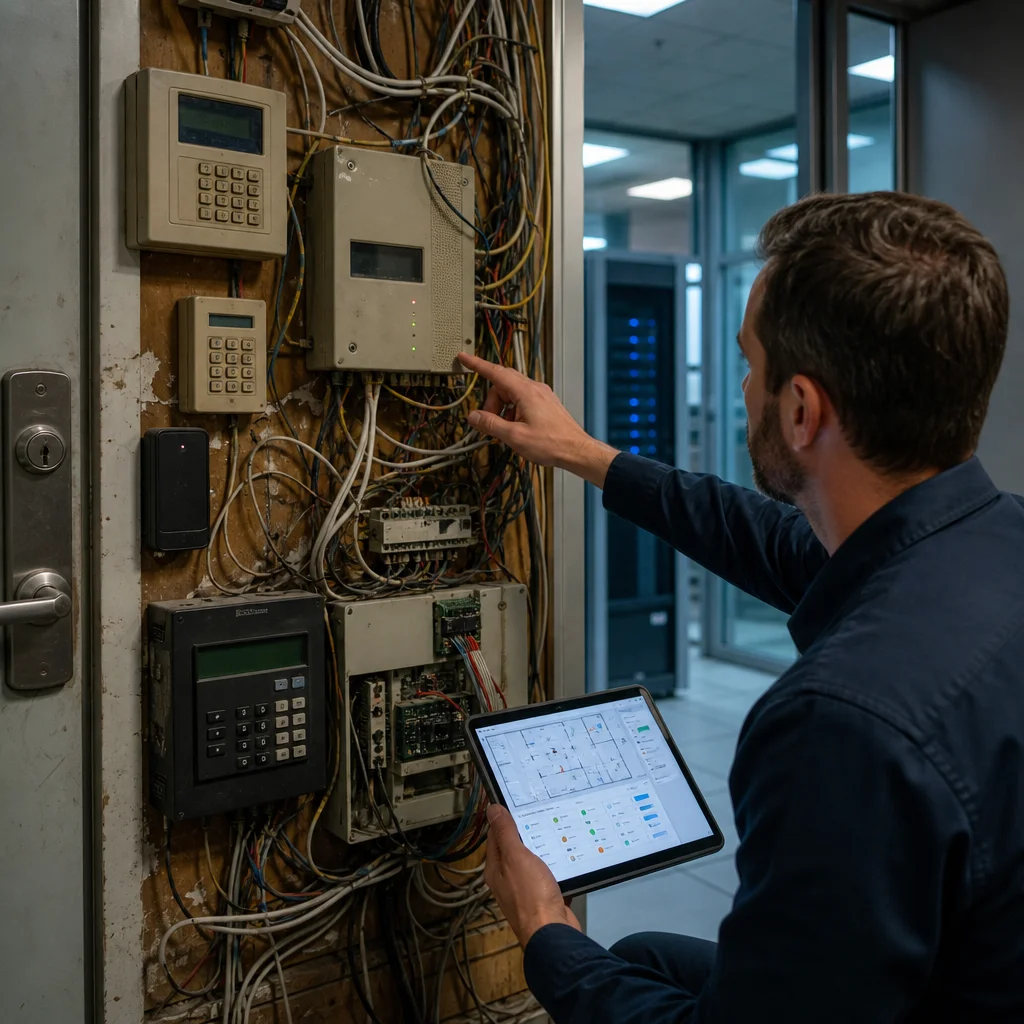
Managing security across multiple vendors creates operational friction that compounds over time. You’re coordinating separate contracts, juggling different support teams, and maintaining incompatible systems that don’t communicate effectively. When a breach occurs or compliance audit arrives, you’re scrambling to piece together data from disconnected platforms.
Most mid-sized facilities in Southern California operate with legacy access control systems that require on-site servers, coupled with newer cloud platforms handling other security functions. This fragmentation isn’t accidental, it’s typically the result of incremental technology decisions made across departments and years. The cost isn’t just financial, though that’s significant, it’s the operational complexity that diverts your team from strategic work.
We understand this pain point because we work with facility leaders running hospitality, warehouse, and healthcare operations across the region. The decision between cloud and on-premise access control isn’t theoretical for you, it directly impacts how your team responds to security incidents, manages visitor access, and maintains compliance documentation.
Why Your Current Multi-Vendor Approach Is Costing You
Fragmented security infrastructure creates hidden expenses that extend beyond monthly licensing fees. Support tickets require routing to different vendors, meaning a single access issue might involve calls to multiple teams with no single point accountability. Your IT staff spends time translating between systems, writing custom integrations, and troubleshooting compatibility problems that shouldn’t exist in a modern infrastructure.
Consider a practical scenario: a department head needs to grant temporary access to contractors. With disconnected systems, your facilities team submits a request to the access control vendor while IT manages credentials in a separate system. Nobody owns the end-to-end process, so timelines stretch from hours to days. Meanwhile, the contractor is waiting at the loading dock.
Real financial drains appear when you calculate redundancy costs. Many organizations maintain backup systems or duplicate hardware because their vendors can’t guarantee integration. You’re paying for overlapping functionality, duplicate support contracts, and infrastructure that serves as insurance against poor system integration.
Consolidating into a single technology partner eliminates this waste. We help you move toward one SLA partner architecture where access control, network infrastructure, and security systems share common management interfaces and response protocols.
Understanding Cloud-Based Access Control Systems
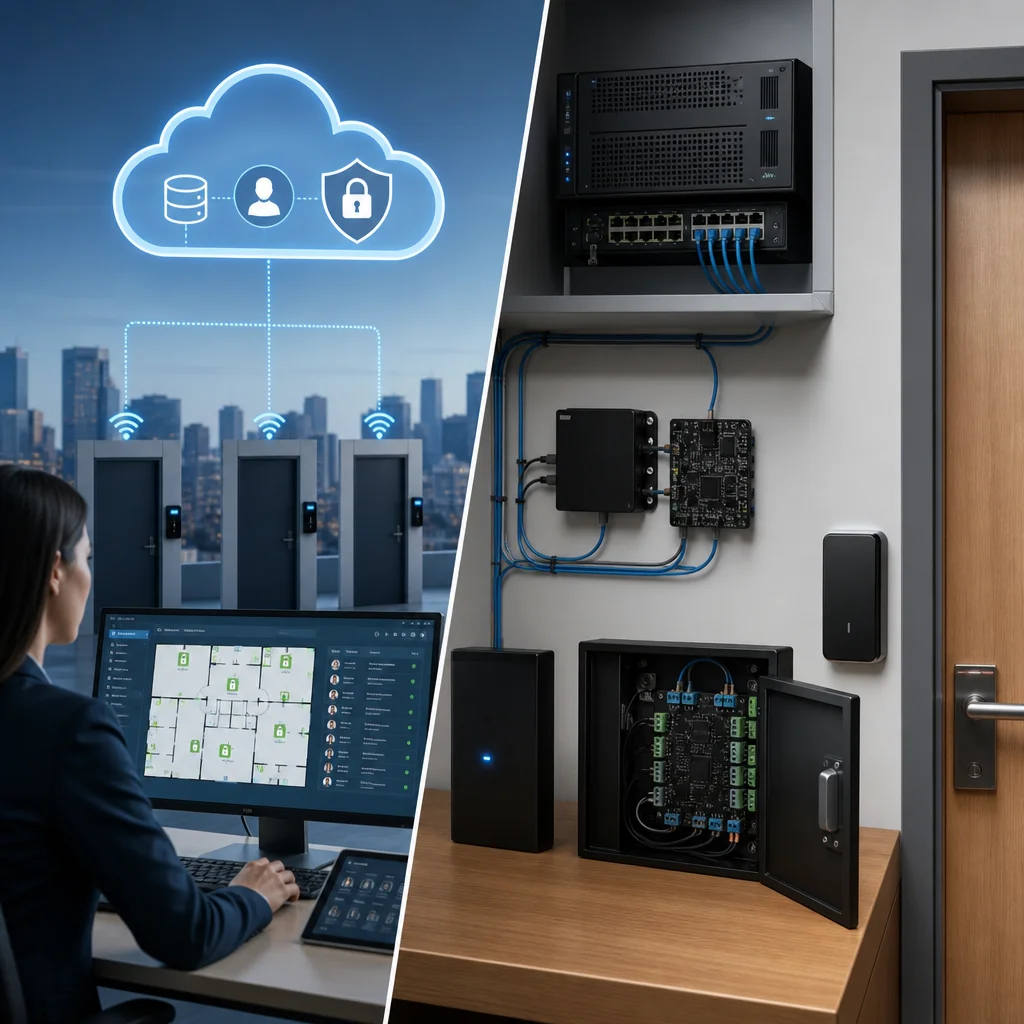
Cloud-based access control distributes your authentication and authorization logic across provider infrastructure, meaning your organization doesn’t maintain physical servers managing card readers or door locks. Systems like Salto KS operate through secure cloud connections, enabling real-time access updates, remote credential management, and simplified scaling across multiple facilities.
The operational advantages are immediate. Your access policies update globally within minutes rather than requiring technician visits to each location. A new employee in your San Diego warehouse gets added to the system instantly and can access appropriate areas without manual provisioning at each door. If someone needs access revoked due to termination, that takes effect across all locations simultaneously.
Cloud platforms handle critical housekeeping automatically. Software updates roll out without your involvement, security patches deploy without downtime, and backup systems operate transparently. Your facility manager doesn’t need to worry about server maintenance or capacity planning. For multi-site organizations, this centralized management is particularly valuable.
The trade-off centers on network dependency. Cloud access control requires reliable internet connectivity at each entry point. A connectivity outage at a critical location could lock down access until connection restores. Most modern systems include local failover logic, but this is an important consideration for facilities where network reliability has been inconsistent.

Exploring On-Premise Access Control Architecture
On-premise systems place control and data within your physical infrastructure, typically running on dedicated servers within your facility. Salto Space and similar platforms give you direct management authority, meaning your security policies and access logs remain entirely within your systems. For organizations with stringent data residency requirements or network constraints, this architecture often feels safer.
Local processing provides immediate access decisions. Your door controllers operate independently of internet connectivity, so network outages don’t impact physical security. This resilience appeals to operations requiring absolute uptime, particularly in healthcare or high-security warehouse environments where access control failure creates immediate operational problems.
You maintain complete visibility into your access logs and can implement custom policies without relying on cloud provider capabilities. This appeals to large facility operators running complex multi-site environments with unique access patterns.
The operational burden is substantial, however. Your team owns server maintenance, security patching, backup management, and capacity planning. When your access control server requires maintenance, you must plan for downtime or invest in redundant systems. As your organization grows, scaling becomes more expensive because you’re building infrastructure rather than consuming managed services.
Operational Efficiency: Which Deployment Model Wins
Cloud deployment typically delivers superior operational efficiency for growing organizations. Your team shifts from infrastructure maintenance toward policy optimization and security strategy. Help desk tickets resolve faster because the platform provider owns system health, not your internal IT staff.
Remote management capabilities in cloud systems enable your leadership to adjust access policies while traveling, responding in real-time to facility needs without requiring on-site technicians. For enterprises managing multiple Southern California locations across different time zones, this flexibility is operationally significant.
On-premise systems excel in highly specialized environments where custom integrations or specific compliance requirements demand local control. If your organization requires access control decisions integrated with proprietary manufacturing equipment or specialized healthcare workflows, on-premise architecture might provide necessary flexibility.
The efficiency inflection point typically occurs around five to seven facilities. Smaller organizations benefit from cloud’s simplicity and reduced staffing burden. Larger enterprises might justify on-premise investment if they have dedicated security infrastructure teams and specialized requirements. Medium-sized operations, like your typical regional hotel group or multi-warehouse distribution company, almost always find cloud efficiency advantages outweigh the control trade-off.
Security, Compliance, and Data Control Considerations
Your security requirements and regulatory obligations directly influence this decision. HIPAA healthcare facilities, PCI-compliant hospitality venues, and ISO-certified manufacturers each have specific compliance burdens that shape infrastructure choices.
Cloud providers operating at scale maintain security capabilities that exceed what most mid-sized organizations can build independently. They employ dedicated security teams, maintain redundant systems across geographic regions, and achieve compliance certifications that individual organizations struggle to match. Salto KS, for example, operates with enterprise-grade encryption, multi-factor authentication, and comprehensive audit logging.
On-premise systems give you absolute data control and potentially simpler compliance documentation for regulated environments. You control exactly what happens with access logs, credential information, and audit data. Some healthcare or financial organizations prefer this direct ownership.
The distinction blurs when you consider shared responsibility models. Cloud access control providers maintain infrastructure security while you remain responsible for policy configuration, credential management, and access authorization. Neither deployment eliminates your compliance obligations, they simply shift which party owns which aspects.
For most Southern California facility operators, cloud security standards exceed their internal capabilities. The risk isn’t cloud platforms, it’s the hybrid environment where cloud access control connects to aging network infrastructure without proper segmentation. We ensure your entire ecosystem, including network infrastructure and security systems, operates under consistent security standards regardless of cloud or on-premise access control.
Integration with Your Existing IT Infrastructure

Your access control architecture must align with current infrastructure, not exist in isolation. Cloud platforms require stable network infrastructure with redundant internet connectivity, appropriate firewall rules, and network monitoring. If your facility operates over older network equipment or relies on single internet connections, cloud access control creates dependencies that could impact reliability.
On-premise systems need dedicated server infrastructure, regular maintenance windows, and IT staff trained on specific platforms. They integrate directly with your network but require local infrastructure investment.
We evaluate your complete infrastructure ecosystem when recommending deployment architecture. A hotel group with modern network infrastructure throughout their properties often benefits from cloud simplicity. A warehouse with aging network equipment might need infrastructure modernization regardless of access control choice. A healthcare facility with strict data residency requirements might need hybrid architecture with cloud management and local processing.
Modern access control systems integrate with building management systems, visitor tracking platforms, and security camera networks. Your choice of deployment model influences how these integrations operate. Cloud platforms often provide easier integrations through APIs and cloud-native architectures. On-premise systems offer deeper local system integration but require more custom development.
Total Cost of Ownership: Long-Term Financial Analysis
The financial comparison extends beyond monthly licensing costs to encompass infrastructure investment, staffing, and operational expenses across your planning horizon.
Cloud deployment typically shows lower total cost of ownership over five to ten years for mid-sized organizations. Monthly recurring expenses are predictable and scale with facility growth. You avoid major infrastructure investments, eliminate redundant systems, and reduce staffing requirements for system maintenance. For a ten-location regional operation, this often means 30-40% lower total cost compared to on-premise architecture with equivalent redundancy.
On-premise systems require significant upfront capital investment for servers, networking equipment, and installation labor. Subsequent costs include maintenance contracts, security updates, eventual hardware replacement, and internal staff time for ongoing management. Organizations underestimate this staffing cost. Maintaining access control infrastructure isn’t a part-time responsibility, it’s a specialized role requiring training and expertise.
Break-even analysis typically favors cloud for organizations without existing on-premise infrastructure. If you currently operate on-premise systems nearing end-of-life, replacement cost analysis should consider cloud migration. Sometimes the migration cost makes financial sense even if operation cost advantages seem modest.
We work with you to model your specific scenario. Your facility count, growth projections, current infrastructure condition, and internal staffing constraints all influence the financial calculation. A consulting partner should help you quantify these factors rather than pushing predetermined conclusions.
How We Help You Make the Right Choice
Our process begins by understanding your facility operations, security requirements, and infrastructure reality. We’re not here to sell you cloud or on-premise solutions, we’re here to recommend the architecture that serves your business most effectively.
We conduct infrastructure assessments evaluating your network reliability, existing systems, compliance obligations, and staffing capabilities. This assessment reveals whether your current infrastructure supports cloud deployment, what modernization might be necessary, or whether on-premise architecture genuinely makes sense for your situation.
We then model scenarios showing financial implications, implementation timelines, and operational impacts of each approach. Some organizations discover hybrid architecture makes sense: cloud-based management with local processing for critical facilities, or on-premise systems for specialized locations with cloud-based access control for standard facilities.
Our recommendation always prioritizes your business operations. If on-premise architecture genuinely serves you better, we’ll implement it effectively. Most often, we find that cloud platforms with proper network infrastructure and security integration deliver the best combination of capability, reliability, and cost efficiency.
Implementation and Support From Our Team
Once you’ve selected your architecture, implementation execution determines success. Cloud deployment seems simpler but requires careful network planning, credential migration, and user training. On-premise deployment involves hardware installation, system configuration, and integration complexity.
We manage the complete implementation process, including network infrastructure preparation, credential migration from existing systems, integration with your security cameras and visitor management platforms, and comprehensive staff training. We don’t hand off a system and disappear, we ensure your team operates it confidently.
Our managed IT services model means you have ongoing support and optimization. We monitor your access control systems, handle software updates, manage credential provisioning workflows, and continuously optimize policies based on your operational experience. When you encounter access issues or need policy adjustments, you contact us through a single support channel rather than coordinating multiple vendors.
For Southern California organizations managing hotels, warehouses, healthcare facilities, or distribution centers, we provide 24/7 support ensuring security incidents receive immediate attention regardless of time or location.
Why Business Leaders in Southern California Trust Us
We understand regional facility operations because we work embedded in your facilities. We know the access control requirements for Marriott, Hilton, and Hyatt properties throughout Southern California. We understand warehouse operations at distribution centers requiring complex dock access protocols. We support healthcare facilities managing HIPAA compliance through robust access control architecture.
Our expertise spans the complete spectrum: structured cabling infrastructure, network management, access control systems, HD security camera installation, and specialized electrical installation. This integrated approach means your access control decision considers your complete technology ecosystem rather than existing in isolation.
We consolidate multiple technology vendors into a single trusted partner. Rather than juggling separate relationships with network providers, access control specialists, and security system integrators, you work with one team accountable for your complete security and IT infrastructure. This simplification drives operational efficiency and reduces cost through elimination of redundant services.
Business leaders trust us because we deliver results. We’ve implemented hundreds of access control systems across regional facilities, managed successful migrations from aging infrastructure, and provided security solutions that scale with growing operations. More importantly, we stand behind our recommendations and support our implementations with dedicated resources and genuine accountability.
Your access control decision shapes your security posture and operational efficiency for the next five to ten years. Make it thoughtfully, with guidance from a partner who understands your facility operations, your compliance requirements, and your business objectives. Contact us to discuss your specific situation and receive a detailed assessment of which architecture serves your organization best.
Frequently Asked Questions (FAQ)
What’s the main difference between cloud and on-premise access control for our facilities?
We typically recommend cloud-based systems like Salto KS when you need real-time remote access and lower upfront costs, while on-premise solutions like Salto Space work best if you require complete data control and have reliable IT infrastructure in place. Cloud systems let us manage your access permissions from anywhere, whereas on-premise deployments keep all your security data within your facility’s servers. The right choice depends on your specific compliance requirements and whether you prefer managed responsibility or direct control.
How do we integrate access control with our existing IT infrastructure?
We ensure seamless integration by evaluating your current network setup, security protocols, and managed IT systems before recommending a deployment model. Our team handles the technical alignment so your access control system communicates properly with your existing servers, security cameras, and IT management tools. We’ve found that this integration planning prevents costly complications down the road and maximizes your investment across all security systems.
What does the total cost of ownership look like for each approach?
Cloud solutions typically offer lower initial expenses but recurring monthly fees, while on-premise systems require significant upfront investment with lower ongoing costs over time. We conduct a detailed financial analysis for your specific situation, factoring in maintenance, software licensing, staffing needs, and potential future expansion. Our goal is helping you understand the real five-to-ten-year costs so you can make a decision that aligns with your budget and business goals.