CONTACT US
Table of Contents
- Why Integrated Cabling and Access Control Matter for Your Facility
- The Challenge with Multiple Technology Vendors
- Our Comprehensive Approach at Terapixels
- Structured Cabling Excellence and Performance Standards
- Advanced Access Control Integration
- How We Compare to HPE and Aruba Solutions
- Seamless System Integration and Unified Management
- Scalability and Future-Ready Infrastructure
- Cost Efficiency Through Single-Partner Solutions
- Security and Compliance in One Platform
- Client Success Stories and Results
- Why Terapixels is Your Definitive Partner
- Frequently Asked Questions (FAQ)
Why Integrated Cabling and Access Control Matter for Your Facility
Your facility’s backbone determines how well everything else works. When cabling infrastructure and access control operate independently, you’re essentially running two separate nervous systems through the same building. We’ve watched mid-sized hotel chains, warehouse operators, and healthcare facilities struggle with this fragmentation for years.
Integrated cabling and access control solutions eliminate costly redundancies and create a unified nerve center for your physical security and operational efficiency. A hotel property managing guest access, staff credentials, and emergency protocols needs these systems talking to each other in real time. A warehouse requiring inventory area restrictions, employee tracking, and audit trails can’t afford system delays or data silos. Manufacturing facilities with strict compliance requirements depend on synchronized access logs that match network activity.
When cabling infrastructure supports both data and security systems from a single foundation, you gain several immediate advantages:
- Real-time access alerts that integrate with your IT monitoring dashboard
- Unified reporting for compliance audits across both physical and digital security
- Faster incident response when physical access matches network authentication
- Reduced wiring costs and installation disruption
The integration isn’t just about saving space in your server closet. It’s about creating accountability and visibility throughout your entire facility. When your access control and IT systems operate from the same infrastructure with coordinated management, you can track who was where, when they accessed what, and correlate that with network activity. That correlation is what transforms security from reactive to predictive.
Next step: Assess your current cabling infrastructure. Is it supporting both physical security and data networks, or are you running parallel systems?
The Challenge with Multiple Technology Vendors
Most Southern California businesses inherited their access control and cabling systems from different eras. You might have legacy cabling from one installer, access control hardware from another vendor, and network management from a third party. This creates invisible friction that compounds over time.
The problems are real:
- Integration headaches: Your access control system can’t communicate with your network monitoring platform, so you lose correlated intelligence.
- Vendor finger-pointing: When something fails, you’re caught between multiple companies blaming each other for compatibility issues.
- Fragmented support: You maintain separate contracts, support tickets, and escalation procedures instead of one unified point of contact.
- Costly redundancy: Each vendor installs their own cabling, conduit work, and infrastructure, doubling costs and creating aesthetic and safety issues.
- Knowledge gaps: Technicians from different vendors don’t understand each other’s systems, making upgrades and maintenance unnecessarily complicated.
- Compliance exposure: Audit trails are split across systems, making regulatory compliance harder and more expensive to demonstrate.
A property management company with 15 hotel properties we worked with was paying three separate vendor contracts totaling $280,000 annually. When a guest access card issue occurred at one property, the access control vendor blamed the network infrastructure, the IT vendor blamed the cabling, and the situation took three weeks to resolve. That’s lost operational time, frustrated staff, and security gaps.
The hidden cost multiplies when you consider staff training, documentation management, and the mental overhead of coordinating across vendors. You’re not just paying three invoices. You’re paying for complexity.
Our Comprehensive Approach at Terapixels
We built Terapixels Systems around a simple principle: your facility deserves one trusted partner who owns the full technology stack, not a loosely coordinated committee of vendors.
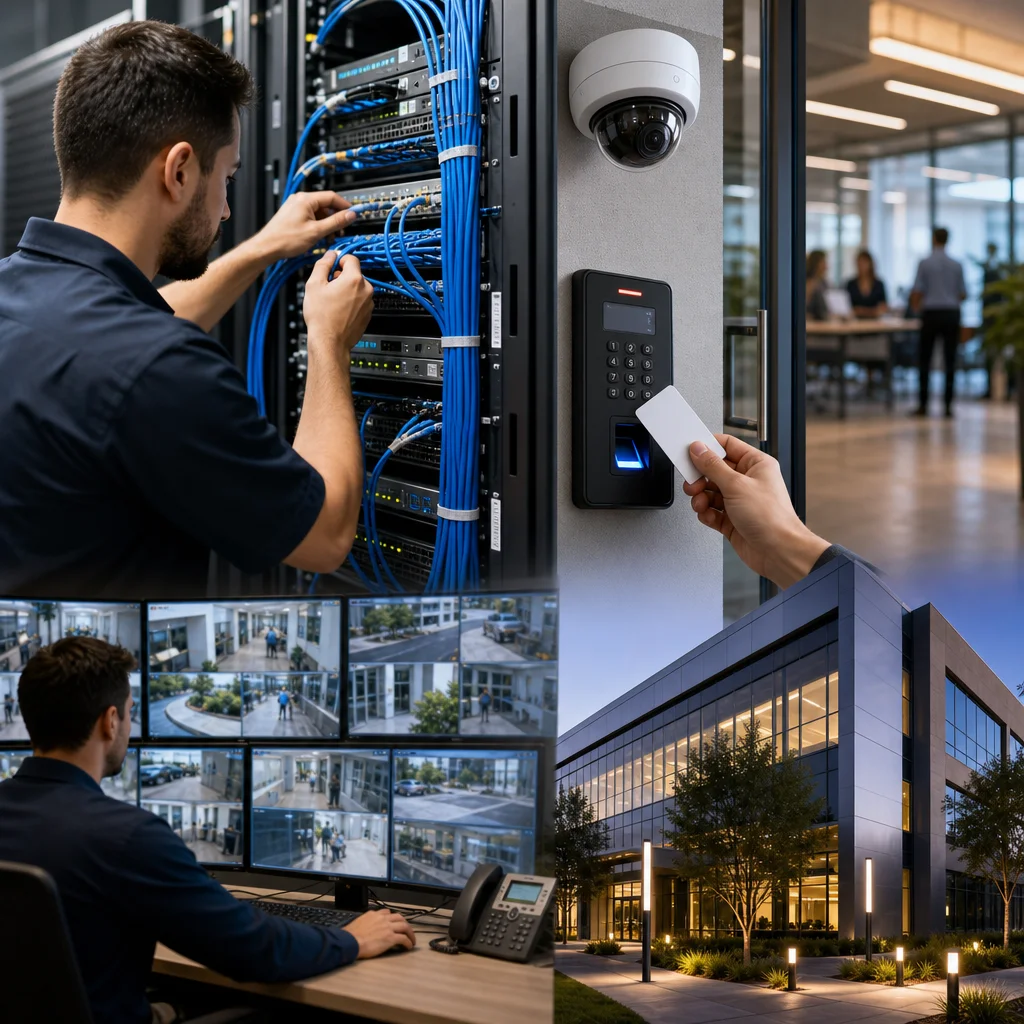
Our end-to-end approach covers structured cabling, access control systems, security camera installation, managed IT infrastructure, and specialized electrical installation. We design and install the entire foundation, then manage it as an integrated ecosystem. That means when you call us with a problem, we troubleshoot the cabling, the access control logic, the network segment, and the security protocol together, not in isolation.
Here’s how our methodology differs:
Single point of accountability: We own the entire installation and ongoing performance. There’s no vendor finger-pointing because we’re responsible for every component working together.
Unified infrastructure planning: Our engineers design cabling systems that support both data and security from day one, eliminating parallel installations and future compatibility issues.
Integrated management platform: You get one dashboard that shows network health, access events, security camera streams, and user credential status all at once.
Consistent support standards: One support contract, one escalation path, and one team trained across all systems means faster response times and fewer misdiagnosed issues.
Long-term optimization: As your facility evolves, we upgrade and integrate new systems without ripping out existing infrastructure or creating orphaned equipment.
We specialize in serving hotels, healthcare clinics, warehouses, distribution centers, manufacturing facilities, and property management companies across Southern California. These businesses typically face strict compliance requirements, need scalability as they grow or expand, and can’t afford security gaps or downtime.
Structured Cabling Excellence and Performance Standards
Your cabling infrastructure is the foundation for everything we do. We don’t cut corners here.
We design and install structured cabling systems that meet or exceed industry standards for Category 6A and Cat 8 performance, depending on your specific requirements. This means your access control systems, security cameras, network devices, and future technologies all run on infrastructure built to last 10-15 years with minimal degradation.
Our approach includes:
- Comprehensive site surveys: We map every access point, cable run, power requirement, and future expansion zone before installation begins.
- Proper cable management and documentation: Every run is labeled, tested, and documented so future upgrades don’t require guessing or tracing.
- Redundancy where it matters: Critical security and network pathways get redundant cabling so a single failure doesn’t take down operations.
- Conduit and pathway planning: We avoid installing cable directly where mechanical damage or environmental factors could degrade performance.
- Standards-compliant termination: All connections are terminated to TIA/EIA standards with verification testing, not best-guess installations.
A warehouse we equipped for a major distribution operator initially needed cabling for basic network connectivity and access doors. We anticipated their growth trajectory and installed infrastructure that could support four times their current access points and network load. Five years later, when they doubled their facility footprint, they expanded access control to 40 additional zones using our existing infrastructure. Zero rework required.
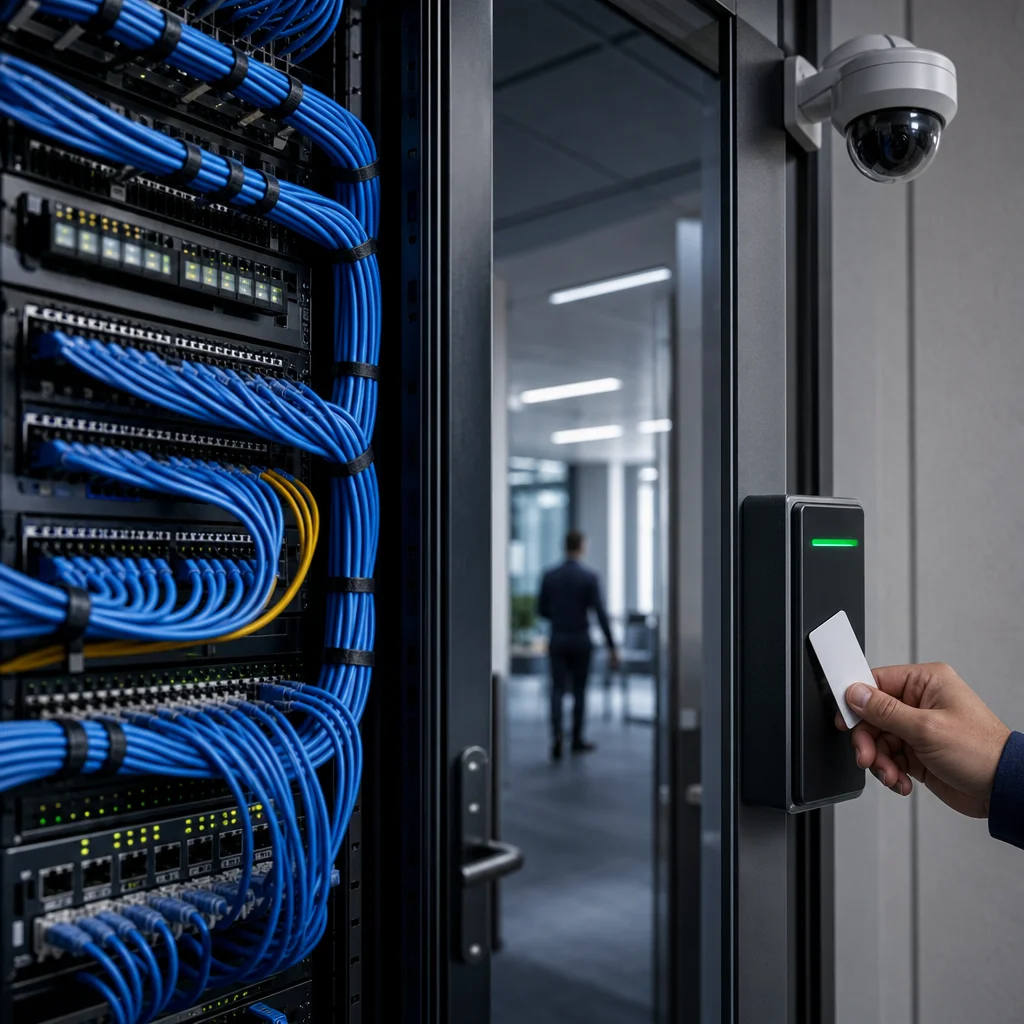
Performance standards matter because cheap cabling fails silently. A degraded ethernet run to your access control panel might work most of the time, creating intermittent authentication delays and false alerts that frustrate staff and undermine your security posture. We test every cable run after installation and provide documented performance metrics.
Actionable takeaway: Request a cabling audit from your current provider. Ask for physical test reports for each cable run. If you don’t have them, you’re operating on assumption, not verification.
Advanced Access Control Integration
Access control isn’t just about locking and unlocking doors. It’s about creating a security event log that ties physical movement to organizational policy.
Our access control integration combines modern credential technology with intelligent access logic that understands your facility’s operational flow. We implement solutions using standards-based platforms that avoid vendor lock-in while delivering enterprise-grade capability.
Here’s what integrated access control looks like in practice:
Multi-credential support: Your system reads proximity cards, mobile credentials, biometric data, and PIN codes depending on the access point and security level required. A hotel front desk uses a PIN, but your server room requires biometric verification plus a valid credential.
Time-based access rules: Your system grants access only during authorized hours or shifts, preventing after-hours facility access without explicit approval.
Visitor management integration: Temporary credentials issue automatically when a contractor or vendor arrives, with access limited to specific zones and times.
Anti-passback logic: Your system prevents someone from swiping a credential multiple times to grant a second person entry, a common security gap.
Real-time alerts: Access denial attempts, invalid credentials, after-hours access, and unusual patterns trigger immediate alerts to your security team and management.
Integration with IT systems: Access events feed into your security information and event management (SIEM) system, creating correlated logs of who accessed what, both physically and digitally.
For a hospital clinic network we support, we integrated access control with their badge printing system so credentials activate automatically upon creation. We also connected access logs to their IT infrastructure, allowing them to audit which physical spaces were accessed during the same time period as specific network logins. This level of correlation helped them identify a former employee who was accessing systems from unauthorized locations.
California access control systems work best when they’re designed around your specific operational requirements, not generic templates.
Next step: Map your current access points and document which ones are truly high-security, which are convenience locks, and which could benefit from real-time monitoring.
How We Compare to HPE and Aruba Solutions
HPE and Aruba provide excellent networking and infrastructure platforms, and many enterprise organizations use their equipment. But there’s an important distinction: they’re network equipment manufacturers, not integrated security solution providers.
HPE and Aruba excel at switches, routers, wireless controllers, and data center infrastructure. They’re designed for IT teams managing network connectivity and performance. When you buy HPE or Aruba, you’re buying network capability, not a facility-wide security and access control ecosystem.
Here’s the practical difference:
HPE and Aruba handle network infrastructure but require you to partner separately for structured cabling design, access control systems, security camera integration, and unified management. You still need multiple vendors.
Terapixels delivers the complete stack: we design the cabling infrastructure that carries HPE or Aruba network traffic, we integrate access control systems with that network, we install security camera feeds through the same conduit system, and we provide a unified management dashboard that ties everything together.
You could buy HPE switching equipment and still have fragmented access control and cabling systems. That’s not a solution; that’s just one component of a larger, more complex problem.
Many organizations use HPE or Aruba at their core network layer, and we respect that choice. In fact, we often design cabling infrastructure that optimally supports their equipment. The difference is we don’t stop there. We complete the picture by integrating everything a mid-sized or enterprise facility actually needs: security, access control, credential management, and compliance reporting.
For a hotel chain managing 25 properties across Southern California, we deployed HPE networking equipment alongside our structured cabling and integrated access control platform. Each property could manage its own local security credentials while headquarters got unified reporting across all locations. HPE provided the network foundation; we provided the complete security ecosystem.
Why this matters: Don’t confuse network equipment vendors with facility security integrators. You need both, but they serve different purposes.
Seamless System Integration and Unified Management
The real power emerges when all your systems report to a single management interface.
We build integration architecture where your access control platform, network monitoring, security camera management, and IT infrastructure health metrics all feed into one command center. Your facilities manager doesn’t toggle between five different software platforms to understand what’s happening in the building. They open one dashboard and see everything.
This unified view enables:
Incident correlation: A badge attempt at a secure area triggers an access denial. The system simultaneously notes no valid network credentials for that user ID at that location and flags the corresponding security camera feed. Your team sees a complete incident profile instead of isolated alerts.
Operational efficiency: Your facilities team schedules maintenance work knowing exactly which access points will be affected, which network segments carry critical data, and which camera views cover the work area.
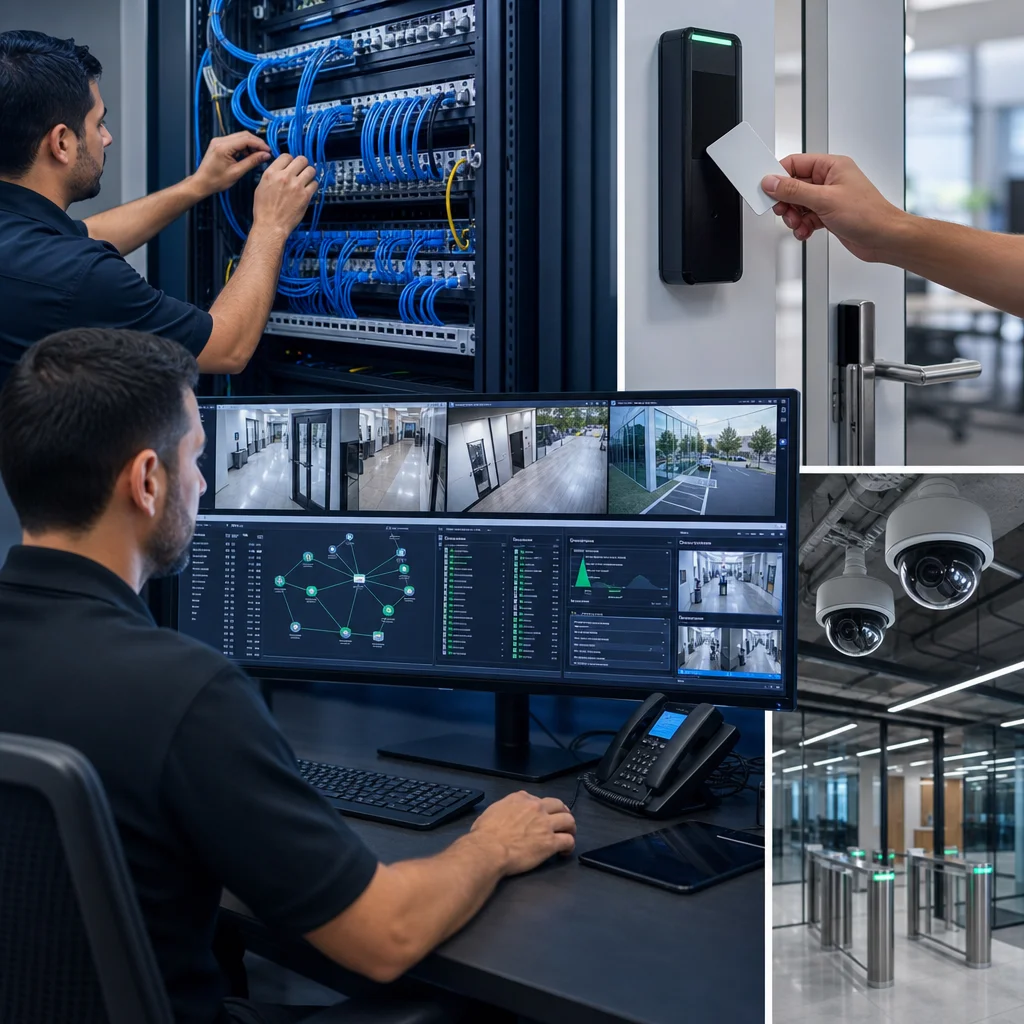
Compliance documentation: Auditors get a single, comprehensive report showing access events, network activity, camera footage timestamps, and system health metrics all aligned to specific dates and times.
Faster troubleshooting: When your IT team investigates a network anomaly, they can instantly cross-reference physical access logs to see if unauthorized personnel accessed the network infrastructure during the suspicious activity window.
For a manufacturing facility we equipped, we integrated their access control system with their production network and security cameras. When they noticed unusual inventory movements during off-hours, the unified system immediately showed that someone accessed the warehouse with a valid credential during those hours, plus IP logs of network activity during the same period, plus camera footage of the specific locations involved. Investigation that would have taken days across disconnected systems was resolved in hours.
Actionable insight: If your current systems can’t generate a single report showing access events, network activity, and camera footage with aligned timestamps, you don’t have true integration. You have disconnected systems.
Scalability and Future-Ready Infrastructure
Your facility will change. You’ll add departments, expand locations, increase security requirements, or shift your operational model. Your infrastructure should flex with you instead of fighting you.
We design systems with forward capacity built in. A hotel property we equipped five years ago had 8 access-controlled zones and 40 network drops. We installed cabling infrastructure designed for 40 access zones and 200 network drops. Today, they’ve expanded to 28 controlled zones and 180 network drops. No rework. No new conduit runs. Just activation of existing infrastructure.
Scalability works at multiple levels:
Physical expansion: Your cabling infrastructure has room to grow without new trenching or wall penetrations.
Technology evolution: Your system architecture uses open standards, not proprietary lock-in, so you can upgrade access control hardware, swap network equipment, or add new security technologies without replacing the entire foundation.
Geographic growth: If you manage multiple facilities, we design them with consistent architecture so credentials, policies, and reporting work seamlessly across locations.
User growth: Adding 50 new employees doesn’t require system redesign; it requires credential provisioning and potentially new access rules.
Integration expansion: When you add a new security technology like facial recognition, automated visitor management, or advanced analytics, it integrates into your existing platform without replacing what works.
A healthcare clinic network we support serves a hospital system with three locations and plans for three more. We designed the cabling and access control infrastructure across all three locations with standardized architecture. When they open facility four in 18 months, they’ll use the same cabling specifications, the same access control platform, and the same management interface. No new vendor relationships. No compatibility surprises.
The upfront cost of designing for scalability is less than the cost of rebuilding systems multiple times as your business grows.
Cost Efficiency Through Single-Partner Solutions
You don’t save money by hiring the cheapest vendor. You save money by eliminating waste, reducing complexity, and avoiding expensive rework.
When you consolidate multiple vendors into one partner, you remove significant costs that most businesses overlook:
Eliminated redundancy: Instead of three separate companies running three separate cabling systems through your walls, we run one integrated system. That’s one installation crew, one set of conduit, one cable plant, one termination effort. Concrete savings of 30-40% on infrastructure costs.
Simplified support: One contract. One escalation path. One team trained on your entire system. You eliminate the overhead of coordinating between vendors and the risk of problems falling through cracks between their responsibilities.
Reduced downtime: When something fails, we troubleshoot the entire stack, not just one layer. Problems that would take three weeks to resolve across disconnected vendors often resolve in days because we see the full picture immediately.
Avoided mistakes: When vendors hand off responsibility, mistakes happen. Cabling gets installed in incompatible ways. Access control systems get configured without understanding network capacity. We eliminate handoff errors by owning every layer.
Future upgrade efficiency: When you need to expand or upgrade, you’re not negotiating with multiple vendors with conflicting schedules and contradictory recommendations. One partner means one plan, one installation window, one invoice.
We worked with a property management company managing 12 hotel properties that was spending $420,000 annually across three separate vendors for cabling maintenance, access control support, and network management. They were also budgeting $60,000 per year for emergency repairs and vendor coordination time. After consolidating with us, their annual cost dropped to $280,000 for the complete integrated stack, including maintenance and 24/7 support.
That’s not a discount. That’s elimination of waste.
Real calculation: Factor in not just service costs, but staff time spent coordinating between vendors, emergency repair markups, and downtime impact. Most businesses find single-partner integration costs 35-45% less than managing multiple vendors, even if the per-unit vendor costs appear higher in isolation.
Security and Compliance in One Platform
Your industry likely requires compliance with specific standards. Hotels must comply with property security protocols. Hospitals must meet HIPAA requirements for physical and digital access. Manufacturing facilities require audit trails for material access. Warehouses need accountability for inventory handling.
Compliance isn’t a separate project from security. It’s the documentation that security creates.
When your structured cabling, access control, network infrastructure, and security systems all report to a unified platform, compliance becomes automatic documentation rather than manual scrambling. Every access event gets logged with timestamp, user ID, access point, and authorization level. Every network activity gets correlated with the physical location where that traffic originated. Every security incident gets recorded with camera footage, access logs, and system health metrics all aligned.
During an audit, instead of producing separate reports from three vendors with conflicting timestamps and gaps in coverage, you produce one comprehensive audit trail that satisfies regulatory requirements with minimal interpretation.
For a healthcare facility we support, a patient privacy incident occurred involving access to a protected area. The compliance team needed to prove who accessed the area, when, and what information they could have seen. Our integrated system provided:
- Access control logs showing badge swipes and authentication timestamps
- Network logs showing which credentials accessed patient data systems during the same time window
- Security camera footage with synchronized timestamps matching the other logs
- System health records showing no unauthorized access attempts or system tampering
Complete, irrefutable documentation. The investigation took days instead of weeks.
Compliance also means redundancy and failover. If your access control system fails, can backup systems maintain security? We design systems with redundancy that keeps security intact even if primary systems fail temporarily.
Compliance actionable step: Request an audit trail report from your current systems showing a specific access event with network activity and camera footage correlated by timestamp. If you can’t get this in one report from one system, you don’t have true compliance readiness.
Client Success Stories and Results
Our clients across Southern California have seen measurable improvements in security, operational efficiency, and cost management.
A Marriott property managing 400 guest rooms, 120 staff members, and multiple secure areas (kitchen, administrative offices, engineering spaces) needed to replace aging access control hardware while simultaneously expanding their property. They were juggling three vendor relationships with conflicting recommendations and no unified reporting. We designed and installed structured cabling infrastructure that supported both their existing network and new access control systems, then integrated everything into one management platform.
Results: Access to secure areas went from manually logged cards to real-time digital tracking. Guest safety improved because housekeeping access was logged and monitored. Staff accountability increased because all facility access was documented. Compliance reporting that previously took their team three days now generates automatically in minutes.
A distribution center managing inventory access across 12 distinct warehouse zones needed to track exactly who accessed what during specific timeframes. Their previous access control system didn’t integrate with their network, so investigators couldn’t correlate physical access with network logins from the same user. We integrated their access control with their IT infrastructure, giving them complete correlation. During a subsequent inventory investigation, they immediately identified that one employee accessed a restricted network folder from the warehouse floor during a time when inventory discrepancy occurred. Problem solved with data instead of suspicion.
An independent healthcare clinic managing patient privacy and staff access across multiple suites needed separate access credentials and manual badging processes for different areas. We designed an integrated access control system where credentials automatically adjusted permissions based on staff role and location. Visitors automatically received temporary credentials upon check-in that expired at checkout. Patient privacy improved, staff efficiency improved, and compliance auditing became automatic.
These aren’t theoretical benefits. These are real results from real businesses solving real problems with integrated infrastructure.
Why Terapixels is Your Definitive Partner
If you’re a mid-sized business leader managing a facility in Southern California with security and operational requirements, you face a choice: continue managing multiple vendor relationships with fragmented systems, or consolidate with a single partner who owns the entire technology stack.
Terapixels Systems is purpose-built to serve exactly your situation. We don’t manufacture networking equipment and hope you’ll buy access control elsewhere. We don’t install access control as an afterthought to network infrastructure. We design complete ecosystems where structured cabling, access control, security cameras, IT infrastructure, and managed services work as one integrated platform.
Here’s what that means practically:
One point of accountability: We own your complete security and IT infrastructure. You don’t have vendor A blaming vendor B. You have one partner responsible for your security posture and operational efficiency.
Integrated design and installation: Our teams design cabling infrastructure that optimally supports access control, camera systems, and network traffic from the beginning, not as an afterthought. That eliminates redundancy, reduces costs, and improves performance.
Unified management and visibility: One dashboard shows you security events, network health, system status, and compliance metrics all correlated by time and location. You understand what’s actually happening in your facility instead of piecing together fragments from multiple systems.
Proven expertise with your business type: We’ve equipped hotels, healthcare facilities, warehouses, manufacturing plants, and property management companies throughout Southern California. We understand your compliance requirements, operational constraints, and growth patterns.
Long-term partnership approach: We don’t treat installation as the end of our relationship. We manage your infrastructure, respond to your support needs, and evolve your systems as your business changes. You have a true partner, not a vendor you call once every five years.
Enterprise-grade security without enterprise-sized overhead: You get institutional-quality access control, compliance documentation, and security integration without managing massive IT teams or complex vendor ecosystems.
The businesses that switched to unified, integrated infrastructure consistently report better security outcomes, faster incident response, lower total costs, and easier compliance. That’s not coincidence. That’s the direct result of eliminating fragmentation.
If your facility currently depends on multiple vendors with disconnected systems, you’re not getting security. You’re getting security theater. Real security requires visibility, correlation, and accountability. That only happens with integration.
We’re ready to audit your current infrastructure, identify integration gaps, and show you exactly how unified systems would improve your security posture and operational efficiency. Contact Terapixels Systems to schedule a facility assessment and discover what integrated infrastructure could mean for your business.
Frequently Asked Questions (FAQ)
What makes our integrated cabling and access control approach different from managing separate vendors?
We combine your network infrastructure, physical security, and access control into a single unified system managed by our team. Rather than coordinating between multiple vendors with different management platforms, we provide one integrated solution where your cabling, cameras, and access controls communicate seamlessly and are monitored from a centralized dashboard.
How does consolidating with us reduce your overall technology costs?
We eliminate the redundant service fees, separate support contracts, and coordination expenses that come with multiple vendors. Our single-partner model means you have one point of contact, one billing cycle, and streamlined maintenance schedules, which directly reduces both operational overhead and capital expenditure on duplicated infrastructure.
Can your solutions scale as our Southern California facility grows?
Yes, our infrastructure is designed for growth from day one. We build structured cabling systems and access control networks that expand with your organization, whether you’re adding new buildings, increasing user access points, or integrating additional security layers without requiring a complete system replacement.