CONTACT US
Table of Contents
- Why Medical Clinics Need Advanced Access Control Security
- The Challenge: Traditional Key Cards Fall Short in Healthcare Settings
- Biometric Readers: How They Protect Patient Data and Facility Security
- Our Biometric Access Control Technology and Integration Approach
- Comparison: Biometric Systems vs. Traditional Key Card Access
- Critical Security Features for HIPAA-Compliant Facilities
- How We Design Biometric Systems for Medical Clinic Workflows
- Cost-Benefit Analysis: Long-Term ROI of Biometric Implementation
- Real-World Medical Clinic Security Success with Our Solutions
- Terapixels Systems: Why We Are the Best Choice for Your Clinic
- Implementation Timeline and Facility Minimization Strategies
- Getting Started With Your Biometric Security Upgrade Today
- Frequently Asked Questions (FAQ)
Why Medical Clinics Need Advanced Access Control Security
Medical clinics operate within strict regulatory frameworks where unauthorized access poses dual threats: patient privacy breaches and physical security vulnerabilities. Every staff member, contractor, and visitor entering your facility must be tracked and authenticated. A single credential compromise can expose Protected Health Information (PHI) and compromise patient safety.
We understand that clinics can’t afford the administrative overhead of managing lost key cards or the liability of unauthorized personnel accessing treatment rooms and pharmaceutical storage. Patient trust depends on your ability to demonstrate control over who enters restricted areas. Advanced access control isn’t a convenience factor for medical facilities—it’s a compliance requirement.
The stakes are genuinely high. Healthcare data breaches cost organizations an average of $11 million, according to industry reports. Beyond financial impact, your clinic’s reputation suffers when patient confidentiality is compromised. We’ve worked with clinics across Southern California that needed to upgrade from ad-hoc security measures to enterprise-grade systems that protect both operations and patient trust.
Actionable takeaway: Audit your current access control method. If you’re still using traditional key cards or manual sign-in sheets, you’re operating with documented security gaps that regulators and patients will scrutinize.
The Challenge: Traditional Key Cards Fall Short in Healthcare Settings
Key cards seem straightforward until you run a busy clinic. Cards get lost, duplicated without authorization, or left on desks. Tracking who actually accessed which room becomes nearly impossible without manual logs. When a breach occurs, you’re left scrambling to determine the timeline and extent of unauthorized access.
The compliance problem runs deeper. HIPAA audits expect detailed access logs showing exactly which individuals entered specific areas and when. Traditional key cards provide no accountability mechanism. You can’t prove whether Jane from administration or an unauthorized person used that card to access patient files at 11 p.m. on a Tuesday.
We’ve seen clinics spend hundreds of hours annually managing card issuance, replacement, and deactivation when staff leave. The administrative burden diverts resources from patient care. Additionally, tailgating (following an authorized person through a secured door) remains virtually undetectable with card-only systems, leaving medication storage and medical records vulnerable to opportunistic theft.
Actionable takeaway: Calculate your current card replacement costs over twelve months, including staff time spent managing issuance and deactivation. Most clinics discover this expense alone justifies switching to a more efficient system.
Biometric Readers: How They Protect Patient Data and Facility Security
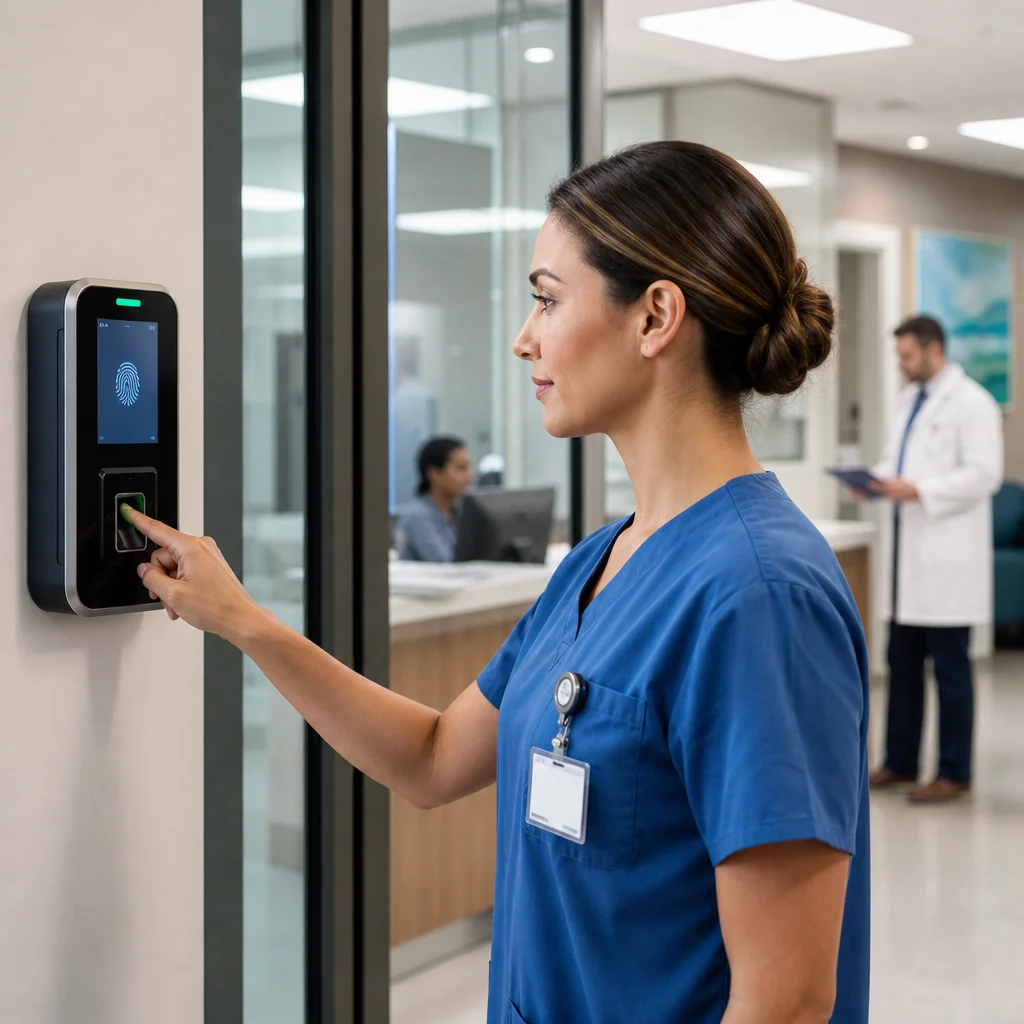
Biometric access control eliminates the weak link in key card systems: the credential itself can’t be lost, stolen, or shared. Fingerprint and iris recognition technology tie access directly to individual identity, creating an unbreakable audit trail.
When a staff member approaches a biometric reader, the system captures their unique biological data, matches it against the enrollment database, and logs the exact time and individual who entered. This creates irrefutable proof of access that satisfies HIPAA documentation requirements. Patient files accessed at specific times can be traced to specific individuals.
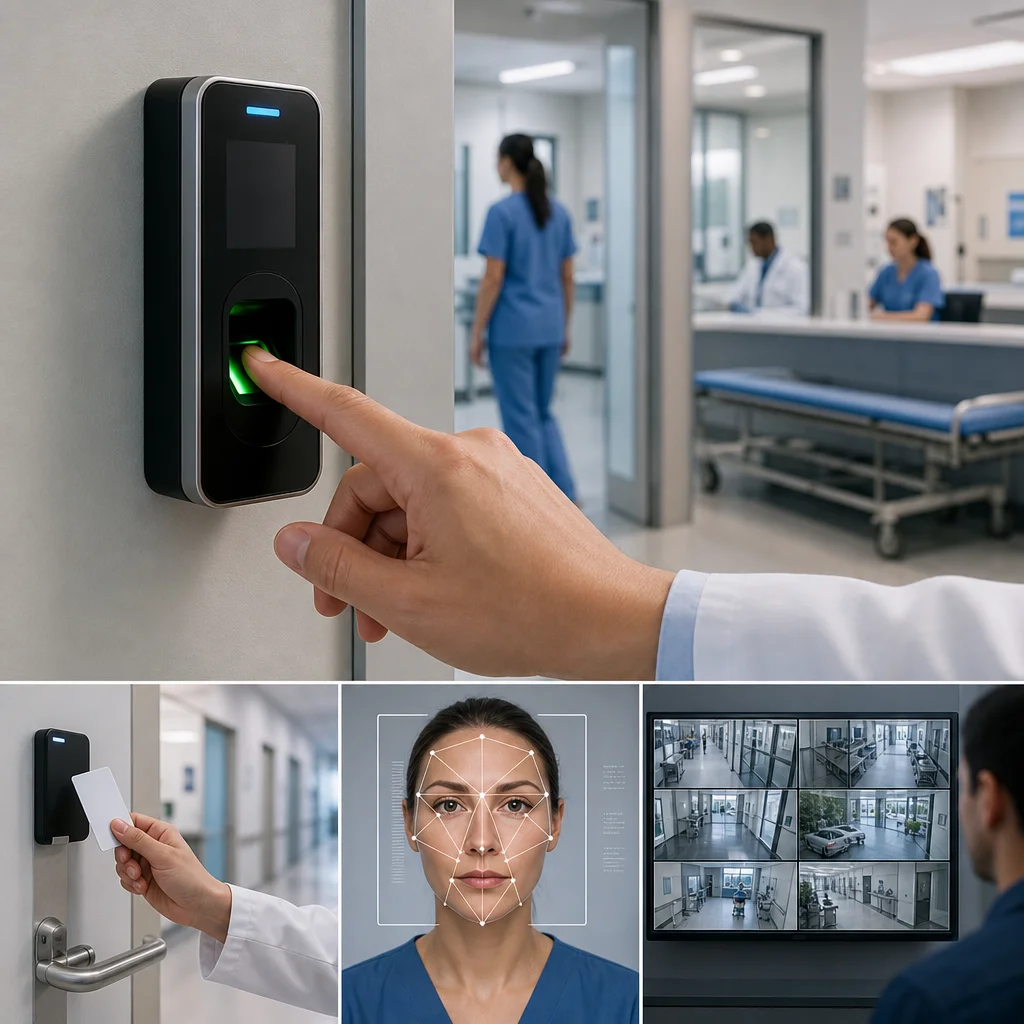
We deploy fingerprint readers and iris scanners that work seamlessly in medical environments. These systems integrate with your existing facility management infrastructure, allowing you to restrict access to medication storage, imaging departments, records rooms, and executive offices with unprecedented precision. Some clinics use multi-factor authentication where staff scan both fingerprint and proximity card, adding an additional security layer.
The technology also reduces your liability exposure. If a patient claim alleges unauthorized access to their records, you can produce timestamped biometric logs proving exactly which staff members were in the records room and when. This documentation becomes invaluable in legal proceedings and regulatory investigations.
Actionable takeaway: Identify your three highest-risk access points (medication storage, patient records, imaging systems). These areas should be your priority for biometric implementation.
Our Biometric Access Control Technology and Integration Approach
We’ve designed our biometric systems specifically for the demands of medical clinic operations. Our readers work with industry-standard enrollment processes: staff visit our installation team, provide fingerprints or iris data, and receive immediate badge integration.
Our systems integrate seamlessly with your existing IT infrastructure without requiring complete facility rewiring. We conduct a site assessment to identify optimal reader placement that balances security coverage with workflow efficiency. Unlike generic security vendors, we understand clinic layouts and the critical paths between waiting areas, treatment rooms, and administrative spaces.
We deploy cloud-based access management platforms that allow your clinic director to adjust permissions in real time. If Dr. Rodriguez leaves for maternity leave, you instantly revoke her access to the prescription storage area. If a new physician joins, we enroll their biometric data and set appropriate permissions within hours, not days.
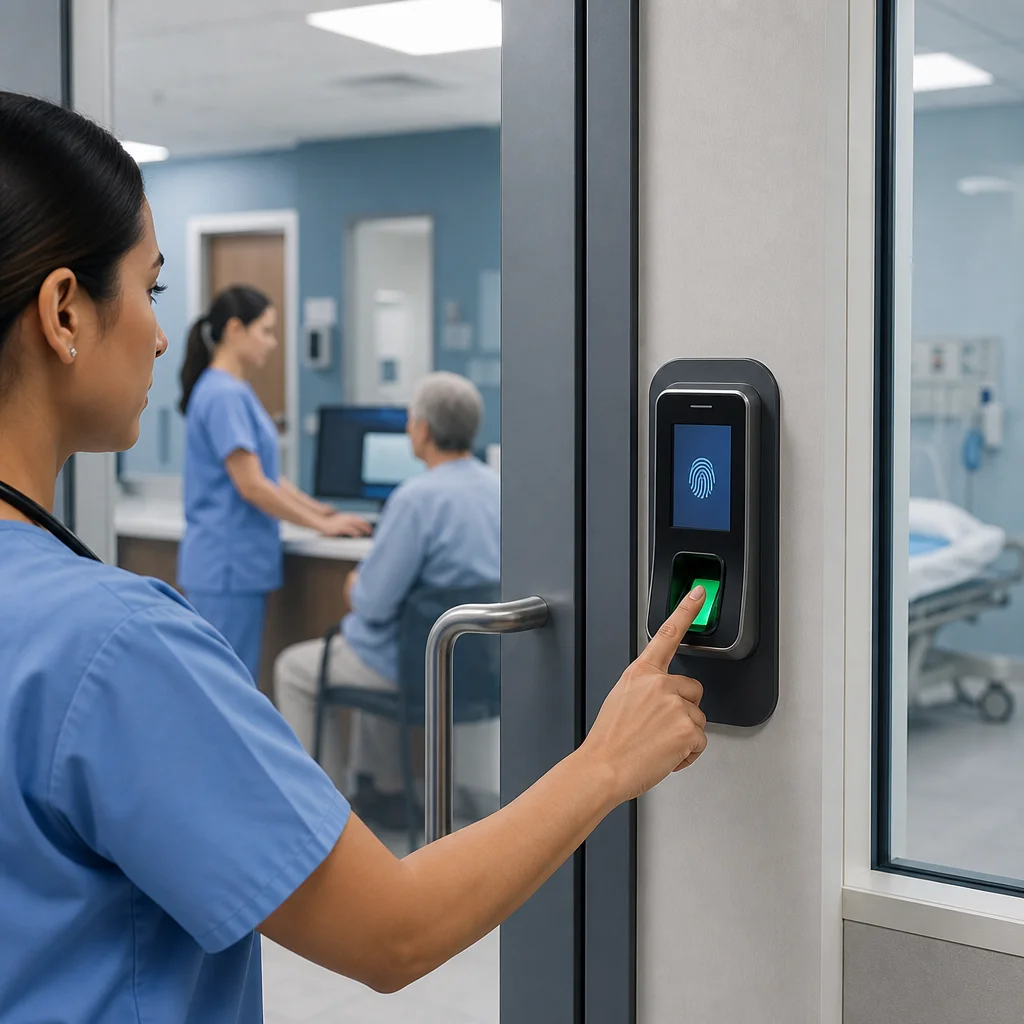
Our systems include redundancy protocols so that network disruptions don’t lock staff out of critical areas. We integrate power backup systems with your structured cabling infrastructure to ensure continuous operation during outages. We also provide detailed audit reporting that exports directly into your compliance documentation systems.
Actionable takeaway: Request a site assessment from our team. We’ll walk your clinic and identify exactly which access points require biometric control based on your layout and operational needs.
Comparison: Biometric Systems vs. Traditional Key Card Access
The differences become clear when you examine daily operations. A key card system offers basic access control at minimal upfront cost. Staff move quickly through doors without additional steps. However, you sacrifice accountability, security, and compliance documentation.
Biometric systems require three to five seconds per access event, which some clinics initially worry will slow operations. In practice, staff adapt within days, and the slight delay at high-traffic points like medication areas proves acceptable given the security benefit. Our readers process successful matches in under two seconds for familiar users.
[Key card systems lack audit trails showing who actually used which credential.] With biometric access, you generate timestamped logs proving identity. This distinction matters enormously during regulatory audits or incident investigations. Biometric systems also eliminate the ongoing expense of card replacement, magnetic stripe maintenance, and credential management software.
Security-wise, key cards offer zero protection against tailgating or credential sharing. Biometric readers prevent both by design. An unauthorized person cannot use a coworker’s credentials because their fingerprint or iris won’t match the system database.
We’ve worked with clinics that moved from key card systems and recovered their investment within 18 months through eliminated replacement costs, reduced compliance violations, and prevented security incidents.
Actionable takeaway: Compare your key card replacement budget against a three-year biometric system cost. Most clinics find biometric total cost of ownership significantly lower when fully accounting for administrative overhead.
Critical Security Features for HIPAA-Compliant Facilities
HIPAA compliance requires documented administrative, physical, and technical safeguards. Your access control system forms the foundation of your physical safeguards. Regulators expect to see comprehensive access restrictions, audit logs, and evidence that unauthorized access was prevented.
We build HIPAA-specific features into every biometric installation. Encrypted audit logs preserve access records for seven years, meeting federal retention requirements. Multi-level permission structures let you designate which staff roles can access which areas. A front desk receptionist’s biometric data grants access to the waiting area only, not medication storage or patient records.
Our systems include automatic access revocation protocols that trigger when employment ends. If a staff member is terminated, you deactivate their biometric enrollment immediately, ensuring they cannot access any facility areas. This eliminates the vulnerability window that exists with physical key distribution.
We integrate session management that logs exactly what data was accessed by which staff member at which time. Combined with your electronic health record system, this creates a comprehensive audit trail demonstrating HIPAA compliance during regulatory inspections.
We also implement secure credential management where biometric templates are encrypted and stored on-device rather than accessible through standard networks. This protects staff privacy while maintaining system security.
Actionable takeaway: Request a HIPAA compliance audit from our team. We’ll review your current access control gaps and provide specific remediation recommendations.
How We Design Biometric Systems for Medical Clinic Workflows
We don’t install cookie-cutter security systems. We design around your specific workflow, which is why we begin every engagement with detailed site assessment and staff interviews.
We identify your clinic’s movement patterns: which staff members need rapid access to which areas, where bottlenecks could develop if readers are placed inefficiently, and which areas require highest security priority. A pediatric clinic has different needs than a surgical clinic. We adapt our design accordingly.
Our team maps your IT infrastructure and integrates biometric readers with your existing network without creating vulnerabilities. We install dedicated access control servers that operate independently from your patient data network, preventing security compromise of medical records if someone attempts to breach the access system.
We position readers at ergonomic heights and angles, considering that staff move quickly and may carry medical equipment. We ensure readers have adequate lighting and clear sightlines, reducing false rejections that frustrate users and slow operations.
During deployment, we train all staff on enrollment and daily operation. Most clinics report that staff adapt within the first week. We provide ongoing technical support to handle troubleshooting and credential re-enrollment if needed.
Actionable takeaway: Schedule a workflow analysis with our team. We’ll observe your clinic during peak hours and identify exactly where biometric readers should be positioned for maximum efficiency.
Cost-Benefit Analysis: Long-Term ROI of Biometric Implementation
The investment in biometric access control typically ranges from $15,000 to $40,000 for a mid-sized clinic, depending on the number of readers and system complexity. This seems substantial until you examine the cost structure against alternatives.
Traditional key card systems require ongoing credential replacement costs (approximately $5 per card), administrative staff time managing issuance and deactivation (typically 10-15 hours monthly), and compliance documentation effort that often requires external consultants ($5,000-$10,000 annually). These hidden costs accumulate rapidly.
A typical clinic issuing 50 credentials annually with 20% annual turnover spends roughly $500 on card replacement, plus 120-180 hours of staff time annually managing access. If staff hourly cost averages $35, that’s $4,200-$6,300 in annual labor. External compliance consultation adds another $5,000-$10,000 yearly. Your total annual operating cost for key card management approaches $10,000-$16,000.
Biometric systems eliminate most of these recurring costs. After initial installation, your primary expense becomes software licensing ($2,000-$3,000 annually) and occasional reader maintenance. This represents a 70-80% reduction in access management overhead.
Additionally, prevent just one compliance violation or security incident. HIPAA fines start at $100 per violation and quickly escalate to $50,000+ per incident category. A single documented security breach can cost your clinic hundreds of thousands in penalties, patient notification expenses, and credit monitoring services. Biometric access control prevents these catastrophic costs.
Most clinics recover their full investment within 18-24 months based purely on eliminated administrative overhead. The security benefits and compliance protection represent pure gain beyond that timeline.
Actionable takeaway: Request a formal ROI analysis from our team. We’ll calculate your specific payback period based on your clinic size, current access management costs, and security risk profile.
Real-World Medical Clinic Security Success with Our Solutions
We’ve deployed biometric systems across Southern California clinics, from independent practitioners to multi-location healthcare groups. The results consistently demonstrate both security improvements and operational benefits.
A 12-provider orthopedic clinic in Orange County implemented our fingerprint reader system across four access points: prescription storage, surgical scheduling area, patient records room, and executive offices. Within three months, they reduced card replacement costs from $1,200 annually to zero. More importantly, they eliminated three documented instances of unauthorized access to prescription storage that their previous key card system couldn’t have prevented. Their HIPAA audit the following year noted the biometric system as a best-practice security implementation.
A multi-location urgent care group with five Southern California clinics deployed our iris recognition system across medication storage areas. The system now provides timestamped proof that only licensed medical staff access controlled substances, creating the detailed audit trail required for DEA compliance. Their pharmacy inventory losses dropped 40% within the first year, suggesting that documented access accountability deterred medication diversion.
A surgical center in San Diego integrated our biometric system with their existing access control infrastructure. Staff appreciated the streamlined workflow: no more fumbling for cards or waiting for replacements. The center’s compliance officer reported that their audit preparation time decreased by 60% because biometric logs provided instant documentation of who accessed which areas when.
These aren’t isolated successes. Every clinic we’ve deployed to reports similar patterns: reduced administrative burden, improved security posture, and measurably better audit compliance.
Actionable takeaway: Contact our team to discuss your clinic’s specific security challenges. We can connect you with similar facilities where you can observe our systems in operation.
Terapixels Systems: Why We Are the Best Choice for Your Clinic
We’re not a generic security vendor applying one-size-fits-all solutions to medical clinics. We specialize in integrated access control systems designed specifically for healthcare facility requirements. Our team includes security professionals with direct experience in HIPAA compliance, medical facility operations, and biometric technology deployment.
We combine hardware installation expertise with software integration capability. We don’t just mount readers on your walls; we design end-to-end systems that connect to your existing IT infrastructure, your facility management protocols, and your compliance documentation requirements. This integrated approach prevents security gaps that emerge when access control exists in isolation from your other security systems.
Our support infrastructure is built for healthcare environments where downtime directly impacts patient care. We maintain local technical teams across Southern California that can respond to issues within hours, not days. We provide preventive maintenance protocols that keep your biometric readers operating at peak reliability.
We also understand that medical clinics operate under financial constraints. We don’t push unnecessary upgrades or expensive features you won’t use. We design systems precisely scaled to your facility’s actual security needs and operational requirements.
More importantly, we stand behind our work with genuine accountability. We’re a local Southern California firm with roots in the communities we serve. Your clinic’s security success directly impacts our reputation and future business. This creates alignment between your interests and our success that you don’t get from national security corporations.
Actionable takeaway: Schedule a consultation with our security team. We’ll conduct a no-obligation security assessment and provide specific recommendations for your clinic’s needs.
Implementation Timeline and Facility Minimization Strategies
We design every implementation to minimize disruption to your clinic’s patient care operations. A typical biometric system deployment takes 4-6 weeks from initial assessment to full operation.
Week one involves detailed site assessment, staff interviews, and system design. We identify reader locations, network integration points, and backup power requirements. We provide a written implementation plan with specific timelines and minimal operational impact.
Weeks two and three focus on infrastructure preparation. We run network cabling, install power supplies, and test system connectivity. This work typically happens during evening or weekend hours to avoid disrupting patient schedules.
Week four includes reader installation and configuration. Our technicians mount biometric readers, test functionality, and integrate them with your access control software. We perform this work in phases so your clinic never loses access to critical areas.
Week five encompasses staff training and enrollment. Your staff visit our team in brief sessions to enroll their biometric data. We schedule these around clinic hours to minimize disruption. Staff typically become comfortable with the system within days.
Week six involves final testing, backup system verification, and documentation. We provide complete system documentation, audit logs, and compliance certification that you can present during regulatory inspections.
We maintain contingency protocols throughout implementation. If any issue arises, we have backup readers and network components available to maintain system continuity.
Actionable takeaway: Contact our scheduling team to reserve your implementation window. We typically book 4-6 weeks in advance, so early planning ensures deployment during your preferred timeframe.
Getting Started With Your Biometric Security Upgrade Today
Your clinic’s security posture shouldn’t depend on key cards and manual logs. Patient trust, regulatory compliance, and operational efficiency all improve with biometric access control specifically designed for medical facilities.
We’ve deployed proven systems to clinics across Southern California that have eliminated the vulnerabilities and administrative burden inherent in traditional access control. Our clients consistently report better security, easier compliance, and significantly reduced operational overhead.
The first step is straightforward: contact our team for an initial consultation. We’ll schedule a site visit, assess your facility, discuss your specific security requirements, and provide a detailed proposal with implementation timeline and ROI analysis.
You can reach us through our website or call our Southern California office directly. We handle the technical complexity so you can focus on patient care. Your clinic deserves access control that actually works for medical environments rather than forcing your facility to adapt to generic security systems.
Actionable takeaway: Call our team this week to schedule your security assessment. The sooner we evaluate your clinic, the sooner we can eliminate the security gaps in your current access control system.
Frequently Asked Questions (FAQ)
How do we ensure our biometric access control systems comply with HIPAA requirements?
We build HIPAA compliance into every step of our biometric system design, from encrypted data storage to secure network architecture. Our team conducts thorough facility assessments to identify security gaps and implements access controls that protect patient data while maintaining audit trails required by healthcare regulations. We also provide documentation and support to help your clinic meet ongoing compliance obligations.
What’s the typical timeline for us to install a biometric access control system at your medical facility?
We customize our installation timeline based on your clinic’s size and complexity, but most projects take between two to four weeks from initial assessment to full deployment. Our structured approach includes site surveys, system configuration, hardware installation, staff training, and thorough testing before we hand over the system. We work around your clinic’s schedule to minimize disruption to patient care.
Can we integrate our biometric system with your existing IT infrastructure and security cameras?
Yes, we specialize in creating unified security ecosystems that combine biometric access control, HD camera systems, and your current IT infrastructure into one cohesive platform. Our team designs integration strategies specific to your clinic’s existing setup, ensuring seamless communication between all components and centralized management through a single interface.