CONTACT US
Table of Contents
- The Reception Bottleneck: Why Manual Visitor Processes Cost You
- Security Vulnerabilities in Traditional Check-In Methods
- How We Integrate Access Control with Your Office Operations
- Seamless Integration: Combining HD Security Cameras and Access Systems
- Reducing Administrative Overhead Through Automation
- Real-Time Monitoring and Compliance Documentation
- Customized Solutions for Your Orange County Facility
- Implementation Timeline and Minimal Disruption
- ROI: Time Savings and Enhanced Security Benefits
- Partner with Us for Complete Visitor Management
- Frequently Asked Questions (FAQ)
The Reception Bottleneck: Why Manual Visitor Processes Cost You
Manual visitor check-in processes drain time, compromise security, and create compliance headaches. We’ve watched countless mid-sized organizations in Orange County struggle with spreadsheets, sign-in logs, and reactive security measures that leave blind spots in their facilities. Automated visitor access workflows eliminate these friction points by combining intelligent access control, real-time monitoring, and seamless integration into your existing operations. This article walks you through how we architect these systems to work for your specific environment.
Your reception team spends significant time managing visitor arrival. A contractor shows up, your receptionist looks for the right badge, checks a calendar or printed schedule, escorts the visitor to their destination, collects a badge, then manually logs the departure. Multiply this across 50 to 100 daily visitors and you’re looking at 10-15 hours per week on administrative tasks that don’t add strategic value.
The hidden costs compound quickly. Time your receptionist spends on check-in is time they’re not answering phones or managing client relationships. If an expected visitor doesn’t appear on your schedule, reconciling that gap takes additional investigation. Peak times create bottlenecks where visitors queue while staff scrambles to process them. Many organizations also experience turnover in reception roles, meaning new team members require training on your specific check-in procedures.
Beyond time waste, manual processes lack consistency. Different staff members follow procedures differently. Some verify ID thoroughly; others rush through it. Some log entry and exit times accurately; others estimate them afterward. This inconsistency becomes problematic during audits or security investigations. We’ve found that automating visitor workflows reclaims 5-7 hours per reception staff member per week while simultaneously improving security compliance.
Actionable takeaway: Audit your current visitor volume and average check-in time. Multiply those numbers to quantify your actual administrative cost, then compare it against the investment in an automated system.
Security Vulnerabilities in Traditional Check-In Methods
Paper-based visitor logs create immediate security exposures. A printed sign-in sheet sits in your lobby accessible to anyone who passes through. Unauthorized personnel can walk past reception, grab a temporary badge from an unattended desk, or follow an approved visitor into restricted areas without anyone capturing their presence. Once someone is inside, manual oversight depends entirely on your staff noticing something amiss.
Shared temporary badges present another risk. Your facility issues generic badges to all vendors and contractors. Multiple people might use the same badge across different time periods, making it impossible to establish who was actually in a given space during a specific timeframe. When a security incident occurs, you can’t definitively trace which individual accessed sensitive areas.
Guest lists also suffer from information gaps. Employees often forget to add visitors to the system, or they add them with incomplete details. You lack confidence in who should actually be on your premises at any given moment. If an emergency evacuation occurs, your headcount won’t match the documented visitors. Regulatory compliance becomes difficult because you can’t prove who was present during specific hours.
Unauthorized area access happens routinely with manual systems. A contractor’s friend arrives and the contractor just walks them inside, bypassing reception entirely. Delivery personnel enter through rear doors where no check-in occurs. Employees let visitors through badge readers without verification. These gaps mean your facility perimeter isn’t actually secured despite having physical barriers in place.
Automated systems prevent these vulnerabilities through identity verification at entry points, digital audit trails that capture individual identity with timestamps, and access permissions that restrict which zones each visitor can enter.
How We Integrate Access Control with Your Office Operations
We design integrated access control systems that sit at the center of your visitor workflow rather than operating as isolated technology. Our approach begins by understanding your facility layout, staffing structure, and operational requirements.

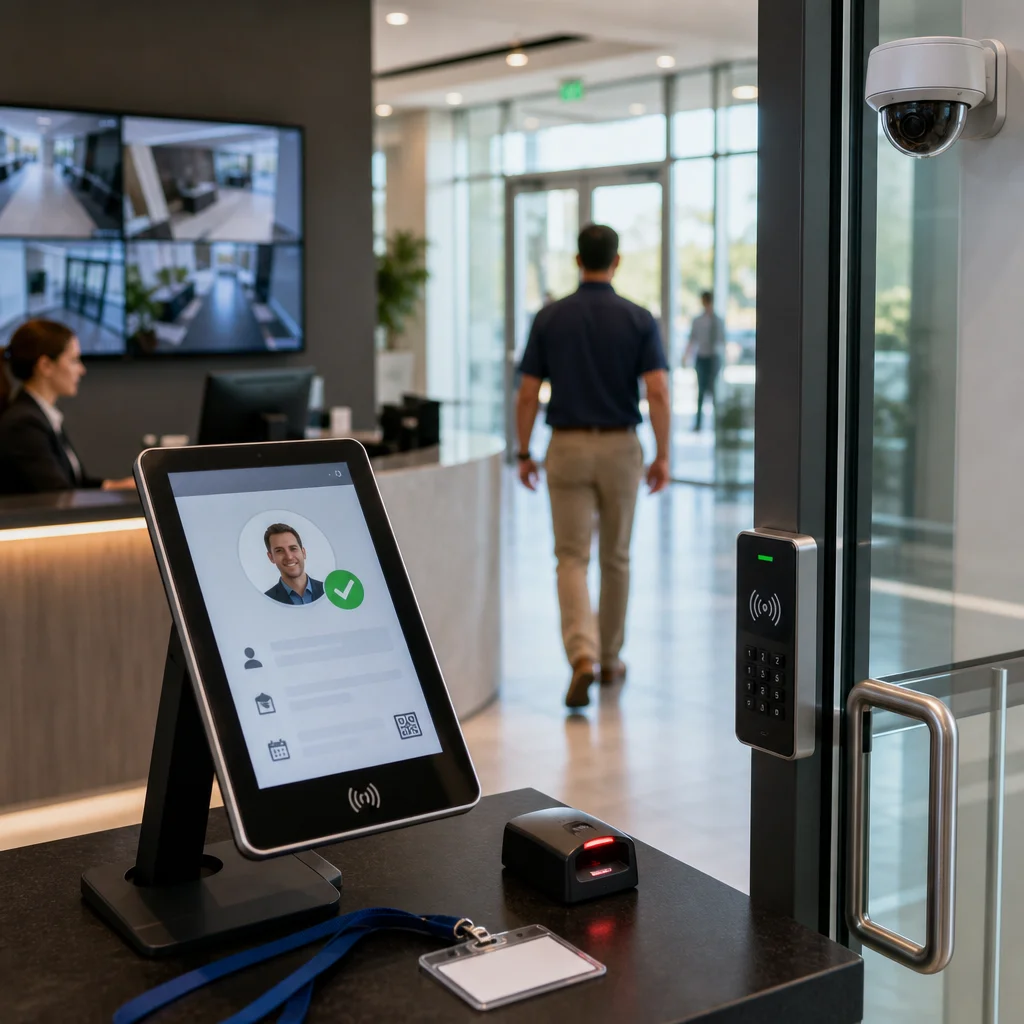
When a visitor arrives at your Orange County facility, they interact with an integrated kiosk system. They provide their name and reason for visit, or your reception staff can quickly pull up pre-registered visitors from your employee schedule. The system immediately verifies that person should be present and alerts the host employee. If pre-approval exists, the system issues a credential (either a physical card or mobile credential) that activates in real-time.
That credential is linked directly to your access control system. It only opens doors the visitor should access. A vendor meeting with your accounting department can’t wander into your server room or operations area. Permissions automatically expire at a set time, preventing lingering access after the visit concludes. If a visitor leaves the building and returns, the system knows their departure and re-entry.
Our team integrates this workflow with your existing employee database and calendar systems so we’re not creating duplicate data entry. Your IT infrastructure remains simplified because we’re extending your current network and systems, not replacing them. We handle all physical wiring, network configuration, and security protocols so your internal team focuses on operations.
Seamless Integration: Combining HD Security Cameras and Access Systems
Modern visitor management depends on visual verification. We pair our IP camera systems with access control to create comprehensive visibility. HD cameras positioned at entry points capture clear facial images of every person entering your facility. These images are automatically associated with the access control event, so when you review a security incident, you see exactly who accessed which door at what time, combined with video confirmation of their identity.
The camera and access system communicate intelligently. When someone attempts to use an invalid credential, the cameras are already trained on that location. Suspicious behavior triggers alerts that combine access log data with video footage. Our system can detect unusual patterns like multiple people accessing one credential or someone attempting entry during unauthorized hours.
This integration provides investigators with immediate answers. If a confidential document goes missing, you can query which specific individuals accessed that area on that date, then review corresponding video footage to understand context. During compliance audits, regulators see proof of both systematic access control and visual documentation, which satisfies enterprise-level security requirements.
For high-traffic facilities like hospitality properties or distribution centers, this combination prevents tailgating. A legitimate employee swipes their credential at a door and walks through. The camera confirms one person entered, not two. If multiple people try to pass on a single credential, the system flags it immediately and the camera captures the violation.
Reducing Administrative Overhead Through Automation
Automation eliminates routine tasks that consume your team’s attention. Visitor credentials are issued automatically once pre-registration occurs, eliminating the step where reception staff manually create badges. Departure is automatically logged when the credential expires or the visitor exits through a monitored door, removing end-of-day reconciliation work.
Your employees pre-authorize visitors through a simple online portal rather than calling reception with arrival notices. This notification reaches your staff automatically when the visitor checks in, eliminating phone tag. Meeting room availability integrates with the visitor system, so your reception team knows instantly whether expected guests will find their hosts available.
Data entry errors drop significantly because the system captures information once at check-in and reuses it throughout the visit. No more manually logging names, times, and company affiliations on multiple forms. Badge tracking becomes automatic since digital credentials are issued and revoked by system logic rather than managed by staff.
Reporting shifts from labor-intensive to instant. Instead of your staff manually compiling visitor logs for compliance review, the system generates detailed reports with one click. You can filter by date, visitor type, area accessed, or host employee. This transformation means your team moves from reactive administrative work to proactive facility management and customer service.
Actionable takeaway: Calculate the total hours your reception team spends on visitor-related administration each month. Even a 50% reduction through automation justifies a modern access control investment.
Real-Time Monitoring and Compliance Documentation
Enterprise-level organizations require audit trails that satisfy regulatory frameworks. Our systems generate tamper-proof logs documenting every access event. When a visitor credential is issued, modified, or revoked, the system records who made that change and when. This accountability satisfies compliance requirements for hospitality, healthcare, and distribution operations.
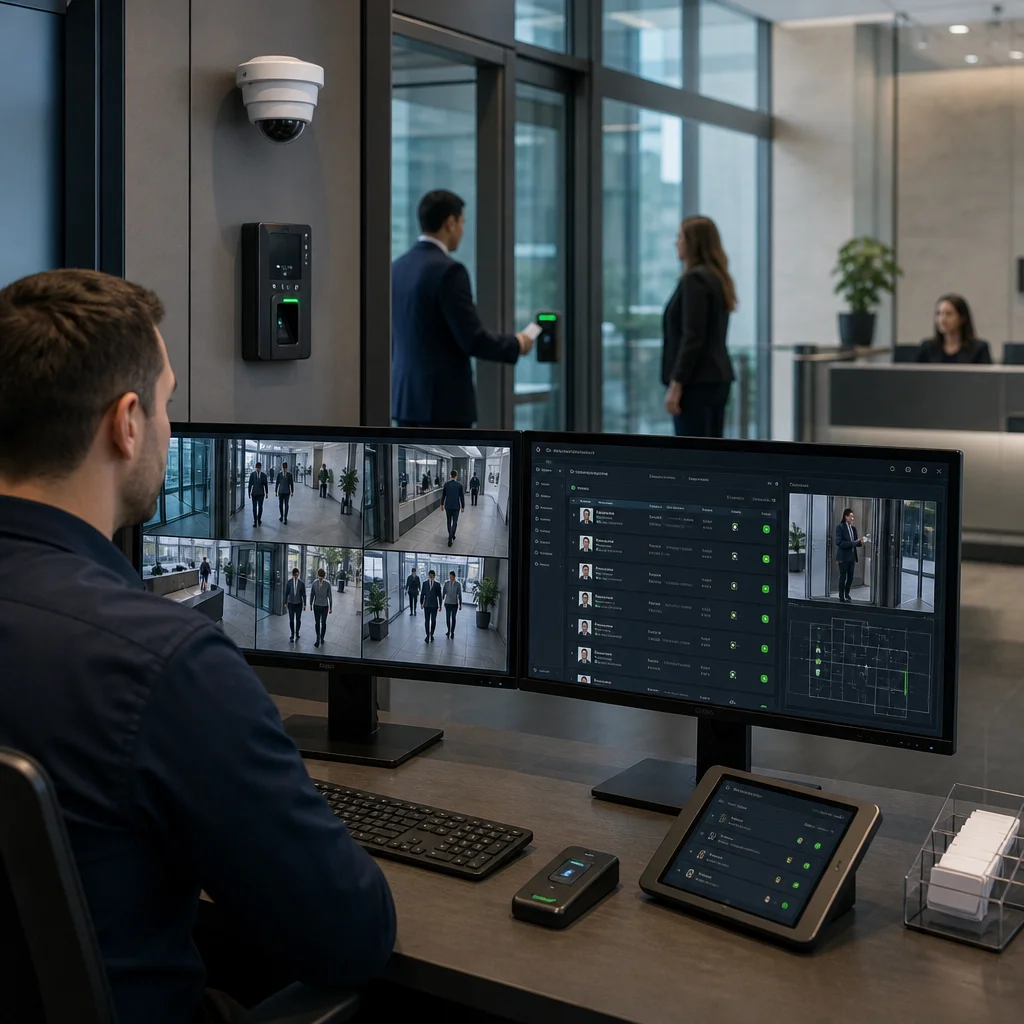
Real-time monitoring gives you immediate visibility into facility occupancy. A dashboard shows who is currently in your building, which areas they’re accessing, and whether their credential is still valid. If an authorized visitor’s credential is about to expire, the system can alert reception so they can process departure or extend approval if the visit extends longer than expected.
Compliance reporting becomes audit-ready. Healthcare facilities need to document that only credentialed contractors accessed patient care areas. Hospitality operations must prove security protocols were enforced during specific incidents. We’ve designed our reporting to align with common compliance frameworks so you’re not translating system data into regulatory language. Your reports are already formatted for auditor review.
The system also creates accountability for your own staff. When someone overrides access control procedures or manually approves exceptions, that action is logged. If an employee allows unauthorized access or loses control of their credential, the audit trail shows exactly what occurred. This accountability encourages proper security discipline across your organization.
Customized Solutions for Your Orange County Facility
Every facility in Orange County has unique security requirements based on its specific operations. A distribution center needs different access strategies than a hotel property, which differs from a manufacturing facility. We don’t apply generic templates; we architect solutions matching your actual workflow.
For hotel operations, our system manages both guest check-in and staff access. Guest credentials are issued upon arrival, automatically expire at checkout, and never grant access to administrative areas. Staff credentials are permanent and zone-specific based on job role. Our system separates guest and employee flows so you maintain clear operational boundaries.
Warehouses and distribution centers require high-volume processing with robust access restrictions. Receiving areas need different access levels than inventory storage than shipping areas. Our system manages these complex zone restrictions while maintaining the speed necessary during peak receiving hours. Delivery personnel get time-limited credentials that only open the receiving area.
Manufacturing facilities often require dual authentication in sensitive areas. Critical equipment rooms might require both credential access and PIN entry, preventing unauthorized access even if a credential is stolen. Hazardous material storage areas can be restricted to trained personnel only, with the system verifying current certifications before allowing access.
Property management companies overseeing multiple Orange County properties appreciate centralized management across facilities. We build systems where a corporate administrator can manage access policies consistently while allowing local property managers to handle day-to-day visitor processing. This balance maintains security standards while preserving local operational control.
Implementation Timeline and Minimal Disruption
We understand that your facility operates continuously and can’t support extensive downtime during implementation. Our deployment methodology minimizes disruption through staged rollout and careful planning.
Initial phases focus on infrastructure. Our team installs network cabling, access control hardware, and camera systems during off-peak hours. We work with your facilities team to coordinate timing around your operational schedule. For 24/7 operations, we stage installation during low-activity windows like overnight hours.
System configuration happens in parallel with hardware installation. We don’t wait until everything is physically installed to begin configuring software. This overlap compresses overall timeline. Once your employee directory is imported and initial access policies are configured, we begin training your reception staff on the new workflow.
Pilot testing occurs with a subset of your facility before full deployment. Perhaps we launch the system for one building entrance while others continue using manual processes. This approach lets staff adapt gradually and lets us refine procedures based on real operational feedback before expanding facility-wide.
Handoff to your team includes detailed training documentation, ongoing support for the first 30 days, and responsive technical assistance as your staff learns the new system. We typically complete implementation within 4-6 weeks depending on facility size and complexity.
ROI: Time Savings and Enhanced Security Benefits
The financial benefits of automated visitor workflows materialize quickly. Your reception team reclaims 5-7 hours weekly per staff member, translating to approximately 250-350 hours annually per position. If your reception roles cost $25-35 per hour loaded, that’s 6,000-12,000 dollars in recovered capacity annually. Multiply across multiple team members and the labor savings alone justify the investment within 12-18 months.
Beyond labor recovery, you reduce compliance risk. Security vulnerabilities cost far more to address after an incident than preventing them beforehand. Regulatory violations carry substantial fines; data breaches carry legal and reputational costs; unauthorized facility access can result in theft or vandalism. Our systems prevent these scenarios through systematic access control and comprehensive audit documentation.
Visitor experience improves noticeably. Check-in becomes faster and less intrusive. Visitors don’t wait while staff searches for paperwork. Your host employees receive immediate notification when expected guests arrive rather than discovering the visit later. This efficiency reflects well on your organization and sets a professional tone for business interactions.
Operational visibility increases value beyond security. You understand actual visitor volume, peak check-in times, and which areas receive the most traffic. This data informs future facility planning and staffing decisions. If you’re opening a new department, you understand expected traffic patterns that impact reception workload.
Actionable takeaway: Request a customized ROI analysis from us specific to your facility size and visitor volume. We’ll model your exact labor savings and compliance benefits so you understand the financial case clearly.
Partner with Us for Complete Visitor Management
We’ve spent years designing automated visitor access workflows for Orange County businesses, from hospitality operations to distribution centers. Our approach combines enterprise-level security with operational practicality, ensuring your system serves your business rather than constraining it.
Your facility deserves integrated systems that work together intelligently. Access control and HD cameras should communicate seamlessly. Visitor credentials should integrate with your existing operations. Your compliance documentation should be audit-ready without requiring manual compilation.
Reach out to our team at Terapixels Systems to discuss your specific facility requirements. We’ll assess your current processes, identify automation opportunities, and design a solution matching your security standards and operational workflow. Your reception team will spend less time managing logistics and more time supporting your business.
Frequently Asked Questions (FAQ)
How do automated visitor access workflows reduce security risks at our facility?
We eliminate the gaps inherent in manual check-in processes by integrating access control systems with HD security cameras that capture real-time documentation of every visitor entry and exit. Our integrated approach ensures that unauthorized access attempts are immediately logged and flagged, giving your team precise oversight rather than relying on paper sign-in sheets that can be lost or falsified. We also synchronize visitor credentials with your access points, so only approved guests can enter designated areas of your Orange County facility.
What’s the typical timeline for implementing visitor management automation at our Orange County office?
We design our installation process to minimize disruption to your daily operations, typically completing the core system setup within two to four weeks depending on your facility’s size and infrastructure complexity. Our team coordinates with your staff to schedule cabling runs and access point installations during off-peak hours, and we handle all integration testing before going live. We’ll work closely with your team throughout deployment to ensure your reception staff is fully trained on the new workflows before we transition away from your old processes.
How much administrative time do we actually save with automated visitor workflows?
Our clients typically report eliminating 10-15 hours per week of manual check-in, verification, and compliance documentation tasks, allowing your reception team to focus on higher-value visitor experiences and security monitoring. We streamline everything from credential issuance to badge printing and access grant approvals, with our system automatically generating compliance reports that previously required manual compilation. The time freed up from administrative overhead often translates into improved visitor satisfaction and measurable security enhancements that directly impact your operational efficiency.