CONTACT US
Table of Contents
- The Hidden Costs of Managing Multiple Technology Vendors
- How Fragmented Systems Create Security Vulnerabilities
- Unified Infrastructure: Our Integrated Approach in San Diego
- Advantage 1: Seamless Integration Across All Systems
- Advantage 2: Simplified Vendor Management and Support
- Advantage 3: Enhanced Security Through Coordinated Monitoring
- Advantage 4: Cost Efficiency and Budget Predictability
- Advantage 5: Future-Ready Scalability and Growth
- Our End-to-End Solution Architecture
- Getting Started With a Single Infrastructure Partner
The Hidden Costs of Managing Multiple Technology Vendors
Managing technology infrastructure across multiple vendors creates operational friction that most facility leaders only recognize after problems compound. When your network provider doesn’t coordinate with your low-voltage cabling contractor, and neither talks to your access control installer or camera system provider, the result is missed opportunities, redundant spending, and security gaps that create real business risk.
At Terapixels Systems, we see this pattern repeat constantly across mid-sized and enterprise organizations throughout San Diego and Southern California. The solution isn’t juggling more contractors. It’s consolidating them under one accountable partner.
Running separate contracts with an IT provider, a security company, a cabling specialist, and an access control vendor sounds organized on paper. In practice, it fragments responsibility.
Consider a typical scenario in a San Diego facility: Your IT vendor deploys a new network switch upgrade or installs a Cisco Meraki MX250 security appliance. Your video surveillance system requires reconfiguration to work with the new bandwidth allocation and VLAN settings. But the camera team doesn’t know about the network changes until cameras go offline. Now you’re coordinating emergency calls between three parties, each pointing fingers at the other. What should take a single afternoon takes a week of costly downtime.
The financial impact runs deeper than delay costs. You end up paying for:
- Duplicate support contracts for overlapping network and security infrastructure.
- Integration fees every time disparate software platforms need to communicate.
- Premium rates for emergency cross-vendor troubleshooting.
- Administrative overhead managing multiple service level agreements (SLAs).
- Internal staff time explaining one vendor’s technical limitations to another.
San Diego organizations—from hotels in Downtown San Diego to logistics centers in Otay Mesa—report a 30% to 40% reduction in operational overhead simply by consolidating infrastructure oversight to a single partner who owns the entire physical and network architecture.
Your Next Step: Audit your current vendor contracts and identify where communication gaps between your IT, cabling, and security teams have already cost you money, time, or system reliability.
How Fragmented Systems Create Security Vulnerabilities
Security vulnerabilities multiply in fragmented environments because no single team owns the complete picture.
Your access control system may flag suspicious activity, but if your network team hasn’t synchronized protocols, they cannot correlate it with IT access logs. Your security cameras capture an incident, but the video data lives on an isolated server with independent retention policies and zero integration with physical door access logs. When an incident occurs, you are left stitching together data from incompatible systems instead of having unified evidence.
The regulatory and operational exposure is significant across San Diego’s core industries:
- Healthcare & Life Sciences: Clinics and biotech hubs in Torrey Pines and Sorrento Valley must maintain strict compliance (HIPAA, physical access logging, and perimeter auditing).
- Education & Commercial Real Estate: Campuses and office towers need instant, centralized lockdown capabilities during emergencies.
- Manufacturing, Retail & Hospitality: High-density resorts, retail centers, and manufacturing plants require clear audit trails to prevent internal loss and unauthorized access.
Worse, fragmented vendors create physical blind spots. Vendor A secures the front door badge readers. Vendor B manages the IP camera network. Neither is responsible for ensuring those systems talk to each other, so nobody notices that your security cameras aren’t covering the exact zones where your access control readers sit. An actual security gap exists, but nobody fixes it because everyone assumes someone else is handling it.
We help organizations eliminate these vulnerabilities by deploying unified physical security platforms where access control, high-definition camera coverage, and structured cabling are architected as a single coordinated solution from day one.
Actionable Step: Schedule a comprehensive audit of your physical security infrastructure. Identify where your access control systems and camera platforms sit in separate, disconnected silos. That gap is a vulnerability waiting to be exploited.

Unified Infrastructure: Our Integrated Approach in San Diego
We build infrastructure differently because we manage every layer of your physical and digital ecosystem. Your network backbone, structured cabling, access control hardware, security cameras, VMS software, and managed IT services work as one synchronized architecture.
When we design your infrastructure, we don’t optimize for individual components in isolation. We optimize for your facility’s total security posture, network reliability, and long-term scalability. A video surveillance upgrade isn’t just about mounting hardware; it is integrated directly into your network planning so bandwidth allocation, Power-over-Ethernet (PoE) delivery, and storage capacity scale seamlessly.
Our unified approach includes:
- A single point of contact for all structured cabling, networking, camera, and access control needs.
- Single-pane-of-glass visibility across physical security, network performance, and hardware health.
- Coordinated firmware updates and preventive maintenance that eliminate version conflicts.
- Clear, single-source accountability for all physical security and operational standards.
- Consistent audit trails and documentation across every installed system.
For property managers, manufacturing plants, and hospitality groups operating across San Diego County, this unified architecture provides a reliable foundation that lets you scale without multiplying complexity.
Advantage 1: Seamless Integration Across All Systems
When we install structured cabling, we aren’t just pulling wire. We are laying the high-speed Cat6A or fiber optic backbone that supports your enterprise switches, high-throughput wireless access points, IP surveillance cameras, and smart access control readers. Every cable drop and patch panel is specified with neighboring hardware in mind.
That deep integration delivers concrete advantages:
- Bandwidth Optimization: Axis, Avigilon, or Hanwha IP cameras and smart door readers pull from an intelligently segmented network, eliminating bandwidth contention and video stutter.
- Unified Intelligence: Centralized Video Management Systems (VMS) like Milestone Systems, Exacqvision, Eagle Eye Networks, or Salient Systems receive real-time events from physical access doors and network switches simultaneously.
- Coordinated Maintenance: Firmware updates for hardware and network appliances—such as Cisco Meraki MX450 firewalls or Ruckus SmartZone controllers—are scheduled in harmony, preventing cascading compatibility glitches.
- Centralized Management: Your entire technology environment can be monitored and audited from a single intuitive dashboard.
We regularly deploy this unified model across San Diego warehouse and distribution centers where physical access control, inventory tracking, and camera coverage previously required three separate contractors. Now, facility managers have one conversation, one escalation path, and one system owner.
Implementation Step: Document which of your current technology platforms cannot share data with each other. Those communication breakdowns represent your primary friction points and are the first targets for consolidation.
Advantage 2: Simplified Vendor Management and Support
One phone number. One contract. One local vendor relationship.
Instead of managing separate support contracts, tracking different renewal dates, and mediating arguments between contractors, you gain direct access to a dedicated San Diego team that knows your infrastructure inside out because we engineered it.
When an issue arises, there is no finger-pointing about whether the fault lies with the Cat6A cabling, the network switch, or the door controller. We own the entire ecosystem. We resolve the issue immediately and implement measures to prevent recurrence.
For facility managers running hotels, multi-tenant commercial buildings, or medical centers across San Diego, this simplification saves hundreds of hours annually. You stop copying multiple support teams on support tickets, stop managing redundant vendor relationships, and stop paying overlapping service fees.
What To Do: List every external vendor you currently contact for low-voltage cabling, IT support, camera repair, and access control maintenance. If that list exceeds two, vendor consolidation will immediately reduce your administrative burden and operating costs.

Advantage 3: Enhanced Security Through Coordinated Monitoring
Real-time physical security requires all your hardware and software systems to communicate simultaneously.
When an unauthorized badge swipe or forced-door event occurs at a warehouse loading dock in Otay Mesa, our integrated solution doesn’t just store an isolated event log. It automatically triggers nearby high-definition Axis or Hanwha cameras to focus on that exact location, flags the live feed on your security dashboard, and logs the event alongside network access records.
We unify industry-leading access control platforms—such as Brivo, Openpath, Kantech, and AMAG Technology—with open-architecture camera systems (Avigilon, Milestone Systems, Eagle Eye Networks, ACTi, and Salient).
This level of coordination allows San Diego facilities to detect sophisticated threats. Tailgating through an access door might go unnoticed on an unmonitored camera stream, but when correlated instantaneously with access control logs, it becomes an immediate actionable alert.
Next Step: Ask your current security vendor if their system can generate a single automated alert combining access control anomalies, camera analytics, and network health indicators on a unified interface. If they can’t, you lack true coordinated security.
Advantage 4: Cost Efficiency and Budget Predictability
Consolidated technology infrastructure costs significantly less to operate and provides long-term budget predictability.
By partnering with Terapixels Systems, you eliminate redundant service agreements, avoid “out-of-scope” integration fees from uncoordinated vendors, and reduce emergency service calls because integrated systems run more reliably.
More importantly, your capital and operational expenditures become transparent:
- Hardware Efficiency: Standardizing on proven enterprise brands—such as Cisco, Aruba, Ruckus, Axis, and Brivo—ensures long product lifecycles and simple replacement paths.
- Scalable Core Networking: Deploying high-capacity security appliances like the Cisco Meraki MX250 or Meraki MX450 gives your facility the throughput needed to add dozens of 4K cameras without replacing core routing hardware.
- Predictable Upkeep: Instead of dealing with surprise invoices for cross-vendor troubleshooting, you operate under a single, clear support agreement.
San Diego distribution centers and manufacturing facilities that consolidate their structured cabling, IT networks, and security hardware with us routinely achieve 25% to 35% savings in total annual technology spending while gaining superior capabilities.
Budget Exercise: Add up your annual spending across all separate vendors for cabling, security, access control, and network maintenance. Subtract 30% from that total—that figure represents your baseline return on investment (ROI) through vendor consolidation.
Advantage 5: Future-Ready Scalability and Growth
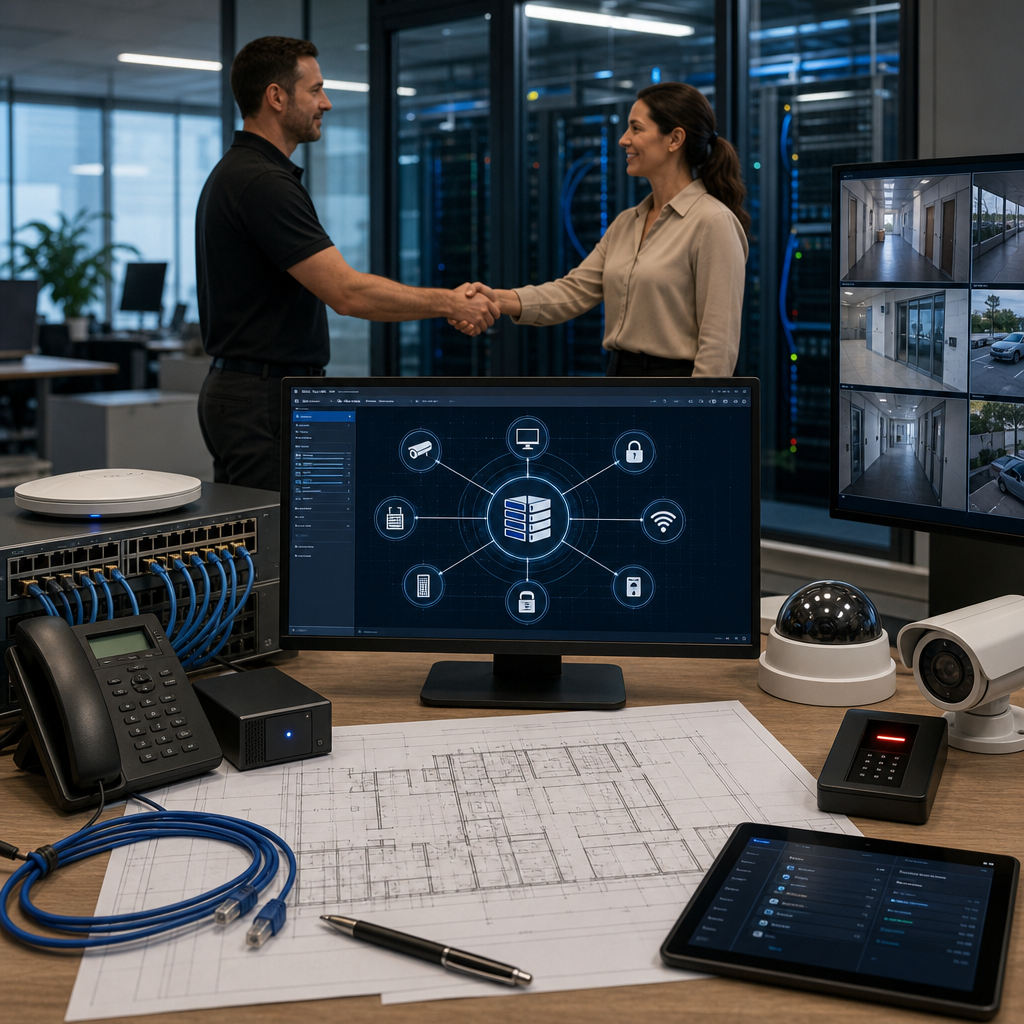
Building your infrastructure with a single expert partner makes expanding your physical footprint straightforward. When you open a new branch, expand a warehouse, or upgrade your facility’s security posture, there is zero vendor coordination overhead. Because we engineered your initial architecture, we scale it cleanly.
With fragmented contractors, expansion requires negotiating new scopes with multiple entities, hoping new hardware communicates with legacy systems, and managing the risk of unexpected network bottlenecks. With a unified architecture, growth simply means extending an established, proven framework.
Whether expanding a biotech lab in La Jolla, adding distribution capacity in the Inland Empire, or renovating a hotel property in Downtown San Diego, unified infrastructure ensures your technology enables growth rather than delaying it.
Planning Consideration: If your organization plans to expand, add facilities, or renovate existing spaces within the next 2 to 3 years, vendor consolidation is your most strategic move today. You lay a standardized foundation now that simplifies every future buildout.
Core Capabilities Across San Diego’s Key Industries
We tailor our consolidated low-voltage, networking, and security solutions to meet the specific operational demands of San Diego’s primary business sectors:
- Hospitality & Retail: High-density Wi-Fi networks using Aruba and Ruckus Wireless (managed via Ruckus SmartZone), paired with discrete Axis camera coverage and cloud-managed Brivo or Openpath access control for guest and staff areas.
- Warehousing & Logistics: Certified Cat6A and Fiber Optic structured cabling plants built for high-bay environments, backed by Cisco Meraki MX450 firewalls, license plate recognition (LPR) cameras, and heavy-duty Kantech or AMAG Technology gate and door control.
- Healthcare & Life Sciences: Strict compliance-ready infrastructure combining clean-room certified cabling, Avigilon or Milestone Systems video auditing, and multi-factor biometric access control.
- Manufacturing & Commercial Real Estate: Shielded low-voltage cabling designed to withstand industrial interference, paired with robust enterprise switching (Cisco, Aruba) and Salient or Exacqvision video platforms.
Our End-to-End Solution Architecture
Terapixels Systems delivers your technology infrastructure as a complete, integrated system rather than a collection of disconnected products:
- Structured Cabling Design & Installation: High-performance Cat6A and Fiber Optic cabling engineered for high bandwidth, low latency, and maximum durability.
- Network Infrastructure & Optimization: Enterprise routing, switching, and security appliances (including Cisco Meraki MX250/MX450, Aruba, and Ruckus).
- HD Security Camera Systems: High-resolution cameras (Axis, Hanwha, Avigilon, ACTi) connected to centralized VMS platforms (Milestone, Eagle Eye, Exacqvision, Salient).
- Integrated Access Control: Modern card, mobile, and biometric access platforms (Brivo, Openpath, Kantech, AMAG Technology) fully unified with video feeds.
- Managed IT & Support Services: Continuous local monitoring, proactive maintenance, and rapid-response support across San Diego County.
Getting Started With a Single Infrastructure Partner
Transitioning from a fragmented vendor setup to a unified infrastructure starts with a clear-eyed assessment of your current environment:
- Identify where you are paying duplicate contract fees.
- Pinpoint where systems fail to communicate during security or network events.
- Calculate the internal staff hours spent managing multiple vendor calls.
Once these friction points are identified, partner with an integrator that can architect, install, and support your entire technology stack under one roof. We conduct detailed on-site audits, identify consolidation savings, and present a seamless transition roadmap that protects your ongoing operations.
Ready to eliminate vendor friction and secure your facility with a unified solution? Contact Terapixels Systems today to schedule your San Diego infrastructure assessment.