CONTACT US
Table of Contents
- The Multi-Vendor Chaos: Why Mid-Sized Businesses Struggle with Fragmented Systems
- The Real Cost of Managing Multiple Technology Partners
- Why Unified Infrastructure Matters for Enterprise Security
- Our Integrated Approach: Structured Cabling, Access Control, and Network Management Working Together
- Case Study One: Manufacturing Facility Reduces Vendor Count and Improves Response Times
- Case Study Two: Professional Services Firm Streamlines Operations with Single-Source Integration
- How We Bridge Security and IT Infrastructure for Seamless Operations
- The Financial Impact: What Our Clients Actually Save
- Eliminating Silos Between Physical Security and IT Systems
- Implementation Timeline: From Assessment to Full System Integration
- Why Partner Selection Matters More Than Technology Alone
- Getting Started: Your Path to Consolidated Technology Management
The Multi-Vendor Chaos: Why Mid-Sized Businesses Struggle with Fragmented Systems
Running a mid-sized business in Southern California means managing complex technology needs across security, networking, and facility operations. Most companies handle this by adding vendors incrementally: one for cabling, another for access control, a third for IT management, and perhaps a fourth for camera systems. What seemed like specialized expertise becomes a coordination nightmare.
We see this pattern repeatedly. A hotel chain might have separate vendors managing their network infrastructure, security camera feeds, access control systems, and IT operations. When a guest has a door lock issue, nobody’s quite sure whether it’s a network problem, a credential sync issue, or an access control configuration error. IT troubleshoots their systems, security investigates theirs, and weeks pass. Meanwhile, operational friction compounds.
The root problem isn’t the vendors themselves, but the invisible walls between them. Each vendor optimizes their own systems without full visibility into how their work affects others. This fragmentation creates what we call the “multi-vendor tax”—hidden costs in coordination, redundancy, troubleshooting delays, and missed optimization opportunities. For manufacturing facilities, distribution centers, and large hospitality groups, this tax becomes substantial.
The Real Cost of Managing Multiple Technology Partners
When we audit existing vendor relationships for mid-sized organizations, the financial picture becomes clear. Direct costs are obvious: you’re paying multiple service contracts, maintenance fees, and support tickets. But indirect costs often dwarf the direct ones.
Consider coordination overhead. Your IT team needs to communicate with your security integrator, who communicates with your facilities manager, who coordinates with your cabling contractor. A single system change that should take hours now requires scheduling across three organizations and validating compatibility at each layer. We’ve seen security camera upgrades delayed by six months because the network infrastructure vendor and the camera vendor couldn’t agree on bandwidth allocation.
Redundancy costs are equally hidden. Multiple vendors often duplicate monitoring, backup systems, and administrative overhead. You’re paying for monitoring expertise from each one separately rather than leveraging a single trusted partner. Staffing multiplies too: your facilities team must learn each vendor’s specific processes, ticketing systems, and escalation procedures. Training a new technician now requires orientation to four different platforms instead of one.
Our clients typically identify 30-40% of operational spending tied to vendor coordination inefficiencies. For a mid-sized distribution center spending $500,000 annually on technology and security, that represents $150,000-$200,000 in waste—money disappearing into friction rather than capability.
Why Unified Infrastructure Matters for Enterprise Security
Enterprise security isn’t just about cameras and access control. It’s about creating a defensible infrastructure where every component reinforces the others. When physical security, network security, and IT infrastructure operate independently, you create gaps that sophisticated threats exploit.
Consider a scenario: unauthorized personnel breach your facility’s access control system and reach a network cabinet. A truly integrated approach means that physical intrusion immediately triggers network alerts. Your structured cabling infrastructure is designed so that critical security feeds have redundant pathways. Your managed IT services team already has context about your physical layout because they helped design the entire system as one ecosystem.
We design unified infrastructure with this philosophy: every element should enhance security at multiple layers simultaneously. Your access control system doesn’t exist in isolation—it integrates with your network management to ensure credential servers remain accessible even during network issues. Your security cameras don’t just record; they integrate with your access control logs so you can correlate who accessed which doors at which times. Your IT infrastructure provides the backbone that makes this cross-system visibility possible.
This integration becomes critical for hospitality groups managing multiple properties. A hotel operator can’t afford the luxury of calling four different vendors when guest access issues arise. They need one integrated system that handles physical access, network routing, security monitoring, and IT operations as a unified whole.
Our Integrated Approach: Structured Cabling, Access Control, and Network Management Working Together
We build integrated systems around four core components that work as one ecosystem: structured cabling, access control, network infrastructure, and managed IT services.
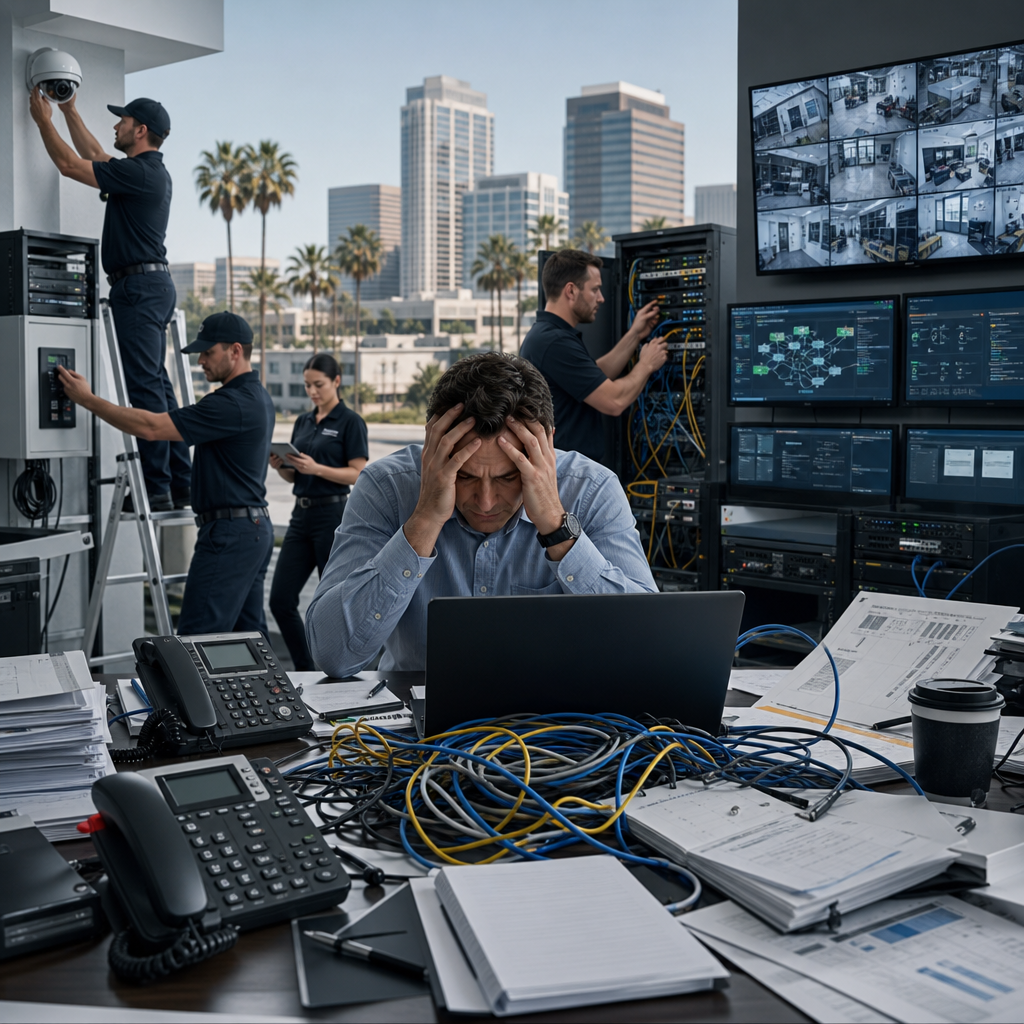
Structured cabling forms the physical foundation. We design cabling systems that carry both power and data efficiently, with redundancy built in. Rather than running separate cable runs for different vendors, we create a unified backbone that serves multiple purposes: network data, access control credentials, security camera feeds, and facility management systems all leverage the same infrastructure. This reduces installation costs, improves maintainability, and eliminates the “whose equipment caused this failure?” disputes that plague fragmented environments.
Integrated access control systems represent the physical security layer. We deploy systems that communicate directly with your IT infrastructure, using standards-based protocols that prevent vendor lock-in. Your access control server doesn’t sit on a separate, isolated network—it integrates with your managed IT services so we can monitor its health, apply security patches, and ensure high availability.
HD security camera systems integrate with both your access control timeline and your network management. When we deploy cameras, we’re not just installing recording devices. We’re creating visual verification that correlates with access events, network anomalies, and facility operations. You can pull a unified report showing exactly what happened during a specific incident across all your systems.
Our managed IT services team operates as the nervous system connecting everything. We monitor your entire infrastructure proactively, ensuring that physical security and network operations remain aligned. When you upgrade your access control system, we handle the network implications. When you add security cameras, we manage bandwidth optimization.
Case Study One: Manufacturing Facility Reduces Vendor Count and Improves Response Times
A 150,000-square-foot manufacturing facility in Orange County operated with five separate technology vendors: one for facility management, one for network infrastructure, one for security cameras, one for access control, and one for IT helpdesk. When production floor equipment malfunctioned, they couldn’t determine whether the issue was network-related, security-related, or operational.
The facility had experienced two significant incidents where access control failures disrupted production. Each incident required calling all relevant vendors, waiting for arrival, and coordinating troubleshooting across teams with no shared visibility. Total resolution time averaged 4-6 hours per incident.
We consolidated their infrastructure into a single integrated system. Rather than replacing working equipment, we created a unified platform where existing systems communicated through a common management layer. We installed structured cabling that properly supported all their systems simultaneously. We implemented our managed IT services to monitor the entire ecosystem.
Results within the first year: vendor count dropped from five to one, mean time to resolution for security-related issues fell from 3.5 hours to 28 minutes, and they eliminated 40% of their monthly technology spending. The facility gained something less quantifiable but equally valuable: a single point of accountability. When something fails, they contact one team who understands the entire environment.
Case Study Two: Professional Services Firm Streamlines Operations with Single-Source Integration
A regional professional services firm with 12 office locations across Southern California managed separate vendors for each location, creating administrative nightmares. Different buildings used different access control systems. Network management varied by location. Security camera systems didn’t communicate with each other. It cost them a dedicated manager just to coordinate vendor relationships.
Their facilities team couldn’t achieve consistent security policies across locations. One building upgraded to modern access control while another still used badge readers from 2012. Guest access procedures differed at each location. When they needed to onboard 50 new employees across multiple offices, the coordination required was exhausting.
We unified their infrastructure across all 12 locations under a single managed service model. Every office received the same structured cabling foundation, integrated security systems based on common platforms, and centralized network management. Their IT team could now manage all 12 locations from one console rather than managing separate systems at each site.
The firm eliminated their dedicated vendor-coordination role, consolidated 8 separate service contracts into one, and achieved consistent security policies across all locations. Their facilities team could now implement company-wide changes in days rather than weeks. They recovered nearly 450 hours annually in administrative overhead.
How We Bridge Security and IT Infrastructure for Seamless Operations
The bridge between physical security and IT infrastructure is where most organizations struggle because it requires expertise in both domains. Security professionals typically specialize in cameras, access control, and physical hardening. IT professionals focus on networks, data systems, and digital security. Few organizations have personnel who understand both deeply.
We operate at this intersection deliberately. Our structured cabling expertise means we understand both data networking requirements and physical security infrastructure needs. Our access control systems integrate with network security protocols rather than operating independently. Our managed IT services include facility system monitoring because we recognize that physical security is now a digital infrastructure concern.
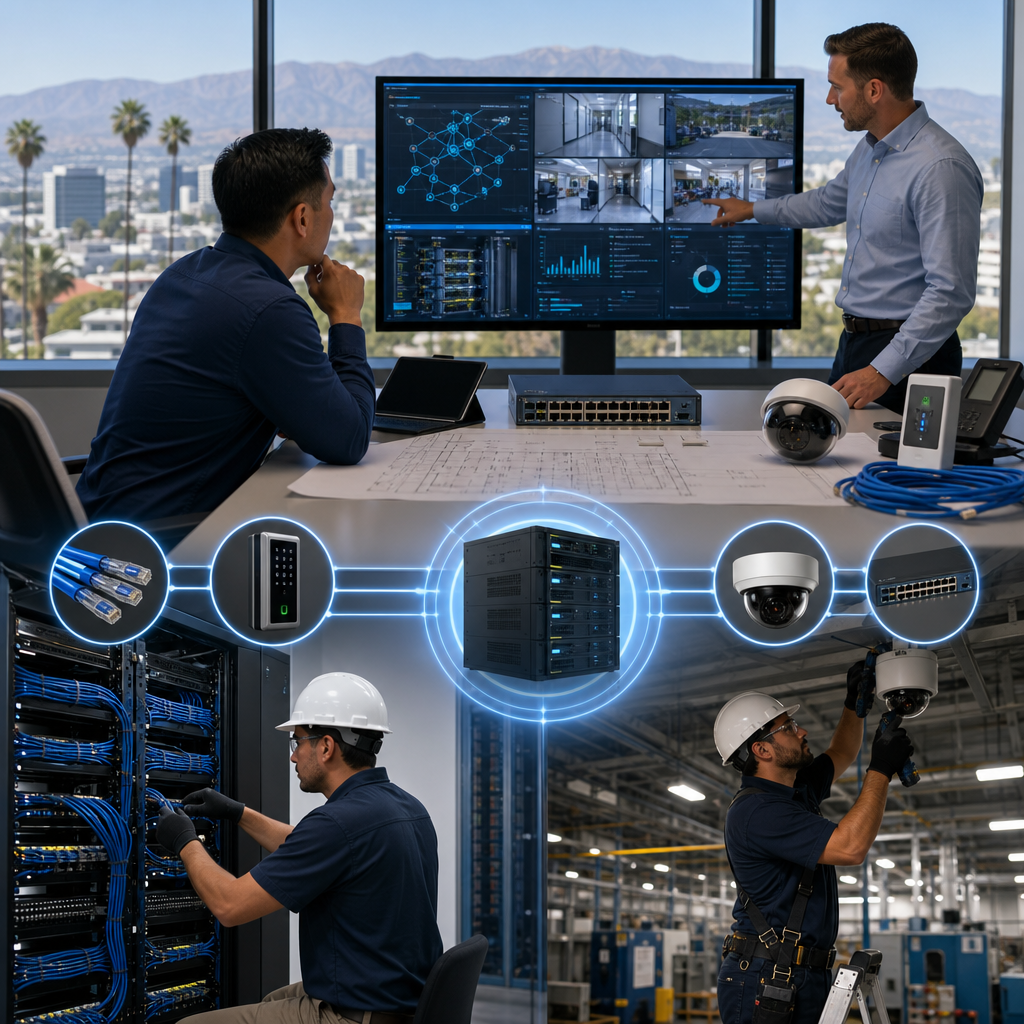
This bridge manifests practically in several ways. Your access control server runs on your monitored network with the same uptime requirements as your email system. Your security cameras stream across your network with quality-of-service guarantees that prevent them from choking your critical business traffic. Your facility management system integrates with your IT monitoring so we catch issues before they impact operations.
When we design new infrastructure, we approach it as one system rather than multiple systems coexisting. Your loading dock access control doesn’t operate independently; it integrates with your inventory management network. Your server room access doesn’t work separately from your network security monitoring. Your visitor management doesn’t exist apart from your overall facility IT infrastructure.
The Financial Impact: What Our Clients Actually Save
The 40% operational cost reduction we reference in our title represents consolidated savings across multiple categories, backed by actual client data across distribution centers, manufacturing facilities, and hospitality properties.
Direct vendor consolidation savings typically represent 15-20% of total spending. You eliminate overlapping service contracts, consolidate support agreements, and reduce administrative overhead. A distribution center paying $40,000 monthly across four vendors typically reduces this to $32,000-$34,000 with consolidated services.
Efficiency gains deliver another 10-15%. When security and IT operate as one system, troubleshooting accelerates dramatically. Your mean time to resolution drops, reducing production downtime. Your facilities team handles more with existing staff because they’re not constantly context-switching between vendor platforms. A manufacturing facility might recover 200-300 hours annually in reduced troubleshooting and coordination time.
Optimization savings contribute 10-15% more. A unified system reveals inefficiencies invisible in fragmented environments. You discover redundant monitoring, identify bandwidth waste, optimize access control credential syncing, and eliminate duplicate security monitoring. These optimizations emerge naturally when you can see the entire infrastructure at once.
For mid-sized organizations, this typically translates to $80,000-$200,000 in annual savings depending on current spending levels and fragmentation severity. For larger operations like hotel chains managing multiple properties, savings often exceed $500,000 annually.
Eliminating Silos Between Physical Security and IT Systems
Silos between physical security and IT systems create operational friction and security vulnerabilities. When your security team manages access control independently from your IT team’s network management, you inevitably create blind spots.
A common scenario: your IT team implements network segmentation to isolate critical systems, but your security team’s access control server still uses default credentials and sits on the general network because nobody communicated the change. Or your security cameras get upgraded, but nobody informs IT about the new bandwidth requirements, causing network congestion that impacts business operations.
We eliminate these silos through integrated design and unified management. Our team includes both security and IT expertise, ensuring decisions account for both domains. Your structured cabling infrastructure serves all systems, created with input from both security and network requirements. Your access control systems integrate with network security monitoring. Your managed IT services include facility system oversight.
Practically, this means your security team and IT team use the same dashboard for monitoring relevant infrastructure. They receive shared alerts when security systems experience issues that impact network operations. They coordinate changes through a single change management process. They share common documentation about the environment.
This integration prevents the scenario where a security incident reveals that your IT team and security team have different understandings of your facility layout, access points, or security policies. It ensures that your physical security remains coordinated with your digital security posture rather than operating in parallel.
Implementation Timeline: From Assessment to Full System Integration
We structure integration projects so they minimize disruption to active operations while delivering results quickly. A typical engagement follows this timeline, though specifics vary based on facility complexity and current infrastructure maturity.
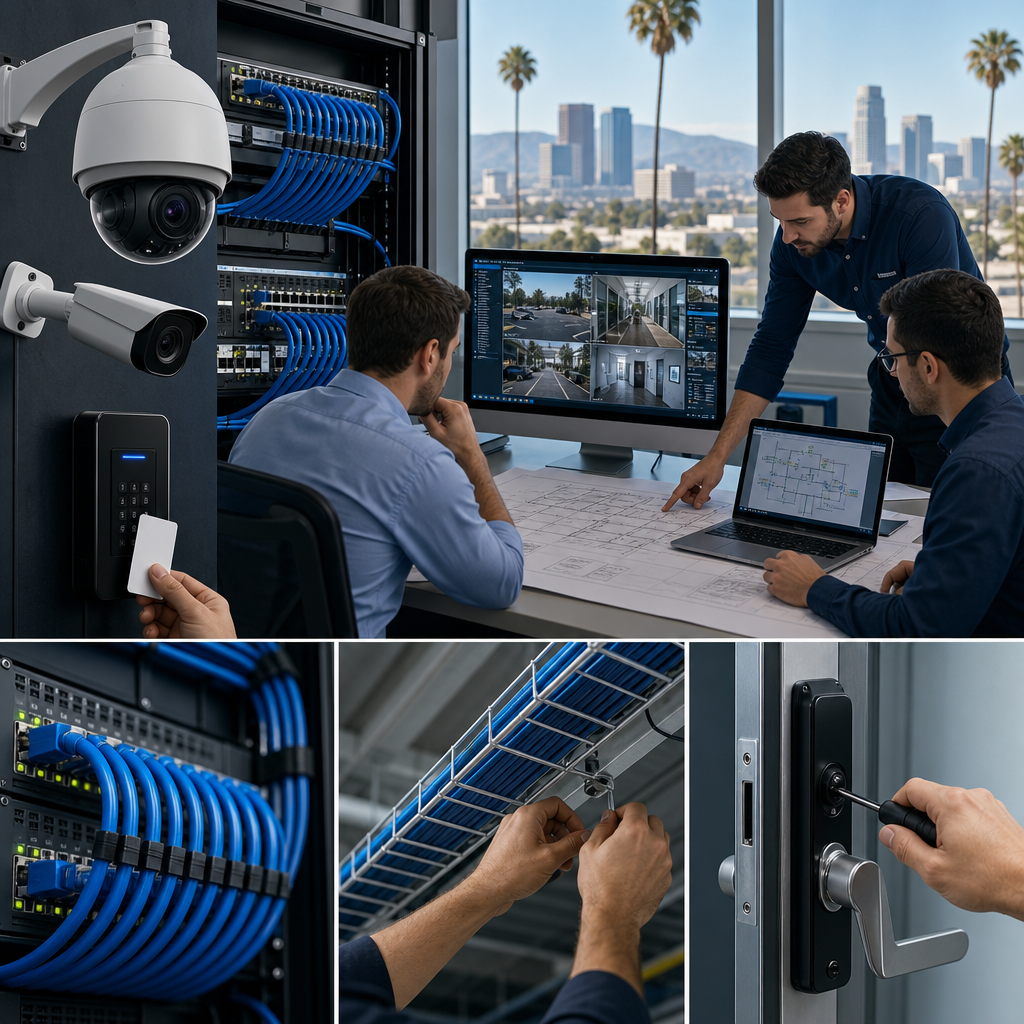
The assessment phase (weeks 1-2) involves comprehensive evaluation of your current systems, identifying integration points, documenting existing technology, and understanding your operational constraints. We walk through your facilities with both IT and security staff, documenting existing cabling, access control infrastructure, camera systems, and network topology. We interview your teams about pain points, security concerns, and operational requirements.
Design phase (weeks 2-4) creates your integrated infrastructure blueprint. We design structured cabling architecture that serves all systems efficiently. We design access control integration points with your network. We design security camera deployment that aligns with both physical security needs and network capacity. We define managed IT services scope. This phase produces detailed design documents that clarify what integration means specifically for your environment.
Implementation planning (weeks 4-5) schedules installation, defines minimal-disruption strategies for active facilities, and aligns with your operational calendar. For a hotel with continuous operations, we schedule cabling work during lowest-occupancy periods. We coordinate access control changes for minimal guest impact. We plan camera installation around your service schedule.
Phased deployment (weeks 6+) executes installation in stages. We might start with critical areas, then expand. For multi-location clients, we might standardize the first location as a model, then replicate across others. Installation typically takes 4-12 weeks depending on facility size and complexity. The goal is delivering integrated systems that work from day one while minimizing operational disruption.
Stabilization and optimization (weeks 12+) involves monitoring integrated systems, addressing any integration issues that emerge, and optimizing performance. We run the entire system for 30-60 days, capturing metrics and fine-tuning configurations. Once everything stabilizes, we transition to ongoing managed services where we monitor everything continuously.
Why Partner Selection Matters More Than Technology Alone
Technology choices matter, certainly. But partner selection matters more because your technology vendor becomes deeply embedded in your operations. They control your physical security access, monitor your network infrastructure, and manage your facility systems. Choosing wrong creates years of friction.
We see companies that selected vendors primarily on price, only to discover they lack integration expertise. A vendor excellent at installing cameras might be incompetent at integrating them with your IT infrastructure. A network provider skilled at enterprise IT might lack understanding of physical security requirements. A security integrator might have no experience with managed services.
The right partner brings integrated expertise across all domains. We employ engineers who understand structured cabling design, access control systems, network infrastructure, security camera deployment, and IT operations management. We’ve invested years in making these specialties work together rather than treating them separately.
The right partner also provides accountability. When issues arise, you need a partner who owns the entire system rather than blaming other vendors. We take responsibility for ensuring your physical security and IT infrastructure work as one ecosystem. If a security camera issue is actually a network bandwidth problem, we fix it rather than claiming it’s outside our scope.
Partner reliability matters too. You need vendors who will still be in business managing your systems in five years. We’ve served Southern California facilities for years, and our consolidation model actually strengthens our business because clients benefit from simplified management and long-term cost savings.
Getting Started: Your Path to Consolidated Technology Management
If you’re managing facilities across Southern California with multiple technology vendors creating coordination challenges, consolidation becomes worth serious consideration. Here’s how to get started.
First, audit your current situation. Document every vendor, every service contract, and every system they manage. Calculate your total annual spending on technology and security. Identify your biggest operational friction points and areas where vendor handoffs create delays. This clarity reveals whether consolidation makes financial and operational sense for your specific situation.
Second, engage with an integrator who can assess your current infrastructure and propose a realistic consolidation path. We offer comprehensive assessments that evaluate your existing systems, identify integration opportunities, and estimate realistic savings. The assessment clarifies what consolidation would look like specifically for your environment.
Third, define success metrics. What does success look like for your organization? Faster incident response? Reduced operational costs? Consistent security policies across locations? Simpler management? Clear success definition helps you evaluate whether consolidation delivers what matters most to your business.
If your organization operates multiple facilities across Southern California and finds itself managing too many technology vendors, we’re here to help. Contact us for a complimentary assessment of your current infrastructure and a realistic proposal for consolidation. We’ll show you specifically what integration could mean for your operations and finances.