CONTACT US
Table of Contents
- Why Managing Multiple Technology Vendors Creates Operational Chaos
- The Real Cost of Fragmented IT and Security Systems
- What a Unified SLA Approach Actually Delivers
- How We Coordinate Structured Cabling Across Your Facilities
- Integrated Security Cameras and Access Control on One Platform
- Managed IT Services That Support Your Entire Network
- Our Rollout Strategy for Zero Downtime Implementation
- Case Study: Streamlining Operations for Southern California Enterprises
- Getting Started with Your Consolidated Technology Partner
Why Managing Multiple Technology Vendors Creates Operational Chaos
Running multiple locations across Southern California without a unified technology partner is like managing separate IT departments for each facility. You’re coordinating with different vendors for network infrastructure, another for security cameras, a third for access control, and yet another for managed IT services. Each operates independently, each has its own support schedule, and none of them talk to each other when something breaks.
We understand this friction. At Terapixels Systems, we’ve worked with mid-sized enterprises, hospitality operators, warehouses, and distribution centers who realized that fragmentation was costing them far more than they bargained for. This article walks you through why consolidation matters and how a unified SLA approach transforms multisite operations.
When you’re working with separate vendors for cabling, security, access control, and IT support, accountability becomes murky. A network outage at one facility might involve calling your IT provider, but if the problem traces back to cabling infrastructure, your IT vendor might blame the cabling contractor. Meanwhile, your access control system stops responding because it depends on network connectivity, and no one is clearly responsible for the fix.
We’ve seen this play out with hospitality chains, manufacturing facilities, and property management companies. A simple network issue cascades into facility access problems, security camera blind spots, and lost productivity while multiple vendors point fingers. The real impact hits your operations team hardest. They’re fielding calls from different departments, managing separate support tickets, and waiting for vendors to coordinate on issues that require input from multiple disciplines.
Beyond the frustration, this approach fragments your technology roadmap. Each vendor operates independently, meaning your security infrastructure might be outdated while your IT systems are modern, or your cabling can’t support the bandwidth your new access control platform requires. You end up with incompatible systems that don’t integrate cleanly.
What to do next: List every technology vendor you’re currently paying for infrastructure, security, or IT support. Tally how many separate support contracts and SLAs you’re managing. That number alone often justifies the switch to consolidation.
The Real Cost of Fragmented IT and Security Systems
The financial impact of fragmentation extends beyond support costs. When your cabling infrastructure, network hardware, security cameras, access control systems, and managed IT services operate independently, you’re essentially paying for redundancy without getting the benefits of redundancy.
Consider a typical scenario: Your security camera system needs network bandwidth, so your IT team provisions extra capacity. But your cabling vendor didn’t consult with your IT vendor during the original infrastructure build, so upgrades cost substantially more than they should. Your access control system runs on a separate network segment because the security provider and IT provider never coordinated deployment. Now you’re maintaining parallel infrastructure, paying for management overhead, and missing integration opportunities that could improve security or reduce operational friction.
Downtime becomes expensive fast. If your managed IT provider isn’t the same entity managing your physical security infrastructure, troubleshooting a facility outage takes longer. When your security cameras or access control systems malfunction, IT support might not understand the physical infrastructure layer, and your security vendor might not understand your network topology. A two-hour outage at a hotel, warehouse, or manufacturing facility costs real revenue and operational capability.
Vendor lock-in paradoxically makes switching harder even though you’re unhappy. When systems don’t integrate, pulling out one vendor requires careful coordination with all the others. You might be stuck with a mediocre vendor simply because replacing them creates too much operational risk.

What to do next: Calculate your average incident resolution time across your current vendors. Then estimate the cost of facility downtime per hour for your operations. That number often reveals how much fragmentation is actually costing you.
What a Unified SLA Approach Actually Delivers
A single SLA that covers your structured cabling, network infrastructure, security systems, access control, and managed IT services transforms how your operations team works. When one partner is accountable for your entire technology ecosystem, accountability becomes clear. If something breaks, there’s one number to call, and that partner has visibility across all layers of your infrastructure.
We coordinate across all technology domains because we’re responsible for the complete solution. If your access control system goes down, our team immediately understands whether the issue is the access control hardware itself, the network segment it runs on, the cabling infrastructure supporting it, or the managed IT layer. We don’t wait for other vendors to respond or coordinate across multiple organizations. We fix it or escalate transparently under one SLA.
Integration becomes seamless when one partner designs and manages your entire environment. Your security cameras and access control systems share the same network management dashboard. Your IT monitoring extends to physical security health. When you scale to a new facility, the cabling, network infrastructure, security systems, and IT architecture work together from day one because the same team specified and installed everything.
Unified billing simplifies your technology budget. One invoice, one account manager, one escalation path. No more reconciling charges across six vendors or remembering which vendor handles which system.
What to do next: List the integration capabilities you wish your current systems had. A unified partner can often deliver these through coordinated design and implementation.
How We Coordinate Structured Cabling Across Your Facilities
Your cabling infrastructure is the foundation for everything that runs on top of it. We don’t treat cabling as a one-time installation project that’s handed off and forgotten. Proper cabling coordination means understanding your current and future IT needs, security system requirements, and facility constraints before the first cable is run.
For multisite deployments, we document and standardize your cabling across all locations. A hotel chain benefits enormously from consistency. If Room 305 at your San Diego property has the same network architecture as Room 305 at your Irvine property, troubleshooting becomes faster and staff transitions between locations become smoother. Manufacturing facilities and warehouses gain operational flexibility when cabling infrastructure is standardized.
We also assess your cable paths and capacity as part of infrastructure planning. If you’re expanding access control or adding security camera coverage, we ensure your cabling can support the bandwidth and capacity you’ll need. This prevents the expensive mid-project discovery that your existing infrastructure can’t handle your new systems.
What to do next: Have your cabling infrastructure professionally assessed. Document which locations have capacity for expansion and which are at capacity. That baseline informs your technology roadmap.
Integrated Security Cameras and Access Control on One Platform
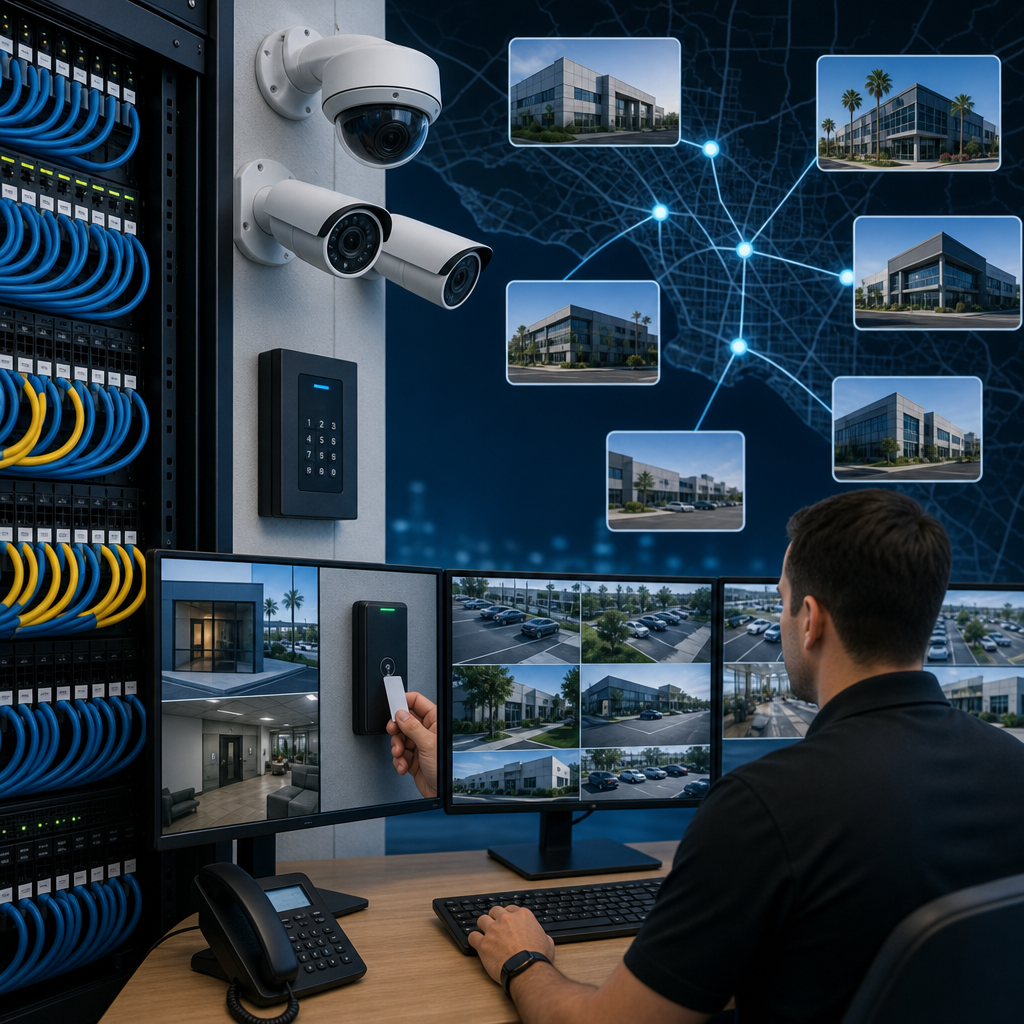
Modern facilities require security systems that work together. Your integrated access control systems need to coordinate with HD security camera coverage so your operations and security teams have a complete picture of facility activity.
We design integrated deployments where camera placement aligns with access control points. When someone accesses a secured area through an access control reader, the associated camera footage is tagged and easily retrievable. For hospitality operators, this means seamless guest movement tracking and security incident investigation. For warehouses and manufacturing facilities, this creates accountability for inventory areas, restricted zones, and loading docks.
The platform integration runs deeper. Your access control system can trigger cameras to start recording when motion is detected in sensitive areas. Facility managers receive unified alerts that something unusual happened at a specific location, with immediate access to video and access logs. One dashboard shows you the health of all security systems across all facilities.
What to do next: Review your current security camera and access control systems. Are they on the same platform? Can your team pull correlated video and access logs easily? If not, integration is a clear improvement area.
Managed IT Services That Support Your Entire Network
IT managed services that only focus on servers and workstations miss critical infrastructure. Your network monitoring needs to encompass cabling performance, security system connectivity, access control network health, and traditional IT systems.
We monitor your entire technology environment continuously. We know when a security camera is struggling to connect, when access control readers are responding slowly, when a network segment is approaching capacity, and when IT systems need updates. Proactive monitoring prevents outages rather than waiting for problems to reach your operations team.
Managed IT services under one SLA also means faster resolution when issues cross traditional boundaries. If your access control system experiences performance problems because of network issues, we investigate and fix both simultaneously rather than escalating between vendors.
What to do next: Ask your current IT provider what they monitor beyond traditional servers and workstations. If the answer is “we don’t,” that’s a clear limitation.
Our Rollout Strategy for Zero Downtime Implementation
Consolidating to a new technology partner creates legitimate anxiety. What if your facilities lose access control or camera coverage during the transition? We’ve deployed consolidated technology solutions across multisite enterprises, and our rollout strategy prioritizes zero downtime.

We start with thorough documentation of your current environment. We map every circuit, every camera, every access point, every network connection. Then we design the new consolidated infrastructure in parallel to your existing systems. For each facility, we stage the migration, test thoroughly, and cut over during a scheduled maintenance window. Mission-critical facilities might receive gradual cutover, with one section moving to the new infrastructure at a time while the rest operates normally.
For hospitality operators managing guest experience, we coordinate migrations around low-occupancy periods. For warehouses and distribution centers, we time transitions to align with operational schedules. Manufacturing facilities get support for equipment downtime windows.
We don’t declare a facility “done” until your operations team and our team have validated that all systems are working correctly. We remain closely engaged post-cutover to refine performance and address any integration nuances specific to your facilities.
What to do next: Identify which facilities are most critical to keep operational during any migration. That informs your cutover strategy and our resource allocation.
Case Study: Streamlining Operations for Southern California Enterprises
A regional hotel operator managing twelve properties across Southern California was working with four separate vendors: network infrastructure, cabling, access control and security cameras, and IT support. Each property had slightly different configurations because each vendor operated independently. When a guest couldn’t access their room, the hotel operations team didn’t know whether to call IT support or the access control vendor. When a security incident required correlated video and access logs, pulling that information required calls to two different vendors and took hours.
The hotel operator consolidated with us. We audited all twelve properties, standardized the cabling infrastructure, unified the access control and security camera platforms, and integrated managed IT services across the entire portfolio. The result was measurable: incident resolution time dropped from an average of 90 minutes to 15 minutes. Guest room access issues resolved in minutes instead of hours. Security investigations that previously took days now take hours because correlated video and access data is immediate.
The operational benefit was equally significant. The hotel operator’s facilities team went from managing four vendor relationships to one. Consistency across properties meant staff could move between locations without relearning systems. Budgeting became simpler with unified billing and predictable costs.
Getting Started with Your Consolidated Technology Partner
If you’re managing multiple Southern California locations and juggling separate technology vendors, consolidation is achievable without the operational risk you might fear. The first step is a straightforward conversation about your current environment and your operational priorities.
We conduct an initial assessment of your cabling infrastructure, network setup, security systems, access control deployment, and IT environment. We identify gaps, integration opportunities, and quick wins. Then we present a roadmap with phased milestones that fit your operational realities.
Contact Terapixels Systems to schedule your assessment. We’ll help you understand the real cost of fragmentation and the specific benefits you’d gain from a consolidated approach tailored to your facilities and operations.